Introduction
Cross-border freight has never been more operationally demanding. U.S.-Mexico goods trade reached $839.9 billion in 2024, with trucks carrying $609 billion of that value — and every shipment moves through a compliance environment shaped by tariff changes, multi-agency requirements, and tight delivery windows.
Most logistics managers already know they need both a customs broker and a freight carrier. The real question is whether those two functions should run as separate workstreams or as one integrated operation.
When freight and customs are siloed across different vendors, coordination gaps accumulate: missed pre-clearance windows, documentation handoffs that introduce errors, and no single party accountable for the full picture. What follows breaks down what integration actually prevents — and where it delivers the most measurable value.
Key Takeaways
- Hazmat, heavy-haul, and high-frequency U.S.–Mexico shippers gain the most from a single-provider model
- Integrated customs and freight services close the handoff gaps that cause border delays and compliance failures
- Pre-clearance filing starts while freight is in transit, cutting border wait time on arrival
- C-TPAT validation and FAST certification unlock expedited lane access unavailable to split-vendor arrangements
- CBP collected $46.04M in trade penalties and liquidated damages in FY2025 — integrated compliance reduces that exposure
What Is Integrated Customs Brokerage and Freight Service?
Integrated customs brokerage and freight service means one provider manages both the physical movement of goods — carrier selection, dispatch, tracking — and the regulatory clearance process — documentation, duty calculation, CBP filing — rather than two separate vendors working in parallel.
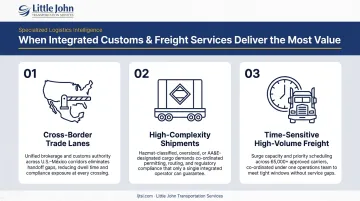
This approach matters most in three scenarios:
- Cross-border trade lanes, particularly U.S.-Mexico and U.S.-Canada, where regulatory complexity on both sides creates compounding coordination demands
- High-complexity shipments involving hazmat cargo, oversized loads, or commodities subject to partner government agency (PGA) oversight from FDA, EPA, or DOT
- Time-sensitive or high-volume freight where customs delays cascade directly into production disruptions or missed delivery commitments
In each of these scenarios, the cost isn't just delay — it's the compounding friction of dead time, document re-entry errors, and missed handoffs that stack up when freight execution and customs clearance run on separate systems with no shared visibility. A single integrated provider closes that gap by design.
Key Advantages of Integrated Customs Brokerage and Freight Services
The advantages below show up in transit times, cost lines, compliance records, and the conversations logistics teams have when something goes wrong at the border.
Streamlined Operations and Faster Border Clearance
When freight and customs are integrated, documentation flows directly from the freight team to the customs team — no handoffs, no waiting on external parties to share files, no version-control problems across email chains.
The operational effect is significant. Pre-clearance filing can begin while freight is still in transit, so border agents receive complete, accurate entry data through automated broker interfaces before the truck arrives. In a split-vendor model, that filing often doesn't start until the shipment is already at the crossing.
Why the timing gap matters:
During exceptional inspection periods — such as the April 2022 Texas border inspections — CBP documented wait peaks of 335 minutes at Ysleta and 320 minutes at Hidalgo/Pharr. These disruptions aren't the norm, but they illustrate what happens when freight volume concentrates at a crossing and documentation isn't pre-positioned for rapid release.
For automotive components running just-in-time supply chains, perishables, or any freight with hard delivery windows, even a multi-hour delay erodes margin and damages customer trust in ways that don't show up cleanly on a freight invoice.
KPIs directly affected:
- Border crossing time
- Customs clearance cycle time
- On-time delivery rate
- Detention and demurrage costs
- Inventory carrying costs
When this advantage matters most: High-frequency U.S.-Mexico shippers, automotive and perishable freight, and operations running lean inventory where any border delay cascades into downstream disruption.
Compliance Integration and Risk Reduction
Customs compliance isn't a static checklist. Tariff classifications, duty calculations, PGA requirements, C-TPAT protocols, and export controls shift with trade policy, new agency requirements, and shipment-specific rules for hazmat or controlled goods.
When the customs brokerage team has real-time visibility into what's being shipped and which carrier is moving it, they can flag compliance issues before the shipment reaches the border — catching problems while there's still time to act.
In a siloed arrangement, the freight carrier doesn't know the customs classification is under review. The customs broker doesn't know the carrier switched ports of entry. Neither party has the full picture, and the shipment sits while both sides sort out what happened.
CBP collected $46.04 million in trade penalties and liquidated damages in FY2025, up from $26.21 million in FY2024. Under 19 USC 1592, fraud penalties can reach the domestic value of the merchandise itself. Integration reduces the source of many of the errors that create that exposure in the first place.
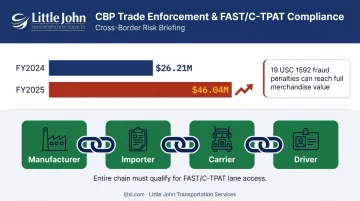
For providers holding C-TPAT validation and FAST program membership, the compliance benefit extends to expedited lane access. CBP's FAST program provides front-of-line inspections and dedicated lanes for pre-approved low-risk carriers.
The catch: the entire shipment chain must qualify — manufacturer, importer, carrier, and driver. A split-vendor arrangement where only one party is FAST-certified can't replicate the coordinated lane access that an integrated provider delivers.
Little John Transportation Services holds both C-TPAT validation and FAST certification, with bilingual operations teams physically stationed in Laredo, Monterrey, and Guadalajara.
Their 50-acre CTPAT-validated Laredo facility serves as the primary cross-border hub — 24/7 monitoring, restricted access, and 1,200 trailer-space staging capacity. The facility was built around regulatory requirements from the ground up, which is why it supports faster processing than infrastructure retrofitted for compliance after the fact.
KPIs directly affected:
- Compliance violation rate
- CBP inspection frequency
- Shipment release rate on first submission
- Documentation error rate
- Penalty and fine costs
When this advantage matters most: Hazmat shipments, cargo moving through high-scrutiny ports like Laredo, freight subject to FDA or EPA oversight, and any load where carrier credentials and customs documentation must align precisely.
Cost Efficiency Through Consolidated Services
Most businesses miss the cost advantage of integration because they compare headline rates — broker fee versus freight rate — and overlook what accumulates between vendors.
Where the hidden costs appear:
- Documentation handover fees: In a split arrangement, both the freight forwarder and the customs broker typically charge for processing and transmitting documentation. These fees appear on both invoices and are rarely aggregated by the shipper into a single cost line.
- Re-filing and amendment costs: CBP's Post Summary Correction process must generally be filed within 300 days of entry. Compliance errors caused by miscommunication between separate vendors generate direct re-filing costs — and those errors are far more likely when two independent parties are managing the same shipment data.
- Administrative coordination overhead: Every cross-border shipment managed across two vendors requires someone on the shipper's side to coordinate, chase documents, and reconcile discrepancies. Across dozens or hundreds of monthly shipments, that labor cost is real even when it doesn't appear as a line item.
- Carrier rate leverage: Integrated providers operating at scale can negotiate carrier rates based on consolidated freight volume. A standalone customs broker working with an external carrier doesn't have that leverage.
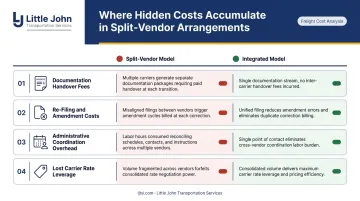
The cost case for integration isn't a universal percentage — it's the aggregate of avoided handover fees, fewer compliance penalties, less administrative rework, and better carrier economics.
KPIs directly affected:
- Total landed cost per shipment
- Administrative overhead per trade lane
- Re-filing and amendment costs
- Carrier rate benchmarks
- Documentation fee line items
What Happens When Customs and Freight Are Managed Separately
When customs brokers and freight carriers operate independently, someone manually transfers information between parties — creating lag time, version-control problems on documents, and no single point of visibility across both the physical movement and the regulatory status of a shipment.
The failure modes that occur in practice:
- Shipments arrive at the border before customs pre-clearance is filed
- Carriers wait at ports while brokers chase missing documentation from shippers
- Data is re-keyed between systems or communicated via email, introducing transcription errors
- FAST eligibility breaks down because one party in the chain isn't certified — and no one confirmed chain-level eligibility before the shipment departed
CBP's ACE system — the electronic Single Window for manifest, cargo release, post-release, and PGA data — means freight and customs teams already depend on the same accurate shipment record. Integration formalizes that dependency under one roof. Without it, that shared record becomes a liability: the moment something goes wrong, no single party owns the outcome.
The accountability problem is where split-vendor models fail most visibly. When a cross-border shipment stalls, the freight carrier points to the customs broker and vice versa. No single party has both the authority and the visibility to resolve the issue end-to-end. The shipper becomes the de facto coordinator of a dispute between two vendors — while the cargo sits at the border.
How to Get the Most Out of an Integrated Provider
Integration works best when the provider has direct operational presence on both sides of the border — teams physically stationed at key crossing points who manage both dispatch and compliance in real time, not a network contact or subcontracted agent.
For U.S.-Mexico freight, that means bilingual staff in locations like Laredo, Monterrey, and Guadalajara who can act immediately when issues arise. Little John's "boots on both sides of the bridge" model puts one integrated team in charge of in-house customs brokerage, mirror fleet coordination, and direct carrier relationships across 12 U.S.-Mexico border gateways.
Three things that make integration deliver its full value:
- Single point of contact with real accountability — your contact owns outcomes across both freight execution and customs clearance, with no handoffs between departments when problems arise
- Proactive compliance review — the provider should identify patterns in classification issues, lane-specific delays, or documentation gaps before they repeat, not only resolve issues after they surface
- Credentials that cover the full chain — C-TPAT and FAST eligibility requires the manufacturer, importer, carrier, and driver to all qualify; confirm that your provider has verified chain-level eligibility for your specific shipments, not just their own certification status
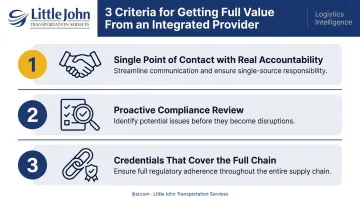
Those three criteria matter more as cargo complexity increases. For hazmat, heavy-haul, and AA&E freight, a gap between the carrier and the customs broker isn't an inconvenience — it's a compliance risk.
Little John holds an FMCSA Hazardous Materials Safety Permit (held by fewer than 1% of U.S. carriers), covering all nine hazmat classes including AA&E and TPS-restricted commodities. Combined with in-house customs brokerage and a 50-acre CTPAT-validated Laredo hub equipped with a 120-ton bridge crane, both the physical execution and the compliance documentation are handled by one team — with shared accountability at every step.
Conclusion
The value of integrating customs brokerage and freight services is the control it creates. When one provider owns both the movement and the clearance, there are no handoff gaps, no accountability vacuums, and no hidden costs accumulating between vendors.
The advantages compound over time. Faster clearance builds relationships with border agencies. Compliant documentation reduces CBP inspection frequency. Consolidated operations generate data that makes future shipments more predictable.
For businesses moving complex, cross-border, or specialized freight, integration isn't a vendor preference — it's an operational decision. When your freight team and your compliance team share the same data, answer to the same organization, and are accountable for the same outcome, border problems get solved before they become delays. That's the difference between a supply chain that absorbs disruption and one that avoids it.
Frequently Asked Questions
What are the benefits of using an integrated customs brokerage and freight service?
The primary benefits are faster border clearance through pre-clearance filing during transit, unified documentation that eliminates handoff errors, and lower total landed cost by removing redundant fees and reducing compliance penalty exposure. A single provider also closes the accountability gap common in split-vendor arrangements.
What is the difference between a customs broker and a freight forwarder?
A customs broker handles regulatory clearance (tariff classification, CBP filing, duty payment), while a freight forwarder manages the physical movement of goods. Integrated providers combine both functions under one operational team, eliminating the handoff between separate vendors.
How does integrated brokerage reduce customs delays at the U.S.-Mexico border?
Pre-clearance filing begins while freight is still in transit, so border agents receive complete entry data before the truck arrives. Bilingual teams stationed at crossings like Laredo can resolve documentation issues in real time, and certifications like C-TPAT and FAST enable expedited lane access that standard arrangements can't access as a coordinated chain.
What certifications should I look for in an integrated freight and customs provider?
Look for C-TPAT validation, FAST program membership, FMCSA compliance ratings, and hazmat endorsements. For specialized cargo, an FMCSA Hazardous Materials Safety Permit and USMCA/T-MEC compliance capability signal a provider equipped to handle both freight execution and customs compliance — the HMSP is held by fewer than 1% of carriers.
Can integrated customs and freight services handle hazardous materials or oversized loads?
Not all integrated providers are equipped for hazmat or heavy-haul. Look for providers with FMCSA HMSP certification, TWIC-certified drivers, AA&E authorization if relevant, and documented heavy-haul infrastructure at the border. Little John Transportation Services covers all nine hazmat classes and operates a 120-ton bridge crane at its Laredo facility for superload transloading.
How does a single-provider approach save money compared to using separate vendors?
Savings come from eliminated documentation handover fees charged on both sides of a split arrangement, reduced administrative coordination costs, fewer compliance error penalties that trigger re-filing, and the provider's ability to negotiate better carrier rates through consolidated freight volume.