A single commercial turbine can require multiple truck loads to complete full delivery — and that's before accounting for route surveys, multi-state permits, escort coordination, and weather windows.
This guide covers the full picture: how blade sizes break down by application, the transport methods available for each category, the logistical challenges that make this freight genuinely complex, and what separates a capable transport partner from one that's simply not equipped for the job.
Key Takeaways
- Onshore blade lengths now reach 71–73.7 meters, exceeding the 67-meter threshold where standard oversized-load logistics break down
- Every blade ships as a single piece, making route selection one of the highest-stakes decisions in the move
- Multi-state oversized load permits are required for every state crossed — no single federal permit exists
- Blade-tilting trailer systems can raise blades up to 60–65 degrees to clear tight infrastructure
- Longer blades and tighter corridors compound transport costs — both add time, equipment, and permit complexity
Wind Turbine Blade Sizes: What You Need to Know
Blade length drives every downstream transport decision. Longer blades mean tighter route constraints, more specialized equipment, and harder permit conversations with state DOTs.
Small and Distributed Wind Blades
Small-scale blades — typically under 20 meters (roughly 65 feet) — serve household systems, agricultural operations, and remote off-grid applications. Standard flatbed equipment handles most moves, and route constraints are minimal.
Unlike utility-scale moves, these loads rarely trigger escort vehicle requirements, specialized trailer configurations, or multi-agency permitting.
Utility-Scale Onshore Blades
This is the category that defines U.S. wind logistics. According to DOE data, the average newly installed land-based blade in the U.S. measured 55 meters as of 2019. Current OEM products have pushed well beyond that — Siemens Gamesa's SG 5.0-145 uses a 71-meter blade, and Vestas markets a 73.7-meter blade on its V150 platform.
The 67-meter figure has historically been cited as a practical logistics breakpoint for typical road transport methods. Current products show that specialized equipment and careful route engineering push that boundary further. The ceiling is a function of trailer capability, route geometry, and permit approval — not a fixed number.
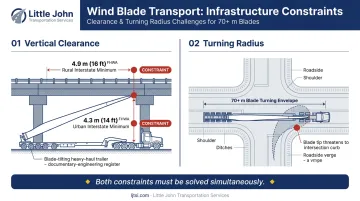
What creates the infrastructure constraint:
- U.S. rural Interstate overpasses require at least 4.9 m (16 ft) of vertical clearance per FHWA standards — though some urban Interstate routes allow 4.3 m (14 ft)
- Blade length creates turning-radius and horizontal-clearance problems on narrow roads and switchbacks
- Both height and length must be solved simultaneously, not independently
Offshore Wind Blades
Offshore blades bypass road infrastructure entirely by traveling via cargo ship. Siemens Gamesa has deployed 108-meter blades commercially and shipped its first 115-meter B115 blades in 2026 for the Thor offshore wind farm.
Windpower Monthly reported full-scale static testing of a 150-meter Dongfang blade in 2025 for a planned 26 MW turbine — a prototype milestone, not a deployed fleet.
Marine transport removes the overpass constraint entirely. That's why offshore turbines routinely run blades twice the length of anything moving on U.S. roads.
The Push Toward Larger Onshore Blades
Several research programs are actively working to move 100-meter-plus blades over land:
- DOE's Big Adaptive Rotor program examined 100-meter land-based blade designs and the infrastructure changes required to support them
- Radia's WindRunner aircraft is designed around a 105-meter maximum payload, with unpaved-runway capability to reach remote wind farm sites
- NREL's rail study modeled moving 100-meter blades across existing U.S. rail infrastructure using controlled flexing distributed across four railcars
None of these are routine commercial operations. But each one represents a serious engineering response to the same logistics problem: blades are outgrowing the roads.
How Wind Turbine Blades Are Transported
Trucking: The Primary Method
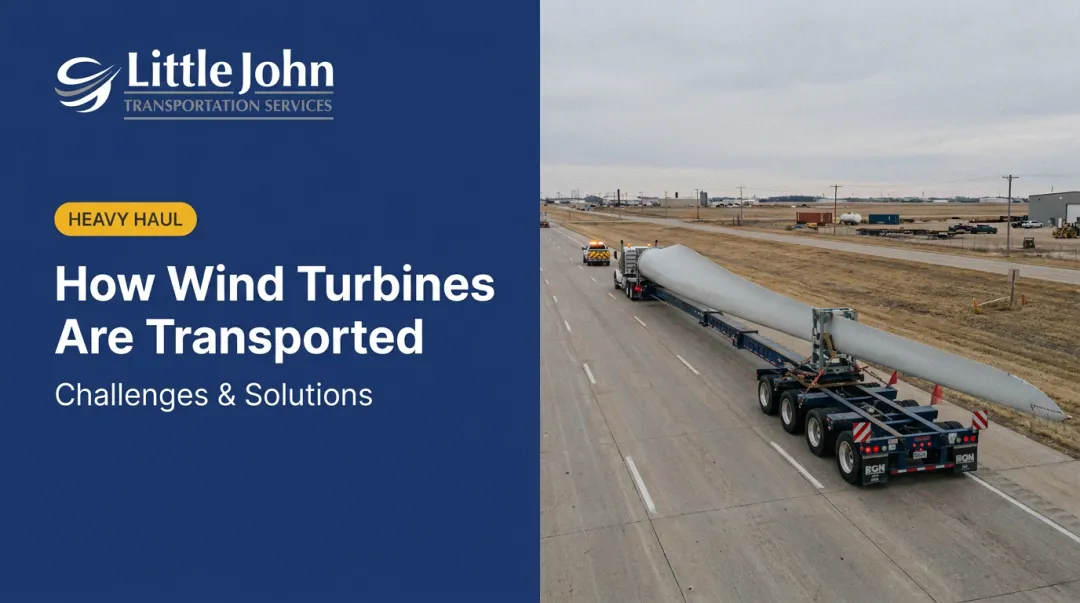
The vast majority of onshore blade transport happens by truck, using specialized multi-axle flatbed trailers configured specifically for extreme length and weight. A full turbine delivery typically requires multiple rigs — one per blade plus additional loads for the tower sections, nacelle, and hub components.
The key piece of equipment is the blade-tilting trailer, sometimes called a blade lifter. Systems from manufacturers like Scheuerle, Goldhofer, and Cometto can raise a blade up to 60–65 degrees above horizontal, or close to vertical in some configurations, using hydraulic mechanisms. This allows blades to clear obstacles and navigate tight curves that would otherwise be impassable.
Operational parameters to know:
- Goldhofer's FTV 930 is rated to 930 metric ton-meters of lifting torque
- Cometto's BladeMAX series offers ratings from 650 to 1,000 mT
- Iberdrola documents a 10 m/s maximum wind speed for transporting a lifted blade; beyond that threshold, the blade must be lowered before the truck can continue
Conventional blade designs must travel in one piece, since standard structural designs can't accommodate field assembly joints. That said, segmented blade options do exist. GE Vernova commercially offers a two-piece jointed blade on its 3 MW platform, and NREL's manufacturing research has examined 80-meter segmented designs.
Segmentation adds design complexity and assembly burden at the site. Still, the assumption that blades can never be transported in sections doesn't hold up.
Rail Transport
Rail becomes viable for longer hauls when specially designed cars are available. NREL has modeled a conceptual system for moving a 100-meter blade across existing U.S. rail infrastructure using controlled flexing across four cars. The practical single-piece rail limit sits at approximately 75 meters under current infrastructure — that gap between concept and capability explains why rail remains a niche option rather than a standard move. Wind farms are typically located far from rail lines, so first- and last-mile truck moves are unavoidable regardless of how far the blade travels by train. Rail works best as a mid-haul option when the origin and destination both have nearby access — a condition that rarely aligns with actual project sites.
Marine Transport
Offshore blades and some onshore components are delivered by cargo ship or barge. Jackup vessels manage offshore installation, positioning themselves against wave action and holding stable enough for crane operations in open water. The marine mode removes road constraints entirely: no overpasses, no turning radius limits, no weight restrictions on pavement. That's the direct reason offshore turbines can use blades twice the length of onshore equivalents.
Key Logistical Challenges in Wind Blade Transport
Route Planning and Infrastructure Limits
Route planning for a blade shipment starts with finding roads physically capable of accommodating the load — then engineering around what can't be accommodated.
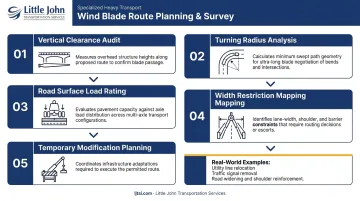
The survey process typically covers:
- Vertical clearances at every overpass along the proposed route
- Turning radius analysis at intersections and ramps
- Road surface load ratings for heavy multi-axle configurations
- Width restrictions on secondary roads leading to the wind farm site
Some routes require temporary modifications — utility line relocation, traffic signal removal, or road widening. A 2024 New York state filing for the Agricola Wind Project documented that roadway widening and/or vegetation clearing would be required at most intersections used by delivery vehicles. In the most constrained cases, entirely new access roads must be built before a single blade can be delivered.
Multi-State Permit Coordination
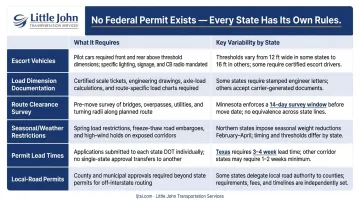
There is no federal oversized load permit. The FHWA makes this explicit: states issue their own permits, and requirements vary substantially across jurisdictions.
A blade shipment crossing multiple states requires a separate permit application in each state — with different lead times, fees, dimensional thresholds, escort requirements, and allowable travel windows.
Texas recommends submitting superheavy permit applications 3–4 weeks before travel unless an approved route is already on file. Minnesota requires physical route surveys within 14 days before the permit start date. Every state along the corridor has its own rules — and none of them defer to another state's approval.
Weather and Timing Constraints
Wind speed directly limits blade-tilting operations. When a blade is elevated, the exposed surface area creates significant aerodynamic load — hence the documented 10 m/s operational ceiling for lifted blades. High-profile loads are also restricted during severe weather events.
Seasonal road weight restrictions compound the scheduling risk. During spring thaw periods, pavement softening can close or restrict certain routes entirely — forcing timing changes even when permits are already in hand.
Equipment and Driver Availability
Specialized blade trailers aren't a commodity. A 2016 Wind Systems report documented that only a limited number of stretch trailers were long enough for blades entering service at that time — and the fleet has had to grow to keep pace with increasing blade lengths.
Those resource constraints don't ease during peak construction seasons. Competition for qualified equipment and experienced heavy-haul drivers can directly constrain project scheduling.
DOE's 2024 market summary reports 150,492 MW of U.S. land-based wind capacity at end of 2023, including 6,474 MW added in 2023 alone — a deployment pace that keeps sustained pressure on the specialized transport market.
Permits and Regulations for Oversized Blade Shipments
Wind turbine blades qualify as oversized loads under U.S. DOT standards based on both length and weight. Exceeding standard highway dimensions triggers mandatory permitting before the load moves. There are no shortcuts through that process.
What varies by state (and must be verified for every corridor):
| Requirement | Notes |
|---|---|
| Escort vehicles | Common but triggered by state-specific dimensions and routes |
| Load dimension documentation | May be required for complex loads; varies by jurisdiction |
| Route clearance survey | Required in many states; timing windows vary (e.g., Minnesota's 14-day rule) |
| Seasonal/weather restrictions | Spring thaw restrictions and storm closures vary by state |
| Permit lead times | Texas: 3–4 weeks for superheavy applications; other states differ |
| Local-road permits | May be required separately from state DOT authorization |
A transcontinental blade shipment may require coordination with six or more state DOTs, each running its own process on its own timeline. Carriers who handle permitting in-house execute more consistently — they're not dependent on a third party's availability or knowledge of the specific corridor.
Little John Transportation Services processes over 100,000 oversize/overweight permits per year in-house, with route engineering — bridge clearances, turn radii, low-overpass alternates — completed before the truck rolls. Their 12 locations across the U.S. and México include direct coverage in Arkansas, Texas, Nevada, North Carolina, and Tennessee, putting teams on the ground in the corridors where wind component shipments run heaviest.
How to Choose the Right Wind Blade Transport Partner
Wind blade transport requires equipment configurations, permit depth, and driver specialization that most carriers simply don't have. A failed or damaged move on an 80-meter blade isn't a delay — it's a project-stopping event.
What to evaluate in a transport partner:
- Multi-axle trailer configurations with blade-tilting capability for loads exceeding 70 meters
- In-house permit management — State-by-state DOT permitting handled internally, not outsourced to third parties
- Route engineering that includes physical surveys, bridge clearance analysis, and alternate corridor planning
- Escort coordination — Front, rear, height-pole, and police escorts sized to the specific load and corridor
- 24/7 dispatch and tracking — Dedicated dispatcher per load, not a call queue
- Cross-border capability — Dual-country permitting and transloading infrastructure for blades moving between the U.S. and México
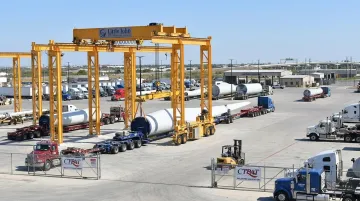
Little John Transportation Services handles all of the above as a single-source partner. With 7,000+ specialized trailers, 30+ years of heavy-haul experience, and in-house permitting across U.S. and México jurisdictions, they take on the moves most carriers won't touch. Their 50-acre CTPAT-validated Laredo facility, equipped with a 120-ton bridge crane, supports cross-border transloading for superloads including wind energy components — with turnaround under two hours.
For project-specific routing and permitting consultations, contact the team at quotes@ljtsi.com or +1 (479) 264-6501.
Frequently Asked Questions
How much does it cost to transport a wind turbine blade?
Transport costs depend on distance, blade size, permit complexity, and escort requirements. Published cost benchmarks vary widely and fluctuate with fuel and equipment market conditions. Contact specialized heavy-haul carriers directly for project-specific estimates, as quotes from carriers with current market exposure will be more accurate than any published range.
Are wind turbine blades transported vertically or horizontally?
Blades typically travel horizontally on multi-axle flatbed trailers. Advanced blade-tilting systems from Goldhofer, Scheuerle, and Cometto can raise blades to 60–65 degrees above horizontal (near-vertical in some configurations), allowing rigs to clear tight curves and obstacles without full repositioning.
What permits are required to transport wind turbine blades?
State DOT oversized load permits are required in every state the load crosses; there is no federal permit. Requirements typically include load dimension documentation, route surveys, escort arrangements, and compliance with seasonal travel restrictions. Lead times and specific requirements vary by jurisdiction.
What is the longest wind turbine blade that can be transported by truck?
Current commercial onshore blades reach 73.7 m (Vestas) and 71 m (Siemens Gamesa), and specialized equipment has pushed the practical limit well beyond earlier benchmarks. There is no fixed legal ceiling; the actual limit depends on trailer capability, route geometry, and permit approval.
What type of trailer is used to transport wind turbine blades?
Specialized multi-axle flatbed blade trailers, many equipped with hydraulic tilting mechanisms, are the standard equipment for onshore blade transport. Manufacturers including Goldhofer, Scheuerle, and Cometto produce systems rated for the load moments generated by blades at 70+ meters.
How long does it take to plan a wind turbine blade transport?
Full planning (route surveys, multi-state permitting, equipment coordination, and scheduling) can take weeks to months depending on corridor complexity. States like Texas specify 3–4 week lead times for superheavy permit applications alone. Complex projects involving new access roads or extensive route modifications require significantly more lead time.