DAT's December 2025 rate data shows flatbed spot rates running at $2.53/mile versus $2.29/mile for van — a gap that compounds quickly over long hauls. But the cost difference is just one dimension. The real question is whether the wrong trailer even gets the job done.
This guide breaks down both trailer types side by side: physical specs, cargo fit, load securement requirements, permit considerations, and the factors that should drive your decision.
Key Takeaways
- Flatbed trailers are open-deck — essential for oversized, heavy, or top/side-loaded cargo that won't fit inside an enclosed trailer
- Dry van trailers are fully enclosed — the default for palletized, weather-sensitive, or theft-vulnerable freight
- Flatbed rates run higher due to lower carrier availability, specialized equipment, and securement overhead
- Dry van offers the widest carrier availability and suits dock-based, drop-and-hook operations
- The right choice depends on cargo dimensions, sensitivity, loading method, and regulatory requirements
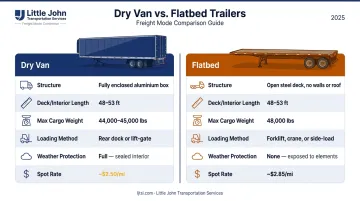
Flatbed vs. Dry Van: Quick Comparison
| Attribute | 53-ft Dry Van | Standard Flatbed (48–53 ft) |
|---|---|---|
| Structure | Fully enclosed aluminum trailer | Open deck, no sides or roof |
| Interior/Deck Length | ~52 ft 6 in interior | 48 ft or ~53 ft deck |
| Width | 99–100 in interior (102 in exterior) | 102 in deck |
| Height | 9 ft–9 ft 2 in interior | Deck height ~60 in; no height ceiling |
| Typical Max Cargo Weight | 42,000–44,000 lb | 45,000–48,000 lb |
| Loading Method | Dock (rear door only) | Side, top, or rear; crane accessible |
| Weather Protection | Full enclosure | None |
| Load Securement | Pallet positions, no tiedown requirements for standard loads | Chains, straps, edge protection per 49 CFR Part 393 |
| Permit Requirements | None for standard loads | Required for loads exceeding federal width/weight thresholds |
| Carrier Availability | Highest (61% of trailer production, 2017–2021) | Lower (~9% of trailer production) |
| Dec. 2025 Spot Rate | $2.29/mile | $2.53/mile |
Sources: DAT Flatbed Guide, Hale Trailer dry van specs, ACT Research
Some industries are locked into one trailer type by the nature of their freight. Manufacturers moving both heavy equipment and finished packaged goods, for example, routinely run flatbed and dry van loads within the same supply chain. The sections below break down where each trailer type fits — and where the decision gets complicated.
What Is Flatbed Trucking?
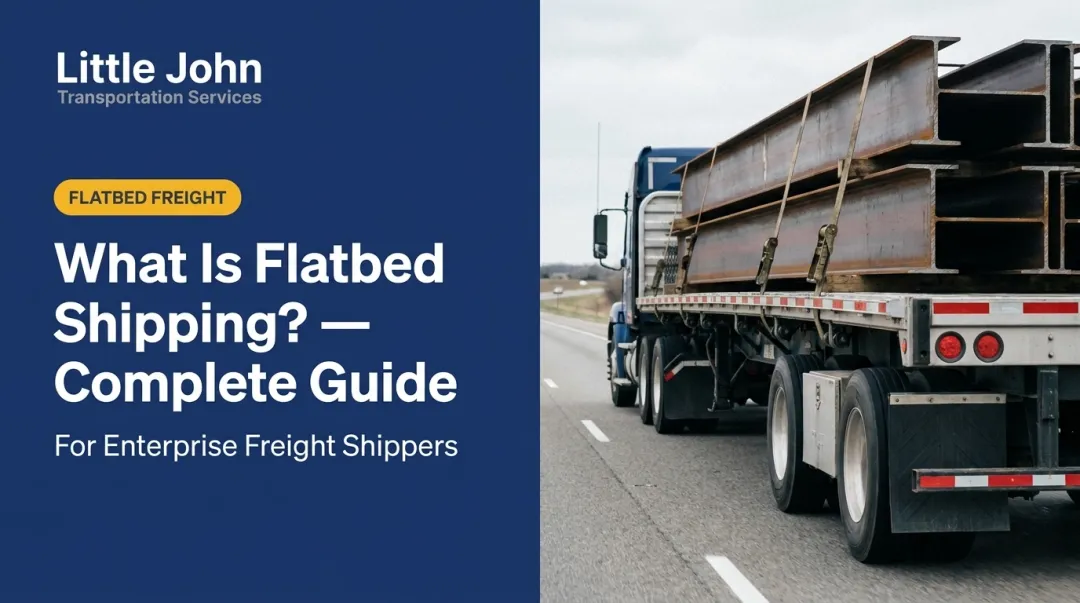
A flatbed trailer has no sides, no roof, and no enclosure. That open design exists for a reason: cargo that is too large, too heavy, or too irregularly shaped simply cannot fit inside an enclosed trailer.
Flatbed Trailer Variants
Different flatbed configurations exist precisely because "oversized" covers a wide range of freight:
| Variant | Best For |
|---|---|
| Standard flatbed | General oversized cargo, steel, lumber, machinery |
| Step deck / drop deck | Tall loads exceeding dry van height limits (lower deck up to 10 ft 6 in) |
| Lowboy | Construction equipment where loaded height is critical |
| RGN (Removable Gooseneck) | Heaviest machinery requiring drive-on loading; detachable front section |
Industries That Depend on Flatbed
Flatbed isn't optional for certain freight categories — it's the only practical option:
- Construction materials: Steel beams, precast concrete panels, rebar bundles
- Oil and gas: Drilling equipment, frac tanks, wellhead components
- Wind energy: Turbine tower sections, nacelles, blades (which can exceed 150 ft and require specialized stretch trailers)
- Industrial and agricultural machinery: CNC equipment, combines, excavators
- Lumber: Long-length timber that exceeds dry van interior dimensions
- Heavy automotive parts: Stamping dies, chassis components, large assemblies
Load Securement and Compliance
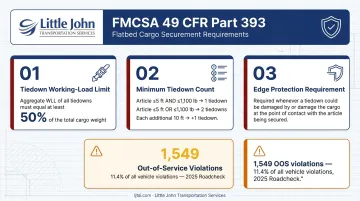
FMCSA's cargo securement rules under 49 CFR Part 393, Subpart I set binding requirements for flatbed loads. Key obligations for shippers:
- Aggregate tiedown working-load limit must equal at least half the cargo weight (§393.106)
- Minimum tiedown count depends on article length and weight — one tiedown for articles under 5 ft and 1,100 lb; two for heavier or longer pieces; additional tiedowns required per additional 10 ft of length (§393.110)
- Edge protection is required wherever a tiedown could be cut or abraded (§393.104)
- Commodity-specific rules cover metal coils, heavy machinery over 10,000 lb, concrete pipe, and other categories
Securement violations aren't low-stakes: cargo securement accounted for 1,549 out-of-service violations — 11.4% of all vehicle OOS violations during the 2025 International Roadcheck. Non-compliance creates direct liability for the shipper, not just the carrier.
For loads exceeding federal width (102 in) or gross weight (80,000 lb) limits, state-specific oversize/overweight permits are required. There is no federal height limit — state rules apply, typically ranging from 13 ft 6 in to 14 ft 6 in. Permits are state-issued; the federal government does not issue them directly.
Little John Transportation Services holds the #1 Flatbed/Heavy ranking on the TT Top 100 and operates 2,700+ specialized trailers across flatbed, step-deck, RGN, lowboy, and multi-axle configurations. That includes permit coordination and route engineering for complex oversized moves where securement and state compliance requirements make carrier selection critical.
What Is Dry Van Trucking?
A dry van is a fully enclosed 53-foot aluminum trailer. It's the most common trailer in North American freight for a reason: it fits the widest range of general cargo, is available from the largest pool of carriers, and requires no special permits for standard-dimension loads.
Freight That Belongs in a Dry Van
Full enclosure matters for specific cargo categories:
- Servers, networking hardware, and data center components — theft-sensitive and moisture-vulnerable, making enclosure non-negotiable
- Temperature-stable pharmaceuticals and medical devices that require tamper-evident transport
- Retail merchandise, packaged food, and apparel on standard 48" × 40" pallets
- Finished furniture and appliances that need protection from road debris and weather
CargoNet recorded 3,625 cargo theft incidents in 2024 — up 27% from 2023, with an average reported value of $202,364 per incident. Consumer electronics ranked among the top targeted categories. Enclosed transport is a practical risk-management decision.
Operational Advantages for Shippers
- Carrier availability: Dry vans represented 61% of U.S. trailer production from 2017–2021, meaning deeper carrier pools and stronger rate competition
- Drop-and-hook compatibility: Pre-loaded trailers can be swapped at docks without driver wait time — a meaningful efficiency gain for high-volume distribution operations
- No permit overhead: Standard dry van loads don't require oversize/overweight permits, reducing administrative complexity
Limitations Shippers Must Know
- Cannot accommodate cargo exceeding interior dimensions (roughly 52 ft 6 in L × 99–100 in W × 9 ft 2 in H)
- No temperature control — that requires a refrigerated (reefer) trailer
- No side or crane access — all loading and unloading happens through the rear doors at a dock
Flatbed vs. Dry Van: Which One Is Right for Your Freight?
Five factors determine the right trailer. Work through them in order.
Factor 1 — Cargo Dimensions and Weight
If your cargo exceeds the dry van's interior envelope — roughly 53 ft long, 99–100 in wide, 9 ft 2 in tall — flatbed is required, not optional. The same applies if loading requires crane access, side forklift approach, or top-loading.
Cargo that's physically compatible with a dry van but heavy enough to approach axle limits may still fit inside a van — check gross and axle weights against FHWA limits (80,000 lb gross, 20,000 lb single axle, 34,000 lb tandem axle) before assuming a flatbed is required.
Factor 2 — Cargo Sensitivity and Protection
| Use Dry Van | Use Flatbed |
|---|---|
| Electronics, servers, pharma | Structural steel, machinery |
| High-value or theft-targeted goods | Oil and gas equipment |
| Moisture-sensitive cargo | Wind energy components |
| Palletized retail merchandise | Lumber, precast concrete |
Weather-resistant cargo that's inherently difficult to damage — steel beams, heavy equipment, tower sections — has no practical need for enclosure and often can't fit inside one.
Factor 3 — Loading and Unloading Method
Audit both your origin facility and the delivery point before selecting a trailer:
- Dock with rear access → dry van
- Open yard, job site, or port → flatbed
- Crane or side-forklift required → flatbed
- No dock, ground-level loading → flatbed or step deck depending on height
Miss this step and a job-site delivery without a dock means a costly reschedule.
Factor 4 — Cost and Compliance
Loading constraints settled, cost is the next variable. Flatbed freight runs higher per mile — driven by lower carrier availability, specialized equipment costs, and securement labor. DAT's December 2025 data shows a $0.24/mile premium for flatbed over van at the national spot level. On a 1,500-mile cross-country haul, that's roughly $360 per load before adding permit and escort costs.
Oversized loads add state permit fees, which vary by state (Texas charges $60 per single-trip general permit; California charges $16 for seven consecutive days), plus pilot car costs where required. These are real additions to total landed cost that dry van shippers never face.
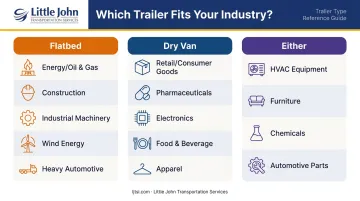
Factor 5 — Industry and Supply Chain Fit
| Flatbed | Dry Van | Either (Load-Dependent) |
|---|---|---|
| Energy and oil & gas | Retail and consumer goods | HVAC equipment |
| Construction | Pharmaceuticals | Furniture |
| Industrial machinery | Electronics | Chemicals |
| Wind energy | Food and beverage | Automotive parts |
| Heavy automotive | Apparel |
Real-World Scenarios: Choosing the Right Trailer
Scenario A: Industrial Equipment — Flatbed Required
An energy company needs to move a 58,000-lb industrial compressor unit from a fabrication facility in Houston to a processing plant in West Texas. The unit is 14 ft wide and 12 ft tall.
The cargo exceeds dry van interior dimensions on every axis. A lowboy configuration was selected to keep loaded height within state limits. State-specific oversize/overweight permits were required for Texas highways, with pilot car escorts on non-Interstate segments of the route. The carrier coordinated permit procurement and route pre-approval before the truck moved.
Choosing dry van wasn't an option — the cargo physically couldn't enter the trailer. Attempting to force the move without proper permits and escort would have meant fines, potential seizure, and cargo damage from inadequate securement.
Scenario B: AI Infrastructure Components — Dry Van Required
A data center operator needed to ship a rack of server hardware from a manufacturing facility to a new build-out in the Southeast. The cargo weighed 22,000 lb, fit standard pallet positions, and carried a replacement value exceeding $800,000.
Dry van was the clear choice. Key factors:
- Enclosed trailer provided tamper-evidence and theft deterrence for high-value electronics
- Drop-and-hook at both origin and destination reduced driver dwell time
- No permits required — standard dimensions, standard process
- Cargo arrived without exposure to weather, road debris, or unauthorized access
Little John Transportation Services regularly handles this type of move for technology clients including Oracle, Microsoft, Meta, and AWS — applying the same compliance discipline and chain-of-custody documentation that governs their hazmat and heavy-haul operations.
The Decision Framework
The cargo dictates the choice — neither trailer type is inherently better. For shippers whose supply chains include both standard and specialized freight, working with a carrier experienced across trailer types removes the operational friction of managing multiple vendors, negotiating separate contracts, and coordinating handoffs between carriers.
Contact Little John Transportation Services for a freight assessment or quote:
- Email: quotes@ljtsi.com
- Phone: +1 (479) 264-6501
Frequently Asked Questions
Why are flatbed trucking rates higher than dry van rates?
Flatbed hauls require specialized equipment, more limited carrier availability, additional load securement labor, and often state permits for oversized loads. Each of those factors adds cost relative to the abundant dry van market, where competition among carriers keeps rates lower.
What types of cargo require flatbed shipping?
Cargo that is oversized, overweight, oddly shaped, or requires side or top loading — including steel beams, heavy machinery, oil and gas equipment, wind turbine components, and large construction materials. If the freight can't physically fit inside a dry van, flatbed is the only option.
Can the same carrier handle both flatbed and dry van shipments?
Full-service specialized carriers can manage both trailer types under one vendor relationship. For shippers with mixed freight — industrial components on flatbed, finished goods in dry van — that eliminates the overhead of managing separate carriers.
What permits are needed for oversized flatbed loads?
Loads exceeding federal width (102 in) or gross weight (80,000 lb) limits require state-issued oversize/overweight permits — each state sets its own rules — and often pilot car escorts and pre-approved routing. A qualified carrier handles permitting and route engineering on the shipper's behalf.
Do flatbed drivers earn more than dry van drivers?
Flatbed drivers typically earn more per mile due to securement responsibilities, tarp handling in all weather conditions, and the technical demands of compliance with DOT regulations.
Is driving a flatbed harder than driving a dry van?
Yes. Flatbed driving is more physically and technically demanding — requiring load securement, tarping, and working knowledge of FMCSA compliance standards. That's why carrier experience matters more for flatbed moves than for standard van loads.