Heavy haul transportation corridors exist to solve exactly this problem. These are engineered roadways designed from the ground up to handle vehicles and loads that standard roads simply can't accommodate safely or legally.
This guide covers what these corridors are and how they're built, where the major ones are located across the U.S. and at the border, what permits you'll need, what equipment is involved, which industries depend on them most, and what to look for in a carrier.
Key Takeaways
- Heavy haul corridors are purpose-engineered routes rated well above the federal 80,000 lb interstate limit
- OS/OW permit requirements vary by state — multi-state moves require separate compliance in each jurisdiction
- Pilot car requirements, travel restrictions, and seasonal bans differ by state and load dimensions
- Equipment selection directly affects permitting thresholds and route eligibility
- Carrier positioning near your origin and destination matters as much as their credentials
What Are Heavy Haul Transportation Corridors?
A heavy haul transportation corridor is a designated roadway or route system engineered specifically for vehicles and loads that exceed standard legal weight or dimension limits. The difference goes beyond legal classification — the infrastructure itself is built to different engineering standards.
Standard roads are designed around the 80,000 lb federal GVW cap. A dedicated heavy haul corridor is built to carry loads that would crack standard pavement within weeks.
Corridor vs. Standard Road: Key Differences
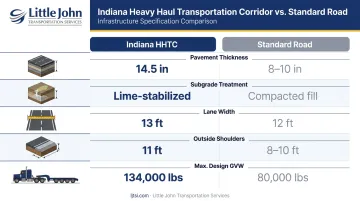
Indiana's Heavy Haul Transportation Corridor (HHTC) is the most thoroughly documented U.S. example. INDOT's specifications show exactly what separates purpose-built corridors from standard pavement:
| Feature | Indiana HHTC | Standard Road |
|---|---|---|
| Pavement thickness | 14.5 inches | Typically 8–10 inches |
| Subgrade treatment | Lime-stabilized | Compacted fill |
| Lane width | 13 ft | 12 ft |
| Outside shoulders | 11 ft | 8–10 ft |
| Max design GVW | 134,000 lbs | 80,000 lbs |
Beyond structural differences, there's a significant permit advantage. On a designated corridor, qualifying vehicles may operate without individual OS/OW permits. On any standard road, every non-divisible load over legal limits requires a state-issued permit, a route survey, and often escort vehicles.
Weight and Dimension Thresholds
The federal baseline is 80,000 lbs GVW on interstate highways, with axle limits of 20,000 lbs (single) and 34,000 lbs (tandem). The Federal Bridge Formula governs how weight distributes across axle groups — adding axles doesn't automatically legalize more weight.
Loads exceeding these federal limits fall into heavy haul classification. Dedicated corridors typically accommodate 100,000 to 134,000+ lbs GVW, depending on their design.
Three classifications cover most heavy haul scenarios:
- Oversize: Width, height, or length exceeds state dimensional limits
- Overweight: Gross or axle weight exceeds federal or state mass limits
- Combined OS/OW: Load exceeds both dimension and weight thresholds simultaneously
That last category is the most common in practice. A mining excavator on a multi-axle lowboy is typically wide, tall, and heavy — requiring permits that address all three dimensions at once.
Major Heavy Haul Corridors Across the U.S.
Dedicated corridors tend to cluster around the same geographic drivers: proximity to ports, energy production zones, manufacturing hubs, and intermodal rail connections.
Indiana's HHTC connects River Ridge Commerce Center to the Ports of Indiana-Jeffersonville — a direct response to industrial demand from one of the state's largest logistics parks. The same logic drives corridor investment everywhere else.
Regional Corridor Highlights
Indiana and the Midwest Manufacturing Belt
The Indiana HHTC is the clearest example of corridor investment triggered by industrial concentration. Ohio, Illinois, and the Great Lakes corridor host similar activity — in 2024, ODOT managed a permitted superload move for a 916,000 lb air processor traveling from Manchester to New Albany for the Intel semiconductor project. That was a project-specific permitted route, not a permanent corridor, but it shows the scale of loads moving through this region.
Steel mills, auto plants, and port connections along Lake Michigan and the Ohio River drive consistent heavy haul demand through the Midwest.
Gulf Coast and Texas
Texas doesn't operate one statewide heavy haul corridor — TxDOT documents a network of county-authorized and port-designated OS/OW routes instead. In Hidalgo County alone, there are 47 miles of documented OS/OW corridors and 12 designated bridges. Port of Brownsville routes cover SH 48/SH 4 and US 77/US 83 connections.
The Gulf Coast petrochemical belt, running from Houston through Beaumont and into Louisiana, produces constant heavy haul traffic: refinery components, pressure vessels, and LNG infrastructure moving on a near-continuous cycle.
Louisiana's system formalizes this further: as of September 2025, annual OS/OW heavy equipment permits cover loads up to 120,000 lbs, 12 ft wide, 14 ft 4 in high, and 90 ft long on registered routes.
U.S.–Mexico Cross-Border Heavy Haul Routes
Where Gulf Coast corridors end, cross-border complexity begins. Loads crossing between the U.S. and Mexico must comply with both FMCSA regulations and Mexican SCT (Secretaría de Comunicaciones y Transportes) weight and dimension rules, and those frameworks don't always align.
Laredo is the critical gateway. TxDOT's 2024 Border Report records 2.8 million northbound commercial-vehicle crossings at Laredo ports of entry in 2022.
Laredo alone handles 54.7% of all northbound truck traffic from Mexico into Texas and more than $331.2 billion in trade value annually.
For heavy haul specifically, shippers using the Laredo corridor need carriers with physical operations on both sides of the border. Key requirements include:
- Bilingual dispatch and documentation teams on both the U.S. and Mexico sides
- Permit coordination under both FMCSA and SCT regulatory frameworks
- Transloading capability for superloads that exceed border crossing constraints
- In-country staffing to coordinate moves from northern Mexico's industrial zones
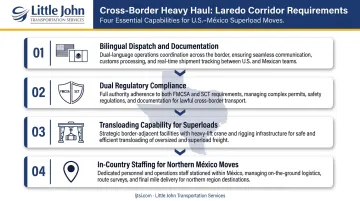
Little John Transportation Services runs a 50-acre CTPAT-validated facility in Laredo with a 120-ton bridge crane for transloading superloads, with staffed offices in Monterrey and Guadalajara covering moves originating in northern Mexico.
Permit and Regulatory Requirements for Heavy Haul Moves
No single federal agency issues OS/OW permits — permitting is a state function. FHWA is explicit about this: federal law sets the limits, but states control the permitting process.
FMCSA does play a role at the federal level through the Hazardous Materials Safety Permit (HMSP) program, which applies to carriers transporting specific hazardous cargo categories including highway route-controlled radioactive materials, bulk explosives, and certain toxic-by-inhalation materials. State permitting is where the real complexity begins — each jurisdiction sets its own triggers, limits, and procedures.
State Permit Requirements
Here's how four key states compare:
| State | Width Trigger | Height Trigger | GVW Trigger |
|---|---|---|---|
| Texas | Over 8 ft 6 in | Over 14 ft | Over 80,000 lbs |
| Indiana | Over 8 ft 6 in | Over 13 ft 6 in | Over 80,000 lbs |
| Arkansas | Over 8 ft 6 in | Over 13 ft 6 in | Over 80,000 lbs (5+ axles) |
| California | Over 8 ft 6 in | Over 14 ft | Over 80,000 lbs |
The width and GVW triggers look similar. But routing requirements, approved roads, bridge rating reviews, and application processes differ state by state. A carrier that knows Texas permitting cold may still cause delays if they're unfamiliar with Indiana's M-204 general provisions.
Route surveys are required before most heavy haul moves. Carriers verify bridge ratings against FHWA load rating data, confirm clearance heights, and identify any utility conflicts. Automated systems can screen bridges along a proposed route; complex moves may require refined structural analysis before approval.
Escort and Pilot Car Requirements
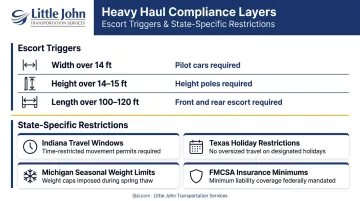
Escort requirements kick in based on load dimensions — and differ by state, which matters on multi-state moves:
- Width over 14 ft: Typically requires pilot car(s)
- Height over 14–15 ft: State-dependent; some require height poles
- Length over 100–120 ft: Usually triggers front and rear escort
Additional compliance layers compound this:
- Indiana travel windows: Loads over 16 ft wide or 200,000 lbs are restricted to Monday–Friday, 8:30 a.m.–3:30 p.m.
- Texas holiday restrictions: Movements are prohibited on major holidays for loads exceeding 14 ft wide, 16 ft high, or 110 ft long
- Seasonal weight restrictions: Michigan reduces normal axle loading by 25% on rigid pavement and 35% on flexible pavement during spring thaw
- Carrier insurance minimums: FMCSA requires $750,000 for standard for-hire carriers; $1 million for specified hazmat; $5 million for explosives or poison gas
Equipment Built for Heavy Haul Corridors
Trailer selection isn't just about whether something fits — it directly affects weight distribution across axles and determines whether a move needs a permit at all.
Primary trailer types:
- Lowboy (double-drop): Reduces deck height for tall equipment; Talbert's 65SA modular spread-axle lowboy is rated at 130,000 lbs in 14 ft
- Removable Gooseneck (RGN): Detachable front section allows equipment to drive on under its own power
- Multi-axle expandable trailers: Distribute weight across additional axles to stay within bridge formula limits
- Self-Propelled Modular Transporters (SPMT): Scheuerle's SPMT system supports up to 60 tons per axle line, used for reactor vessels and large industrial modules
Under the Federal Bridge Formula, adding axles with proper spacing can increase permissible weight — but single-axle and tandem limits, plus the 80,000 lb cap, still apply on undesignated roads. Axle configuration isn't a formality; it's what separates a compliant move from a stopped one.
Tractor requirements scale with the same logic. High-horsepower rigs — often 600 HP or more — paired with tandem or tri-drive rear axle setups handle the gradient challenges common on heavy haul corridors. Matching tractor to terrain matters as much as matching trailer to load.
That range of equipment — tractors, trailers, and axle configurations — is why fleet depth is decisive on corridor moves. Little John Transportation Services operates 2,700+ specialized trailers across configurations including step-deck, flatbed, RGN, stretch, multi-axle lowboy, Schnabel, and dual-lane, with a maximum capacity of 160,000 lbs on a single bill of lading and 100,000+ permits processed annually.
Industries That Rely on Heavy Haul Corridors
Energy
Wind energy is among the largest drivers of heavy haul demand. DOE data shows that modern land-based turbine blades exceed 170 ft in length and cannot be bent or folded after manufacture. The U.S. added 16.8 GW of wind capacity in 2020 alone, and blade sizes continue growing , putting sustained pressure on transportation networks.
Oil and gas moves drilling rigs, frac tanks, pressure vessels, and refinery components through Gulf Coast and Permian Basin corridors regularly.
Industrial Machinery, Mining, and Construction
Several industries depend on these corridors to move equipment that can't travel any other way:
- Mining and construction: Excavators, crushers, cranes, and processing plants move between job sites and ports throughout their operational lives
- Automotive manufacturing: Large stamping dies and assembly-line equipment for OEMs like Honda, Tesla, and Caterpillar move on the same specialized trailer configurations as industrial superloads
AI Infrastructure and Data Centers
This sector is growing fast as a heavy haul driver. DOE reported in December 2024 that data centers consumed 4.4% of U.S. electricity in 2023, with projections reaching 6.7%–12% by 2028. Large power transformers typically weigh 150–400 tons, creating logistics constraints that require the same specialized equipment and corridor access as industrial moves.
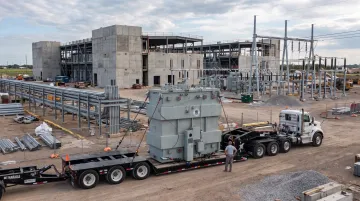
Generator skids, UPS systems, and switchgear for hyperscale data centers regularly exceed standard weight limits. Little John serves Google, Microsoft, Meta, AWS, and Oracle in this sector, coordinating the corridor access and multi-axle equipment their infrastructure buildouts require.
How to Choose a Heavy Haul Transportation Partner
The qualifications aren't optional. Before signing with a carrier, verify:
- FMCSA Satisfactory safety rating — not Conditional, not Unrated
- HMSP holder status if cargo falls within covered hazmat categories
- OS/OW permit experience across every state the move will cross
- CSA scores across all BASIC categories
- Liability insurance at appropriate minimums for your cargo value and type
- Specialized equipment availability without long repositioning delays
Positioning matters more in heavy haul than in almost any other freight category. A carrier dispatching from an office 1,500 miles from your origin will have slower response times, less familiarity with local permit offices, and no ground team to handle complications when they arise.
Little John Transportation Services is a concrete example of what the right profile looks like operationally:
- 30+ years in specialized freight, including the loads most carriers refuse
- 2,700+ specialized trailers across flatbed, RGN, lowboy, and multi-axle configurations
- FMCSA HMSP certification and Satisfactory safety rating
- Offices across key U.S. and México hubs, including Laredo and Monterrey
- C-TPAT validated with bilingual cross-border operations
- 100,000+ loads moved annually, 99.9% claim-free
Credentials and fleet depth only go so far. What separates a reliable partner from a dispatch-only broker is physical presence at the corridors where your freight actually moves — and a team that owns the outcome when something goes sideways.
Frequently Asked Questions
What does transportation corridor mean?
A transportation corridor is a defined geographic route or designated roadway used to move freight between two points. Heavy haul corridors are specifically engineered or legally designated to handle vehicles and loads far exceeding standard road weight limits, making them distinct from general truck routes in both structure and legal status.
What is considered heavy haul trucking?
Heavy haul trucking involves transporting loads that exceed federal or state legal weight or dimension limits — typically over 80,000 lbs GVW, or beyond standard width, height, or length thresholds. These moves require specialized equipment, state-issued permits, and advance route planning.
What permits are required for heavy haul transportation?
Most oversize/overweight moves require a state-issued OS/OW permit. Certain hazardous cargo also requires an FMCSA HMSP at the federal level. Multi-state moves need a separate permit from each state crossed, with different requirements in each jurisdiction.
How are weight limits determined for heavy haul corridors?
Limits are set based on engineered pavement thickness, subgrade load-bearing capacity, bridge ratings, and axle spacing. Indiana's HHTC, for example, is rated to 134,000 lbs. That exceeds the federal 80,000 lb interstate baseline because its 14.5-inch pavement and lime-stabilized subgrade are designed for that load.
What equipment is used in heavy haul transportation?
The main trailer types are lowboys, RGNs, multi-axle expandable trailers, and self-propelled modular transporters, each matched to high-horsepower tractors sized for the load and route terrain. Axle count and spacing directly affect permitting thresholds under the Federal Bridge Formula.
What industries most commonly use heavy haul transportation corridors?
Energy (wind, oil and gas), industrial machinery, construction, mining, and automotive manufacturing are the primary sectors. AI infrastructure and data center buildout is an increasingly significant driver, given the transport weight of large power transformers, generator skids, and UPS systems.