Introduction
Shipping hazardous materials by freight is one of the most regulated logistics decisions a company makes. A missed classification, an unlabeled package, or a carrier without the right credentials can mean shipment rejection, federal fines, environmental incidents, or worse.
The regulatory framework isn't simple: multiple federal agencies share oversight, and shippers and carriers carry separate obligations under the same rulebook. Civil penalties under 49 CFR 107.329 now reach $102,348 per violation, with criminal exposure up to $500,000 for organizations.
This guide cuts through the complexity. You'll find a plain-language breakdown of the nine DOT hazmat classes, the federal regulatory structure, step-by-step compliance requirements, documentation standards, and a practical checklist for vetting any carrier you trust with regulated freight.
Key Takeaways
- All nine DOT hazmat classes — from explosives to dry ice — carry distinct packaging, labeling, and documentation requirements
- Shippers bear legal responsibility for classification, packaging, and shipping papers; carriers are responsible for lawful acceptance and placarding
- Civil penalties exceed $100,000 per violation; criminal penalties can reach $500,000 for corporations
- The FMCSA Hazardous Materials Safety Permit is required for certain high-risk loads — fewer than 1% of U.S. carriers hold it
- Every hazmat shipment must be audit-ready: documentation must hold up at any roadside inspection
What Is Hazmat Freight Shipping?
Hazmat freight shipping is the commercial trucking movement of any material the Secretary of Transportation has determined capable of posing an unreasonable risk to health, safety, or property when transported in commerce. That legal definition comes from 49 U.S.C. 5103 and is implemented through 49 CFR.
That scope is broader than most logistics teams realize, and it applies whether or not a shipper has identified their cargo as hazardous.
What Actually Counts as Hazmat
Many logistics managers picture drums of industrial chemicals when they hear "hazmat." The actual scope is much wider. Under DOT classification, all of the following are regulated hazardous materials:
- Lithium-ion batteries (UN3480, Class 9)
- Aerosol canisters (UN1950, Division 2.1 or 2.2 depending on contents)
- Petroleum products (UN1268, Class 3)
- Dry ice (UN1845, Class 9, PG III)
- Certain pharmaceuticals (e.g., UN1851, Division 6.1)
- Ammunition (UN varies by type — small arms through explosives, each with separate packaging and placard requirements)
A company shipping consumer electronics with lithium batteries, or a food manufacturer moving dry ice, is moving hazmat. The regulation doesn't require internal awareness — only compliance.
Why It's Different from Standard Freight
Standard freight compliance ends largely with a bill of lading and basic carrier vetting. Hazmat adds a separate layer of federal obligations that apply before the truck leaves the dock:
- Carriers must hold specific certifications, including the FMCSA Hazardous Materials Safety Permit (HMSP) for certain high-risk loads
- Drivers must carry hazmat endorsements on their CDLs
- Vehicles require DOT-specified placards
- Shipping papers must include a 24/7 emergency response telephone number — monitored throughout transit
- Both shipper and carrier face independent liability for violations under 49 CFR Part 171
The 9 DOT Hazmat Classes Explained
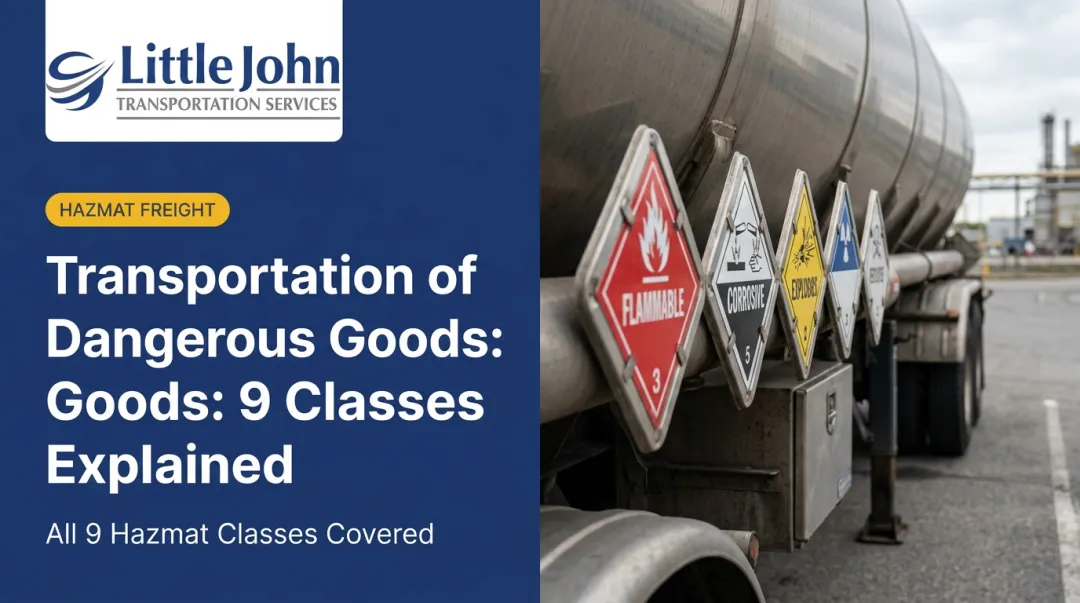
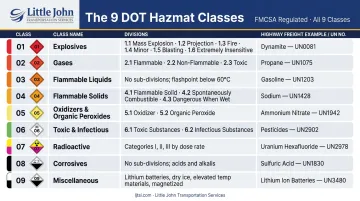
Under 49 CFR 172.101, hazardous materials are sorted into nine classes based on the nature of their hazard. A material's class determines its required labels, placarding, permissible packaging, and documentation. Misclassification is among the most common — and costly — compliance failures in hazmat shipping.
| Class | Name | Divisions | Highway Example |
|---|---|---|---|
| 1 | Explosives | 1.1–1.6 | Black powder (UN0027, 1.1D) |
| 2 | Gases | 2.1 Flammable, 2.2 Non-flammable, 2.3 Poison gas | Acetylene, dissolved (UN1001, 2.1) |
| 3 | Flammable Liquids | None | Acetone (UN1090, PG II) |
| 4 | Flammable Solids | 4.1 Flammable solid, 4.2 Spontaneous combustion, 4.3 Dangerous when wet | Barium (UN1400, 4.3, PG II) |
| 5 | Oxidizers/Peroxides | 5.1 Oxidizer, 5.2 Organic peroxide | Barium nitrate (UN1446, 5.1, PG II) |
| 6 | Toxic/Infectious | 6.1 Poison, 6.2 Infectious substance | Adiponitrile (UN2205, 6.1, PG III) |
| 7 | Radioactive | None | Radioactive material, LSA-I (UN2912) |
| 8 | Corrosives | None | Acetic acid, glacial (UN2789, PG II) |
| 9 | Miscellaneous | None | Lithium-ion batteries (UN3480) |
Packing Groups: The Other Half of Classification
Most hazmat classes are further divided into packing groups that reflect the degree of hazard:
- PG I — Great danger
- PG II — Medium danger
- PG III — Minor danger
The packing group directly determines which UN-specification packaging is authorized. A Class 3 flammable liquid with an initial boiling point at or below 35°C (PG I) requires far more stringent containment than the same chemical class at PG III.
Shippers must assign the correct packing group by consulting available product data — including the Safety Data Sheet — and verifying it against the Hazardous Materials Table. The offeror retains legal responsibility for the final classification.
When a material presents multiple hazards — a flammable toxic substance, for example — both classes must be declared, and the more dangerous classification governs packaging requirements under 49 CFR 173.2a.
Federal Regulations Governing Hazmat Freight Shipping
The Regulatory Framework
Title 49 CFR Parts 100–185 is the master rulebook for hazmat transportation in the U.S. Two agencies share primary jurisdiction:
- PHMSA (Pipeline and Hazardous Materials Safety Administration) — writes and administers the Hazardous Materials Regulations (HMR)
- FMCSA (Federal Motor Carrier Safety Administration) — enforces highway motor carrier compliance
Shippers and carriers operate under the same regulatory document but with separate, distinct obligations.
The FMCSA Hazardous Materials Safety Permit
Certain high-risk materials require the carrier to hold an active FMCSA HMSP before the load moves. HMSP requirements apply to carriers transporting:
- Highway route-controlled quantities of Class 7 radioactive materials
- More than 25 kg of Division 1.1, 1.2, or 1.3 explosives
- More than 1 L per package of PIH Hazard Zone A material
- Bulk PIH Hazard Zone B in packaging of at least 3,500 gallons (liquids/gases) or more than 468 cubic feet (solids)
- Methane/LNG in bulk packaging of at least 3,500 water gallons
The HMSP program launched January 1, 2005. Fewer than 1% of U.S. carriers hold an active HMSP, so verifying this credential before booking the highest-risk loads is a practical first filter.
Shipper Obligations Under 49 CFR
As the offeror, shippers are responsible for:
- Correct classification and packing group assignment
- Authorized UN-specification packaging
- Required markings and labels on every package
- Completed shipping papers with a 24/7 emergency response number
- Hazmat employee training records
- DOT annual registration where required under 49 CFR 107.601 (fees: $250 for small businesses/nonprofits; $2,575 for others, plus a $25 processing fee)
Once the shipper's documentation is complete, responsibility shifts to the carrier to verify, placard, and execute the move safely.
Carrier Obligations Under 49 CFR
Carriers must:
- Verify shipper classification and paperwork before accepting the load
- Ensure the transport vehicle is correctly placarded
- Maintain trained hazmat employees
- Keep a 24/7 emergency response number active throughout transit
- Maintain a written security plan under 49 CFR Part 172 Subpart I for applicable high-risk materials
Failure to meet these obligations — on either side — triggers federal penalty exposure that scales quickly with severity.
Penalty Exposure
The numbers make non-compliance expensive:
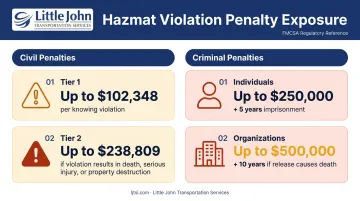
- Civil penalties: Up to $102,348 per knowing violation; up to $238,809 if the violation causes death, serious illness, severe injury, or substantial property destruction
- Criminal penalties: Up to $250,000 for individuals, $500,000 for organizations — plus up to five years imprisonment (or ten years if a release causes death or bodily injury)
How to Ship Hazmat Freight: A Step-by-Step Compliance Guide
Step 1: Identify and Classify Your Material
Start with the Safety Data Sheet. Section 14 of the SDS provides transport information — UN/NA number, proper shipping name, hazard class, and packing group — but treat it as a starting point, not the controlling legal source. The offeror is legally responsible for verifying that classification against the DOT Hazardous Materials Table at 49 CFR 172.101.
Cross-reference Section 14 data against the HMT to confirm:
- The correct UN/NA number
- The proper shipping name
- The hazard class and any subsidiary hazards
- The applicable packing group
- Any special provisions that modify how the material may be shipped
If the material presents multiple hazards, both must be declared on the shipping paper, and the more dangerous classification governs packaging.
Step 2: Select the Right Packaging
UN-specification packaging must pass defined performance tests under 49 CFR Part 178, including drop, leakproofness, hydrostatic pressure, stacking, and vibration testing. Applicability varies by packaging design and intended contents.
Packaging specification marks tell you which packing groups a container is certified for:
- X — Certified for PG I, II, and III
- Y — Certified for PG II and III
- Z — Certified for PG III only
A Class 3 flammable liquid at PG I must be packed in X-marked containers. Using a Y-marked container for that material is a federal violation, and the shipper is responsible for confirming that match before tendering the load.
Step 3: Apply Proper Labeling and Placarding
Once packaging is confirmed, labeling is the next compliance layer — and it operates at two distinct levels.
Package-level labels are the shipper's responsibility. Each package must display the appropriate DOT diamond-shaped hazard warning label for its class and any subsidiary hazards. Labels must be at least 100mm per side, placed on the same surface near the proper shipping name, with primary and subsidiary labels within 150mm of each other.
Vehicle-level placards are the carrier's operational responsibility, but the offeror supplies the required placards. General thresholds under 49 CFR 172.504:
- Table 1 materials (highest risk — including Divisions 1.1–1.3, 2.3, 4.3, and PIH Division 6.1): placarding required regardless of quantity
- Table 2 materials: placarding required at 454 kg (1,001 lbs.) or more aggregate gross weight
Missing, damaged, or incorrect placards are among the common violations cited in FMCSA roadside inspections.
Hazmat Shipping Documentation Requirements
The Hazmat Shipping Paper
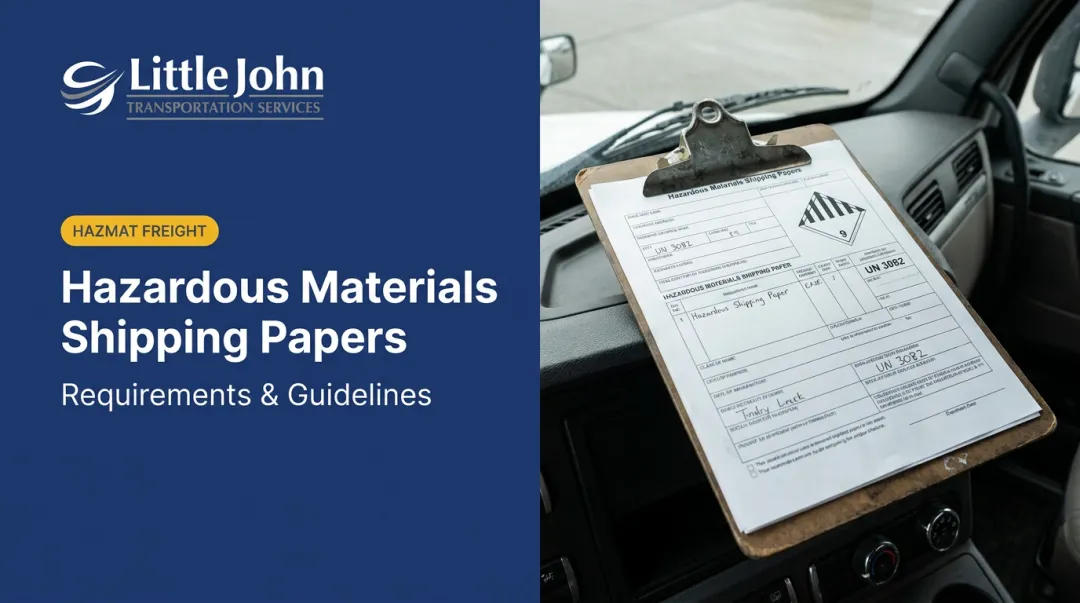
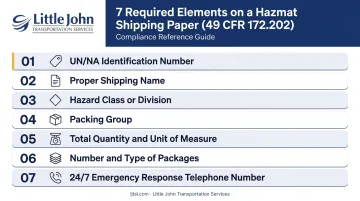
Every hazmat shipment must travel with a shipping paper that meets 49 CFR 172 Subpart C. The required basic description, in order, is:
- UN/NA identification number
- Proper shipping name
- Hazard class or division
- Packing group
- Total quantity and unit of measure
- Number and type of packages
- 24/7 emergency response telephone number
This document must be immediately accessible to the driver throughout transit — in the cab, not buried in the load.
The Emergency Response Telephone Number
This requirement trips up more shippers than most. Under 49 CFR 172.604, the number must be:
- Monitored at all times the material is in transportation, including incidental storage
- Answered by someone who can provide immediate technical guidance on the specific material — or a contracted provider like CHEMTREC with a valid agreement
Answering machines, switchboards, and callback-only systems do not satisfy the requirement.
Retention and Additional Records
Federal retention minimums:
- Carrier shipping papers: 1 year
- Shipper (offeror) shipping papers: 2 years
- Hazardous waste manifests: 3 years
- Hazmat employee training records: Duration of employment plus 90 days, available to DOT on demand
Two additional compliance layers apply depending on what you're shipping:
- Security plans (49 CFR Part 172 Subpart I): Required for specific quantities and classes, including certain explosives, PIH materials, and bulk flammable gases/liquids listed in 172.800(b)
- Annual DOT registration (49 CFR 107.601): Required for shippers and carriers of certain classes and quantities
For chemical manufacturers, pharmaceutical shippers, defense contractors, and oil and gas operators, documentation failures during roadside inspections or post-incident audits can halt operations entirely. Inspectors do pull shipping papers — and they know exactly what they're looking for.
How to Choose a Certified Hazmat Freight Carrier
Minimum Credentials to Verify
Before tendering a hazmat load, confirm:
- FMCSA Satisfactory safety rating — verify in the SAFER database
- Active FMCSA HMSP — required for certain high-hazard materials; verify by USDOT number through FMCSA's HMSP verification function
- Hazmat CDL endorsements on 100% of drivers operating on your loads
- TWIC certification — required for unescorted access to secure areas of MTSA-regulated maritime facilities and vessels; relevant for port and intermodal hazmat movements
- Written security plan for applicable materials under 49 CFR Part 172 Subpart I
Each party — shipper and carrier — retains its own HMR obligations under 49 CFR 171.2 and 173.22. Tendering freight to a non-compliant carrier does not transfer your liability away; it adds to it.
What Real Operational Capability Looks Like
Paper credentials matter. So does what happens after the truck leaves.
Ask prospective carriers:
- Is hazmat-trained dispatch available 24/7, with a live human able to respond to emergencies?
- Can they provide audit-ready chain-of-custody documentation from pickup through delivery?
- Do they have documented experience with U.S.–Mexico cross-border hazmat movements, where 49 CFR applies on the U.S. side and Mexican SCT regulations (including applicable NOMs) apply in Mexico — simultaneously?
Little John Transportation Services holds an FMCSA HMSP, ISO 9001:2015 certification, Responsible Care Partner status, AA&E certification, TPS approval, and CTPAT validation — a credential stack held by fewer than 1% of carriers. Their 8,500+ hazmat-certified owner-operators are endorsed across all nine DOT classes, including Division 1.1–1.3 explosives and materials poisonous by inhalation.
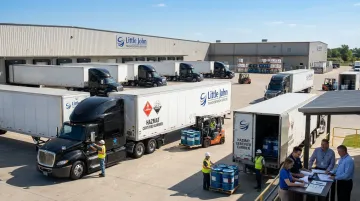
For cross-border hazmat movements, their 50-acre CTPAT-validated Laredo facility and bilingual operations teams in Laredo, Monterrey, and Guadalajara provide the on-the-ground infrastructure that regulatory documents alone cannot substitute for.
Practical Vetting Checklist
- Search the carrier's USDOT number in SAFER — confirm operating status and safety rating
- Verify HMSP status through FMCSA's shipper verification function for applicable materials
- Request hazmat training records and confirm 100% driver CDL hazmat endorsements
- Confirm a 24/7 emergency response plan with a live-monitored number
- Ask for incident history — DOT crash frequency relative to the national average is a concrete safety benchmark
- For cross-border loads: confirm bilingual documentation capability and familiarity with Mexican SCT regulations
Frequently Asked Questions
What is considered hazmat shipping?
Hazmat shipping covers any material the DOT has designated as posing an unreasonable risk to health, safety, or property during transport. The nine classes span explosives and flammable gases to corrosives, radioactive materials, and common items like lithium batteries, aerosol canisters, and dry ice.
Can hazmat freight be shipped LTL (less-than-truckload)?
Yes, hazmat can move LTL, but HMR compliance applies regardless of shipment size. Not every LTL carrier accepts every hazmat class, and quantity limits may apply. Shippers must verify carrier authorization before booking — the LTL designation creates no federal compliance exemption.
What 7 items are required on a hazmat shipping paper?
Under 49 CFR 172.202: UN/NA identification number, proper shipping name, hazard class or division, packing group, total quantity and unit of measure, number and type of packages, and a 24/7 emergency response telephone number. Specific materials may require additional entries based on special provisions.
What certifications should a hazmat freight carrier have?
At minimum: FMCSA Satisfactory safety rating, HMSP for applicable high-risk loads, hazmat CDL endorsements on all drivers, and TWIC where access to regulated maritime facilities is required. For chemical or defense shippers, Responsible Care Partner status and AA&E/TPS credentials are additional meaningful indicators.
What are the penalties for violating hazmat shipping regulations?
Civil penalties reach $102,348 per knowing violation, or $238,809 if the violation causes death, serious illness, severe injury, or substantial property damage. Criminal exposure runs up to $250,000 for individuals and $500,000 for organizations, with up to five years imprisonment, or ten years when a release results in death or bodily injury.
Do hazmat shipping rules change for cross-border freight between the U.S. and Mexico?
Yes. Each segment operates under its own jurisdiction: 49 CFR applies while in the U.S.; Mexican SCT regulations and applicable NOMs govern the Mexico portion. Carriers must carry authorized credentials on both sides, maintain bilingual documentation, and have proven experience coordinating at the border.