For pharmaceutical manufacturers, specialty pharmacies, hospital supply chain managers, and biotech companies, this isn't a logistics nicety — it's operationally critical. Product spoilage, patient harm, regulatory non-compliance, and significant financial exposure are all on the line when a cold chain breaks.
This guide covers how the process works end-to-end, what regulatory standards govern it, what factors affect cold chain performance, and what separates a qualified carrier from a standard freight provider.
Key Takeaways
- Temperature controlled shipping maintains drugs within required ranges — most commonly 2°C to 8°C — throughout the entire transit chain.
- A broken cold chain can render medications ineffective or unsafe, creating direct patient safety liability.
- Freezing is just as destructive as overheating for biologic and protein-based drugs.
- Compliance with FDA, USP, ISTA, and GDP standards is mandatory, not optional.
- Carrier credentials matter as much as packaging: look for hazmat endorsements, calibrated equipment, and real-time temperature monitoring.
What Is Temperature Controlled Medication Shipping?
Temperature controlled medication shipping — also called pharmaceutical cold chain logistics — is the coordinated management of refrigerated transport, temperature-monitored containers, compliant packaging, and documented handling. The goal: every medication arrives at the pharmacy, hospital, or patient with the same potency and safety profile it had when it left the manufacturer.
How It Differs from Standard Freight
This distinction matters. Standard freight moves goods from point A to point B. Pharmaceutical cold chain logistics requires:
- Certified equipment calibrated to maintain defined temperature zones
- Continuous temperature records captured through real-time data logging
- Regulatory documentation demonstrating chain-of-custody compliance
- Carrier training aligned with Good Distribution Practices (GDP)
A standard dry van or common carrier doesn't meet these requirements. A pharmaceutical shipment that arrives on time but outside its temperature window is a failed shipment. Products must be destroyed, shipments rejected, and regulatory incidents documented — no proof of delivery changes that outcome.
Why Temperature Controlled Shipping Is Critical in Pharmaceutical Logistics
The Scale of the Exposure
The financial stakes are substantial. According to IQVIA, cold-chain medicines represented 32% — or $384 billion — of the $1.2 trillion global pharmaceutical market in 2021, excluding vaccines and COVID-19 therapeutics. Medicines requiring refrigeration accounted for 45% of 2021 sales among the top 20 pharmaceutical companies.
The pipeline is accelerating this exposure. Cold-chain medicines grew at a 13% CAGR from 2017 through 2022, compared to 6% for the total market. Biologics — drugs manufactured in living systems and uniquely sensitive to temperature fluctuations — represented 49% of the global drug pipeline as of October 2022.
Patient Safety Stakes
Medications that experience temperature excursions — whether too hot or too cold — can lose potency or become chemically unstable. The clinical consequences include treatment failures, recurring symptoms, and adverse events for patients depending on those drugs.
Real incidents confirm the risk. A 2009 insulin shipment exposed to temperatures near freezing was destroyed as a precaution, and peer-reviewed research documents insulin-associated diabetic ketoacidosis following accidental freeze-thaw exposure.
The Freezing Misconception
Cold chain logistics must manage both temperature extremes — not just heat. Over-packing shipments with excessive coolant can cause biologics and protein-based drugs to freeze, with consequences just as serious as heat exposure.
Research published in PMC found that a single fast-freeze/slow-thaw cycle produced 3.2% protein aggregates in a therapeutic fusion enzyme, rising to 14.4% after three cycles. Both the upper and lower temperature limits must be actively managed.
The Regulatory Framework
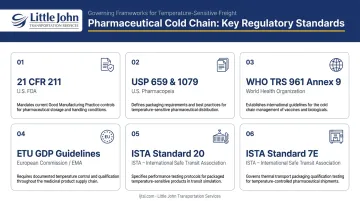
Temperature controlled pharmaceutical shipping isn't optional. Key governing standards include:
- 21 CFR 211.142 and 211.150 — FDA requirements for storage conditions and distribution procedures
- USP <659> — defines "Refrigerator" as 2°C to 8°C
- USP <1079> — risk mitigation guidance for storage and transport of finished drug products
- WHO TRS 961 Annex 9 — model guidance for storage and transport of time- and temperature-sensitive pharmaceuticals
- EU GDP Guidelines — require equipment qualification before use and risk assessment of delivery routes
- ISTA Standard 20 and 7E — container qualification and thermal test profiles
How Temperature Controlled Medication Shipping Works
Cold chain shipping is a continuous system — pre-shipment qualification through final-mile delivery — where every link must perform within defined parameters. A single gap anywhere in that chain puts the drug, the patient, and the shipper's regulatory standing at risk.
Step 1: Pre-Shipment Planning and Qualification
Before any shipment moves, shippers must confirm:
- The drug's exact required temperature range
- Transit duration and route climate conditions
- Secondary sensitivities (light, humidity)
- Packaging selection and coolant quantity based on the above
WHO TRS 961 and EU GDP guidelines both require pre-use qualification of containers against the product stability profile, anticipated ambient temperatures, and transport duration. In practice, this means stress-testing packaging to confirm it will actually perform under real-world conditions before a live shipment moves.
Skipping this step is one of the most common causes of cold chain failure. Organizations that select packaging based on vendor spec sheets rather than validated testing introduce unquantified risk into every shipment.
Step 2: Carrier Execution and In-Transit Control
In-transit execution is where cold chain failures are most likely to occur, which is why carrier credentials carry more weight here than at any other stage.
During transport, qualified carriers must:
- Maintain pharmaceutical-grade refrigerated trailers calibrated to defined temperature zones
- Ensure no cold chain breaks at loading docks, transfer points, or during handoffs
- Operate with hazmat-endorsed drivers trained in pharmaceutical handling requirements
- Provide real-time dispatch coverage capable of responding to temperature excursions
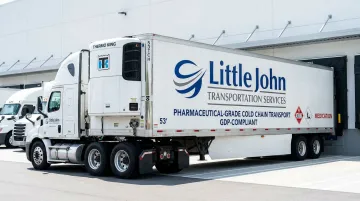
Little John Transportation Services holds FMCSA HMSP certification — held by fewer than 1% of U.S. carriers — with 100% hazmat-endorsed BCO drivers and ISO 9001:2015 quality management certification. Their cold chain network operates with GDP-compliant documentation, 24/7 live temperature monitoring, and CTPAT validation for cross-border pharmaceutical shipments through the Laredo–Mexico corridor.
Step 3: Temperature Monitoring, Documentation, and Final-Mile Delivery
Continuous temperature monitoring must run for the entire shipment duration. Data loggers or real-time GPS-enabled devices capture a chain-of-custody record usable for regulatory audits — documentation that demonstrates the drug was maintained within its required range at every point.
Final-mile delivery carries the highest excursion risk in the entire chain. Dock wait times, transfer delays, and door-side exposure all create temperature vulnerabilities that even well-designed packaging cannot fully absorb.
A U.S. medication-mailing study recorded temperatures ranging from 5.1°F to 102.3°F across parcel shipments, with packages outside the USP controlled-room-temperature range for an average of 68.3% of transit time.
Final-mile planning must account for these variables — not assume they won't occur.
Key Factors That Affect Cold Chain Medication Shipping
| Factor | What It Affects |
|---|---|
| Temperature range and product sensitivity | Packaging insulation, coolant type, transit duration limits |
| External environment and route climate | Cold pack conditioning, coolant quantity, transit planning |
| Equipment and carrier capabilities | Temperature integrity, data quality, excursion response |
| Transit duration and route complexity | Number of handoff points, border dwell time, qualification scope |
Temperature Range and Product Sensitivity
The required temperature window dictates every downstream decision. Common storage requirements by product type include:
- Biologics and vaccines: 2°C to 8°C
- Controlled room temperature products: 15°C to 25°C
- Specialty frozen products: -20°C or below
No single packaging profile covers all products. Each drug's labeled storage condition must drive the engineering of the shipping system — not the other way around.
Operating Conditions and External Environment
Ambient conditions along the route directly affect how a package performs. Summer ground transport through the US Southwest, humid tropical corridors, and sub-zero northern winters each stress packaging in ways that standard lab testing profiles don't fully capture.
The US medication-mailing study referenced above documents just how severe real-world parcel exposure can be — with winter three-day shipments outside the target temperature range for 80.1% of transit time. These aren't edge cases. They're representative conditions that qualified cold chain systems must be designed to handle.
Transit Duration and Route Complexity
Longer routes with multiple transfer points create more opportunities for excursion. Cross-border pharmaceutical shipments introduce customs clearance, handoff delays, and inspection periods that must be factored into cold chain planning.
WHO guidance specifically requires arrangements to avoid delay and protect products during customs procedures — acknowledging that border dwell time is a controlled variable that carriers can plan around. Carriers with dedicated cross-border infrastructure, in-house customs brokerage, and FAST certification can significantly reduce this exposure.
Common Mistakes in Temperature Controlled Medication Shipping
Most cold chain failures don't come from a single catastrophic event. They come from predictable, fixable mistakes made before the shipment leaves the dock.
Mistake 1: Treating Cold Chain as a Packaging Problem
Organizations invest heavily in insulated containers and gel packs, then engage carriers without verifying hazmat endorsements, equipment calibration, or GDP compliance. No packaging solution compensates for a carrier that breaks the cold chain in transit.
Mistake 2: Assuming Colder Is Safer
Excessive coolant causes biologics to freeze. Freeze-thaw cycles damage protein structure just as heat exposure does — potency is destroyed and medications become unsafe. Both upper and lower temperature limits require active management, not just the high end.
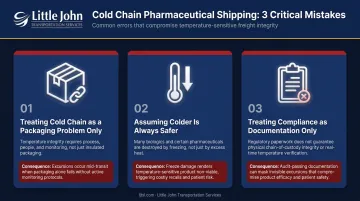
Mistake 3: Treating Compliance as a Documentation Exercise
Teams that focus on paperwork completeness without validating calibrated monitoring devices, GDP-compliant carriers, and accurate chain-of-custody records create real exposure: audit failures, product recalls, and liability. Documentation reflects operational reality. It doesn't create it.
Conclusion
Temperature controlled medication shipping is a multi-party, multi-phase process. Packaging, carrier operations, monitoring technology, and regulatory documentation must all perform within defined parameters — a failure at any single point can compromise the entire shipment.
That's why carrier selection is one of the most consequential decisions a pharmaceutical shipper makes. Little John Transportation Services brings the credentials and infrastructure to carry that responsibility:
- 30+ years of specialized freight experience
- FMCSA HMSP certification and ISO 9001:2015 quality management
- CTPAT validation and GDP-compliant cold chain infrastructure
- 100% hazmat-endorsed drivers on every load
- Dedicated cross-border capabilities through the Laredo corridor for US-Mexico pharmaceutical shipments
Every load ships with audit-ready documentation and full chain-of-custody tracking — so compliance isn't a question mark at delivery, it's accounted for from the first mile.
Frequently Asked Questions
How do you ship temperature-sensitive medications?
Three steps cover the essentials:
- Confirm the product's required temperature range from the manufacturer's labeled storage conditions
- Select validated packaging and the appropriate coolant for that range and transit duration
- Engage a certified carrier with pharmaceutical-grade refrigerated equipment, hazmat-endorsed drivers, and continuous temperature monitoring
Maintain complete chain-of-custody documentation from pickup through delivery for regulatory audit readiness.
What temperature range is required for refrigerated medications?
The most common range for biologics and vaccines is 2°C to 8°C (36°F to 46°F), as defined by USP <659>. Individual products may have different requirements — shippers must always follow the manufacturer's labeled storage conditions, not a default range.
What regulations govern temperature-controlled pharmaceutical shipping?
Key standards include:
- FDA 21 CFR 211 — storage and distribution procedures
- USP <659> and <1079> — packaging and storage requirements
- WHO TRS 961 Annex 9 — good distribution practices for pharmaceuticals
- EU GDP Guidelines — European distribution standards
- ISTA Standard 20 and 7E — container qualification testing
For air transport, IATA's Temperature Control Regulations (TCR) apply specifically to pharmaceutical cargo.
What is the difference between cold chain logistics and temperature-controlled shipping?
Temperature-controlled shipping refers specifically to maintaining a defined temperature range during transport. Cold chain logistics is the broader, end-to-end system — encompassing cold storage, refrigerated transport, monitoring, documentation, and handling from manufacturer to point of administration.
What should I look for when choosing a carrier for pharmaceutical cold chain shipments?
Prioritize carriers that meet these criteria:
- FMCSA HMSP certification (fewer than 1% of carriers hold this)
- 100% hazmat-endorsed drivers
- Pharmaceutical-grade refrigerated equipment with verified calibration records
- Real-time temperature monitoring with alert capability
- GDP compliance and ISO 9001:2015 or equivalent quality management
- Audit-ready documentation practices
Route-specific experience and familiarity with the regulatory environments involved matter just as much as credentials on paper.
What happens if medications are exposed to incorrect temperatures during shipping?
Temperature excursions — whether too hot or too cold — can degrade potency, alter chemical stability, or render a medication unsafe to administer. Consequences include clinical harm to patients, mandatory product disposal, significant financial losses, and potential regulatory action against the shipper or carrier.