Two distinct groups search for this information. Aspiring owner-operators want to know whether hotshot is a viable business. Shippers want to know whether hotshot is the right solution for their urgent freight. Both groups get incomplete pictures from most sources.
This guide covers what hotshot trucking actually is, the real pros and cons, what compliance looks like before you haul a single load, and the practical sequence for launching a profitable operation — including where hotshot capacity ends and when freight needs to escalate to a specialized carrier.
Key Takeaways
- Hotshot trucking moves time-sensitive, smaller freight using Class 3–5 pickup trucks and flatbed or gooseneck trailers
- No CDL is required when combined GVWR stays under 26,001 lbs, but USDOT registration, MC authority, and $750,000 liability insurance are still mandatory for interstate for-hire operations
- DAT estimates trailer and early compliance costs alone can reach $15,000–$30,000, with the truck adding the largest expense on top
- OOIDA's 2024 owner-operator survey reports a $2.06 median rate per mile and roughly 20% deadhead
- Hotshot has real weight, size, and hazmat ceilings — freight that exceeds those limits requires a certified specialized carrier
What Is Hotshot Trucking?
Hotshot trucking is the transport of time-sensitive, less-than-truckload freight using Class 3–5 medium-duty pickup trucks and flatbed or gooseneck trailers. Most operators are owner-operators who respond quickly to urgent load requests, hauling smaller cargo that can't wait for a standard truckload cycle.
According to Overdrive and Teletrac Navman, hotshot trucking grew out of the 1970s oil industry, where drivers waited near manufacturing plants for completed drill parts and rushed them directly to active rigs. The 24/7 demand of drilling operations created the model, and it spread into construction, agriculture, and manufacturing from there.
Hotshot is often confused with expedited freight. The distinction matters:
- Hotshot uses Class 3–5 trucks for regional or medium-distance urgent loads — typically smaller cargo volumes
- Expedited freight can involve semi-trucks, straight trucks, or cargo vans, covers longer distances, and can handle significantly larger cargo
FMCSA doesn't recognize "hotshot" as a separate regulatory category. From a compliance standpoint, it's simply a for-hire motor carrier operation subject to the same rules as any commercial carrier.
Hotshot Truck and Trailer Types
Three truck classes handle the majority of hotshot work:
| Class | GVWR Range | Common Examples |
|---|---|---|
| Class 3 | 10,001–14,000 lbs | Ford F-350 (up to 14,000 lb GVWR) |
| Class 4 | 14,001–16,000 lbs | Ford F-450 (14,000 lb GVWR) |
| Class 5 | 16,001–19,500 lbs | Ford F-550 chassis cab |
Four trailer types cover most hotshot configurations:
- Bumper pull — affordable, suited for lighter loads under 10,000 lbs
- Gooseneck — higher capacity, better stability, the most common choice for commercial work
- Dovetail — designed for wheeled equipment like skid steers, with a ramped tail for ground-level loading
- Tilt deck — hydraulic tilting bed that lowers to ground level, useful for self-propelled equipment
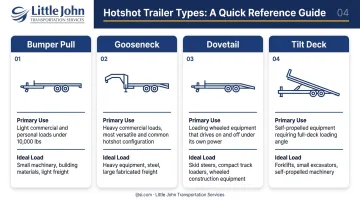
The trailer you choose determines which loads you can legally haul, what your insurance will cost, and whether you'll need a CDL. That decision deserves as much research as the truck.
Pros and Cons of Hotshot Trucking
Hotshot has genuine advantages over traditional trucking. It also has tradeoffs that newcomers regularly underestimate. Treat this section as a decision tool.
Pros of Hotshot Trucking
Lower cost of entry than Class 8 trucking. A Class 3–5 pickup and trailer combination costs significantly less than a semi-tractor setup. The 2026 Ford F-350 XL starts at $47,270 MSRP, and a Diamond C bumper-pull equipment trailer starts around $10,000. Used Class 8 trucks averaged above $61,000 in June 2026 — and that's before adding a trailer. The total capital commitment for hotshot entry is meaningfully lower.
No CDL required for most setups. When the combined Gross Combined Weight Rating stays under 26,001 lbs (with the towed unit under 10,001 lbs), federal law doesn't require a commercial driver's license. That opens hotshot to a wider pool of operators who couldn't otherwise enter commercial trucking.
Scheduling flexibility. Hotshot operators choose their loads, set their own rates, and aren't subject to forced dispatch. For owner-operators who want independence over their schedule, that autonomy is a core part of the appeal.
Consistent demand from time-sensitive industries. Oil and gas, construction, and manufacturing regularly need critical parts moved fast. Hotshot is often the most cost-effective option for urgent sub-truckload freight when a full flatbed would be overkill.
Cons and Limitations of Hotshot Trucking
Income is inconsistent. Hotshot drivers earn per mile or per load. OOIDA's 2024 owner-operator survey reports roughly 20% deadhead across the broader owner-operator population — meaning one in five miles driven earns nothing. Slow seasons, empty return legs, and load gaps cut directly into monthly income.
Hard ceilings on weight, size, and freight type. Hotshot trailers are limited by the vehicle's axle ratings, tire ratings, and bridge formula — not a single universal weight cap. Operators work within the weight their specific truck-and-trailer combination can legally carry. Beyond those limits — or for any freight requiring hazmat placards or oversized permits — hotshot simply isn't an option.
Running your own authority means running a business. Hotshot isn't a gig. Load sourcing, compliance documentation, fuel tracking, invoicing, and maintenance all land on the operator — it requires the discipline of a small business owner, not just a driver.
Licenses, Compliance, and Startup Costs
Even without a CDL, hotshot trucking is a regulated for-hire operation the moment the truck-trailer combination exceeds 10,001 lbs GVWR and crosses state lines. Skipping compliance steps risks fines, out-of-service orders, and loss of operating authority.
Federal Registrations Required
USDOT Number: Any interstate carrier operating a vehicle or combination at 10,001 lbs GVWR or more must register with FMCSA. The FMCSA's registration portal handles this through the Unified Registration System.
Motor Carrier (MC) Authority: For-hire carriers transporting property owned by others in interstate commerce need MC authority. The fee is $300 per permanent authority type, non-refundable. New applications typically take 20–25 business days to process — operators cannot legally haul for hire until authority clears.
BOC-3 Filing: A process agent must be designated in every state of operation. Third-party filing services typically charge $19–$35 for this step. It must be filed within 20 days of your authority publication date.
UCR Registration: Required annually. The 2026 fee for a 0–2 vehicle fleet is $46; 3–5 vehicles runs $138.
Insurance Requirements
FMCSA requires a minimum of $750,000 in public liability insurance for non-hazardous property carriers operating vehicles at 10,001 lbs or more. Insureon's 2025 data reports an average of $896/month ($10,757/year) for hotshot commercial auto customers. Cargo insurance is separate and adds to that total.
IFTA and ELD Considerations
IFTA applies to qualified motor vehicles — those with two axles over 26,000 lbs, three or more axles regardless of weight, or combinations over 26,000 lbs. Many hotshot setups fall below this threshold, but operators running heavier Class 5 combinations should verify.
ELD rules apply to most drivers required to keep records of duty status. A short-haul exemption covers operators who:
- Work within 150 air miles of their normal reporting location
- Return to that location each day
- Are released within 14 consecutive hours
This exemption applies to local hotshot runs — not long-distance hauls.
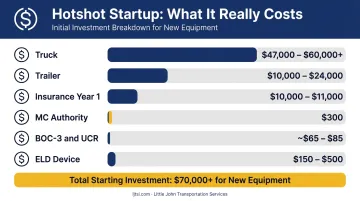
Startup Cost Summary
| Expense Category | Approximate Range |
|---|---|
| Class 3–5 pickup truck (new) | $47,000–$60,000+ |
| Gooseneck trailer | $10,000–$24,000+ |
| Commercial auto insurance (first year) | $10,000–$11,000 |
| MC authority filing | $300 |
| BOC-3 + UCR | ~$65–$85 |
| ELD device | $150–$500+ |
| Initial fuel float and gear | Variable |
DAT notes that trailer and early compliance expenses alone can reach $15,000–$30,000. Add a new truck, and total startup investment climbs well above $70,000 before hauling a single load. Used equipment reduces entry costs substantially.
How to Start a Hotshot Trucking Business – Step by Step
Many new operators launch before they've validated their route economics or figured out how to find consistent loads. Work through the steps below in order — skipping ahead is where the expensive mistakes happen.
Step 1 – Choose Equipment Based on the Loads You Plan to Haul
Before buying, define your target freight type and weight range. A bumper pull works for light local runs, but gooseneck trailers are the right long-term investment for commercial hauling. Get specific:
- What industries will you serve — oilfield, construction, agricultural?
- What's the typical load weight in your target market?
- Will your setup require a CDL (combined GVWR of 26,001+ lbs with towed unit over 10,000 lbs)?
Research new vs. used options carefully. A used F-350 in good condition may cut your entry cost significantly versus buying new. Factor financing payments, depreciation, and estimated maintenance into your per-mile cost before committing.
Step 2 – Register Your Business and Obtain Operating Authority
Work through compliance in this order:
- Register your business entity — an LLC provides liability separation between personal and business assets
- Apply for USDOT number through FMCSA's Unified Registration System
- File for MC authority ($300 fee; 20–25 business day processing window)
- File BOC-3 within 20 days of authority publication
- Complete UCR registration annually
- Register for IFTA if your combination qualifies
- Secure all insurance before hauling a single load
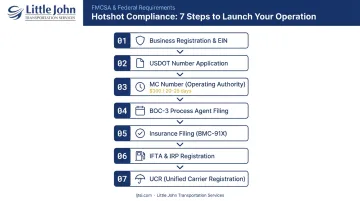
Don't launch before all compliance is in place. One incident without proper authority or coverage can end the business permanently.
Step 3 – Find Loads and Price Your Services Correctly
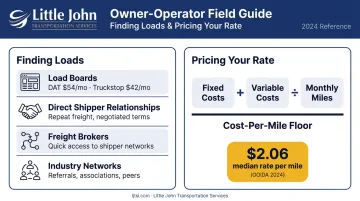
Finding loads: Most operators combine multiple channels:
- Paid load boards (DAT plans start at $54/month; Truckstop starts at $42/month)
- Direct shipper relationships built through networking in target industries
- Freight brokers, especially useful during early-stage operations
- Industry networks in oilfield and construction sectors
Pricing: Start with your cost-per-mile baseline. Add all fixed costs (insurance, authority fees, equipment payments) and variable costs (fuel, maintenance, tires) and divide by monthly miles. That number is your floor — not your asking rate.
OOIDA's 2024 data shows a $2.06 median rate per mile across owner-operators broadly. Urgent or specialized runs in oilfield and construction can push significantly higher. Price to cover costs with margin, not just to win the load.
Step 4 – Track Performance and Scale Deliberately
Establish financial tracking from day one:
- Profit and loss by load
- Fuel cost per mile
- Deadhead ratio (target well below the 20% industry average)
- Monthly net income, not just gross revenue
Scaling too early is where most hotshot businesses run into trouble. Add trucks or drivers only after you have consistent load volume, predictable margins, and established customer relationships. All three together signal the operation is ready to grow — any one of them alone isn't enough.
Frequently Asked Questions
Can I do hotshot without a CDL?
Most hotshot setups avoid CDL requirements by keeping the combined GVWR under 26,001 lbs with the towed unit under 10,001 lbs — the federal Class A threshold. Hauling placarded hazardous materials or operating a vehicle designed for 16+ occupants creates separate triggers regardless of weight. Verify your specific configuration with FMCSA and your state DMV before hauling.
How much does it cost to start a hotshot trucking business?
Core startup expenses include a Class 3–5 truck, trailer, commercial auto insurance, MC authority, and compliance fees. DAT estimates trailer and compliance costs alone at $15,000–$30,000; a new truck adds $47,000+ on top. Used equipment reduces total entry costs considerably.
How much do hotshot truckers make per mile or per year?
OOIDA's 2024 owner-operator survey reports a $2.06 median rate per mile and median gross income of $155,000 for operators running their own authority. Gross income is business revenue, not take-home pay — operating costs come straight off that figure before a dollar reaches your pocket.
What kinds of loads can a hotshot truck carry?
Common freight includes construction equipment, oilfield components (valves, drill tools), machinery, agricultural equipment, and building materials. Actual capacity depends on your truck-trailer combination's axle and tire ratings — loads requiring hazmat placards, oversized permits, or heavy-haul configurations fall outside standard hotshot scope.
What insurance do I need for hotshot trucking?
Interstate hotshot operations require a minimum of $750,000 in commercial liability insurance under 49 CFR Part 387. Cargo insurance is separate and protects the freight you're hauling. Insureon's 2025 data shows commercial auto averaging $896/month for hotshot operators — your actual premium will vary by load type, operating radius, and driving history.
Is hotshot trucking worth it in 2026?
Hotshot can be profitable for operators who manage costs carefully, price loads to cover actual expenses, and build direct shipper relationships over time. Income variability, deadheading, and the full burden of compliance make it a real business commitment. Operators who approach it as a side hustle rarely last past the first year.