Every dangerous good shipped in the U.S. must be assigned to one of nine internationally recognized hazard classes under 49 CFR, administered by PHMSA. Each class carries its own rules for packaging, labeling, placarding, documentation, and carrier qualifications. This guide breaks all nine down in plain language, so shippers and logistics teams know exactly what they're dealing with before a load moves.
Key Takeaways
- Dangerous goods include far more products than most shippers expect — any substance posing risk to people, property, or the environment during transport.
- The U.S. DOT recognizes 9 hazard classes, each requiring specific packaging, labeling, placarding, and documentation.
- Packing groups (PG I, II, III) express severity within a class — incorrect assignment is one of the most common compliance errors.
- PHMSA's 2025 civil penalty ceiling is $102,348 per violation, rising to $238,809 when severe consequences result.
- Carrier authorization varies by class — fewer than 1% of U.S. motor carriers hold the FMCSA Hazardous Materials Safety Permit required for the most restricted shipments.
What Are Dangerous Goods?
Dangerous goods — called hazardous materials or "hazmat" in the U.S. — are substances or articles that can pose a risk to people, property, or the environment during transport. The U.S. DOT, through PHMSA, governs their transport by road, rail, air, and water under 49 CFR Parts 171–180.
One common misconception: dangerous goods aren't limited to industrial chemicals or military cargo. Lithium batteries, aerosol cans, gasoline, hand sanitizer, dry ice, and certain paints all fall under hazmat regulations. If you ship any of these, classification rules apply to you — and the hazard class determines everything downstream:
- Required packaging and UN specification
- Safety marks, labels, and vehicle placards
- Shipping paper content and emergency response information
- Which carriers are legally permitted to move the load
Get the classification wrong, and every downstream requirement is wrong with it.
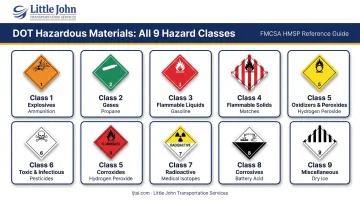
The 9 Classes of Dangerous Goods Explained
The nine classes aren't arbitrary groupings. They reflect fundamentally different hazard types, each requiring a distinct approach to containment, handling, and compliance.
At a glance, the nine classes cover:
- Class 1 — Explosives
- Class 2 — Gases (flammable, non-flammable, toxic)
- Class 3 — Flammable Liquids
- Class 4 — Flammable Solids
- Class 5 — Oxidizing Substances and Organic Peroxides
- Class 6 — Toxic and Infectious Substances
- Class 7 — Radioactive Materials
- Class 8 — Corrosives
- Class 9 — Miscellaneous Dangerous Goods
Class 1: Explosives
Class 1 covers substances or articles capable of producing an explosion, fire, or fragment projection hazard. It contains six divisions:
| Division | Hazard Type | Examples |
|---|---|---|
| 1.1 | Mass explosion hazard | Dynamite, detonators |
| 1.2 | Projection hazard, no mass explosion | Certain ammunition |
| 1.3 | Fire plus minor blast/projection | Propellant explosives |
| 1.4 | Minor effects, largely confined to package | Consumer fireworks |
| 1.5 | Very insensitive with mass-explosion potential | Ammonium nitrate blasting agents |
| 1.6 | Extremely insensitive articles | Specialized military articles |
Transport implication: Divisions 1.1, 1.2, and 1.3 require a written carrier route plan under 49 CFR Part 397. Carriers moving Arms, Ammunition & Explosives for Department of Defense traffic must hold AA&E certification through the Army's SDDC Freight Carrier Registration Program — a credential that requires an active HMSP among other qualifications.
Class 2: Gases
Class 2 covers any gas transported in compressed, liquefied, refrigerated liquefied, or dissolved form. Three divisions:
- 2.1 Flammable Gases — propane, butane, hydrogen
- 2.2 Non-Flammable/Non-Toxic Gases — nitrogen, compressed air, helium
- 2.3 Toxic Gases — chlorine, hydrogen sulfide, ammonia
Division 2.3 carries the highest handling restrictions. These gases require placarding at any quantity, which means any driver operating a placarded vehicle needs at minimum an H (hazmat) CDL endorsement — or an X endorsement when both tank and hazmat apply. Cylinder and tank certification requirements apply across all divisions.
Class 3: Flammable Liquids
Class 3 covers liquids with a flash point at or below 60°C (140°F). It's among the most frequently transported dangerous goods classes on U.S. roads, and widely misunderstood.
Common examples include gasoline, diesel, ethanol, paints, hand sanitizer, essential oils, and cleaning solvents. Many shippers don't realize their products qualify until a carrier flags the issue at tender.
Packing groups are assigned based on flash point and boiling point:
- PG I — Initial boiling point ≤35°C
- PG II — Boiling point >35°C and flash point <23°C
- PG III — Boiling point >35°C and flash point ≥23°C through 60°C
Incorrect PG assignment is one of the most common errors PHMSA enforcement actions document.
Class 4: Flammable Solids
Class 4 covers three distinct hazard types across its divisions:
- 4.1 Flammable Solids — combust through friction or heat; examples include naphthalene and safety matches
- 4.2 Spontaneously Combustible — ignite on contact with air; examples include activated carbon and white phosphorus
- 4.3 Water-Reactive (Dangerous When Wet) — emit flammable or toxic gas on contact with water; examples include sodium and calcium carbide
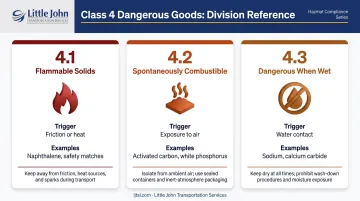
The division assignment matters operationally. Under 49 CFR Part 177, Division 4.3 materials must be protected from moisture during loading and kept dry throughout transit. This requires active coordination between shipper and carrier — not just correct labeling.
Class 5: Oxidizing Substances and Organic Peroxides
Class 5 covers substances that intensify combustion in other materials:
- 5.1 Oxidizing Substances — yield oxygen to fuel fire in other materials; examples include ammonium nitrate and hydrogen peroxide
- 5.2 Organic Peroxides — thermally unstable compounds that can decompose explosively; examples include benzoyl peroxide and peracetic acid
Segregation requirements here are non-negotiable. The 49 CFR Part 177 compatibility matrix requires Class 5.1 materials to be separated from Class 3 flammables to prevent commingling after leakage. Division 5.2 organic peroxides are temperature-sensitive and may require refrigerated transport when the Self-Accelerating Decomposition Temperature (SADT) is 50°C or below.
Class 6: Toxic and Infectious Substances
Class 6 covers materials that cause harm through exposure, split across two distinct divisions:
- 6.1 Toxic Substances — cause death or serious injury through inhalation, skin contact, or ingestion; examples include chloroform, arsenic compounds, and pesticides
- 6.2 Infectious Substances — contain or are reasonably expected to contain pathogens; examples include medical waste, clinical specimens, and virus cultures
Division 6.2 has particularly stringent packaging requirements. Category A infectious substances — those capable of causing life-threatening disease — require triple packaging meeting 49 CFR 173.196 performance tests and a UN specification mark.
Category B substances (UN3373) also require triple packaging with 1.2m drop capability, but the outer package carries the UN3373 mark rather than a UN specification designation. Carrier handling protocols must comply with both DOT and public health requirements.
Class 7: Radioactive Materials
Class 7 covers any material containing radionuclides where activity concentration and total activity exceed defined thresholds. Regulated under 49 CFR and, for licensed facilities, the NRC under 10 CFR Part 71. Examples include medical isotopes, uranium ore, X-ray equipment, and nuclear fuel elements.
Shipments are categorized by surface radiation level:
- Category I-White — surface ≤0.005 mSv/h, Transport Index of 0
- Category II-Yellow — surface ≤0.5 mSv/h, Transport Index ≤1
- Category III-Yellow — surface ≤2 mSv/h, Transport Index ≤10
Certain materials also require a Fissile label carrying a criticality safety index. Carriers must be specifically authorized, and route planning for Class 7 shipments is regulated under 49 CFR Part 397 Subpart D.
Class 8: Corrosives
Class 8 covers substances that cause irreversible tissue damage on contact with skin or mucous membranes, or that severely corrode metal containers. Common examples include sulfuric acid, hydrochloric acid, sodium hydroxide (lye), battery fluid, and industrial cleaning agents.
Packing groups are assigned based on how quickly skin destruction occurs:
- PG I — Full-thickness destruction within 3 minutes
- PG II — Destruction in more than 3 minutes up to 60 minutes
- PG III — Destruction in more than 60 minutes up to 4 hours, or metal corrosion exceeding 6.25 mm/year at 55°C
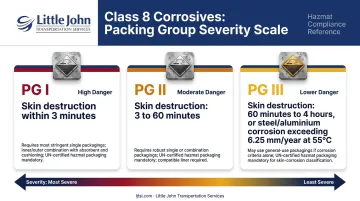
Compatibility between the corrosive and the container material is non-negotiable. Mixed-load shipments require review of the 49 CFR 177.848 segregation matrix — Class 8 liquids have specific separation requirements when loaded alongside Class 3 and Class 4.3 materials.
Class 9: Miscellaneous Dangerous Goods
Class 9 is the catch-all category for transport hazards that don't fit neatly into Classes 1–8. This includes:
- Lithium batteries (cells and packs)
- Dry ice (carbon dioxide, solid)
- Magnetized materials
- Elevated-temperature liquids
- Environmentally hazardous substances (marine pollutants)
- Battery-powered vehicles
Lithium batteries deserve specific attention. For highway transport, small-cell exceptions under 49 CFR 173.185(c) cap lithium-metal batteries at 1g per cell and 2g per battery; lithium-ion cells at 20 Wh per cell and 100 Wh per battery. Standalone small-battery packages generally require a strong rigid outer packaging, the lithium battery mark, and a 30 kg gross-mass cap. One important clarification: the 30% state-of-charge limit that often gets cited for lithium batteries is an aircraft-only requirement under 49 CFR — it does not apply to highway transport.
What Dangerous Goods Classification Means for Shippers
Classification is the foundational decision in hazmat shipping. Get it wrong, and every requirement that follows — packaging, labeling, shipping papers, driver training — is built on a faulty premise.
How Packing Groups Work
Packing groups apply to Classes 3, 4, 5, 6, 8, and select Class 9 entries. They do not apply to Classes 1, 2, or 7, or to Divisions 5.2 and 6.2.
- PG I — High danger; strictest packaging requirements
- PG II — Moderate danger
- PG III — Minor danger; least restrictive packaging
Incorrect packing group assignment is one of the compliance errors PHMSA enforcement cases document. In 2022, PHMSA assessed $10,350 against one shipper for violations that included misclassification, improper packaging, and missing labels — all stemming from a single classification error that propagated through every other requirement.
The Consignor's Responsibility
Under 49 CFR 173.22, the person offering hazmat for transport bears primary responsibility for correct classification, description, packaging, marking, and labeling. The carrier does not absorb that liability.
The 2025 civil penalty ceiling sits at $102,348 per violation, rising to $238,809 when specified severe consequences result. Those figures are per violation. A misclassification that generates errors in packaging, labeling, shipping papers, and driver training can multiply quickly.
Dual-Hazard Shipments
Some goods carry hazards across more than one class (a flammable liquid that is also corrosive, for example). These require secondary hazard labeling, and both classes must be declared on shipping documents. Before tendering a mixed-class load, shippers must also verify the 49 CFR Part 177 segregation matrix to confirm the goods can legally travel together.
Choosing a Carrier Qualified for Hazardous Materials Transport
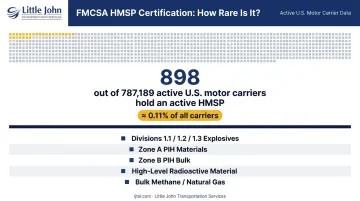
Not every motor carrier is authorized to haul every class of dangerous goods. The FMCSA requires carriers to hold a Hazardous Materials Safety Permit (HMSP) for certain high-hazard shipments, including:
- More than 25 kg net of Divisions 1.1, 1.2, or 1.3 explosives
- Poison-inhalation-hazard Zone A materials exceeding 1 liter per package
- Zone B PIH in bulk packaging of at least 3,500 gallons
- High-level radioactive material quantities (HRCQ)
- Methane/natural gas in bulk packaging of at least 3,500 gallons
According to FMCSA's 2024 Pocket Guide, only 898 carriers out of 787,189 active motor carriers held an active HMSP in 2023 — roughly 0.11%.
What to Verify Before Awarding a Hazmat Load
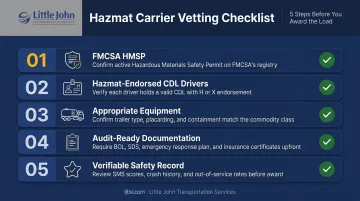
Before tendering dangerous goods to any carrier, confirm:
- FMCSA HMSP — required for the specific shipment type and quantity
- Hazmat-endorsed CDL drivers — H or X endorsement as applicable
- Appropriate equipment — tankers for bulk liquids, temperature-controlled trailers for certain Class 5.2 and Class 6 materials, UN-certified packaging compatibility
- Audit-ready documentation practices — shipping papers, emergency response information, and placarding verification
- Verifiable safety record — FMCSA carrier snapshot, inspection history, out-of-service rate
Few carriers can check every box on that list. Little John Transportation Services holds an active FMCSA HMSP, AA&E certification for arms, ammunition, and explosives, and operates with 8,500+ hazmat-endorsed, TWIC-certified owner-operators across the Landstar network. DOT crash frequency runs near half the national average, with a 99.9% claim-free delivery rate.
Cross-Border Dangerous Goods: U.S.–Mexico
Cross-border hazmat adds another layer. U.S.–Mexico dangerous goods shipments involve parallel regulatory compliance: U.S. DOT 49 CFR on the American side and Mexico's SICT framework (including NOM-002-SCT-SEMAR-ARTF/2023) on the Mexican side. These are separate regulatory regimes, not one unified rulebook.
Carriers operating in this corridor need bilingual documentation capability, active cross-border permits, CTPAT validation, and customs expertise on both sides. Little John's 50-acre CTPAT-validated Laredo facility handles exactly this — with a 120-ton bridge crane for hazmat transloading and in-house customs brokerage operating on both sides of the border.
Frequently Asked Questions
What are the different classes of dangerous goods in transport?
There are 9 internationally recognized hazard classes, established by the UN and adopted by the U.S. DOT under 49 CFR. They range from Class 1 Explosives to Class 9 Miscellaneous Dangerous Goods, each defined by the substance's primary hazard type during transport.
What is Class 3 freight?
Class 3 covers flammable liquids with a flash point at or below 60°C (140°F), including gasoline, diesel, ethanol, paints, and solvents. It's one of the most frequently shipped dangerous goods classes in road transport and affects more shippers than they typically expect.
What are Class 7 dangerous goods?
Class 7 covers radioactive materials — substances containing radionuclides above defined activity thresholds. Shipments are categorized by surface radiation level (Category I-White, II-Yellow, or III-Yellow), and carriers must hold specific authorization to handle them.
Can dangerous goods from different classes be shipped together?
Mixed-class shipments are permitted under DOT regulations but subject to strict segregation rules. Certain classes cannot be loaded together due to incompatible hazards. Shippers must consult the 49 CFR Part 177 compatibility table before combining loads.
What certifications does a carrier need to transport hazardous materials?
Carriers must have hazmat-endorsed CDL drivers (H or X endorsement) at a baseline. High-hazard loads additionally require an FMCSA Hazardous Materials Safety Permit, held by fewer than 1% of carriers. Other credentials, including TWIC cards for port-adjacent moves and AA&E certification for explosives, vary by class and shipment quantity.
What happens if dangerous goods are misclassified during transport?
PHMSA can assess civil penalties of up to $102,348 per violation (or $238,809 for severe consequences), plus shipment rejection and carrier liability exposure. Under 49 CFR 173.22, the consignor holds primary responsibility for correct classification, not the carrier.