Many companies treat CTPAT certification as a regulatory checkbox. That's the wrong frame. With more than 11,400 certified partners accounting for over 52% of U.S. cargo imports by value, CTPAT membership signals supply chain credibility to every partner, customer, and regulator in your network.
The challenge is that the certification process is genuinely demanding. The Minimum Security Criteria cover 12 categories. The 2022 forced labor requirements added new mandatory obligations. And many companies don't know where the gaps in their current operations actually are.
This guide covers what CTPAT is, who qualifies, the 12 security criteria, the step-by-step process, key benefits, and how to stay certified once you've earned it.
Key Takeaways
- 11,400+ certified partners represent more than 52% of U.S. cargo imports by value — certification carries real market weight
- Minimum Security Criteria span 12 categories across four domains: Corporate, People, Physical, and Transportation Security
- The 2022 forced labor mandate added six audited requirements to CTPAT Trade Compliance — compliance is verified, not assumed
- The application averages 20 hours to complete; CBP issues a decision within up to 90 days
- Certified status requires an annual Security Profile review and full revalidation every four years
What Is CTPAT?
CTPAT — Customs-Trade Partnership Against Terrorism — is a voluntary supply chain security program run by U.S. Customs and Border Protection (CBP). It launched in November 2001, in the months after the September 11 attacks, on a straightforward premise: private-sector partners with strong security practices represent lower risk and should be treated accordingly, with faster clearance and fewer inspections at the border.
Participation is free. CBP assigns each applicant a Supply Chain Security Specialist (SCSS) who reviews the security profile and coordinates validation. Approval doesn't end the relationship — CBP conducts ongoing review cycles to confirm that practices stay current.
That review process is built around a three-tier structure, where each level reflects how thoroughly CBP has verified a member's security practices.
The Three-Tier Structure
| Tier | Status | What It Means |
|---|---|---|
| Tier I | Certified | Meets Minimum Security Criteria; accepted by CBP |
| Tier II | Validated | CBP conducted on-site review; practices match policies |
| Tier III | Exceeds | Sustained security measures above Tier II standards |
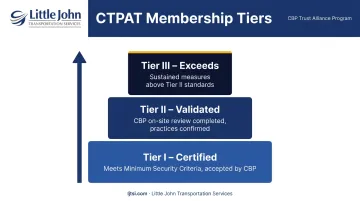
Most companies enter at Tier I and advance to Tier II after CBP's on-site validation.
Who Qualifies for CTPAT Certification?
CTPAT is open to a broad range of entities across the international supply chain, as defined under 6 USC § 963:
- U.S. importers and exporters
- U.S./Canada and U.S./Mexico highway carriers
- Rail, sea, and air carriers
- Licensed U.S. customs brokers
- Freight forwarders and ocean transportation intermediaries (NVOCCs)
- Warehouse operators and marine port authority/terminal operators
- Mexican and Canadian manufacturers
- Mexican long-haul carriers
- Third-party logistics providers (3PLs), subject to eligibility parameters
Core Eligibility Conditions
CBP evaluates each applicant individually, but common requirements across entity types include:
- Active status in the relevant business with required licenses or identifiers
- No significant security-related events in the company's history
- A completed security profile in the CTPAT Portal with a designated security contact
- Commitment to maintain entity-specific Minimum Security Criteria on an ongoing basis
Eligibility varies by entity type — an importer's requirements differ from a highway carrier's, which is why each entity type has its own MSC workbook.
The Carrier Partnership Advantage
For shippers and importers moving freight through the U.S.-Mexico corridor, working with a CTPAT-validated carrier extends supply chain security credibility to every load — even before a shipper completes their own certification.
Little John Transportation Services is a CTPAT-validated, FAST-certified carrier operating a 50-acre cross-border facility in Laredo, TX. The facility is built to CBP's physical security standards:
- Restricted perimeter access with controlled entry points
- Full-coverage video surveillance
- 24/7 monitored entrances
- In-house U.S. and Mexican customs brokerage
For a shipper building their CTPAT application, partnering with a carrier that has already passed CBP's on-site validation strengthens a shipper's security profile in ways CBP evaluates directly.
CTPAT Minimum Security Requirements: The 12 Criteria
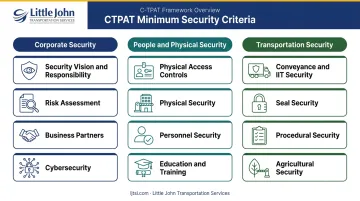
CBP's Minimum Security Criteria, finalized in May 2019, are organized into 12 categories across three focus areas. Each criterion is labeled "must" (mandatory) or "should" (recommended) depending on risk level.
| Focus Area | MSC Categories |
|---|---|
| Corporate Security | Security Vision & Responsibility; Risk Assessment; Business Partners; Cybersecurity |
| People & Physical Security | Physical Access Controls; Physical Security; Personnel Security; Education, Training & Awareness |
| Transportation Security | Conveyance & IIT Security; Seal Security; Procedural Security; Agricultural Security |
Corporate Security Requirements
Companies must maintain documented security policies and conduct formal risk assessments at least annually — more frequently for complex or higher-risk supply chains. Supply chain partners must be mapped by location and compliance history, and a code of conduct for suppliers must be in place.
The most common audit failure is the gap between what policies say and what operations actually do. CBP auditors compare documented procedures against observed practices, not just against each other.
Cybersecurity became a standalone MSC category in the 2019 update. CBP's Cyber Essentials framework requires written IT security policies, individual user authentication, access restrictions for sensitive data, and protection from unauthorized access. Physical and digital security are treated as inseparable requirements.
People and Physical Security Requirements
Personnel screening goes beyond a standard criminal background check. CBP expects vetting that considers financial instability and connections to high-risk jurisdictions for anyone with cargo access. Access must be revoked immediately when employees depart, and training records must be maintained and available for CBP review.
Physical security requirements include:
- Perimeter fencing around cargo and facility areas
- Surveillance cameras with adequate resolution and storage capacity
- Controlled entry points with access logs
- Security lighting at all access areas
- Tamper-evident container seals meeting or exceeding the ISO 17712 standard on all shipments
CBP physically inspects these systems during validation. Written policies alone won't pass.
Forced Labor Prevention: The 2022 Mandate
In August 2022, CBP added mandatory forced labor requirements to CTPAT Trade Compliance, effective for existing Trade Compliance partners on August 1, 2023. Six requirements apply to importers in the Trade Compliance program:
- Risk-Based Business Mapping — identify risk points throughout the supply chain
- Code of Conduct — documented supplier standards addressing forced labor
- Evidence of Implementation — proof that the code is actively enforced
- Due Diligence and Training — documented training for relevant personnel
- Remediation Plan — a written plan for addressing violations if discovered
- Shared Best Practices and Path Forward — ongoing engagement with CBP on improvement
These requirements are tied to UFLPA (Uyghur Forced Labor Prevention Act) enforcement. CTPAT Trade Compliance members whose shipments face a UFLPA hold receive preliminary notification and Front-of-the-Line Admissibility Review — advantages that non-certified importers do not have.
The CTPAT Certification Process, Step by Step
Step 1: Review Eligibility and MSC Workbooks
Before submitting anything, review the MSC workbook specific to your entity type. Importers, carriers, brokers, and freight forwarders each have different workbooks with different requirements. A gap assessment against your current operations should drive resource allocation before the application is opened.
Step 2: Conduct a Formal Supply Chain Risk Assessment
A completed risk assessment is required before the application and must be repeated at least annually thereafter. CBP's five-step process covers:
- Map cargo and data flows, including supply chain partners
- Assess and rank threats (terrorism, contraband, human trafficking)
- Conduct a vulnerability assessment against MSC requirements
- Build a written action plan to address identified weaknesses
- Document how the assessment process itself is conducted
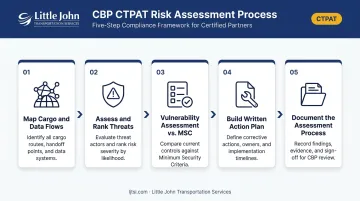
For complex international supply chains, third-party CTPAT auditors can help complete this assessment before you open the application.
Step 3: Apply Through the CTPAT Security Portal
The application is submitted through CBP's online CTPAT Security Portal and includes:
- A Company Profile and Security Profile
- Completed security protocol documentation
- A signed agreement to voluntarily participate (the binding commitment to CBP's terms)
CBP's federal burden estimate for completing the application is 20 hours, a practical baseline for scheduling internal resources.
Step 4: CBP Review and Decision
After submission, CBP reviews the materials and issues a decision within up to 90 days. Possible outcomes:
- Acceptance — advances to Tier I Certified status
- Suspension — company receives a window to respond with corrections
- Denial — company may address deficiencies and resubmit
Step 5: On-Site Validation and Ongoing Maintenance
Acceptance moves the company to Tier I (Certified) status. CBP then conducts an on-site validation, typically within one year, where security practices are confirmed against documented policies.
Companies that pass advance to Tier II (Validated) status. To avoid delays at this stage, ensure that written procedures, training records, and access control logs are current and match what was submitted in the application.
Key Benefits of CTPAT Certification
Operational Benefits at the Border
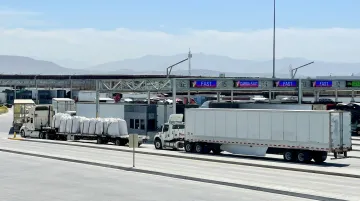
CTPAT-certified shipments receive fewer examinations at U.S. ports of entry and front-of-line inspection treatment compared to non-certified cargo. Specific access includes:
- FAST lanes at U.S.-Canada and U.S.-Mexico land borders, including high-volume crossings like Laredo, TX — meaningful for any company moving regular cross-border volume
- AQUA (Advanced Qualified Unlading Approval) for eligible CTPAT sea carriers, enabling faster vessel unloading
- Priority processing that reduces dwell time and unpredictable inspection delays
Global Trade Advantages
As of July 2025, CBP has 19 Mutual Recognition Arrangements covering 45 countries — including the EU, Canada, Mexico, Japan, South Korea, India, and Brazil. CTPAT certification translates into trusted trader status in these markets, reducing inspections at foreign ports as well.
Additional benefits include:
- Eligibility for CBP's Importer Self-Assessment Program
- Priority business resumption following disasters or security incidents
- Access to the CTPAT Resource Library and network of certified partners
- Competitive credibility when qualifying for contracts with large enterprise customers
Forced Labor Compliance Protections
CTPAT Trade Compliance members get enforcement advantages that matter when a UFLPA hold hits. These protections — unavailable to non-certified importers — directly affect how quickly detained cargo moves through CBP review:
- Preliminary notification before a shipment is formally detained under UFLPA
- Front-of-the-Line Admissibility Review, placing your detained shipment ahead of standard enforcement queue
- A Redelivery Hold option that lets goods remain at your facility instead of a CBP-controlled location during review
Without certification, importers enter the enforcement queue with no priority status and no advance notice — meaning longer detention timelines and less control over where cargo sits while CBP reviews the case.
Maintaining CTPAT Compliance After Certification
Three Ongoing Obligations
| Obligation | Timing | Scope |
|---|---|---|
| Security Profile Review | Annual, due on certification anniversary | Confirm no material operational changes |
| Revalidation | Every four years | CBP reviews actual security practices against MSC |
| Change Reporting | Promptly upon material changes | Mergers, ownership transfers, major supply chain partner shifts |
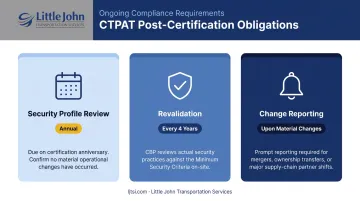
Note: The Annual Notification Letter (ANL) is specific to the CTPAT Trade Compliance program. Security-program members maintain their compliance through the annual Security Profile review.
What Internal Compliance Looks Like in Practice
Effective internal compliance means identifying problems before CBP does. An audit-ready routine includes:
- Auditing security operations at least annually (every six months for complex supply chains)
- Testing whether documented procedures actually function as written
- Verifying background checks are current for all personnel with cargo access
- Confirming surveillance systems record continuously with no coverage gaps
- Maintaining complete, current incident logs
These steps matter because CBP auditors look for patterns. A recurring problem without documented remediation signals systemic negligence, not an isolated incident. Companies that document problems and show corrective action consistently fare better in revalidation than those with clean records that can't demonstrate how they maintain them.
For shippers pursuing or maintaining their own CTPAT certification, the carriers in their supply chain affect their standing. Little John Transportation Services is CTPAT-validated, operating a 50-acre compliant facility in Laredo with bonded cargo handling, in-house customs brokerage, and background-verified operators — the kind of documented infrastructure CBP reviews during revalidation.
Frequently Asked Questions
What are the requirements for CTPAT?
CTPAT requires meeting Minimum Security Criteria across 12 categories — Corporate Security, People Security, Physical Security, and Transportation Security — plus completing a supply chain risk assessment and submitting a security profile via CBP's portal. Trade Compliance participants must also meet the 2022 forced labor prevention requirements, including supply chain mapping and a remediation plan.
Who needs CTPAT certification?
CTPAT is voluntary and open to any entity in the international supply chain — importers, exporters, brokers, freight forwarders, carriers, warehouse operators, manufacturers, and 3PLs. Companies that regularly move cargo across U.S. borders benefit most through reduced inspections and FAST lane access.
How long does the CTPAT certification process take?
The application carries a federal burden estimate of 20 hours to complete. CBP issues an acceptance, suspension, or denial within up to 90 days of submission. CBP typically conducts an on-site validation within one year of acceptance to reach Tier II (Validated) status.
What is the difference between CTPAT certified and CTPAT validated?
Tier I (Certified) means CBP accepted the application and confirmed the company meets the Minimum Security Criteria on paper. Tier II (Validated) means CBP conducted an on-site review and confirmed that actual security practices match documented policies. Validated status delivers stronger trusted trader standing and greater operational benefits.
How often does CTPAT certification need to be renewed?
Security-program members complete an annual Security Profile review due on their certification anniversary date. Full revalidation occurs every four years. Material changes — including mergers, ownership transfers, or significant supply chain partner shifts — should be reported to CBP promptly through the portal or via the assigned SCSS.
What happens if CTPAT certification is suspended or revoked?
A Security suspension gives you 30 days to submit a written appeal, with a further 90-day window to appeal a Commissioner's adverse decision to the Secretary; Trade Compliance suspensions allow 60 days to respond. Common triggers include unmet MSC requirements, missed reporting deadlines, or significant unreported organizational changes.