But intermodal isn't the right answer for every shipment. Understanding how it works, where it fits, and — just as importantly — where it breaks down is what separates shippers who use it strategically from those who either avoid it entirely or apply it to freight it can't handle.
This article covers what intermodal shipping is, how the process works step by step, the key differences between domestic and international containers, the real benefits (and real limitations), and how to determine whether it belongs in your freight strategy.
Key Takeaways
- Intermodal moves freight via two or more modes — typically truck for pickup/delivery and rail for the long haul — without unloading cargo between transfers
- U.S. railroads originated 12.7 million intermodal units in 2023, representing roughly 25% of major railroad revenue
- Rail is three to four times more fuel-efficient than truck and can reduce greenhouse gas emissions by up to 75%
- Best-fit lanes exceed 500 miles, involve non-time-critical dry goods, and sit near a rail ramp
- Oversized loads, Class 1 explosives, AA&E cargo, and time-sensitive freight fall outside intermodal — these require specialized OTR carriers
What Is Intermodal Shipping?
IANA defines intermodal as "the movement of cargo in shipping containers or trailers by more than one mode of transportation." The cargo stays in the same container throughout — only the mode underneath it changes.
In practice, this means a truck picks up a loaded container at the shipper's facility, delivers it to a rail ramp, and rail handles the long-haul portion. A second truck completes final delivery at the destination. The freight itself is never touched between transfers.
How Intermodal Differs from OTR Truckload
In standard over-the-road (OTR) shipping, one truck handles the entire journey. Intermodal splits that journey: truck handles the first and last mile, rail handles everything in between. Rail costs less per mile than truck on long distances, but adds terminal handling time at each end — a trade-off that works in the shipper's favor once distances exceed roughly 500 miles.
That trade-off has driven consistent adoption. U.S. railroads originated 12.7 million intermodal units in 2023, and total intermodal volume grew 8.5% in 2024, with domestic containers up 6.5% and international containers up 9.6% in Q4 alone.
Two Categories Shippers Encounter
Most shippers work with one of two structures:
- Domestic intermodal — freight moving within North America, typically in 53-foot containers on rail between U.S., Canadian, and Mexican distribution points
- International intermodal — ocean freight using ISO containers (20-foot, 40-foot) that arrive at U.S. ports and transfer to rail or truck for inland delivery
The Role of Intermodal Marketing Companies (IMCs)
Most shippers don't contract directly with Class I railroads. Instead, they work through Intermodal Marketing Companies (IMCs) — intermediaries that purchase rail and drayage capacity from multiple sources and provide a single freight bill. IMCs make intermodal accessible by handling what would otherwise require multiple separate relationships. In practice, that means shippers get:
- A single freight bill covering rail and drayage
- Access to rail capacity without direct railroad contracts
- Container sourcing and chassis coordination managed on their behalf
How Intermodal Shipping Works: Step by Step
Step 1 — Pickup and Drayage
A truck picks up the loaded container from the shipper's facility and hauls it to the nearest intermodal rail ramp. This short-haul truck move is called drayage. Proximity matters: facilities within 100–150 miles of a ramp keep drayage costs manageable. Beyond that range, the economics start to erode the rail savings.
Step 2 — Rail Transfer and Long-Haul Movement
At the ramp, lift equipment (typically a rubber-tired gantry crane) removes the container from the truck chassis and places it onto a well car for rail movement. Well cars have a depression between their wheel assemblies, allowing containers to sit lower to the rails. That design enables double-stacking while keeping the center of gravity manageable — the primary reason rail achieves its fuel efficiency advantage over truck.
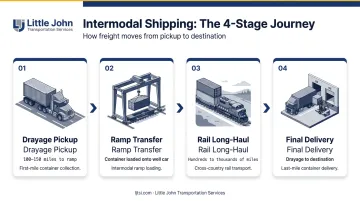
The rail leg typically covers hundreds to thousands of miles. This long-haul stretch is where intermodal generates its cost advantage.
Step 3 — Destination Ramp and Final Delivery
At the destination ramp, once the long-haul leg is complete, the process reverses: lift equipment places the container back on a truck chassis, and a drayage carrier completes delivery to the warehouse, distribution center, or retail location.
Step 4 — Visibility and Tracking
Intermodal once had a reputation for poor shipment visibility. That's no longer accurate. BNSF's customer APIs provide automated tracing every 15 minutes, exposing container availability, storage location, and driver pickup information in real time. Union Pacific recently introduced GPS tracking across its entire 53-foot domestic container fleet — described as the largest GPS-enabled, rail-owned container fleet in North America — providing real-time location, load/empty status, geofencing, and API connectivity.
Shippers who dismissed intermodal over visibility concerns a decade ago are working with a different system today.
Domestic vs. International Intermodal Containers
Domestic Intermodal Containers
53-foot containers are the North American standard. They hold approximately 26 pallets, mirror full truckload capacity, and are built for U.S., Canada, and Mexico rail-truck moves. These containers are owned by railroads or asset-based IMCs — shippers don't need to source or own equipment.
International Intermodal Containers (ISO Containers)
20-foot and 40-foot ISO containers are the global ocean freight standard, governed by ISO 668:2020. They arrive at U.S. ports and can be repositioned inland via rail or truck. Steamship lines actively seek backhaul opportunities for these boxes — particularly westbound repositioning to West Coast ports — which sometimes creates competitive pricing for shippers moving freight in that direction.
Key Practical Differences
The two container types serve different networks, carry different ownership structures, and come with different operational considerations. Here's how they stack up:
| Factor | Domestic (53') | International (20'/40') |
|---|---|---|
| Primary use | U.S./Canada/Mexico rail moves | Ocean + inland repositioning |
| Pallet capacity | ~26 pallets | ~10–22 pallets (size-dependent) |
| Equipment ownership | Railroad or IMC | Steamship line |
| Pricing driver | Rail market rates | Import/export cycles |
| Chassis complexity | Lower | Higher (multiple IEPs involved) |
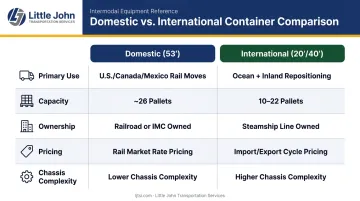
Chassis sourcing for international containers involves more complexity. IANA's Global Intermodal Equipment Registry tracks over 750,000 chassis across more than 100 Intermodal Equipment Providers. Coordinating the right chassis for an international box adds a layer of planning that domestic moves simply don't require.
Key Benefits of Intermodal Shipping
Cost Savings on Long-Haul Lanes
Rail has higher fixed costs but significantly lower variable costs than trucking. That cost structure only delivers savings after sufficient distance — the rail and drayage overhead needs enough lane length to pay off. On lanes where intermodal is viable, the fuel efficiency advantage is substantial: freight rail moves one ton of freight nearly 500 miles per gallon of fuel and is three to four times more fuel-efficient than trucks.
Shippers should run a total-cost comparison on specific lanes — including drayage both ends, any accessorial charges, and the inventory carrying cost of extended transit — rather than assuming a fixed savings percentage.
Sustainability and Carbon Footprint Reduction
Moving freight by rail instead of truck lowers greenhouse gas emissions by up to 75%. For shippers with ESG commitments or Scope 3 emissions targets, converting long-haul truckload moves to intermodal is one of the highest-impact changes available in ground transportation. The EPA SmartWay program tracks and certifies these reductions for shippers needing documented sustainability reporting.
Capacity Access Without Capital Investment
Shippers access the scale of the North American rail network without owning tracks, containers, or terminal infrastructure. Trucks handle origin and destination, while the IMC managing the rail relationship coordinates everything in between — giving shippers broad network reach without the capital exposure.
Service Consistency
Well-managed intermodal delivers predictable transit windows — and that consistency has real operational value:
- Staffing loading docks more efficiently around reliable arrival windows
- Aligning inventory replenishment cycles to reduce carrying costs
- Reducing the cost impact of late or variable arrivals
For freight that isn't time-critical, that consistency often offsets the one-to-two-day transit differential versus OTR.
Cross-Border Applications
Intermodal plays a growing role in U.S.–Mexico trade lanes, where containers can move on rail across the border and connect to distribution networks on both sides. For shippers sourcing from or distributing into Mexico, this adds a cost-effective mode option alongside direct truck movements.
Who Should Use Intermodal — And Who Shouldn't
Ideal Intermodal Candidates
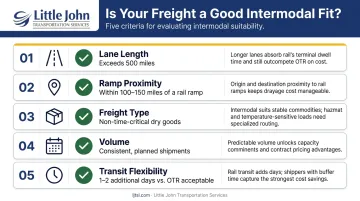
Intermodal works best when several conditions align:
- Lane length exceeds 500 miles — enough distance for rail's lower variable cost to overcome terminal handling overhead
- Origin and destination are within 100–150 miles of a rail ramp
- Freight is non-time-critical — typically dry goods on a planned replenishment cycle
- Volume is consistent — irregular or sporadic freight is harder to optimize
- Transit flexibility exists — typically one to two additional days versus OTR, depending on the specific lane
When Intermodal Is Not the Right Fit
Not every freight problem has an intermodal solution. Intermodal doesn't work for:
- Short lanes under 300 miles — the economics simply don't work
- Time-sensitive shipments requiring guaranteed next-day delivery
- Oversized or heavy-haul cargo that exceeds container dimensions or weight limits
- Certain hazardous materials that rail networks restrict or refuse — including Class 1 explosives, AA&E commodities, and TPS-restricted government freight
- Freight requiring specialized handling, temperature control beyond dry-van, or complex compliance documentation
That gap requires a different kind of carrier. Little John Transportation Services moves heavy-haul loads up to 160,000 lbs, all nine hazmat classes including AA&E and TPS-restricted materials, and cross-border freight between the U.S. and México. As one of fewer than 1% of U.S. carriers holding an FMCSA Hazardous Materials Safety Permit (HMSP), Little John handles the specific freight categories that intermodal networks are structurally prohibited from carrying.
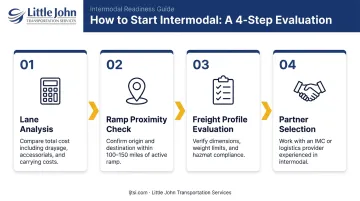
How to Get Started with Intermodal Shipping
Run a lane analysis. Pull your highest-volume, longest-haul lanes and calculate the full cost of intermodal on each — rail rate, drayage at both ends, accessorials, and the carrying cost of any additional transit days. An intermodal savings calculator is a useful starting point, but total-cost analysis beats rate-per-mile comparisons.
Check ramp proximity. Confirm your origin and destination facilities are within 100–150 miles of an active intermodal ramp. If one end is too far out, drayage cost erodes the savings.
Evaluate your freight profile. Confirm your cargo fits standard 53-foot containers, meets weight limits, and has no hazmat or dimensional restrictions that would disqualify it from standard intermodal networks.
Work with a freight partner who knows intermodal. An IMC or logistics provider with real intermodal experience can evaluate your lanes, weight profile, ramp proximity, and cross-border requirements — and manage the transition without disrupting your supply chain. The mode recommendation should come from someone who understands your freight, not whoever has the easiest booking.
Not every load belongs on rail. If your freight involves heavy-haul, regulated hazmat, or cross-border moves into México that intermodal can't accommodate, Little John Transportation Services handles intermodal and drayage alongside specialized OTR and cross-border operations — so the right mode gets matched to the right freight, every time.
Frequently Asked Questions
What is an intermodal shipping container?
An intermodal shipping container is a standardized steel box built to move freight across multiple transportation modes (ship, rail, and truck) without unloading cargo between transfers. The most common sizes are 20-foot and 40-foot ISO containers for ocean freight and 53-foot domestic containers for North American rail-truck moves. ISO 668:2020 ensures dimensional compatibility across global transport systems.
How much does an intermodal shipping container cost?
Most shippers pay a freight rate for use of a container on a specific lane rather than purchasing equipment outright. Rates vary by lane, equipment type, and market conditions. For current pricing, get a quote directly from a freight carrier or intermodal provider.
How much does a 40-foot intermodal shipping container weigh?
An empty standard 40-foot container has a tare weight of approximately 8,160 lbs, per Maersk's published equipment specifications. The maximum gross weight (container plus cargo) is typically 67,200 lbs per ISO standards. U.S. highway weight limits cap gross vehicle weight at 80,000 lbs including tractor and chassis, which constrains the practical cargo payload below the ISO maximum.
What is the difference between intermodal and truckload shipping?
Truckload (OTR) uses a single truck for the entire journey. Intermodal splits the haul between truck for pickup and delivery and rail or ocean vessel for the long-haul leg. The tradeoff is lower cost per mile on longer lanes against one to two additional days of transit time from ramp handling at each end.
How long does intermodal shipping take compared to truckload?
Intermodal transit runs one to two days slower than OTR on comparable lanes, depending on ramp handling time, train schedules, and drayage distance. On longer lanes, the service is consistent and predictable enough that many shippers find the time difference manageable when planning inventory replenishment.
What types of freight cannot be shipped intermodally?
Standard intermodal networks cannot accommodate: oversized or heavy-haul cargo exceeding container dimensions or weight limits; certain hazardous materials including Class 1 explosives, AA&E commodities, and TPS-restricted freight; time-critical shipments requiring guaranteed same-day or next-day delivery; and cargo requiring temperature or handling conditions beyond a standard dry-van container.