Logistics managers in energy, construction, industrial machinery, and automotive sectors deal with OD freight regularly — and many still underestimate what it actually takes to move a large, indivisible load legally and safely. Misreading permit requirements, booking the wrong trailer, or skipping route engineering doesn't just cause delays. It creates permit violations, infrastructure liability, and in some cases, impounded loads.
This guide covers what qualifies as OD freight, why it demands specialized handling, how the shipping process works from start to finish, what regulations apply across state lines and into Mexico, and which misconceptions cause the most damage.
Key Takeaways
- OD freight exceeds legal limits for width, height, length, or gross weight — and requires permits, specialized equipment, and route planning.
- Oversize and overweight are separate classifications with separate permit requirements; both can apply simultaneously.
- Permits must be obtained from every state the load passes through — no single federal permit exists.
- Moving an OD load follows a strict sequence — from cargo assessment and equipment selection through route engineering, permitting, escort coordination, and transit execution.
- Cross-border OD moves into Mexico require separate authorization under Mexico's federal permit system (NOM-040 / SCT regulations).
What Is Over Dimensional Freight?
Over dimensional freight is any commercial shipment exceeding the standard legal dimensions or weight limits established by the U.S. Federal Highway Administration (FHWA) and applicable state agencies.
The federal baselines to know:
| Dimension | Federal Threshold |
|---|---|
| Width | 102 inches (8 ft 6 in) on the National Network |
| Height | No federal maximum — states set limits, commonly 13 ft 6 in to 14 ft |
| Length | No single federal overall maximum for tractor-semitrailers; states must allow at least a 48-ft semitrailer |
| Gross Weight | 80,000 lb on the Interstate System; 20,000 lb single axle; 34,000 lb tandem axle |
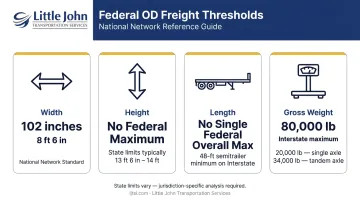
These numbers don't form one clean OD threshold — height and length rules vary state by state, which is why every OD move requires jurisdiction-specific analysis rather than a single federal checklist. That state-by-state variation also means the oversize/overweight distinction matters more than most shippers expect — and the two terms are not interchangeable.
Oversize vs. Overweight: Two Different Compliance Problems
- Oversize means the load exceeds dimensional limits — width, height, or length.
- Overweight means the load exceeds gross or axle weight limits.
A shipment can trigger one classification, both simultaneously, or neither. Each classification carries its own permit requirements and travel restrictions. Treating them as the same thing is one of the most common compliance failures in OD freight.
The Nondivisible Requirement
Most states only issue OD permits for loads that cannot reasonably be broken down into smaller pieces that would comply with standard limits. The FHWA defines a nondivisible load as one that would exceed applicable limits and, if separated, would either compromise its intended use, destroy its value, or require more than 8 work hours to dismantle.
A wind turbine nacelle qualifies. A pile of steel beams generally does not — that's a divisible load, and most states won't issue an oversize permit for it.
Why Over Dimensional Freight Requires Specialized Handling
An OD load placed on the wrong trailer, routed through the wrong corridor, or moved without proper permits creates real consequences — for infrastructure, other motorists, and the shipper's bottom line.
Infrastructure Risk Is Documented and Serious
NHTSA reports approximately 850 deaths and nearly 19,000 injuries annually in crashes involving unsecured loads. For OD-specific incidents, the consequences extend well beyond the vehicle itself.
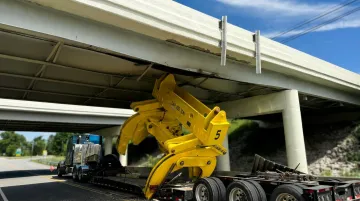
In May 2013, the I-5 Skagit River Bridge in Washington collapsed after an oversize combination vehicle — with a load listed at 15 ft 9 in high — struck the bridge's overhead load-bearing structure. The NTSB investigation cited deficient route planning and pilot car communication failures as contributing factors. One span collapsed into the river.
The scale of the problem extends well beyond a single corridor. PennDOT reported in 2025 that vehicles exceeding height requirements had struck more than 600 bridges or overhead structures in Pennsylvania over the preceding ten years.
Regulatory Complexity at Every State Line
There is no single nationwide OD permit. Every state the load passes through may impose:
- Different permit requirements and fees
- Daylight-only or weekday-only travel restrictions
- Speed limits specific to the load
- Escort vehicle mandates based on load dimensions
- Superload engineering reviews for loads well above standard OD thresholds
Compliance is jurisdiction by jurisdiction. A permit valid in Texas does not authorize travel in Arkansas.
The Planning Burden Before the Truck Moves
Standard freight operations don't account for what OD moves require before departure:
- Route surveys for high-risk corridors
- Bridge weight capacity checks
- Axle weight distribution calculations
- Utility coordination (overhead power lines, etc.)
- Police escort authorization in some states
Skipping or rushing any of these steps can invalidate permits, trigger liability exposure, or result in the kind of structural incident that shuts down a route for days.
How the OD Freight Shipping Process Works
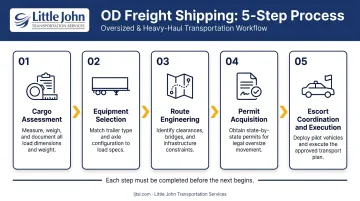
OD freight moves through a structured, sequential process. Each stage must be completed correctly before the next begins.
Step 1: Cargo Assessment
Collect precise cargo dimensions — length, width, height — plus total weight including tractor and trailer. Classify whether the load is oversize, overweight, or both. Confirm whether it qualifies as legally nondivisible.
Inaccurate measurements at this stage create cascading problems. A dimension measured incorrectly by six inches can mean a permit is invalid before the truck leaves the yard.
Step 2: Equipment Selection
Match the cargo profile to the right trailer type:
- Flatbed — Open-deck platform; versatile for standard OD widths loaded from the top, side, or rear
- Step-deck / Double-drop — Lower deck height accommodates taller equipment without requiring excessive height permits
- Removable Gooseneck (RGN) — Detachable front allows drive-on loading for heavy machinery like excavators and cranes
- Multi-axle / Hydraulic modular — Distributes extreme weight loads across more axles to meet per-axle weight limits
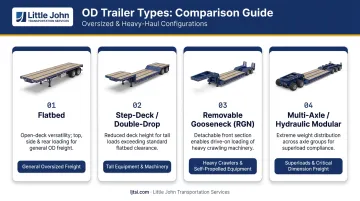
The wrong trailer doesn't just create compliance problems — it can make loading or unloading physically impossible.
Step 3: Route Engineering
Route engineering maps a safe, compliant path before anything moves. For complex or high-risk corridors, a physical route survey is required. Every route must account for:
- Bridge weight ratings and structural load limits
- Overhead clearance restrictions and low-overpass alternates
- Road width and turn radii at critical intersections
- Active construction zones
- Jurisdiction-specific travel rules for each state crossed
Step 4: Permit Acquisition
Apply for oversize and/or overweight permits from each state transportation agency along the route. Each permit specifies:
- The authorized route (sometimes down to specific roads)
- Approved travel dates and hours
- Maximum travel speed
- Escort vehicle requirements
Permits are load-specific — a new permit is required for each shipment. Factor in that routine permits may process in 1–3 business days in some states, while superloads requiring engineering review can take several weeks. Start early.
Step 5: Escort Coordination and Execution
Arrange certified pilot cars as required by each state based on load dimensions. Execute the move within permitted travel windows, with active tracking throughout transit. Contingency plans for weather delays, re-routing, and mechanical issues must be finalized before departure.
That five-step sequence demands significant coordination capacity. Little John Transportation Services manages the full process in-house — route engineering, permit acquisition across every state, and pilot car coordination — processing over 100,000 oversize/overweight permits annually.
Oversize Load Regulations, Permits, and Route Planning
The Federal Framework — and Its Limits
The FHWA sets baseline size and weight standards, but individual states control their own limits, permit systems, and travel restrictions. The federal government does not issue OS/OW permits — that's entirely a state function. A multi-state OD move requires separate authorization from every state along the route, with no federal override.
Escort Vehicle Requirements
Pilot car mandates vary by load dimensions and by state. State requirements differ significantly — and getting them wrong is one of the most common causes of permit violations in transit:
- Minnesota: Certified rear escort required above 15 ft wide or 110 ft long
- Texas: Dimensional triggers may require front and rear escorts, or law enforcement escort for certain loads
- Most states (wide/tall loads): Both front and rear escorts, with certified drivers carrying height poles and two-way radios
Cross-Border OD Freight: U.S.–Mexico
Mexico operates under its own federal standards, separate from anything issued by a U.S. state. Ordinary vehicle limits are governed by NOM-012-SCT-2-2017, which sets a maximum width of 2.60 m and maximum height of 4.25 m on federal roads, with authorized length and weight varying by vehicle configuration. For indivisible loads of exceptional size or weight, NOM-040-SCT-2-2012 authorizes the Secretaría de Comunicaciones y Transportes (SCT) to issue special permits.
A U.S. state permit has zero validity in Mexico. Cross-border OD moves require separate Mexican federal authorization, coordination with SCT, and in many cases state-level permits and police escorts within Mexico.
This corridor demands carriers with established cross-border operations, bilingual teams, and physical presence in border hubs like Laredo, Monterrey, and Guadalajara — not ones learning the process on your load.
Lead Time Is Not Optional
Plan early. Routine OD permits may clear in 1–3 business days in some jurisdictions, but Washington State requires at least 30 days of advance lead time for qualifying superload moves. Shippers who underestimate lead time face a straightforward choice: costly delays or suboptimal routing.
Common Misconceptions About Over Dimensional Freight
"Oversize and overweight are the same thing."
They're separate classifications with separate permit requirements. A load can be legally overweight but within dimensional limits, or oversized but within gross weight limits. Treating them as interchangeable results in incomplete permitting and compliance failures on the road.
"One permit covers the whole route"
A single state permit authorizes travel within that state only — along the specific approved route, within the approved travel window. Multi-state moves require coordinated permit stacking, with each state's permit in hand before departure. Deviating from an approved route invalidates the permit in most states.
"Any flatbed carrier can move an OD load."
Standard flatbed carriers typically don't have the permitting expertise, specialized trailer inventory, route engineering capability, or escort coordination experience that OD freight requires. Using an unqualified carrier risks permit non-compliance, cargo damage, and infrastructure liability — and shippers generally bear the consequences, not the carrier.
Vetting your carrier's OD experience before booking is the simplest way to avoid all three.
Conclusion
Over dimensional freight is a distinct category defined by loads that exceed legal size or weight thresholds — and moving it safely and legally requires a structured process, not a standard freight booking. Cargo assessment, equipment matching, route engineering, permit acquisition, and active transit execution with proper escorts aren't optional steps. They're the job.
Shippers who treat OD freight like standard freight encounter permit violations, infrastructure liability, and unnecessary cost with regularity. The complexity is real, but it's manageable with the right partner.
For companies shipping oversized machinery, industrial equipment, or complex loads across the U.S., into México, or across North America, Little John Transportation Services has spent 30+ years moving the loads most carriers walk away from. Key capabilities include:
- 65,000+ vetted carriers across the U.S., México, and Canada
- 100,000+ permits processed annually with full route engineering
- 30+ years of OD freight expertise — heavy-haul, project cargo, and superloads
- End-to-end compliance management from cargo assessment through final delivery
Frequently Asked Questions
What is over dimensional freight (OD)?
OD freight is any commercial shipment exceeding standard legal limits for width, height, length, or gross weight as set by federal and state transportation agencies. These shipments require special permits, specialized equipment, and careful route planning before a truck can move legally.
How is over dimensional freight different from normal cargo?
Standard freight fits within established dimensional and weight limits and moves without special permits. OD freight exceeds those limits and requires specialized trailers, state-by-state permit acquisition, engineered routing, and in many cases certified escort vehicles. Standard loads carry none of these requirements.
What permits are required for oversize loads in the United States?
There is no federal OD permit. Permits must be obtained from the transportation agency of each state the load passes through. Each permit specifies the authorized route, approved travel window, speed restrictions, and escort requirements — and a new permit is required for each individual shipment.
What equipment is typically used to transport over-dimensional freight?
Common trailer types include flatbeds, step-decks, double-drops (lowboys), removable gooseneck (RGN) trailers, and multi-axle configurations. The right choice depends on the cargo's height, weight, loading method, and overall dimensions. Mismatched equipment creates compliance violations before the truck leaves the yard.
How long does it take to get an oversize load permit?
Routine OD permits process in 1–3 business days in many states. Superloads requiring engineering review can take several weeks or more. Plan your permit applications well ahead of your scheduled move date.
Can over-dimensional freight be shipped across the U.S.–Mexico border?
Yes, but cross-border OD freight requires separate permit applications under Mexico's federal system (NOM-040/SCT) — U.S. state permits are not valid in Mexico. Coordination with Mexican federal authorities is required, making carriers with established cross-border operations and bilingual teams critical for this corridor.