Introduction
Less-than-truckload (LTL) freight shipping is a model where multiple shippers share space on a single trailer, each paying only for the portion their freight occupies. It sits between parcel delivery and full truckload — the right tool for loads too large for a UPS box but not large enough to justify an entire trailer.
For logistics managers and procurement teams, understanding how LTL actually works isn't an academic exercise — it directly affects cost, delivery reliability, and mode selection. A working knowledge of LTL pricing mechanics, terminal routing, and freight classification prevents invoice surprises and fulfillment gaps before they become operational problems.
This guide covers:
- How LTL moves freight from pickup through terminal routing to final delivery
- The factors that drive LTL pricing, including freight class and accessorial charges
- When LTL is the wrong mode — and what to use instead
Key Takeaways
- LTL consolidates freight from multiple shippers onto one trailer, making it cost-effective for loads too large for parcel carriers but too small to fill a full truck
- The hub-and-spoke model drives LTL efficiency, which is also why transit times are less predictable than FTL
- Freight class, weight, dimensions, and accessorial services are the main pricing factors in LTL
- LTL transit times are longer than FTL by design — supply chains that don't account for this run into fulfillment gaps
- When freight is oversized, hazardous, time-critical, or requires specialized handling, standard LTL networks are not the right answer
What Is LTL Freight Shipping?
LTL freight typically ranges from around 500 to 15,000 pounds, occupying only part of a standard 53-foot trailer. According to XPO's freight shipping overview, most LTL shipments fall within that weight band and share trailer space with other shippers' cargo, sometimes being unloaded and reloaded during transit.
How LTL Compares to Adjacent Modes
Understanding LTL means understanding what it isn't:
| Mode | Typical Weight | Trailer | Service Model |
|---|---|---|---|
| Parcel | Under ~150 lbs | Package-level | Point-to-point, carrier-sorted |
| LTL | ~500–15,000 lbs | Shared trailer | Hub-and-spoke, consolidated |
| FTL | 20,000+ lbs | Dedicated trailer | Point-to-point, one shipper |
LTL fills the gap between these two. It accepts both palletized and some non-palletized freight, unlike most FTL arrangements, and uses common carriers who consolidate shipments from multiple customers onto the same truck. The tradeoff is straightforward: shared space drives cost efficiency, but your freight moves through a multi-stop terminal network rather than point-to-point. "LTL" refers to both the freight type and the carrier class — the same common carriers who consolidate loads also operate those terminal networks.
How LTL Freight Shipping Works: The Hub-and-Spoke Model
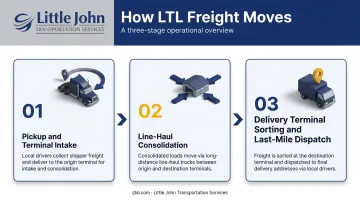
LTL doesn't move freight in a straight line from A to B. It runs through a hub-and-spoke system: local pickup, consolidation at a regional terminal, line-haul to a destination hub, then last-mile delivery. This model creates the efficiency that makes LTL cost-competitive, but it also introduces transit time variability that catches shippers off guard when they plan LTL like FTL.
According to Transport Topics, average LTL delivery ranges from one to five business days depending on distance and carrier network structure. Shipments within a single terminal's coverage area may arrive next-day; cross-country routes requiring multiple hub sorts will take longer.
Step 1: Pickup and Terminal Intake
A local pickup-and-delivery driver runs a set daily route, collecting freight from multiple shippers. Once the route is complete, the trailer returns to the origin terminal where freight is unloaded, weighed, inspected, and staged.
This is where the first billing risk appears. Carriers weigh and dimension freight against the shipper's paperwork. Old Dominion's tariff, for example, permits a $25 inspection or reweigh fee when a reweigh finds a discrepancy of 20 lbs or more, and a $25 shipment-verification fee for incorrect descriptions. Getting weights and dimensions right before pickup isn't optional — it's how you avoid post-shipment billing adjustments.
Step 2: Line-Haul Consolidation and Movement
At the origin terminal, shipments are sorted by destination region and loaded onto line-haul trailers alongside freight from other shippers heading the same direction. These trailers typically depart overnight. A single line-haul trailer might carry freight from dozens of shippers, dramatically reducing the per-shipment cost of long-distance movement.
Terminal density directly affects how this step performs. Carriers with dense networks complete it with fewer interline handoffs — and shipping on a lane where your carrier has direct coverage is faster and lower-risk than routes that depend on interline partnerships.
Step 3: Delivery Terminal Sorting and Last-Mile Dispatch
Freight arriving at the destination terminal is sorted by delivery zone and loaded onto local trucks. Drivers run fixed routes repeatedly, which builds consignee familiarity and improves delivery consistency over time.
That consistency scales with network size. Estes Express, for instance, reports over 750 million one- and two-day origin-destination points within its direct network — a concrete illustration of how terminal density translates into service reliability.
Key Factors That Affect LTL Freight Costs
LTL pricing is more complex than FTL. Several variables interact to determine the final rate — and misunderstanding any one of them produces invoice surprises.
Freight Class and NMFC Code
The National Motor Freight Classification (NMFC) system assigns every commodity a freight class from 50 to 500 across 18 tiers. Class assignment is based on four factors:
- Density — weight relative to occupied space
- Stowability — how effectively the freight can be loaded in a trailer
- Handling — ease of movement across docks and equipment
- Liability — exposure to damage, theft, or loss
Higher freight classes mean higher rates per hundredweight. Class 50 (dense, easy-to-ship freight like heavy metal parts) costs far less per pound than Class 500 (extremely low-density items like ping-pong balls). Misclassifying freight — even unintentionally — triggers carrier reclassification and the associated correction fees.
Weight, Dimensions, and Density Pricing
LTL pricing uses hundredweight (CWT) pricing within weight bands. But as Old Dominion notes, LTL carriers use freight density rather than the dimensional weight (DIM weight) model that parcel carriers apply.
In practice: a lightweight but bulky pallet may be rated at a higher effective weight based on the space it occupies relative to actual weight. This matters most for lower-density commodities. Measuring accurately before shipment prevents the carrier from determining dimensions at the terminal — and billing accordingly.
Accessorial Fees
Accessorials are charges added to the base rate for services beyond standard pickup-and-delivery. They're frequently overlooked when comparing carrier quotes, which is why invoice totals often exceed initial estimates. Common accessorials include:
- Liftgate pickup or delivery — when no dock is available at either end
- Inside delivery — moving freight beyond the threshold of the receiving location
- Residential delivery — delivery to a home or non-commercial address
- Limited access locations — schools, construction sites, military bases, remote areas
- Notification or appointment scheduling — required advance notice to the consignee
- Overlength freight — cargo exceeding standard dimensional thresholds
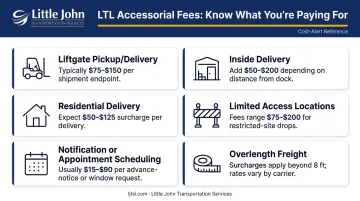
Identify all applicable accessorials before requesting quotes. A base rate comparison between carriers is meaningless if one quote excludes liftgate service you'll actually need.
Lane Coverage and Network Density
Beyond accessorials, the route itself shapes cost and risk. Not all carrier networks cover all lanes equally — and the difference matters more than most shippers expect.
Shipments that stay within a carrier's direct terminal footprint move faster and cheaper, with fewer damage touchpoints. Routes requiring interline partnerships — where your carrier hands freight to a second carrier mid-route — introduce more terminal touches, longer transit, and higher damage exposure. The contrast matters most on complex corridors:
- Direct service lanes: Single carrier, fewer handoffs, faster transit, lower damage risk
- Interline routes: Multi-carrier handoffs, more terminal touches, elevated damage exposure
- Cross-border lanes (U.S.–Mexico): Carrier network depth outweighs headline rate — interline gaps at the border compound every other risk factor
For shipments moving through complex corridors, vet carrier network depth before comparing rates.
When LTL Is Not the Right Choice
LTL works well within specific load parameters. Outside those parameters, it becomes either uneconomical or operationally inappropriate.
The Cost Crossover with FTL
LTL saves money on partial loads because you're only paying for the space your freight uses. But as shipment volume grows, that calculus changes.
As freight approaches the higher end of LTL weight ranges — and particularly as pallets multiply — the rate per unit can approach or exceed FTL pricing, while adding the transit time penalties and damage risk of multi-stop handling.
There is no universal breakeven point. The comparison depends on lane, carrier, and freight characteristics. Practical signal: when your LTL quotes start approaching FTL pricing for the same lane, run both numbers before committing to a mode.
Transit Time Is Not Predictable Like FTL
FTL moves point-to-point on a defined schedule. LTL moves through a network where transit depends on:
- Number of terminal sorts required
- Lane-specific line-haul schedules
- Whether your origin and destination fall in the same terminal's coverage zone
Teams that assume LTL will deliver on a specific date — rather than within a range — will encounter fulfillment gaps. Expedited and guaranteed LTL services exist (Saia and Estes both offer time-definite products), but they carry a premium. Transit predictability is just one of several LTL limitations worth mapping before committing to a mode.
Freight That Standard LTL Networks Cannot Handle
Standard LTL is designed for palletized, standard-dimension, non-hazardous freight moving between domestic terminals. Several freight categories fall outside that design:
- Oversized or overweight loads — exceeding standard trailer dimensions or legal weight limits without permits
- Hazardous materials — many hazmat classes require carriers holding specific certifications that most LTL providers don't maintain
- High-value or restricted freight — carriers like Old Dominion explicitly prohibit currency and precious metals; liability caps apply regardless of actual value
- Time-critical shipments — standard LTL's multi-stop routing introduces variability incompatible with JIT supply chains or AOG situations
- Specialized handling requirements — freight requiring flatbed, step-deck, RGN, lowboy, or multi-axle equipment simply cannot move on standard LTL trailers
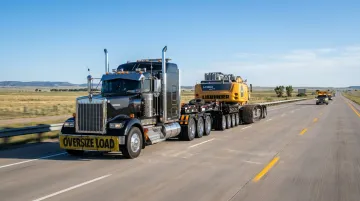
When freight matches any of these categories, the right call is a carrier built specifically for that work. Little John Transportation Services holds an FMCSA Hazardous Materials Safety Permit (a credential fewer than 1% of U.S. carriers carry), TPS approval, AA&E certification, and CTPAT validation for cross-border operations.
Their network covers freight that standard LTL carriers decline by design: all nine hazmat classes, oversized industrial equipment, defense cargo, and complex U.S.–Mexico cross-border lanes.
Frequently Asked Questions
What is the weight limit for LTL freight?
LTL shipments typically range from around 500 lbs to 10,000–15,000 lbs, though carrier-specific limits vary. Freight below roughly 150 lbs generally moves more efficiently through parcel carriers, while freight above the upper LTL threshold becomes more economical as FTL, where the shipper secures a dedicated trailer and avoids multi-stop handling.
How is LTL freight class determined?
Freight class is assigned using the NMFC system based on four factors: density, stowability, handling requirements, and liability. The assigned class directly affects the per-hundredweight rate. Misclassification triggers carrier reweigh and reclassification fees, plus post-shipment billing adjustments that can significantly increase the final invoice.
What are accessorial fees in LTL shipping?
Accessorial fees are charges added to the base LTL rate for services beyond standard pickup-and-delivery — liftgate, inside delivery, residential delivery, or limited access locations. Identify them upfront when requesting quotes; they're one of the most common causes of invoice discrepancies.
How long does LTL freight shipping take?
Transit time depends on terminal sorts and line-haul legs, not just distance. Regional shipments within a single terminal's coverage can deliver next-day; cross-country routes add business days per hub sort. Guaranteed or time-definite services are available from select carriers at a premium.
What is the difference between LTL and FTL shipping?
FTL dedicates an entire trailer to one shipper moving point-to-point, while LTL consolidates multiple shippers' freight onto a shared trailer through the hub-and-spoke network. FTL is faster, lower-risk for damage, and more predictable on delivery timing. LTL is more cost-effective for smaller loads that don't justify a full trailer.
Is LTL freight slowing down?
S.J. Consulting's 2025 report shows total U.S. LTL revenue reached $52.8 billion in 2024, with Top 25 average daily shipments rising 2.7% despite soft volume trends. Leading carriers held pricing discipline: Old Dominion's revenue per hundredweight (excluding fuel) rose 5.0%, and XPO's North American LTL yield excluding fuel increased 7.8%. Volumes pulled back — but carrier margins didn't follow.