
GDP (Good Distribution Practice) compliance is the regulatory benchmark governing how temperature-sensitive pharmaceuticals, biologics, and vaccines are transported and distributed. The challenge: virtually every cold chain provider claims compliance, but far fewer can demonstrate it under scrutiny.
This guide gives procurement and supply chain professionals a practical framework for evaluating, vetting, and selecting a GDP-compliant cold chain logistics provider — covering what to verify, what to avoid, and which questions to ask before signing anything.
Key Takeaways
- GDP compliance requires validated processes, calibrated monitoring, and documented deviation management — not just self-declaration
- Regulatory accountability stays with the contract giver even when logistics is outsourced to a third party
- Six factors separate credible providers from checkbox compliance: certification, transport validation, monitoring, excursion handling, documentation, and network coverage
- Absence of a formal quality agreement is a disqualifying red flag under EU GDP guidelines
- The right provider operates as a compliance partner — audit-ready on any given Tuesday, not just when an inspector calls
What Is GDP-Compliant Cold Chain Logistics?
GDP-compliant cold chain logistics refers to the transportation, handling, and distribution of temperature-sensitive products — primarily pharmaceuticals, biologics, vaccines, and specialty therapies — according to standards set by frameworks such as EU GDP 2013/C 343/01, WHO TRS 961 Annex 9, and USP <1079>.
These are the operational standards regulators use to inspect, certify, and — where violations are found — suspend distribution authorization.
Core Requirements Under GDP
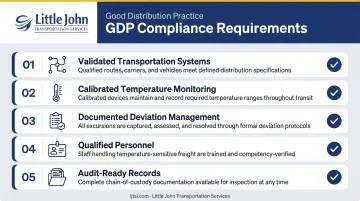
A provider claiming GDP compliance must demonstrate:
- Validated transportation systems — documented evidence that routes and vehicles consistently maintain required conditions
- Calibrated temperature monitoring — devices traceable to national or international standards, with records retained for at least five years per EU GDP 4.2
- Documented deviation management — written procedures for investigating excursions, with CAPA implementation where required
- Qualified personnel — trained staff accountable for GDP-specific responsibilities
- Audit-ready records — complete, contemporaneous, retrievable, and protected from unauthorized alteration
Temperature ranges are product-specific, not universal. EU GDP 9.2 requires transport within the limits stated by the product's manufacturer or outer packaging. Refrigerated pharmaceuticals commonly require +2°C to +8°C, and some biologics require frozen conditions at -20°C or below — but the product label and approved stability data control, not generic industry bands. Any provider that presents fixed universal ranges as the compliance threshold is getting it wrong.
Why GDP Compliance Is Non-Negotiable When Selecting a Logistics Partner
Regulators don't assess compliance as a snapshot. The EU's GDP inspection format, updated effective January 1, 2024, classifies storing refrigerated products at ambient temperature as a critical deficiency — the highest severity level in the inspection framework. A temperature deviation that causes product to fail authorized storage conditions is classified as a major finding.
Outsourcing logistics doesn't transfer regulatory accountability. Under EU GDP Section 7.2, the contract giver remains responsible for ensuring that contracted-out activities meet GDP standards — including conducting an audit before work begins and periodically thereafter. Regulatory exposure follows the manufacturer, not the carrier.
The downstream consequences of choosing a non-compliant provider escalate fast:
- Product degradation from undetected or unreported excursions
- Patient safety risks from compromised product reaching end users
- Regulatory observations triggered by inadequate provider documentation
- Recalls and market withdrawals when product integrity cannot be demonstrated
- Reputational damage that outlasts the logistics failure itself
Each item on that list traces back to a single decision: who you handed the product to. That makes provider selection a quality-critical activity with the same rigor as any other GMP process.
What to Look for in a GDP-Compliant Cold Chain Logistics Provider
Providers vary widely in how they interpret and demonstrate GDP compliance. The six factors below connect provider capabilities to specific regulatory and operational outcomes — and separate genuine compliance discipline from marketing claims.
GDP Certification Status and Regulatory Credibility
Start with verifiable credentials. Ask whether the provider holds:
- GDP authorization from the relevant national competent authority (recorded in EudraGMDP for EU-regulated entities)
- IATA CEIV Pharma certification if air freight or ground handling within an air cargo supply chain is involved
- ISO/IEC 17025-traceable calibration records for all monitoring equipment — EU GDP 3.3 requires calibration at defined intervals, traceable to national or international standards
- ISO 9001:2015 or equivalent quality management certification
Certifications should be current, independently audited, and producible on request. Self-declared compliance or credentials referenced only in marketing materials should be treated as unverified.
Also ask for evidence of recent regulatory inspections: audit outcomes, any GDP observations received, and corrective actions taken. A provider's track record with regulators is the clearest single indicator of real-world compliance discipline.
Transportation Validation and Route Qualification
GDP compliance requires that providers have validated their transportation methods against real operating conditions, not theoretical assumptions. Under EU GDP 9.4 and WHO TRS 961 6.3 and 6.6, this means:
- Route risk assessments identifying where temperature controls are required
- Seasonal qualification — documented evidence that routes have been tested at anticipated ambient extremes (summer and winter profiles)
- Vehicle qualification confirming equipment performance at those extremes
- Packaging performance validation where passive or active systems are used
Ask for documented validation studies specific to the routes and transport modes relevant to your shipments. A provider who can't produce lane-specific data is relying on assumptions, which creates direct audit exposure for the contract giver.
Temperature Monitoring Technology and Data Integrity
Evaluate the provider's monitoring capability against these criteria:
- Continuous logging covering all critical points in transit — including door zones, staging areas, and multi-leg transfer points
- Calibrated devices with traceable records updated at defined intervals
- Real-time exception alerting that enables response before a deviation compounds
WHO TRS 1033 Annex 4 applies ALCOA+ principles to regulated data: attributable, legible, contemporaneous, original, accurate, complete, consistent, enduring, and available. Temperature records must meet this standard.
Ask how data is stored, secured, and made retrievable. Providers should demonstrate validated electronic systems with audit trail controls — spreadsheets and manual logs subject to modification don't satisfy this requirement.
Excursion Management and Deviation Handling
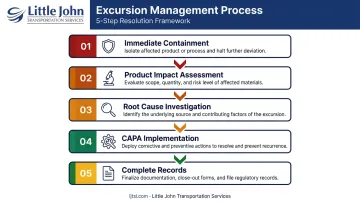
A GDP-compliant provider must have a documented, tested process for temperature excursions that covers:
- Immediate containment: isolate affected product before the excursion compounds
- Product impact assessment: determine whether quality has been compromised and to what extent
- Root cause investigation: establish how and where the excursion originated
- CAPA implementation: document corrective and preventive actions through to verified closure
- Complete records: produce documentation that can withstand regulatory review at any point
EU GDP Chapter 9.2 requires deviations to be reported to the distributor and recipient. Chapter 1 requires investigation and CAPA where appropriate. A provider without a documented excursion protocol is out of conformance with GDP requirements — full stop.
Ask them to walk you through a recent deviation end-to-end. How they respond to excursions — not just whether they occur — is the metric that matters.
Documentation Standards and Chain-of-Custody Practices
GDP compliance lives and dies on documentation quality. Confirm the provider maintains audit-ready records for every shipment leg, including:
- Continuous temperature logs with calibration traceability
- Delivery confirmations and transfer receipts
- Deviation records and CAPA documentation
- Chain-of-custody documentation assembled across all legs
For multi-leg shipments, ask how documentation is centralized. Fragmented records across carriers, warehouses, and freight handlers are one of the most common audit vulnerabilities in complex cold chain operations — and that fragmentation transfers audit exposure directly to the manufacturer.
Cross-Border Coverage and Network Reliability
Validated capability at every transfer point matters. That means:
- Customs dwell procedures — WHO TRS 961 1.1.3 requires temperature-sensitive shipments awaiting customs release to remain under manufacturer-recommended conditions
- Validated handoffs at each cross-border staging point, not just at origin and destination
- On-the-ground operations with established relationships at key border crossings
A provider relying on subcontracted agents with no direct accountability structure at the border creates gaps that are difficult to audit and harder to defend during an inspection.
Red Flags to Watch For When Vetting Cold Chain Logistics Providers
These patterns signal that compliance is a marketing claim, not an embedded operational practice. If you encounter any of them during vetting, treat it as disqualifying:
- Certifications that can't be produced on request — any provider who needs time to "locate" current audit documentation is telling you something
- GDP compliance treated as a one-time certification — if the provider can't explain their deviation management process in operational terms, it doesn't exist at a usable level
- Fragmented or manual documentation — inability to produce a consolidated chain-of-custody record for a multi-leg shipment is an audit liability that transfers to you
- No formal quality agreement — EU GDP Section 7.1 requires a written contract for all outsourced GDP activities; a provider unwilling to execute one has no place handling regulated freight
- No lane-specific validation data — seasonal qualification and route risk assessment are explicit GDP requirements. "We've done this route before" is not a substitute for documented evidence
- Subcontracting without accountability — if your provider will hand off pharmaceutical freight to unvetted subcontractors, you have no visibility into compliance at the handoff points that matter most
How Little John Transportation Services Supports Pharmaceutical and Life Sciences Freight
Little John Transportation Services (LJTS) is a 30+ year specialized freight carrier with ISO 9001:2015 certification, CTPAT validation, FMCSA HMSP authorization, and a 99.9% claim-free delivery rate. The company operates across 12 US and México locations, with particular operational depth at key US-Mexico border logistics hubs — including its 50-acre CTPAT-compliant Laredo facility and on-the-ground teams in Monterrey and Guadalajara.
For pharmaceutical and life sciences shippers, LJTS handles the high-compliance, complex shipments most carriers decline:
- Audit-ready chain-of-custody documentation structured to meet pharmaceutical-grade standards
- 24/7 bilingual dispatch and tracking with English/Spanish operations at every cross-border touch point
- GDP-compliant cold chain transport with continuous temperature logging across 2,400+ thermal-mapped reefer trailers
- Pre-cool confirmation at pickup — verifying set-point temperature before pharmaceutical cargo is loaded
- Real-time exception alerting dispatched to operations teams the moment a deviation is detected
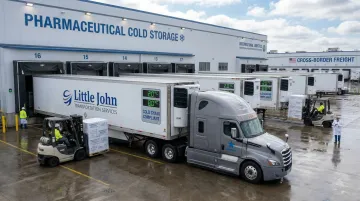
LJTS's compliance stack covers both sides of the border: Hazmat-endorsed drivers (100% of BCOs), TWIC-certified personnel, FAST-certified cross-border operations, and CSA compliance — all auditable, all current.
To discuss your pharmaceutical freight requirements and review available compliance documentation, contact the LJTS team directly at quotes@ljtsi.com or +1 (479) 264-6501.
Frequently Asked Questions
What is a GDP-compliant cold chain logistics specialist?
A GDP-compliant cold chain logistics specialist transports and handles temperature-sensitive products — pharmaceuticals, biologics, vaccines — under Good Distribution Practice guidelines, using validated transportation systems, calibrated monitoring, documented deviation management, and audit-ready records at every shipment leg.
What certifications should a cold chain logistics provider have?
Look for GDP authorization from the relevant national competent authority, IATA CEIV Pharma for air freight involvement, ISO/IEC 17025-traceable calibration records, and quality management certifications like ISO 9001. Confirm all certifications are current and independently verifiable through the issuing authority.
What is the difference between GDP and GMP compliance in logistics?
GMP (Good Manufacturing Practice) governs pharmaceutical product manufacturing. GDP governs distribution and transportation — including controlled storage, transit monitoring, documentation, and supplier qualification. A logistics provider must meet GDP standards; GMP compliance alone doesn't cover distribution activities.
How do I verify that a cold chain logistics provider is actually GDP-compliant?
Request documentation: recent audit outcomes, transportation validation studies, calibration records, deviation management SOPs, and a sample quality agreement. The key test is whether they can produce these on demand, not only when a formal audit is scheduled.
What questions should I ask a cold chain logistics provider before signing a contract?
Ask: Can you provide your most recent GDP audit results? How do you handle temperature excursions end-to-end? What validation data supports your route qualification? How is chain-of-custody documentation consolidated across multi-leg shipments? Will you execute a formal quality agreement?
What happens if a cold chain logistics provider fails a GDP audit?
Failure can result in regulatory observations, suspension of distribution authorization, product quarantine, and product recalls. The manufacturer retains regulatory accountability even when logistics is outsourced — provider vetting is a regulatory obligation, not an optional precaution.