Introduction
Cold chain failure isn't a shipping inconvenience — it's a patient safety event. IQVIA valued cold-chain medicines at $384 billion in 2021, representing 32% of total pharmaceutical market value while accounting for just 0.2% of volume. That disproportion tells the story: these shipments carry far more consequence than their volume suggests.
Temperature excursions can render biologics, vaccines, and specialty therapies ineffective or unsafe. Non-compliant transport can trigger regulatory action, product recalls, and financial loss — before a patient ever receives their medication.
This guide breaks down what GDP compliance actually requires in practice, where US regulatory frameworks fit into domestic pharmaceutical transport, and what separates a carrier that can document compliance from one that can execute it.
Key Takeaways
- GDP compliance requires documented chain of custody, validated temperature control, and audit-ready records at every stage of transport.
- Not all freight carriers qualify — verify certifications, SOPs, and deviation management protocols before awarding business.
- Temperature requirements vary widely: 2–8°C for most vaccines, -20°C for frozen biologics, -60 to -80°C for certain mRNA therapies.
- Cold chain failures carry consequences beyond product loss, including regulatory scrutiny and patient safety risk.
- Match your carrier's capabilities to your product's temperature range, hazmat classification, and documentation requirements.
What Is GDP Compliance for Life Science Cold Chain?
Good Distribution Practice (GDP) is the quality framework governing how pharmaceutical products are stored, handled, and transported to preserve their integrity from manufacturer to end user. As PIC/S defines it, GDP is "that part of quality assurance which ensures that the quality of medicinal products is maintained throughout all stages of the supply chain."
GDP is a process and quality framework, not a single certification issued by one body.
Core GDP Principles for Transport
- Temperature control: Products must be maintained within validated temperature ranges throughout transit
- Contamination prevention: Handling procedures must prevent mix-ups, cross-contamination, and damage
- Chain-of-custody traceability: Every product transfer requires documented records with timestamps, lot numbers, and responsible parties
- Deviation management: Any excursion, delay, or damage must be formally investigated, documented, and resolved — not just flagged
GDP vs. GMP: An Important Distinction
GMP (Good Manufacturing Practice) governs how drugs are made. GDP governs how they move through the supply chain. Both are required for pharmaceutical products to reach patients safely and legally.
Understanding that distinction matters for compliance: in the US, there is no single FDA-issued "GDP certificate." Compliance is demonstrated through adherence to FDA guidance (21 CFR Parts 211 and 600), DSCSA traceability requirements, and alignment with international frameworks including WHO TRS 1025 Annex 7 (2020) and PIC/S GDP guidelines.
That compliance burden extends to the carrier, not just the shipper. Validated equipment, calibrated monitoring devices, trained personnel, and documented SOPs are carrier responsibilities — and how well a carrier meets them directly determines whether your shipment holds up under regulatory scrutiny.
US Regulatory Requirements for Pharmaceutical Cold Chain Transport
The FDA does not publish a standalone "GDP transportation regulation," but enforces temperature control requirements through multiple overlapping mechanisms.
Key Regulatory Touchpoints
| Regulation | Scope |
|---|---|
| 21 CFR 211.142 & 211.150 | Warehousing conditions and distribution procedures for drug products |
| 21 CFR 600.15 | Temperature requirements during shipment for biological products |
| 21 CFR 211.166 | Stability testing — results define required storage/transport conditions |
| 21 CFR 201.57 / 610.61 | Labeling requirements specifying storage and handling conditions |
The product's FDA-approved label is the controlling temperature reference. A carrier must maintain conditions consistent with that label — not with a generic industry standard.
DSCSA Traceability
The Drug Supply Chain Security Act mandates electronic, interoperable tracing at the package level for covered prescription drugs. Statutory trading partners — manufacturers, repackagers, wholesale distributors, and dispensers — hold primary DSCSA obligations. Transportation-only common carriers are not automatically statutory trading partners, but GDP-compliant carriers must support the chain-of-custody documentation that trading partners rely on.
DSCSA exemptions for certain dispensers phased out progressively through 2025. Small dispensers — defined as 25 or fewer full-time pharmacists/technicians — remain exempt from specified enhanced requirements through November 27, 2026.
USP General Chapter <1079>
USP <1079> is the practical industry standard for US pharmaceutical transport. It covers temperature mapping, vehicle and container qualification under actual load and environmental conditions (typically at least three replicate tests), and continuous monitoring requirements.
As a chapter numbered above 1000, it carries informational rather than mandatory compendial status. In practice, regulators and quality auditors use it as the operational benchmark — meaning a carrier that can't demonstrate USP <1079> alignment will struggle to pass a pharmaceutical shipper audit.
Temperature Requirements for Life Science Products
Each product's required temperature range is determined by its stability data and defined in its FDA-approved label or IND/NDA/BLA filing. Generic temperature bands are starting points, not substitutes for label-specific requirements.
Primary Cold Chain Temperature Zones
| Zone | Range | Typical Products |
|---|---|---|
| Controlled room temperature | 15–25°C | Oral solids, some injectables |
| Refrigerated | 2–8°C | Most vaccines, biologics, injectable drugs |
| Frozen | -20°C (±5°C per ICH) | Plasma products, some APIs |
| Ultra-cold | -60°C to -80°C | Certain mRNA vaccines, biologics |
| Cryogenic | ≤-140°C to -150°C | Cell and gene therapies (e.g., vapor-phase liquid nitrogen) |
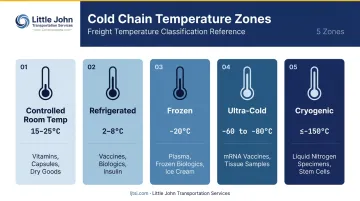
The ICH supports 5°C ±3°C for refrigerated stability studies and -20°C ±5°C for freezer studies. Products intended below -20°C are evaluated case by case based on individual stability data. There is no universal ultra-cold transport standard.
Hazmat Complexity
Cold chain life science shipments frequently carry hazardous classifications that require more than temperature control capability:
- Dry ice (UN 1845) is regulated as a hazardous material under DOT rules — carriers must hold appropriate hazmat endorsements
- Certain biological substances and research specimens carry their own hazmat designations
- For specified quantities and types, carriers also require an FMCSA Hazardous Materials Safety Permit (HMSP) — held by fewer than 1% of carriers nationwide
A refrigerated trailer alone does not qualify a carrier for pharmaceutical cold chain work. The hazmat credentials must match the shipment profile.
What GDP-Compliant Cold Chain Operations Actually Look Like
Understanding what GDP compliance requires operationally helps life science shippers distinguish carriers who have built genuine pharmaceutical handling capabilities from those who have added a temperature trailer as an afterthought.
Validated Equipment
GDP-compliant carriers use validated refrigerated trailers or qualified insulated containers with documented qualification protocols. Validation means the equipment has been temperature-mapped under representative load and environmental conditions. Per USP <1079>, this typically requires at least three replicate tests, with calibration records maintained for all monitoring devices. Pre-cool confirmation at pickup is documented before product is loaded.
Validation criteria include:
- Temperature mapping completed under representative load conditions
- Minimum three replicate tests per USP <1079> requirements
- Calibrated monitoring devices with traceable calibration records
- Pre-cool confirmation documented before loading
Continuous Temperature Monitoring
Compliant operations require calibrated monitoring throughout transit, with complete, tamper-evident logs retained for the required period.
Passive data loggers record temperature data for post-shipment review — appropriate for lower-risk shipments or routes where review upon delivery is sufficient.
Real-time active monitoring provides in-transit visibility with live exception alerts to dispatch when thresholds are breached — appropriate where product sensitivity or route risk justifies immediate response capability. USP <1079> recognizes both types; the right monitoring approach depends on product sensitivity and route risk.
Chain-of-Custody Documentation
Every GDP-compliant transfer requires documented handoffs capturing:
- Product identity and lot numbers
- Temperature conditions at transfer
- Responsible parties and timestamps
- Equipment identifiers
This documentation forms the audit trail regulators expect during inspections and supports the traceability records that DSCSA trading partners maintain.
Deviation and Excursion Management
All the documentation above means little without a credible response when something goes wrong. This is where many carriers fall short: a GDP-compliant operation does not simply flag a temperature excursion. It has a documented corrective action process:
- Quarantine of affected product
- Formal excursion assessment against stability data
- Root cause investigation
- CAPA (Corrective and Preventive Action) documentation
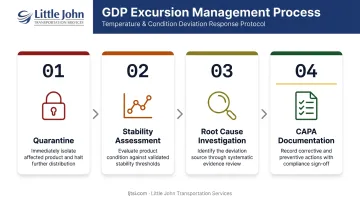
The difference between a carrier who treats GDP seriously and one treating it as a checkbox is most visible here. Ask for examples of prior excursion reports before awarding pharmaceutical business.
How to Evaluate a Cold Chain Carrier for Life Sciences Shipments
Credentials to Require
A baseline credential set for a pharmaceutical cold chain carrier includes:
- ISO 9001:2015 — documents a certified quality management system with audited processes
- FMCSA Satisfactory safety rating — confirms adequate safety management controls
- FMCSA Hazardous Materials Safety Permit (HMSP) — required for motor carriers transporting specified hazardous materials in covered types and quantities
- CTPAT validation — essential for any cross-border movement; confirms supply chain security controls
- Pharmaceutical handling SOPs available on request
None of these credentials individually establishes GDP compliance — they are complementary controls addressing quality, safety, hazmat, and border security respectively. Taken together, they represent the minimum credential baseline life science shippers should expect.
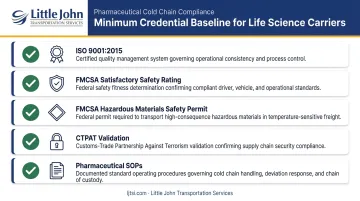
Little John Transportation Services meets every item on that baseline. The company holds ISO 9001:2015 certification, FMCSA Satisfactory rating, FMCSA Hazardous Materials Safety Permit, and CTPAT validation. Operationally, it backs those credentials with 17,000+ trailers across its network, 65,000+ vetted carriers, 24/7 bilingual dispatch, audit-ready chain-of-custody documentation, and a 99.9% claim-free delivery rate — the verified record GDP-compliant pharmaceutical transport requires.
Operational Questions to Ask Before Awarding Business
- How do you validate your temperature-controlled equipment, and can you share mapping reports?
- What is your documented excursion response protocol — can you provide a prior example?
- Can you provide calibration records for your monitoring devices?
- Who is the named point of contact for my shipment during transit, and are they reachable 24/7?
- Do your drivers hold hazmat endorsements? Does your HMSP cover the specific materials in my shipment?
These questions separate carriers built for specialized freight from general carriers who added a reefer trailer. Once you have answers, the next step is confirming those capabilities match your specific product requirements.
Matching Capabilities to Your Shipment Profile
Not every qualified carrier is qualified for your shipment. A vaccine at 2–8°C via domestic FTL has fundamentally different requirements than a cross-border clinical trial sample requiring dry ice replenishment and cryogenic handling.
Confirm the carrier has:
- Equipment validated for your specific temperature range
- Hazmat permits applicable to your materials (dry ice, biological substances)
- Geographic coverage matching your distribution network
- Documentation systems that integrate with your DSCSA traceability requirements
- Cross-border infrastructure if your lanes include US–México movement
General freight carriers retrofitted with a reefer trailer are not equivalent to carriers with purpose-built pharmaceutical handling SOPs, trained hazmat-endorsed drivers, and documented life science logistics execution. Ask directly: what percentage of their annual volume is pharmaceutical or life science freight? The answer tells you whether this is a defined capability or a side accommodation.
Frequently Asked Questions
What is Good Distribution Practice (GDP) for cold chain distribution?
GDP is a quality framework — not a single certifying body's credential — requiring documented temperature control, chain-of-custody records, validated equipment, and trained personnel throughout distribution. It aligns with WHO TRS 1025 Annex 7 (2020), PIC/S GDP guidelines, and in the US, FDA guidance and DSCSA requirements.
Does the FDA require GDP certification for domestic US pharmaceutical transport?
The FDA does not issue a formal "GDP certificate." It enforces equivalent requirements through drug labeling, 21 CFR Parts 211 and 600, DSCSA traceability mandates, and USP <1079> — meaning carriers must demonstrate compliance through documentation and validated processes, not a single credential.
What temperature ranges are required for pharmaceutical cold chain shipments in the US?
The main zones are refrigerated (2–8°C), frozen (-20°C ±5°C per ICH), and ultra-cold (-60°C to -80°C for certain mRNA vaccines). Each product's FDA-approved label, based on its stability data, is the controlling reference — not a generic industry table.
What happens if a temperature excursion occurs during pharmaceutical transport?
The excursion must be documented, assessed against the product's stability data, and investigated for root cause. Depending on severity and duration, affected product may need to be quarantined and destroyed, with the full event documented in a CAPA record.
Do pharmaceutical cold chain carriers need hazmat endorsements?
Yes. Carriers and drivers must hold DOT hazmat endorsements for regulated materials such as dry ice (UN 1845, Class 9) and certain biological substances. Carriers transporting specified quantities of covered hazmat types must also hold an FMCSA Hazardous Materials Safety Permit.
How do I verify that a cold chain carrier is truly GDP-compliant?
Ask for:
- SOPs for pharmaceutical handling
- Calibration records for temperature monitoring equipment
- Vehicle temperature mapping and qualification documentation
- Driver training records
- Sample chain-of-custody and excursion reports from prior pharmaceutical shipments
A carrier who cannot produce these on request is not GDP-compliant in practice.