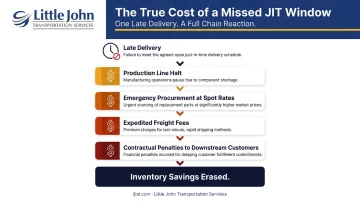
That's the problem most JIT programs run into. The model is well understood; the execution breaks down at the carrier level. Shared freight, spot market capacity, and generic trucking relationships introduce timing uncertainty that JIT cannot absorb. A delivery that arrives four hours late doesn't just miss a window — it can idle a production line, trigger emergency procurement, and erase weeks of inventory savings in a single event.
This article explains how dedicated transportation addresses each of those failure points: through schedule reliability that matches your production cadence, supply chain visibility that keeps teams ahead of exceptions, and specialized capability that covers complex or cross-border freight without introducing new coordination risk.
Key Takeaways
- Dedicated transportation reserves trucks, drivers, and capacity exclusively for your freight — eliminating spot market uncertainty in JIT operations
- A single missed JIT window can halt production lines and generate costs that offset months of inventory savings
- Real-time visibility functions as a control mechanism in JIT, not just a convenience
- Carriers with hazmat certification, CTPAT validation, and cross-border infrastructure reduce compliance risk in regulated JIT programs
- Long-term dedicated carrier relationships grow more efficient over time as carriers learn your routes, facilities, and requirements
What Is Dedicated Transportation for JIT Delivery?
Dedicated transportation — also called dedicated contract carriage (DCC) — is a freight model where a carrier reserves trucks, drivers, and management capacity exclusively for one client. Armstrong & Associates defines DCC as contract truckload operations in which a provider supplies drivers, equipment, and management under agreements typically lasting one to seven years. The U.S. DCC segment generated $32.0 billion in gross revenue in 2025 — a figure that reflects genuine demand for capacity certainty, not just preference for a premium service tier.
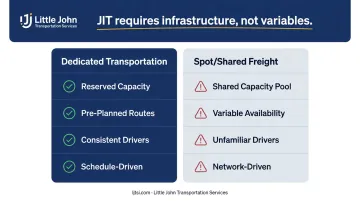
The contrast with spot or shared freight is operational, not cosmetic. In spot freight, a shipper seeks a rate for an individual load from whatever capacity happens to be available. Availability, timing, and driver familiarity all fluctuate based on the carrier's broader network load, not the client's production schedule. That variability is tolerable for non-critical freight. For JIT supply chains, it isn't.
Where dedicated transport matters most in JIT contexts:
- Manufacturing supply chains with fixed production windows
- Automotive component delivery to assembly plants
- Cross-border corridors (U.S.–Mexico) where customs timing must align with downstream schedules
- Chemical, energy, and AI infrastructure projects where freight type requires specialized certification
- Retail replenishment programs with vendor compliance windows
JIT's core promise is right goods, right time, zero excess inventory. That requires a transportation model built to hold a schedule. Spot and shared freight aren't designed for that — dedicated carriage is.
Key Advantages of Dedicated Transportation for JIT Delivery
The three advantages below focus on measurable operational impact — tied to outcomes logistics managers track: on-time delivery rates, production continuity, inventory carrying costs, and compliance performance.
Advantage 1: Schedule Reliability and On-Time Delivery Precision
Dedicated transportation eliminates the scheduling uncertainty that comes with shared freight. Trucks and drivers are available when your JIT window opens. Spot market capacity isn't a factor. Routes are pre-planned around a client's production schedule, drivers are familiar with facilities and delivery protocols, and there is no competition for trailer space with other shippers.
Why this matters: Siemens' 2024 True Cost of Downtime report found that automotive plants lose $695 million annually to unplanned downtime, with one lost hour at a large plant costing $2.3 million. That figure covers all-cause downtime — but the exposure is real regardless of cause. When a late delivery idles a line, it triggers the same financial clock.
Beyond downtime, missed JIT windows create secondary costs that compound quickly:
- Emergency procurement at spot rates
- Expedited freight fees to recover lost time
- Contractual penalties from downstream customers
- Downstream delivery failures to end customers
These costs don't just erode JIT's inventory savings — they often exceed them.
KPIs directly impacted:
- On-Time Delivery (OTD) rate
- Production downtime frequency
- Emergency freight spend
- Inventory carrying cost variance
When this advantage matters most: High-volume recurring freight lanes with fixed production schedules; automotive assembly; retail replenishment with vendor compliance windows; energy projects with site-specific delivery requirements.
Advantage 2: Supply Chain Integration and Real-Time Visibility
Dedicated transportation enables tighter integration with a shipper's internal systems — ERP, WMS, TMS — because routes, volumes, and schedules are consistent. When freight movement is predictable, shipment status maps cleanly against inventory triggers and production timelines, giving planners reliable data instead of estimates.
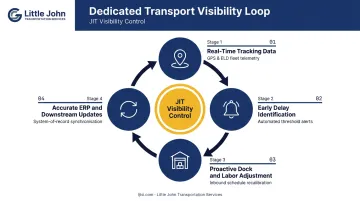
Real-time tracking data, ELD feeds, and direct carrier communication let logistics teams coordinate dock readiness, labor scheduling, and downstream production before a problem surfaces — not after.
A 2022 Deloitte survey of more than 200 U.S. manufacturing executives found that 78% believed digital solutions and monitoring tools would improve supply chain visibility and transparency. The interest is broad because the problem is real: without knowing where a shipment is and when it will arrive, production planning relies on estimates rather than data.
That visibility gap is where JIT programs fail. Dedicated transportation closes it by giving teams:
- Early delay identification with enough lead time to activate a contingency
- Dock scheduling and labor adjustments made before a disruption hits
- Accurate status updates to downstream customers
- ERP data accuracy across inbound inventory positions
KPIs directly impacted:
- Shipment visibility rate
- Dock utilization efficiency
- ERP/WMS data accuracy
- Production schedule adherence
- Exception frequency
When this advantage matters most: Multi-stop or multi-leg supply chains; US–Mexico cross-border corridors where customs timing must sync with production schedules; high-value or hazardous freight requiring chain-of-custody traceability; large manufacturers integrating inbound logistics with assembly operations.
Advantage 3: Specialized Capability and Cross-Border JIT Execution
Standard dedicated trucking covers standard freight. JIT operations in automotive, chemical, energy, and AI infrastructure frequently involve oversized loads, hazardous materials, or cross-border freight that most carriers cannot legally or operationally handle.
The ATA reports nearly 580,000 active U.S. motor carriers, with 91.5% operating 10 or fewer trucks. In that fragmented landscape, specialized certifications are the exception, not the rule.
Each carrier handoff in a JIT program is a coordination risk: a compliance gap, a scheduling conflict, or a point of failure where documentation doesn't transfer cleanly. A dedicated specialized carrier eliminates that fragmentation by covering all freight types under a single relationship.
The compliance dimension is concrete. For hazmat JIT freight, FMCSA requires shippers to verify that a carrier holds a current Hazardous Materials Safety Permit (HMSP) before tendering covered materials. Violations carry civil penalties up to $102,348 per incident — rising to $238,809 when a violation results in serious injury or substantial property damage. Using a carrier without proper certification doesn't just create logistics risk; it creates regulatory and liability exposure that can disqualify a shipper from operating in regulated markets.
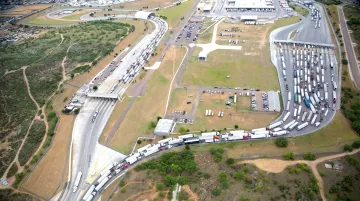
For cross-border JIT programs, the risk compounds. CBP documented commercial truck waits exceeding five hours at Texas-Mexico crossings during 2022 peak disruptions. U.S.-Mexico freight totaled $872.8 billion in 2025, with trucks carrying $642.2 billion (73.6%) of that volume — including $189.1 billion in computer-related machinery and $136.9 billion in electrical equipment. A border delay of five hours in that freight environment doesn't just miss a delivery window — it stalls an assembly line.
Little John Transportation Services is an example of a dedicated carrier built specifically for this freight environment. As an FMCSA HMSP holder — a permit held by roughly 898 carriers out of 787,189 active motor carriers in FMCSA's December 2023 snapshot — the company covers all nine hazard classes, holds AA&E certification, TPS approval, and CTPAT validation. With dedicated teams operating in Laredo, Monterrey, and Guadalajara, and 65 million+ miles covered annually, Little John handles the cross-border complexity that standard dedicated carriers cannot.
KPIs directly impacted:
- Compliance incident rate
- Customs clearance time
- Carrier consolidation ratio
- Cross-border on-time performance
- Claim frequency (benchmark: 99%+ claim-free delivery)
When this advantage matters most: US–Mexico manufacturing corridors (automotive, chemical, industrial); energy and infrastructure projects requiring oversized or hazmat delivery; pharmaceutical and defense JIT programs with strict regulatory requirements; AI infrastructure and data center buildouts requiring coordinated, time-sensitive equipment delivery.
What Happens When Dedicated Transportation Is Missing
Relying on shared or spot freight for JIT operations creates a specific set of predictable failures:
- No capacity priority. During peak demand periods, spot market trucks go to the highest-paying load — not your production window.
- Shifting delivery windows. Timing adjusts based on the carrier's network load, not your schedule.
- No operational familiarity. Drivers unfamiliar with your facilities, dock procedures, or compliance requirements slow down every delivery.
The cascading effects of a single missed JIT window move fast. Production halts. Emergency procurement at spot rates follows. Downstream delivery failures trigger customer penalties. The inventory savings JIT was designed to generate get erased.
Repeated failures push JIT programs in a predictable direction: back toward safety stock. McKinsey's 2024 supply chain risk survey found that 34% of respondents used larger inventory buffers to manage disruption, down from 59% in 2023 — a sign that more companies are absorbing carrier risk through inventory rather than fixing the carrier problem.
That workaround is expensive. Businesses end up carrying the cost of the buffer and the cost of unreliable transport at the same time, effectively paying twice to offset a transportation gap JIT was never designed to absorb.
When the JIT program involves hazmat or cross-border freight, the exposure compounds further. Using a non-certified carrier creates audit risk, regulatory penalties, and — in regulated markets — the possibility of operational disqualification. That's a cost structure no buffer inventory can cover.
How to Get the Most Value from Dedicated Transportation in JIT Operations
Dedicated transportation performs best when it's treated as a structured partnership rather than a service contract. Sharing production schedules, volume forecasts, and demand signals with your carrier in advance — rather than booking loads reactively — directly determines how reliably they can hold your JIT windows. The carrier's ability to plan around your operation is the foundation.
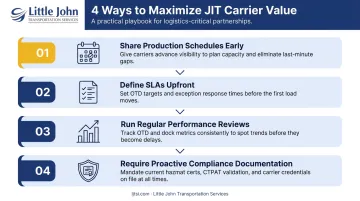
Practical steps to maximize value:
- Share production schedules early enough for your carrier to pre-position equipment and drivers — not just confirm loads at the last minute
- Define agreed SLAs upfront: OTD targets, exception response times, and documentation standards
- Run regular performance reviews tracking OTD rates, exception frequency, and dock performance against those SLAs; use them to surface friction before it becomes disruption
- Require proactive compliance documentation so performance reviews are substantive, not just administrative checkboxes
Little John Transportation Services, for example, operates with 24/7 bilingual dispatch and named human account managers — the same team that quotes a load tracks it to delivery. That model matters for JIT review cycles, where real-time responsiveness and direct accountability separate a functional partnership from a reactive vendor relationship.
That familiarity compounds over time. As a carrier builds operational knowledge of your freight, facilities, and compliance requirements, execution becomes faster and more proactive. Average client tenure — not just price — is the metric that signals a capable long-term dedicated partner. Little John's top 25 customers average 33 years of tenure, which reflects something price alone cannot buy.
Conclusion
Dedicated transportation's value in JIT operations isn't abstract. It shows up in on-time delivery rates, production continuity, inventory carrying costs, compliance performance, and the ability to execute complex or cross-border freight without introducing new failure points.
The advantages compound when applied consistently. A carrier who knows your routes, your compliance requirements, and your production windows doesn't just deliver freight — they become a structural part of your JIT operation's ability to function.
JIT leaves no margin for carrier relationships that require constant oversight. Sustained performance depends on partners who are reachable, accountable, and experienced enough to anticipate problems before they reach your production floor — not respond to them after the fact.
Little John Transportation Services has spent 30+ years in exactly this role, supporting JIT-dependent industries from Automotive OEM to pharmaceutical manufacturing. If your freight demands more than standard capacity can provide, contact our team to discuss a dedicated solution built around your production schedule.
Frequently Asked Questions
What does dedicated transportation mean?
Dedicated transportation is a freight model where trucks, drivers, and capacity are reserved exclusively for one client, typically under multi-year contracts. Because capacity is pre-committed rather than drawn from a shared pool, dedicated transport operates around the client's schedule — suited for time-critical operations like JIT delivery.
What is a just-in-time (JIT) delivery system?
JIT is an inventory and logistics strategy where goods arrive precisely when needed for production or sale — eliminating the cost of holding excess inventory. It requires highly reliable transportation because there is no buffer stock to absorb a late delivery; when freight is late, production stops.
What is the formula for On-Time Delivery (OTD)?
OTD is calculated as (on-time deliveries ÷ total deliveries) × 100, as defined by APQC. It's the primary KPI for evaluating JIT reliability. A carrier at 85% OTD misses roughly one in six deliveries — an unacceptable failure rate in production-critical environments.
What industries benefit most from dedicated transportation for JIT delivery?
Automotive manufacturing, chemical and petrochemical, energy and infrastructure, AI infrastructure and data centers, pharmaceutical, and defense gain the most — any sector where production schedules are fixed and downtime is expensive. Cross-border manufacturing corridors, particularly U.S.–Mexico, amplify the need given the added complexity of customs timing.
What happens if a dedicated carrier misses a JIT delivery window?
The immediate consequences are production halts, emergency procurement at spot rates, and downstream delivery failures to end customers. Contractual penalties may follow. Over time, repeated misses drive businesses to rebuild inventory buffers — eliminating the efficiency gains JIT was designed to create.
How does cross-border shipping affect JIT delivery timelines?
Cross-border freight introduces customs clearance, regulatory compliance, and coordination complexity that can disrupt JIT windows. Carriers with dedicated cross-border infrastructure, bilingual operations, and CTPAT certification reduce this risk through expedited processing and compliance documentation maintained on both sides of the border.