
Flatbed is structurally more expensive than dry van — that part is unavoidable. But a significant share of what shippers overpay has nothing to do with the market. It comes from decisions made before and during the shipment: vague freight specs, last-minute bookings, spot market dependency, and quote comparisons that ignore accessorials.
This guide covers both. What drives flatbed costs structurally, and what you can actually control.
Key Takeaways
- National flatbed spot rates averaged $3.69/mile all-in in June 2026 — a 40% year-over-year increase
- The per-mile quote is only one layer; fuel surcharges, accessorials, and deadhead exposure stack on top
- Capacity tightness, load complexity, and lane imbalances are the main structural cost drivers
- Lead time, contract pricing, and all-in quote comparisons are your highest-leverage cost controls — in that order
- Oversized or complex flatbed freight requires a specialized carrier network — standard brokers frequently lack the equipment, permits, and driver qualifications to cover it
How Flatbed Shipping Costs Accumulate
Most shippers see a per-mile rate and assume that's the cost. It isn't.
Flatbed freight bills are built in layers, and most of those layers don't appear until the invoice arrives:
- Base linehaul rate — the quoted per-mile figure
- Fuel surcharge — added as a percentage of linehaul or a fixed per-mile charge, calculated against the weekly DOE diesel price benchmark
- Accessorial charges — tarping, load securement assistance, detention, stop-off fees, and permits, each billed separately
- Deadhead cost recovery — when a carrier runs empty miles to reach your load or after delivery, those miles get priced into your rate
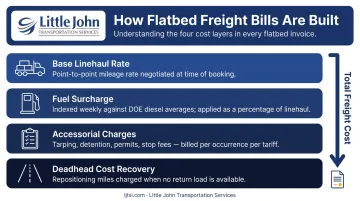
The problem is timing. Carriers and brokers typically quote the base rate first, then add fuel surcharge and accessorials separately. Shippers who don't request all-in quotes are consistently comparing numbers that don't mean the same thing.
Why Timing Multiplies Every Cost Layer
Cost build-up happens in surges, not steady increments. A load booked 24 hours before pickup during peak construction season on a lane with limited backhaul availability will cost dramatically more than the same load planned three weeks out in February. The per-mile benchmark may look identical across both scenarios — the actual invoices won't.
The gap between what you expect to pay and what you actually pay almost always originates at the quoting stage — specifically in what wasn't asked and what wasn't disclosed.
Key Cost Drivers for Flatbed Shipping
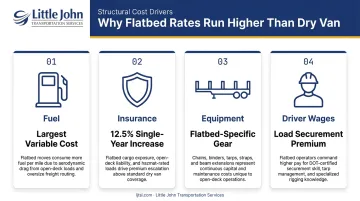
Flatbed rates aren't arbitrary. Four structural factors consistently push costs above dry van — and knowing them helps you anticipate what you're paying for.
Operating Costs Have a Higher Floor
ATRI reported trucking operating costs at $2.336/mile in 2025, up 3.4% year over year. For flatbed specifically, those costs are compounded:
- Fuel remains the largest variable cost component
- Commercial insurance premiums have risen sharply — ATRI recorded a 12.5% increase in a single year
- Equipment costs (trailers, tarps, straps, binders, chains) are flatbed-specific and not shared with dry van operations
- Flatbed drivers command a wage premium because the work is more physically demanding and skill-intensive
Unlike dry van drivers who drop and hook, flatbed drivers handle full load securement — and on complex loads like oversized machinery or steel coils, that can add two to three hours before the truck moves. That labor is in every quote.
Capacity Is Structurally Tight
The pool of qualified flatbed drivers is narrower than dry van. Flatbed requires specific skills in load securement and working knowledge of state permit requirements, and not every CDL holder qualifies. DAT tracked a flatbed load-to-truck ratio of 27.16 in October 2025, meaning roughly 27 loads competing for every available truck.
Fewer trucks chasing the same loads gives carriers pricing power that doesn't disappear when rates soften — it sets the floor for what flatbed will cost, regardless of market conditions.
Lane Imbalances Get Baked Into Your Rate
When freight flows predominantly into a region — a construction boom area, an energy corridor, a port hub — trucks leaving that region often run empty. Carriers factor those deadhead miles into inbound rates to remain profitable.
Shippers on imbalanced lanes absorb deadhead exposure in their pricing whether they realize it or not. It's not a line item. It's in the rate.
Load Specifications Multiply Costs
Standard flatbed rates assume legal dimensions: 102 inches wide, 13.5 feet tall, 80,000 pounds gross. The moment a load exceeds those thresholds, costs compound:
- State oversize/overweight permits required in every state crossed (fees vary widely; Texas starts at $60 for a general single-trip permit, with additional maintenance fees above 80,000 lbs)
- Pilot/escort vehicles may be required depending on width, height, and length
- Travel restrictions may limit movement to daylight hours or specific routes
- Hazmat loads require certified drivers and specialized insurance, narrowing the carrier pool to a fraction of what's available for standard flatbed freight
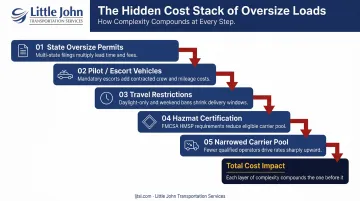
Each additional complexity stacks on the one before it.
Cost-Reduction Strategies for Flatbed Shipping
The most effective flatbed cost reduction isn't about finding the lowest quoted rate. It's about eliminating the conditions that allow avoidable costs to accumulate in the first place.
Strategies That Start Before the Load Moves
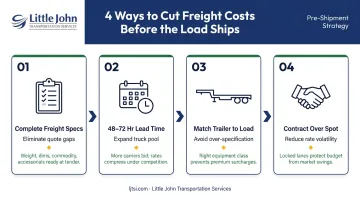
These are the highest-leverage decisions — specifications, timing, and procurement method all set the cost ceiling before a carrier is contacted.
- Provide complete freight specifications upfront. Carriers quote conservatively when dimensions, weight, or commodity type are vague, then correct upward once they inspect the actual load. Precise measurements, weight, commodity description, and any permit or hazmat requirements eliminate that gap and typically result in more accurate — and lower — initial quotes.
- Book with 48–72 hours of lead time minimum. Last-minute flatbed bookings (under 24 hours) compete for a much smaller pool of available trucks. The rate premium for same-day or next-morning bookings is real.
- Match trailer type to actual freight requirements. Over-specifying equipment — booking a lowboy or double-drop when a standard flatbed will do — adds unnecessary cost. Confirm the minimum equipment type required by load dimensions and weight, not the maximum available.
- Shift recurring volume from spot to contract pricing. Spot rates are the most expensive option in a carrier-favored market; for shippers with predictable lane volume, quarterly or annual contracts reduce exposure to swings in either direction.
In June 2026, the spot-contract spread had narrowed to $0.11/mile linehaul — but in December 2025, contract rates ran $0.52/mile above spot. That spread can reverse quickly, which is exactly why locking in contract pricing on predictable lanes matters.
Strategies That Improve How Freight Is Managed
These approaches reduce cost by improving control during the shipping lifecycle — specifically around how loads are quoted, structured, and audited.
- Standardize quote requests to compare all-in. Require every carrier or broker to itemize base rate, fuel surcharge, equipment fees, and accessorial charges. A lower base rate with unspecified tarping fees often costs more than a slightly higher all-in quote.
- Consolidate smaller loads into fuller flatbed utilization. A half-loaded flatbed costs nearly as much as a full one. Identify recurring outbound patterns, batch shipments, and build consolidation windows into your planning cycle to reduce cost per unit.
- Audit accessorial charges before and after each shipment. Confirm tarping requirements, detention free-time policies, stop charges, and permit costs before booking — not after the truck is dispatched. Post-delivery invoice audits comparing quoted accessorials to what was billed surface patterns that can be addressed in future negotiations.
Strategies That Address the Structural Context
These approaches target the surrounding conditions — lane economics, market timing, and carrier relationships — that often drive more cost than the load itself.
- Shift shipments to off-peak windows where operationally feasible. Flatbed rates peak during mid-spring through late summer (construction season) and again in November–December. DAT reported Texas outbound flatbed rates reaching $3.40/mile in June 2026, well above national averages. Shifting shipments even a few weeks earlier or later — and choosing mid-week pickups over Fridays — opens up better carrier availability and more competitive pricing.
- Build carrier relationships on high-volume lanes rather than shopping each load individually. Carriers prioritize shippers who offer consistent, predictable volume on lanes where they already have backhaul freight. That pairing — your outbound load plus their existing return load — cuts deadhead exposure and produces better rates. Dispersing volume across too many brokers leaves no single carrier with enough incentive to offer preferred pricing.
For companies moving heavy, oversized, or complex flatbed freight that most carriers decline, access to capacity is itself a cost lever. Little John Transportation Services manages 65,000+ vetted carriers and 8,000+ dedicated owner-operators across key U.S. corridors — giving shippers reach into specialized capacity that a spot market call typically cannot match.
- Share freight calendars 3–4 weeks out. Carriers and brokers can position trucks more effectively — and price more competitively — when they have visibility into upcoming load volume before the pickup window tightens. A shipper who shares a monthly freight schedule gets treated differently than one who calls 12 hours before pickup. That visibility converts reactive spot bookings into planned, relationship-based freight moves.
Conclusion
High flatbed shipping rates in the USA are structural — capacity constraints, labor premiums, fuel costs, and lane imbalances are real and aren't going away. But a significant share of what shippers overpay originates in controllable decisions: underspecified freight, last-minute bookings, spot market dependency, and quote comparisons that don't account for accessorials.
Identifying where your cost actually comes from is the prerequisite for reducing it.
Cost reduction in flatbed freight is a continuous operating discipline, not a one-time negotiation. Shippers who treat flatbed as a relationship-based, planning-intensive mode — rather than a commodity to be shopped at the last minute — see the results in predictable rates and fewer invoice surprises. If your freight regularly runs oversize, hazmat, or cross-border, working with a carrier that specializes in exactly that will consistently outperform piecing together spot coverage from generalist brokers.
Frequently Asked Questions
What is the going rate for flatbed freight?
The national flatbed spot rate averaged $3.69/mile all-in in June 2026, according to DAT. Regional rates vary — Scale Funding tracked the Southeast at $4.05/mile and the West at $3.23/mile around the same period. Oversized, hazmat, or multi-stop loads will run above these averages.
What is the DAT rate per mile for flatbed?
DAT Trendlines tracks average spot and contract rates per mile by mode and region. The most recent DAT national flatbed spot average was $2.94/mile linehaul ($3.69/mile all-in) for June 2026. DAT rates are market averages covering lanes of 250+ miles — your actual quote on a specific lane will shift based on equipment specs, pickup timing, and how tight capacity is running in that corridor.
How much does it cost to ship 1,000 lbs on a flatbed?
Flatbed pricing is based on per-mile rate and load specs, not weight alone. A 1,000-lb shipment generally won't fill a flatbed — LTL or partial load options are usually a better fit. If dimensions require flatbed, you pay the full trailer rate regardless of how much space the load actually takes up.
Why are flatbed rates higher than dry van rates?
Flatbed requires a more skilled driver (load securement, tarping, permit knowledge), more labor time per shipment, and specialized equipment that is in shorter supply. Cargo often requires state permits, pilot vehicles, or travel restrictions — none of which dry van shippers face. Each factor adds cost.
How can I reduce my flatbed shipping costs?
Five moves that cut your flatbed bill:
- Book with 48–72 hours of lead time minimum
- Shift recurring volume to contract pricing on predictable lanes
- Provide exact freight specifications upfront — dimensions, weight, and any permit triggers
- Consolidate loads to maximize trailer utilization
- Compare quotes all-in (base rate + fuel surcharge + accessorials), not per-mile alone
What is the difference between spot and contract rates for flatbed?
Spot rates are priced per load at current market conditions; contract rates lock in pricing for a defined volume over a set term. In December 2025, contract rates ran $0.52/mile above spot — by June 2026, that gap had collapsed to $0.11/mile. Shippers with predictable lane volume should be on contract to avoid riding that spread in either direction.