Introduction
Picture this: a critical piece of equipment is sitting at a supplier's yard 400 miles away. Your job site goes idle tomorrow without it. A full semi-truck isn't justified for one piece of machinery, and LTL will take three days you don't have. Flatbed hot shot trucking exists precisely for this gap: urgent, open-deck loads too large or awkward for enclosed carriers, too small to justify a full flatbed semi booking, and too time-sensitive for standard freight schedules.
This article covers what flatbed hot shot trucking is, how it works, what cargo it's designed for, and the specific advantages it delivers to shippers in industries like construction, oil and gas, and industrial manufacturing.
Key Takeaways
- Flatbed hot shot trucking moves urgent, partial open-deck loads using Class 3–5 pickup trucks — not full semis
- Speed defines "hot shot" — it's an urgency designation, not a truck size or DOT classification
- Three trailer configurations cover most loads: gooseneck, dovetail, and bumper-pull
- Same-day or next-day dispatch is standard; a dedicated truck goes direct from pickup to delivery
- Construction, oil and gas, industrial manufacturing, and energy are the primary industries served
What Is Flatbed Hot Shot Trucking?
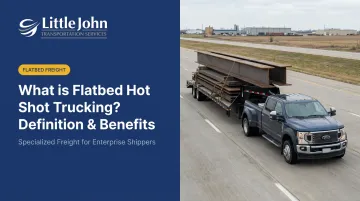
Flatbed hot shot trucking is the expedited transport of time-sensitive, partial loads on open-deck flatbed trailers pulled by medium-duty Class 3–5 pickup trucks. The "hot shot" label has nothing to do with truck size — it originated in oilfield operations where urgent parts runs had to happen same-day or not at all, and today it describes any freight move where speed is the primary driver.
The flatbed element is what separates this from other hot shot configurations. An open-deck trailer has no walls, no roof, and no dimensional restrictions that would make an enclosed trailer impractical. That matters when you're moving steel pipe sections, a compact excavator, or an industrial generator — cargo that simply can't fit inside a box trailer.
How It Fits the Freight Ecosystem
Flatbed hot shot isn't a replacement for full truckload or standard flatbed semi service. It occupies a specific middle ground:
- Too large or irregular for LTL or enclosed freight carriers
- Too small or urgent to justify booking a 48–53-foot flatbed semi
- Too time-sensitive to wait for a multi-stop consolidated route
It's a distinct service — not a cheaper version of standard truckload. Partial loads on dedicated trucks move faster than freight waiting for a full trailer to fill, which is the entire point.
Who Uses It
Industries with urgent, unplanned freight needs rely on flatbed hot shot most heavily:
- Oil and gas — replacement rig parts, downhole tools, wellhead components
- Construction — a single delayed piece of equipment can shut down an entire job site; AGC's 2024 survey found 21% of contractors reported transportation or delivery delays affecting project timelines
- Industrial manufacturing — machinery breakdowns that require fast parts delivery
- Energy and power — transformer components, generators, and utility equipment needed urgently
- Agriculture — seasonal equipment and time-critical replacement parts
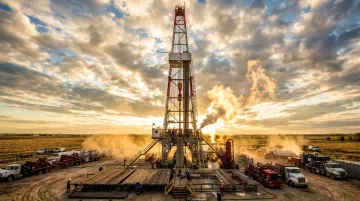
Most flatbed hot shot trailers run 30 to 40 feet in length, compared to the 48–53-foot standard for full-size flatbed semis. Payload capacity varies by trailer model and configuration. Shippers should confirm specific weight ratings with their carrier, since manufacturer specs and applicable axle/bridge limits determine the actual legal payload for any given combination.
How Flatbed Hot Shot Trucking Works: Equipment and Capacity
The power unit in a hot shot operation is a medium-duty Class 3, 4, or 5 pickup truck — with GVWR ranging from 10,001 to 19,500 pounds. These are purpose-built tow vehicles, but they're not Class 8 semi-tractors. For partial loads, deploying a Class 3–5 truck is faster, more flexible, and substantially cheaper than coordinating a full tractor-trailer.
The Three Main Trailer Types
The trailer choice is determined by the freight — not the other way around.
| Trailer Type | Best For | Key Feature |
|---|---|---|
| Gooseneck | Larger hot shot loads; machinery and structural materials | Hitch connects in the truck bed; superior stability and higher capacity |
| Dovetail | Self-propelled equipment — compact tractors, skid steers | Sloped or ramped rear section for drive-on loading |
| Bumper Pull | Lighter loads, shorter hauls | Hitch behind the vehicle; simpler setup, lower capacity |
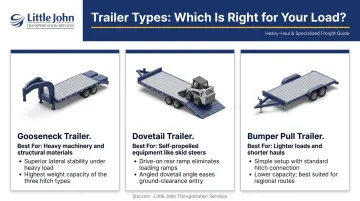
Gooseneck trailers are the most common in professional hot shot operations. They offer longer deck lengths — commonly up to 40 feet — and handle the weight demands of industrial and oilfield freight better than bumper-pull configurations.
Understanding the Limits
Flatbed hot shot trailers are meaningfully smaller than full-size commercial flatbeds. A standard 48-foot flatbed semi can carry approximately 45,000–48,000 pounds of cargo.
Hot shot trailers operate in a narrower range. Manufacturer ratings for common gooseneck models typically fall between 8,000 and 21,000 pounds depending on the specific unit. Lawful payload is further constrained by truck GVWR, axle ratings, hitch specifications, and state bridge laws.
When freight approaches or exceeds what a hot shot rig can legally carry, a standard flatbed or step-deck is the right call. If you're unsure where your load falls, that's a conversation worth having before dispatch — not after.
What Types of Freight Move Best via Flatbed Hot Shot Trucking?
The ideal flatbed hot shot load has three characteristics: it's time-sensitive, it won't fill a full semi, and it needs an open deck.
Common cargo types include:
- Oilfield replacement parts and wellhead equipment
- Single construction machines (compact excavators, skid steers)
- Steel pipe sections and structural steel
- Industrial generators and transformers
- HVAC units and building systems components
- Wind energy components moved in segmented loads
- Agricultural equipment and implements
Industries With the Most Urgent Need
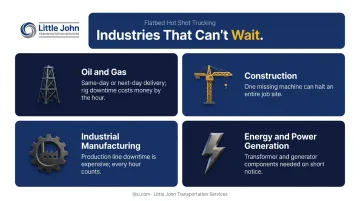
Four industries drive the majority of flatbed hot shot demand:
- Oil and gas — The original hot shot industry. A rig down waiting on a part loses money by the hour; components have to arrive same-day or next-day, with no margin for a scheduled route.
- Construction — One missing piece of equipment can halt an entire job site. When freight is already available and just needs to move, flatbed hot shot eliminates the wait.
- Industrial manufacturing — A production line waiting on a replacement part isn't just inconvenient. Downtime is expensive, and every hour counts.
- Energy and power generation — Transformer and generator components are frequently needed on short notice, especially during grid maintenance or emergency restoration work.
When Flatbed Hot Shot Is NOT the Right Choice
- Loads exceeding the trailer's weight or length capacity
- Fragile freight requiring air-ride suspension or enclosed environmental protection
- High-volume shipments where full truckload economics are clearly superior
- Hazardous materials requiring specialized containment beyond open-deck securement
Each of these situations calls for a different mode — flatbed hot shot excels when speed, partial load size, and open-deck access all align.
Key Benefits of Flatbed Hot Shot Trucking for Shippers
Speed and Direct Routing
Hot shot loads are frequently dispatched same-day or next morning, with some urgent requests moving within the hour. A dedicated truck and trailer go straight from pickup to delivery — no terminal consolidation, no multi-stop routes, no waiting for a full trailer to stage. For shippers on tight timelines, that directness is what justifies the mode.
Cost Efficiency on Partial Loads
Booking a 53-foot flatbed semi to move one piece of machinery wastes capacity you're paying for. Flatbed hot shot scales to the actual load. The lower overhead of Class 3–5 trucks versus full tractor-trailers keeps per-load rates competitive when the freight doesn't fill a full semi.
Per-mile rate benchmarks vary by urgency, distance, and lane demand. Truckstop's December 2024 guidance puts general hot shot carrier rates around $1.50 per mile, with urgent loads reaching $2 per mile. Shipper rates will reflect brokerage margin and market conditions on top of those figures.
Dedicated Visibility
Every flatbed hot shot load has one driver and one trailer going to one destination. No shared-space complications, no intermediate stops that blur transit timing. Operations teams that need precise ETAs get a cleaner picture than multi-stop LTL allows.
For cross-border freight, that visibility matters even more. Little John Transportation Services pairs 24/7 dispatch and real-time tracking with bilingual English/Spanish support — a practical advantage on U.S.–México lanes where coordination across two countries is the norm.
Flexibility for Irregular Cargo
Open deck means no dimensional restrictions for loading. Machinery with odd protrusions, long steel sections, crane-loaded equipment — flatbed hot shot handles cargo that enclosed trailer carriers routinely refuse. That's not a workaround; it's the designed purpose of the mode.
Expanded Carrier Pool
Opening a shipment to the flatbed hot shot carrier market increases the number of trucks competing for the load. That matters most when standard flatbed capacity tightens. More competing trucks means:
- Faster booking in high-demand lanes
- Downward rate pressure when supply is available
- Fallback options if a primary carrier falls through
In constrained markets — think Gulf Coast energy corridors during active drilling seasons — that depth in the carrier pool is often the difference between moving freight today and waiting two days.
Flatbed Hot Shot vs. Standard Flatbed Trucking: Key Differences
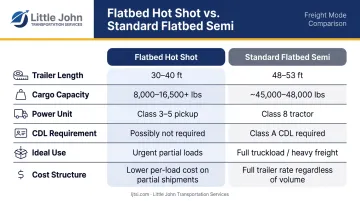
| Dimension | Flatbed Hot Shot | Standard Flatbed Semi |
|---|---|---|
| Trailer Length | Typically 30–40 ft | Commonly 48–53 ft |
| Cargo Capacity | Model-dependent; commonly 8,000–16,500+ lbs | ~45,000–48,000 lbs typical |
| Power Unit | Class 3–5 pickup (10,001–19,500 lb GVWR) | Class 8 semi-tractor (33,001+ lb GVWR) |
| CDL Requirement | Depends on combination weight; non-CDL possible below 26,001 lb GCWR | Class A CDL required |
| Typical Use Case | Urgent partial loads; time-sensitive freight | Full truckload; high-volume or heavy freight |
| Cost Structure | Lower per-load on partial shipments | Full trailer rate regardless of load volume |
When Standard Flatbed Wins
Standard flatbed is the better call when:
- The load exceeds hot shot trailer weight or length capacity
- Freight requires air-ride suspension for vibration-sensitive equipment
- Volume makes full trailer economics clearly superior
- Multiple pickup points require a longer trailer
The right mode depends entirely on what's moving and what it costs to delay it.
A Note on Compliance
Hot shot operations using Class 3–5 trucks for interstate commerce become subject to FMCSA regulations at 10,001 pounds combined weight (the threshold for commercial motor vehicle classification). CDL requirements generally trigger at a gross combination weight rating of 26,001 pounds or more when the towed unit exceeds 10,000 pounds.
Carriers operating below that CDL threshold still need a USDOT number, operating authority for interstate for-hire transport, and minimum liability insurance of $750,000 under 49 CFR 387.9. "Non-CDL" does not mean unregulated. Verify current FMCSA requirements at fmcsa.dot.gov before drawing compliance conclusions.
What to Look for in a Flatbed Hot Shot Trucking Provider
Three things matter most when vetting a carrier:
1. Verified safety and compliance credentials Look for an FMCSA Satisfactory safety rating — held by only about 6% of carriers. Confirm the carrier has a valid DOT number, active operating authority, and appropriate liability coverage. A Satisfactory rating means federal reviewers found adequate safety management controls in place, not just paperwork.
2. Real dispatch communication Hot shot freight is time-critical. A provider with live, human dispatchers available around the clock — not automated ticketing systems — is the difference between a confirmed ETA and a status update that arrives after the problem does. Little John Transportation Services operates with 24/7 dispatch and bilingual support, which matters when freight is moving through U.S.–México corridors where Spanish-English fluency affects coordination speed.
3. Network depth and carrier quality A single owner-operator can cover one lane. A provider with a vetted, multi-regional pool of flatbed hot shot operators can cover your planned load and absorb the emergency run you didn't see coming.
Beyond those three, dig into the numbers and freight experience before committing:
- Cargo claims rate: Little John carries a 99.9% claim-free delivery rate across heavy-haul operations — a direct measure of how carefully freight is handled.
- Crash frequency: Little John's DOT crash frequency runs near half the national average, reflecting operational discipline that reduces shipper risk.
- Specialized freight experience: For oversized equipment, irregular dimensions, or freight most carriers decline, ask how many years and trailer types a provider actually operates. Little John maintains over 7,000 specialized trailers and 30+ years moving complex freight across North America — including configurations standard carriers typically pass on.
Frequently Asked Questions
Can you hot shot with a flatbed truck?
Yes — flatbed trailers are among the most common configurations in hot shot trucking, specifically for open-deck freight like machinery, steel, and construction equipment that can't fit in enclosed trailers. Gooseneck and dovetail flatbed trailers are the most widely used in professional hot shot operations.
What is a hot shot trucker?
A hot shot trucker is a driver (typically an owner-operator) who hauls time-sensitive, partial loads using a medium-duty Class 3–5 pickup truck and trailer rather than a Class 8 semi — delivering a dedicated, fast-moving freight solution without the overhead of a full semi booking.
What is the weight limit for a flatbed hot shot trailer?
There is no single federal weight limit for hot shot trailers — lawful payload depends on truck and trailer ratings, axle limits, and applicable state bridge laws. Common gooseneck configurations range from 8,000 to 21,000+ pounds. Confirm limits with your carrier based on the specific equipment being deployed.
What types of freight are ideal for flatbed hot shot trucking?
Open-deck, time-sensitive partial loads: oilfield equipment, construction machinery, steel or structural sections, HVAC units, industrial parts, and similar cargo that is oversized for enclosed trailers but doesn't fill a full flatbed semi.
How much does flatbed hot shot trucking cost?
Rates vary based on distance, freight weight and dimensions, lane demand, and urgency. Truckstop's December 2024 benchmark places general hot shot carrier rates around $1.50 per mile, with urgent loads reaching $2 per mile. For partial loads that don't justify a full semi booking, hot shot is often more cost-effective — you pay for the capacity you actually use, not an empty trailer.