Introduction
Your company just won a major industrial contract. The centerpiece: a 200-ton power transformer that needs to move from a manufacturing facility in Texas to a construction site in northern Mexico. You call three carriers. All three say no.
That's precisely what project cargo logistics exists to solve — a category of freight so demanding that most carriers won't touch it.
According to TT Club, project cargo covers large, heavy, high-value, or complex equipment that is typically critical to a specific project — freight that standard carriers simply aren't equipped to handle. The gap between "standard" and "specialized" isn't a matter of degree; it's a matter of capability.
This guide covers what project cargo is, the main types, how the shipping process works, what challenges to plan for, and how to evaluate carriers before you commit.
Key Takeaways
- Project cargo refers to freight that exceeds standard dimensional or weight limits and requires custom planning for every shipment
- Routing, equipment selection, and permits are custom-engineered for each move — no two project cargo shipments are handled the same way
- Industries like oil and gas, renewable energy, and data center construction depend on project cargo logistics
- Specialized certifications (FMCSA, CTPAT, ISO 9001:2015) separate qualified carriers from general freight providers
- Engaging a specialist before the move begins is the most reliable way to protect your schedule and budget
What Is Project Cargo?
Project cargo is the specialized transportation of large, heavy, high-value, or mission-critical freight that exceeds the parameters of standard shipping. This includes items that cannot fit standard ISO containers — which measure nominally 20 ft × 8 ft × 8 ft 6 in — or that exceed conventional flatbed trailer limits without custom handling, routing, and equipment.
The term has a few variations worth knowing:
- Heavy lift cargo — used interchangeably, particularly for marine transport
- Project forwarding / project logistics — the logistics process behind moving it
- DSU (Delay in Start Up) insurance — a related insurance term covering financial losses when insured physical damage delays project completion
What Triggers Project Cargo Classification?
There's no single universal threshold, but common triggers include:
- Gross vehicle weight exceeding federal Interstate limits (80,000 lbs, or 20,000 lbs on a single axle)
- Cargo that cannot be disassembled to fit standard containers or trailers
- Items requiring engineered lift points, specialized securement, or custom routing
- Freight where damage or delay would halt an entire project
Complexity is the defining characteristic, not just size or weight. Every project cargo shipment requires custom planning from scratch — dimensions, weight, destination, and handling requirements differ every time.
Why It Matters Operationally
Without project cargo capabilities, large-scale industrial projects cannot be built on time or on budget. The equipment doesn't fit standard transport, and delays don't just inconvenience a single shipment — they stall entire construction timelines.
Industries that depend on this category include:
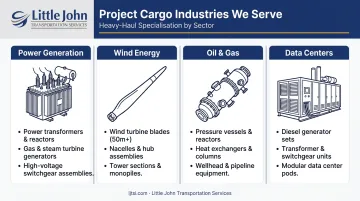
- Power generation — gas turbines, transformers, and boiler assemblies
- Wind energy — nacelles, tower sections, and oversized blade components
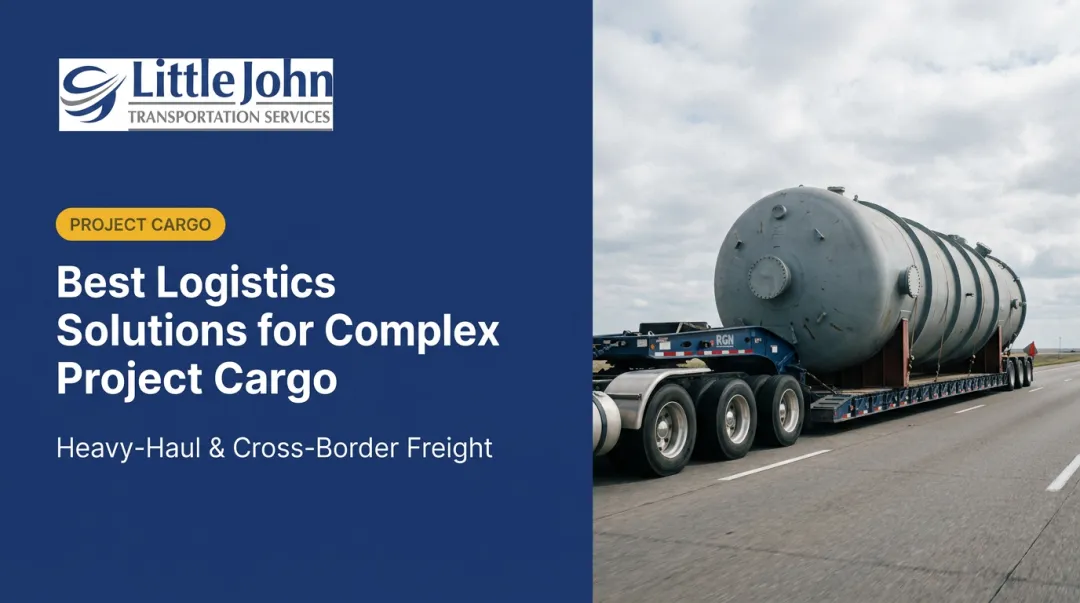
- Oil & gas — refinery modules, pressure vessels, and drilling equipment
- Data centers — generator sets, switchgear, and large UPS systems
Types of Project Cargo
Project cargo spans several freight categories. What they share: none of them fit standard shipping infrastructure.
Oversized and Heavy Equipment
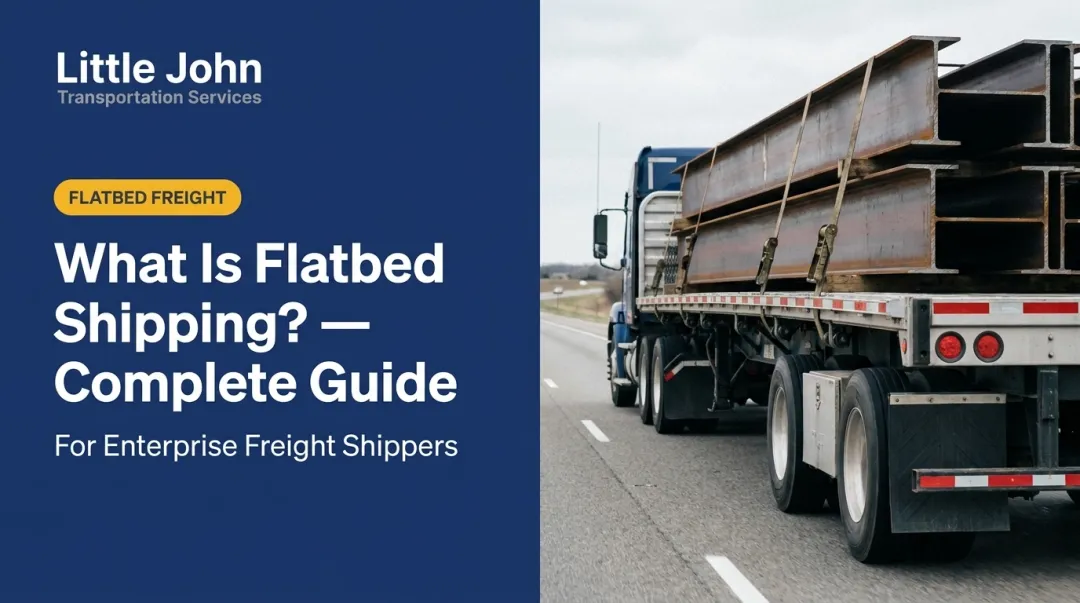
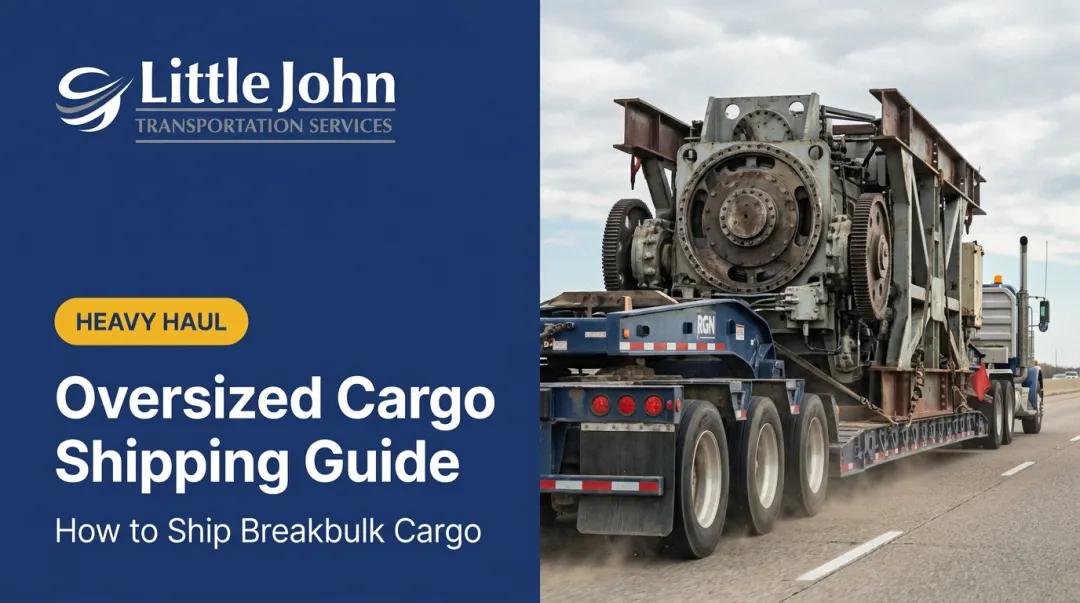
Single items exceeding standard dimensional or weight limits — industrial turbines, compressors, generators, large CNC machinery. These require specialized trailers such as RGN (Removable Gooseneck), lowboy, or multi-axle configurations, and often need road survey clearance before transport begins.
Breakbulk Cargo
Items that can't be containerized efficiently: pipes, steel structures, pre-fabricated sections. These are loaded loose or in units onto specialized vessels or flatbed configurations. Maersk defines breakbulk as non-unitized, non-containerized cargo transported in a vessel hold or on deck — closely related to project cargo, though the terms aren't interchangeable.
Industrial Modules and Pre-Fabricated Units
Pre-fabricated factory or plant sections that can weigh hundreds of tons and cannot be disassembled for shipment. One documented example: a Siemens module moved for Australia's Loy Yang power station weighed 350 tons. These require heavy-lift vessels and specialized cranes at the port of discharge.
Renewable Energy Components
Wind energy has become one of the highest-volume project cargo segments. Modern land-based turbine blades exceed 170 feet in length, with offshore blades reaching over 350 feet. Globally, wind capacity additions rose by nearly 40% in 2025, reaching approximately 160 GW. Every blade, tower section, and nacelle on those turbines moved as project cargo.
That scale drives real operational complexity. Little John Transportation Services handles wind turbine blades as a named specialty within their Energy & Power division — using multi-axle trailer combinations, RGN configurations, and blade-specific route engineering to manage the geometry at every turn.
Industry Applications
The industries most reliant on project cargo:
- Oil and gas — rig components, pipelines, drilling equipment
- Energy and power generation — transformers, boilers, reactors
- Heavy excavators, mining presses, and construction cranes — construction and mining equipment routinely exceeds standard weight and width limits
- Military and defense — vehicles, aircraft, production platforms (USTRANSCOM regularly charters dry-cargo ships for items too large for containers)
- AI infrastructure and data centers — large-scale server modules, cooling systems, and switchgear (the Journal of Commerce has reported data center megaprojects driving heavy-lift and project cargo volumes directly)
Project Cargo vs. General Cargo: Key Differences
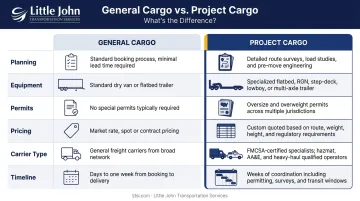
The core distinction is repeatability. General cargo is routine — palletized goods moving through standardized infrastructure with predictable cost and predictable process. Project cargo is custom by necessity.
| Factor | General Cargo | Project Cargo |
|---|---|---|
| Planning | Standardized | Custom for every shipment |
| Equipment | Standard containers, trailers | Specialized trailers, heavy-lift vessels |
| Permits | Not required | State, local, and border approvals |
| Pricing | Volume-based, predictable | Weight, dimensions, routing, jurisdiction-specific |
| Carrier type | Any licensed carrier | Specialist with verified experience |
| Timeline | Reliable | Dependent on permits, equipment, and routing |
Standard freight forwarders and general carriers lack the equipment networks, regulatory experience, and engineering capability to handle project cargo. Attempting to use them for oversized or overweight loads results in refusals, delays, damage, and non-compliance — sometimes all four.
Project cargo pricing is driven by several variables that interact differently on every move:
- Weight and dimensions relative to legal limits
- Routing complexity and jurisdictions crossed
- Required equipment type and availability
- Regulatory permits at state, local, and border levels
- Timeline urgency and escort requirements
Engaging a specialist early gives you accurate cost data before it becomes a budget problem.
How Project Cargo Shipping Works
Project cargo is a phased, engineered process. Planning starts long before the load moves.
Pre-Transport Assessment and Planning
Before any equipment is booked, the logistics team reviews:
- Cargo dimensions, weight, and technical specifications
- Lift points and connection requirements
- Route surveys assessing road width, bridge weight limits, overhead clearances, and any infrastructure needing temporary modification (power lines, signal poles)
For complex moves, this phase may include site visits or third-party surveys. Little John's team processes over 100,000 oversize and overweight permits annually — a volume that reflects how deeply pre-transport assessment is embedded in their operation.
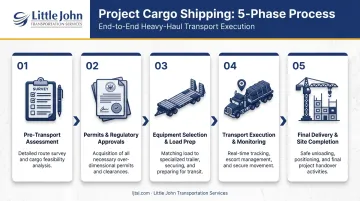
Permits, Regulatory Approvals, and Customs Documentation
Moving oversized or overweight cargo requires permits at every level. The federal government sets Interstate weight limits but does not issue movement permits — those come from individual state DOTs, and requirements vary significantly by jurisdiction.
For US-Mexico cross-border shipments, additional layers apply:
- CTPAT validation for cargo security
- FAST lane eligibility for expedited border processing
- Customs bonds (CBP Form 301, continuous or single-entry)
- Export/import documentation and customs clearance on both sides
Little John handles all permitting in-house. Their stated policy: "We pull them, you don't."
Equipment Selection and Load Preparation
Trailer selection isn't arbitrary — the wrong configuration risks load failure, permit violations, or route restrictions. Common configurations include:
- RGN (Removable Gooseneck) — for ground-loading heavy equipment
- Lowboy / double-drop — for height-sensitive loads
- Multi-axle combinations — for extreme weight distribution
- Extendable trailers — for long, rigid cargo like turbine blades
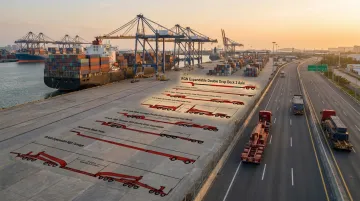
Specialized equipment can be booked months in advance — availability is a real planning constraint. Load preparation includes engineered lashing and tie-down points to make cargo road-ready before it moves.
Transport Execution and Monitoring
Oversized loads commonly travel during restricted hours: nighttime or off-peak windows, with pilot car escorts coordinated to load width and corridor requirements. Georgia, for example, requires both a front and rear escort for loads wider than 12 feet. Law enforcement escort requirements vary by jurisdiction and permit conditions.
When multiple transport modes are involved — truck, rail, sea — continuous tracking and communication across the logistics chain manages timing at each handoff point.
Final Delivery and Completion
Last-mile delivery for project cargo often requires advance site preparation before the load arrives:
- Reinforced access roads capable of handling the load weight
- Crane pad placements for lift and set operations
- Equipment clearance at the installation point
Port discharge typically involves heavy-lift cranes, followed by final transport to the installation site. This phase requires close coordination between the logistics team, the site team, and any reassembly contractors involved.
Key Challenges in Project Cargo Logistics
Route Restrictions
Low bridges, weight-limited roads, sharp curves, and narrow passages can eliminate entire routing options — adding significant distance, time, and cost. Pre-route surveys aren't optional; they're how you find out before the load is already moving.
The NTSB has documented multiple bridge incidents involving oversized or overweight loads. Route engineering is a safety issue, not just a compliance checkbox.
Equipment and Timeline Risk
Heavy-lift cranes and specialized vessels have constrained availability and long lead times. Equipment delays cascade: if a 500-ton crane at port discharge isn't available when the vessel arrives, the schedule for an entire industrial construction project can slip by weeks.
Wood Mackenzie reported in 2023 that half of the existing offshore wind installation fleet was set to become unsuitable for larger turbines. That kind of capacity constraint doesn't stay confined to one sector — it tightens the market for every project competing for the same equipment.
Key risk factors that compound equipment delays:
- Crane and vessel lead times booked months in advance
- Weather windows that narrow available installation days
- Single points of failure when no backup equipment exists in region
- Cascading schedule slippage when one delay pushes crew mobilization costs
Regulatory and Cost Complexity
Overlapping permit jurisdictions, shifting requirements across borders, and weather-related delays create compounding uncertainty. On a large industrial project, even a short logistics delay can halt construction crews, idle equipment, and trigger contract penalties. With day rates for specialized installation crews running into five figures, a two-week delay doesn't just affect the logistics budget — it can put the entire project contract at risk.
What to Look for in a Project Cargo Carrier
Experience and Track Record
Look for carriers with demonstrated history moving your specific cargo type — not just general freight volume. Verify references and case history in the relevant cargo category: wind energy, oil and gas, defense, modular construction. A carrier that has moved similar loads in similar corridors knows where the problems show up before they do.
Certifications and Compliance Credentials
A qualified project cargo carrier should hold:
- FMCSA Satisfactory Safety Rating (held by roughly 6% of US carriers): confirms independently audited safety management systems are in place
- FMCSA Hazardous Materials Safety Permit (HMSP): required for certain regulated cargo classes, fewer than 1% of US carriers qualify
- CTPAT validation: essential for cross-border shipments, as it enables expedited border processing
- FAST certification: reduces border dwell time for North American corridor moves
- ISO 9001:2015: verifies that quality management processes are documented, repeatable, and independently audited
Little John Transportation Services holds all five, plus AA&E certification for Arms, Ammunition & Explosives. A 99.9% claim-free delivery rate and DOT crash frequency near half the national average — across 65 million+ miles annually — show what those credentials look like in practice.
Equipment Network and Cross-Border Capability
Confirm the carrier can field the trailer configurations your load actually requires: RGN, lowboy, multi-axle, extendable. General flatbed capacity is not a substitute. For cross-border shipments, verify established boots-on-the-ground teams, bilingual operations, and customs expertise at the crossing points your freight uses.
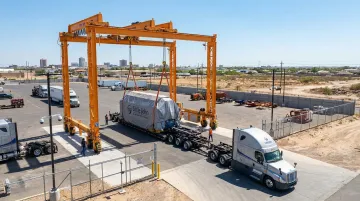
Little John's 50-acre CTPAT-compliant Laredo facility includes a 120-ton bridge crane for superload transloading. Bilingual operations teams are positioned in Laredo, Monterrey, and Guadalajara — so cross-border project cargo moves without handoff gaps at the border.
Frequently Asked Questions
What is project cargo?
Project cargo is the specialized transportation of large, heavy, high-value, or operationally critical freight that exceeds standard shipping dimensions or weight limits. Every shipment requires custom planning, specialized equipment, and expert coordination — no two moves are handled the same way.
What are examples of project cargo?
Common examples include industrial turbines, generators, oil rig components, wind turbine blades and towers, pre-fabricated factory modules, military vehicles and aircraft, and large power infrastructure like transformers and reactors.
What is the difference between general cargo and project cargo?
General cargo follows standardized processes and fits within routine container or truck limits. Project cargo exceeds those limits and requires custom routing, specialized equipment, and unique regulatory handling — meaning a standard carrier cannot legally or physically move it.
What is project cargo insurance?
Project cargo insurance is specialized marine cargo coverage — often including DSU (Delay in Start Up) protection — that covers financial loss when physical damage delays project completion. Cost drivers include route, transit duration, cargo value, and the project's expected income stream.
What industries use project cargo shipping?
The primary industries include oil and gas, energy and power generation, renewable energy, construction and mining, military and defense, industrial manufacturing, and AI infrastructure and data center development.
How do I choose a project cargo carrier?
Look for demonstrated experience in your specific cargo category, not just general heavy freight. Key qualifications include an FMCSA Satisfactory rating, HMSP certification, CTPAT validation, ISO 9001:2015, and a verified claim-free delivery record. Ask for references from comparable moves and confirm cross-border capability if your route requires it.