This guide breaks down exactly what demurrage and detention are, how charges are calculated, what triggers them, and the specific steps you can take to avoid them. It also covers the elevated risk at U.S.-Mexico border crossings, where dual customs processes create compounding exposure that domestic-only shippers rarely anticipate.
Key Takeaways
- Demurrage = container sitting inside the port beyond free days; detention = equipment held outside the port
- Maersk's current U.S. tariff starts at $300/day for general dry containers and escalates to $745/day at high-volume ports like Newark
- Pre-clearing customs before vessel arrival is the single most effective way to prevent demurrage
- Cross-border shipments carry double the documentation risk, as errors in either U.S. or Mexican customs filings can trigger holds on both sides
- Disputed invoices can be challenged — and missing required billing information eliminates the payment obligation entirely under 46 CFR Part 541
Demurrage vs. Detention: Understanding the Difference
These two terms get used interchangeably in practice, which causes real operational problems — because they require different responses from different people.
Demurrage: The Port Clock
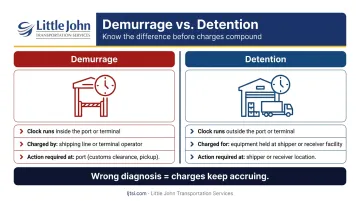
Demurrage is the fee charged by a shipping line or marine terminal when a container remains inside the terminal beyond the allotted free days without being picked up. The clock runs while the container is physically on port property. Per FMC definitions, demurrage accrues when a container exceeds free time on a marine terminal.
When you have a demurrage problem, you need to act at the port — expedite customs clearance, arrange pickup, or contact the terminal directly.
Detention: The Equipment Clock
Detention is charged when the container or carrier equipment is held outside the terminal beyond the allowed free period. This includes:
- Delaying return of an empty container to the depot
- Keeping a full container at your facility while unloading
- Driver waiting time at a shipper or receiver beyond the standard free window
When you have a detention problem, the action is at your facility or your carrier's operation — not the port.
Per Diem: The Third Term
"Per diem" is where the terminology gets slippery. In maritime shipping, per diem means the same thing as container detention — MSC explicitly uses the term to describe daily charges for container use outside the terminal. In trucking, per diem refers to driver waiting time charges after the free period expires at a pickup or delivery location.
The practical distinction: demurrage = inside the port; detention = outside the port. Misidentifying which clock is running sends you to the wrong party — and charges keep accruing while you sort it out.
How Demurrage and Detention Charges Are Calculated
Free Days and How They're Counted
Most ocean carriers provide 4 working days of free time for standard dry import containers before demurrage begins. Reefers and special equipment typically receive only 2 working days. Rail ramp drayage often carries a 3-working-day window. "Working days" and "calendar days" are not interchangeable: charges accrue by calendar day once free time expires.
The Escalating Tier Structure
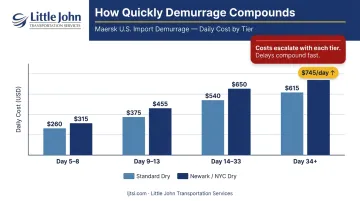
Demurrage doesn't stay flat. Carriers use tiered rate schedules where costs increase the longer cargo sits. Maersk's current U.S. import tariff (effective June 20, 2026) illustrates how quickly costs compound:
| Cargo Type | Free Time | Day 5–8 | Day 9–13 | Day 14+ |
|---|---|---|---|---|
| General dry (most ports) | 4 working days | $300/day | $345/day | $395/day |
| Newark/NYC dry | 4 working days | $390/day | $500/day | $745/day (day 34+) |
| Operating reefer | 2 working days | $490/day | $590/day | $640/day |
| Rail-ramp dry | 3 working days | $190/day | $250/day | $280/day |
Source: Maersk U.S. Import Demurrage Tariff, effective June 2026
A container sitting at Newark for 20 days doesn't cost 20× the day-5 rate. It costs progressively more each tier, which is a common source of shock when invoices finally arrive.
Container Detention Rates
Demurrage isn't the only clock running. Off-terminal container detention under the same Maersk tariff runs $210–$585/day depending on container type and duration.
Driver detention is a separate calculation. FMCSA research found it typically occurs at roughly 1 in 10 stops, averaging 1.4 hours beyond a standard 2-hour free window, with costs varying by carrier hourly rate.
Common Causes of Demurrage and Detention Charges
The causes fall into three categories:
Port-side and transit causes:
- Terminal congestion limiting available pickup windows
- Vessel arrival delays that compress the effective free-time window
- CBP examinations or customs holds preventing cargo release
Documentation and compliance failures:
- Incorrect or missing bills of lading
- Late submission of customs entries or ISF filings
- Unpaid duties or disputes between shipper and consignee
- Documentation errors that trigger holds — correctable before cargo ever ships
Operational and coordination gaps:
- No backup carrier plan when the primary carrier isn't available
- Receiving facility not ready when the container arrives
- Poor scheduling relative to the detention clock on dropped containers
- Lack of real-time shipment visibility causing missed pickup windows
Proven Strategies to Avoid Demurrage Charges
Prepare Before the Vessel Arrives
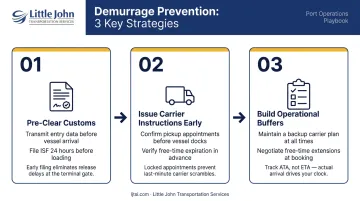
Pre-clear customs before the ship docks. Under CBP's ACE Cargo Release system, importers and brokers can transmit entry data before merchandise arrives in the U.S. The Importer Security Filing (ISF/10+2) must generally be filed no later than 24 hours before cargo is loaded onto a U.S.-bound vessel.
File these documents early so CBP can begin processing before arrival:
- Commercial invoice
- Packing list
- Bill of lading
- Any required permits or licenses
When CBP starts processing pre-arrival, your container is ready for pickup the day it's available — not a day or two after.
Issue delivery instructions to your inland carrier before the vessel arrives. Confirm pickup appointments, share port release details, and align on free-time expiration dates. The carrier should be positioned and ready to move the moment the container is available — not sourced after the fact.
Build Operational Buffers
Three practices that separate shippers who rarely pay demurrage from those who routinely do:
Maintain a backup carrier plan. At congested ports, your primary carrier may not be available within the free-time window. A vetted secondary option on standby eliminates the scramble before it starts.
Plan around Actual Time of Arrival (ATA), not estimated. ETA is a forecast; ATA is when free time actually starts counting. Teams that dispatch against the estimate often find themselves a day behind before they've done anything wrong.
Negotiate extended free time before booking if you move significant container volumes. Maersk offers a purchasable free-time extension product, and carriers reserve negotiated laytime for high-volume shippers — but that conversation happens at contract time, not when the ship is at anchor.
Having a pre-qualified carrier bench is where this pays off most under time pressure. Little John Transportation Services' network of 8,500+ owner-operators and 65,000+ approved carriers — vetted nightly against legal and insurance standards — gives dispatchers exactly that: qualified capacity ready to move when your window opens.
Proven Strategies to Avoid Detention Charges
Detention is primarily a facility-readiness problem. The container gets out of the port on time — then sits at your dock waiting for someone to unload it.
The free period often begins at gate-out from the terminal, not at delivery, which means transit time is already eating into your window before the container reaches your dock. Three actions, taken before arrival, prevent most detention charges:
Confirm facility readiness in advance. Dock staff, forklift operators, and unloading equipment need to be staged at container arrival — not summoned afterward.
Build your unloading timeline backward from the detention deadline. Know exactly when the free period starts and schedule around that clock, not your facility's convenience. For complex freight — heavy machinery, oversized equipment, multi-piece industrial loads — the standard free window may not be sufficient.
Negotiate extended detention windows before pickup. This conversation is far easier before the container leaves the terminal than after you've received an invoice. Carriers will generally accommodate known operational requirements upfront; retroactive waivers require documented justification and rarely succeed.
For cross-border moves, the coordination window is tighter and the consequences of a missed step compound quickly. Little John's bilingual operations teams in Laredo, Monterrey, and Guadalajara run 24/7 dispatch specifically to manage this — confirming facility readiness on both sides of the border before the container ever leaves the terminal.
Special Considerations for Cross-Border Freight
U.S.-Mexico shipments carry materially higher demurrage and detention exposure than domestic moves. The reason: two separate customs authorities, each with their own documentation requirements and their own ability to issue holds.
Dual Customs = Double the Risk
U.S.-bound cargo must clear CBP at the U.S. port of entry. Mexico-bound cargo requires a completed pedimento for all commercial crossings, with annexes including the CFDI (Comprobante Fiscal Digital por Internet) transmitted electronically through Mexico's Ventanilla Digital. Errors in either system — a missing CFDI, an incomplete pedimento, a CAAT discrepancy — can trigger holds that generate demurrage simultaneously on both sides of the border.
The Laredo Volume Problem
According to Bureau of Transportation Statistics data, Laredo handled more than 3 million incoming trucks from Mexico in 2024, up 3.1% year over year. At that volume, inspection queues and congestion are not occasional events — they're routine. The effective free-time window at Laredo can compress significantly when CBP examination backlogs develop.
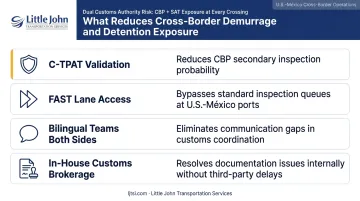
What Reduces Cross-Border Exposure
- C-TPAT validation — CBP-recognized security posture that reduces secondary inspection probability
- FAST lane access — dedicated lanes at U.S.-Mexico ports of entry that bypass standard inspection queues
- Bilingual teams on both sides of the border — eliminates the communication gaps that most commonly delay customs coordination
- In-house customs brokerage — resolves documentation issues internally rather than waiting on third-party brokers
Little John Transportation Services operates a 50-acre CTPAT-validated facility in Laredo built specifically for the Nuevo Laredo corridor. The infrastructure addresses each of the factors above directly:
- 120-ton bridge crane for superload transloads, completing most in under two hours
- 30-bay cross-dock and 1,200-trailer staging capacity to absorb queue delays
- Dedicated bilingual operations teams in Laredo, Monterrey, and Guadalajara
For shippers routing through this corridor, that on-the-ground coverage reduces the dwell time that converts into detention charges.
What to Do If You've Already Been Charged
Charges aren't always correct, and even when they are, some are disputable.
Verify the Invoice First
Under 46 CFR Part 541, demurrage and detention invoices must include specific minimum information: bill of lading and container numbers, port of discharge, why the billed party is liable, allowed free days, free-time start and end dates, import availability date, charged dates, specific rates, and dispute contact information. An invoice missing required minimum information does not create a payment obligation.
Check the terminal's timestamps against your own records. Errors in free-day counting — particularly around weekends, partial days, and the start date — are common. You have the right to request supporting documentation before paying.
Key invoice rules:
- Invoices must generally be issued within 30 calendar days of the last charged date
- You have at least 30 calendar days from invoice issuance to request mitigation, refund, or waiver
- The billing party generally has 30 days to resolve the request
Build a Dispute With Documentation
If the delay was outside your control, document everything and formally dispute with the issuing party. The FMC's 2020 Interpretive Rule identifies several circumstances relevant to the reasonableness of charges:
- CBP examinations and government-ordered holds
- Port closures and terminal congestion
- Force majeure events
- The carrier's own operational failures
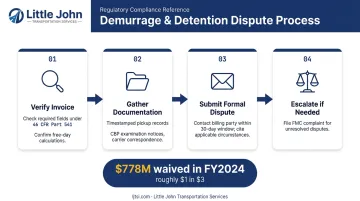
In FY2024, the FMC reported that carriers billed $2.34 billion and waived $778 million in demurrage and detention — roughly one dollar in three. The disputes that succeed share a common thread: timestamped records showing when cargo was available for pickup versus when it was actually retrieved. A logistics partner with audit-ready chain-of-custody documentation makes that case faster and harder to dismiss.
Frequently Asked Questions
How can I reduce shipping detention and demurrage charges?
Pre-clear customs before the vessel arrives, issue pickup instructions to your carrier before the ship docks, maintain a vetted backup carrier for congested ports, and confirm your receiving facility is fully staffed and equipped before the container arrives. Most charges are preventable with earlier action.
What is 14 days free detention and demurrage?
"14 days free" refers to a combined free-time allowance some carriers offer covering both demurrage at the terminal and detention for equipment return. The shipper has 14 calendar days from container availability before any charges begin. That's considerably more generous than the standard 4-working-day demurrage-only window most carriers provide.
How much is demurrage per day?
Rates vary by carrier, terminal, and container type. Maersk's current U.S. import tariff shows general dry containers starting at $300/day, escalating to $395/day after day 13 — and reaching $745/day at Newark for extended overstays. Reefers start at $490/day. These are carrier-specific tariff examples, not market averages.
What is the difference between demurrage and detention charges?
Demurrage is charged when a container remains inside the port terminal beyond its free days. Detention is charged when the container or equipment is held outside the terminal — at your facility, en route, or awaiting empty return — beyond the allowed free period.
Who is responsible for demurrage and detention charges?
The importer or consignee is generally responsible for demurrage. The party holding the equipment is responsible for detention. Under U.S. regulations, a single invoice cannot be sent simultaneously to multiple parties for the same charge — the billing party must identify the specific contractual basis for holding the billed party liable.
Can demurrage and detention charges be disputed?
Yes. You can dispute charges when dates were miscalculated, when delays resulted from force majeure or carrier error, or when documentation shows the container was available within the free period. The FMC's complaint process provides a formal channel, and carriers must include dispute contact information and deadlines on every invoice.