Maquiladora logistics is the integrated supply chain process of moving raw materials duty-free into Mexico, supporting plant-level operations, and exporting finished goods across the U.S.-Mexico border — all while satisfying both Mexican and U.S. customs requirements simultaneously. U.S.-Mexico goods trade reached $872.8 billion in 2025, and a significant share of that volume runs through maquiladora operations.
This guide covers how maquiladora supply chains work end-to-end, what factors drive or kill performance, and where operations most commonly break down.
Key Takeaways
- Maquiladoras import materials duty-free under IMMEX, manufacture or assemble goods, and export — primarily to the U.S.
- Logistics execution — carrier certification, customs documentation, border crossing strategy — determines whether the duty-deferral model pays off or creates a compliance liability.
- C-TPAT validation and FAST enrollment directly control border processing speed — treat them as operational requirements, not optional credentials.
- Laredo handles 46.3% of all U.S.-Mexico truck freight value, making crossing strategy a major operational decision.
- Documentation errors, not distance, cause most maquiladora border delays.
What Is Maquiladora Logistics?
Maquiladora manufacturing and maquiladora logistics are two different things. Manufacturing is what happens inside the plant. Logistics is everything that gets materials there and finished goods out.
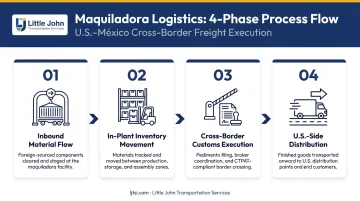
Specifically, maquiladora logistics manages:
- Inbound material flow — importing raw materials and components into Mexico duty-free
- In-plant inventory movement — tracking bonded inputs through production
- Cross-border customs execution — pedimento filing, carrier staging, CBP entry
- U.S.-side distribution — drayage, FTL/LTL handoff, and last-mile delivery
What makes this distinct from standard cross-border trucking is regulatory complexity. The operation runs simultaneously under two separate frameworks: Mexico's IMMEX program (administered by the Secretaría de Economía) and U.S. CBP requirements. Every shipment requires dual-country documentation: a pedimento on the Mexican side and a CBP entry on the U.S. side. Carriers operating in this space must be fluent in both.
The IMMEX Framework
IMMEX — Industria Manufacturera, Maquiladora y de Servicios de Exportación — is the legal mechanism that makes the duty-deferral model work. Under IMMEX, temporarily imported materials can enter Mexico duty-free for up to 18 months (for most raw materials and components), provided they're incorporated into finished goods that are subsequently exported or otherwise properly disposed of.
The requirement that makes it work: every temporarily imported input must be tracked in an automated inventory control system called SAT Annex 24. That system must document:
- What came in
- What went into production
- What was exported
- What remains on hand
Gaps in that tracking create the compliance exposure that can unwind the entire duty-deferral benefit.
Why Maquiladora Logistics Is Critical for Cross-Border Supply Chains
As of April 2026, there are 6,523 registered IMMEX establishments in México — 5,222 manufacturing and 1,301 non-manufacturing. That volume generates continuous cross-border freight flows, and even small disruptions compound fast when hundreds of operations share the same corridors and customs infrastructure.
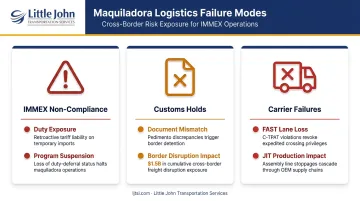
When logistics fails in this environment, it fails in specific, costly ways:
- IMMEX non-compliance — inventory reconciliation errors trigger duty exposure on temporarily imported materials, or worse, program suspension. Companies suspended from IMMEX cannot make temporary imports while suspended; those that don't cure within the deadline face permanent cancellation.
- Customs holds — a documentation mismatch between the pedimento and commercial invoice is enough to trigger secondary inspection. The October 2023 migration-related border disruptions stalled over $1.5 billion in goods at the border, with automotive supply chains absorbing the heaviest losses.
- Carrier failures — using an uncertified carrier routes freight into general commercial processing lanes rather than FAST lanes, adding hours of unpredictable dwell time to shipments tied to JIT production schedules.
Maquiladora logistics is routinely underestimated as cross-border trucking. In practice, it requires synchronized customs brokerage, bonded inventory management, certified carriers, and real-time visibility across two countries and two regulatory systems running simultaneously.
How Maquiladora Logistics Works: The End-to-End Supply Chain Flow
Four phases govern the complete maquiladora logistics cycle. Each phase has distinct compliance and operational requirements — and each one creates exposure points if handled incorrectly.
Step 1: Inbound Material Flow
Raw materials and components enter Mexico duty-free under IMMEX. For this to work correctly:
- The importing entity must hold active IMMEX registration
- All inputs must be logged in the SAT Annex 24 automated inventory system at the time of entry
- Each import entry must be matched against a specific production commitment for future export
Documentation errors at this stage are particularly damaging because they create downstream inventory discrepancies that compound. If inputs are logged incorrectly on entry, reconciling them on export becomes a compliance problem — not just an administrative one.
Step 2: In-Plant Inventory and Production Logistics
Once materials are inside the plant, the logistics layer shifts to bonded inventory tracking. The Annex 24 system applies FIFO (first in, first out) discharge methodology and requires the manufacturer to maintain records showing:
- Materials consumed in production
- Waste, shrinkage, and destruction
- Quantities still pending export
- Returns to the original supplier
Production scheduling must feed directly into export timelines, because the IMMEX clock on temporarily imported materials is running from the moment of entry. Inside the plant, warehouse management is a compliance activity — tracked, time-bound, and audit-ready.
Step 3: Cross-Border Export and Customs Execution
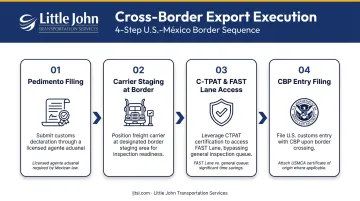
Export execution is where process gaps become border delays. The export process requires:
- Pedimento filing — Mexico's customs declaration, prepared by a licensed customs broker (agente aduanal)
- Carrier staging at the border — coordinating Mexican and U.S. carriers for trailer handoff
- C-TPAT and FAST lane access — certified carriers route to dedicated FAST lanes; uncertified carriers join general commercial queues
- CBP entry filing — U.S. customs documentation, USMCA certificate of origin where applicable
Effective operations stage the U.S.-side carrier before the load crosses, treating the handoff as a planned event rather than a reactive one.
Critical Factors That Affect Maquiladora Supply Chain Performance
IMMEX Compliance and Inventory Reconciliation
IMMEX non-compliance puts the entire operation at risk. The program requires manufacturers to demonstrate that all temporarily imported materials are either exported as finished goods, returned, donated, or destroyed. Failures trigger:
- Duty assessment on the full value of unreconciled materials
- Program suspension, which blocks all new temporary imports
- Potential program cancellation for companies that don't cure within the correction window
Inventory reconciliation accuracy is what keeps the duty-deferral model intact — let it slip and the financial case for the maquiladora structure unravels.
Carrier Certification: C-TPAT and FAST
CBP reports more than 11,400 C-TPAT certified partners as of mid-2026. C-TPAT members are classified as low-risk and are less likely to be selected for physical examination — a meaningful operational benefit when freight crosses daily.
FAST enrollment requires that every link in the supply chain — manufacturer, carrier, driver, and importer — meets applicable C-TPAT standards. An otherwise compliant operation loses FAST lane access if the carrier isn't enrolled. At high crossing frequency, a single non-enrolled carrier can back up dozens of loads per week.
Border Crossing Selection
Crossing point strategy has measurable impact on freight performance.
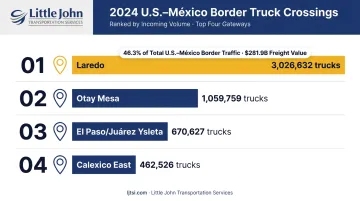
| Gateway | 2024 Incoming Trucks from Mexico |
|---|---|
| Laredo | 3,026,632 |
| Otay Mesa | 1,059,759 |
| El Paso/Juárez (Ysleta) | 670,627 |
| Calexico East | 462,526 |
Laredo processed $281.9 billion in truck freight in 2024, equal to 46.3% of total U.S.-Mexico truck freight value. For maquiladoras in Nuevo León, Tamaulipas, and Coahuila, Laredo is the default primary crossing — but the decision should be driven by production location, congestion patterns, and carrier capability at each specific port, not just proximity.
JIT Manufacturing Pressure
Automotive, electronics, and medical device maquiladoras run on schedules where a missed crossing or documentation hold can halt a production line hours later on the U.S. side. Logistics providers supporting JIT maquiladora clients must maintain:
- 24/7 dispatch with sub-60-minute response capability
- Real-time tracking with human accountability — not automated portals
- Bilingual communication on both sides of the border
- Pre-staged capacity at the crossing point
USMCA Rules of Origin
USMCA duty-free treatment isn't automatic — it requires goods to meet specific regional value content thresholds. For passenger vehicles and light trucks, the current RVC requirement is 75% net cost. For heavy trucks, it's 64% net cost, rising to 70% in 2027.
In March 2025, the U.S. exempted USMCA-qualified goods from the 25% IEEPA tariff on Mexico imports. That makes rules-of-origin compliance directly tied to tariff cost, not just preferential access. Maquiladora logistics managers who aren't tracking origin inputs carefully are carrying tariff exposure they may not recognize.
Common Maquiladora Logistics Misconceptions and Where Operations Fail
Misconception: Any carrier with Mexico experience can handle maquiladora freight.
Mexico route experience isn't the same as maquiladora logistics capability. A carrier without C-TPAT validation cannot access FAST lanes. A carrier without FAST-enrolled drivers cannot use expedited processing regardless of their route history. A carrier without bilingual dispatch creates communication gaps at the border that cause documentation errors and staging delays. Route familiarity doesn't fix structural certification gaps.
Misconception: Customs compliance is the manufacturer's problem, not the carrier's.
Carrier documentation errors are a primary cause of customs holds. Each of the following can trigger secondary inspection regardless of how well the manufacturer manages its IMMEX inventory records:
- Incorrect commercial invoice
- Bill of lading data that doesn't match the pedimento
- Missing or invalid certificate of origin
The logistics provider must treat documentation accuracy as a core function. Carriers should verify document consistency before staging at the border, not after a hold is issued.
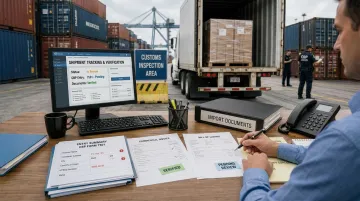
Proximity to the border doesn't guarantee fast crossing times.
Geographic closeness and crossing speed are unrelated. A shipment from a plant 20 miles from Laredo can sit for hours if the carrier isn't C-TPAT certified, the documentation has a mismatch, or the freight is flagged for secondary inspection. Crossing time comes down to compliance readiness (carrier certification, pre-clearance status, and documentation accuracy) — not miles.
Frequently Asked Questions
What does maquiladora mean?
"Maquiladora" comes from maquila, a Spanish term for the miller's fee charged to process grain in colonial Mexico. Today it describes a factory in Mexico that imports materials duty-free, assembles or processes them, and exports the finished goods — primarily to the U.S. The program formally began in 1965 under the Border Industrialization Program.
What is the IMMEX program and how does it affect maquiladora logistics?
IMMEX is the Mexican government program granting duty-free temporary import status to materials used in manufacturing for export. Compliance directly governs how those materials are tracked, documented, and reconciled — from initial import entry through final export.
What documentation is required for maquiladora cross-border shipments?
Core documents include the pedimento (Mexico's customs declaration), commercial invoice, bill of lading, certificate of origin (for USMCA treatment), and CBP entry documentation on the U.S. side. All documents must be accurate and mutually consistent — discrepancies between any two of these trigger customs holds regardless of the cargo's compliance status.
What is C-TPAT and why does it matter for maquiladora freight?
C-TPAT (Customs-Trade Partnership Against Terrorism) is a CBP program that certifies supply chain security standards. Validated carriers are classified as low-risk, qualifying for reduced inspections and expedited border processing. That matters for maquiladora operations where border dwell time directly affects JIT production schedules.
How do FAST lanes benefit maquiladora supply chains?
FAST (Free and Secure Trade) lanes are dedicated crossing lanes for pre-vetted shipments from C-TPAT-certified carriers with FAST-enrolled drivers. They significantly reduce wait times compared to general commercial traffic. The catch: every participant in the supply chain must meet the applicable C-TPAT standards, or FAST access is forfeited.
What are the most common causes of delays in maquiladora logistics?
The primary causes: documentation errors (mismatched pedimento or invoice data), use of non-C-TPAT-certified carriers that can't access FAST lanes, IMMEX inventory discrepancies that trigger customs review, and failure to pre-plan border crossing strategy based on congestion patterns and infrastructure capacity at specific ports of entry.