Introduction
Picture a 500,000-pound power transformer sitting on a loading dock. It won't fit in a container. It can't ride a standard flatbed without blowing axle limits on every bridge between the plant and the substation. And if the dimensions submitted at intake are off by even a few inches, the permit is void before the truck moves a mile.
This is breakbulk territory, and most carriers simply won't touch it.
Operations managers, logistics coordinators, and project teams in energy, oilfield, construction, and industrial manufacturing move loads like this regularly. The problem isn't finding a carrier willing to say yes. It's finding one that can actually execute: legally, safely, and on schedule.
This guide covers:
- What breakbulk cargo is and how it differs from standard freight
- The six-step process for shipping it
- What drives cost and risk
- The mistakes that derail moves at the worst possible moment
Key Takeaways
- Breakbulk cargo is oversized, heavy, or irregularly shaped freight loaded and transported individually, outside standard containers or trailers.
- Any load exceeding 102 inches wide or 80,000 lbs gross weight requires specialized permits, equipment, and route planning.
- The breakbulk process has six core steps — skip or shortcut any one of them and the entire move is at risk.
- Inaccurate dimensions, skipped permits, and wrong equipment selection drive most delays and cost overruns.
- In breakbulk, carrier expertise isn't a nice-to-have — it's what separates a clean move from a costly one.
What Is Breakbulk Cargo?
Breakbulk cargo is freight that cannot be unitized into standard shipping containers or moved on conventional trailers due to its size, weight, or configuration. Each piece must be loaded, secured, and transported individually — with its own rigging plan, permit packet, and equipment selection.
That distinction from containerized freight matters in practice: containerized cargo moves inside enclosed boxes on standard equipment. Breakbulk relies on open-deck equipment — flatbeds, step decks, removable gooseneck (RGN) trailers, and multi-axle lowboys — and requires individual handling for every piece.
What Makes Cargo "Oversized" in the U.S.
According to FHWA's Commercial Vehicle Size and Weight Program, a load becomes permit-required when it exceeds the applicable jurisdiction's thresholds:
| Threshold | Federal Rule |
|---|---|
| Width | 102 inches (8'6") on the National Network |
| Height | No federal maximum; state limits typically fall between 13'6" and 14'6" |
| Length | No universal threshold; states must allow at least a 48-ft semitrailer |
| Weight | 80,000 lbs GVW, 20,000 lbs single axle, 34,000 lbs tandem |
Federal thresholds set the floor. Every state and municipality can set stricter rules — which is why permit requirements must be verified jurisdiction by jurisdiction, not assumed from one national standard.
Common Breakbulk Cargo Types
| Cargo Type | Why It Exceeds Standard Limits |
|---|---|
| Power transformers | DOE-tracked units can weigh up to 500,000 lbs; logistics costs represent 3–20% of device value |
| Wind turbine blades | Modern land-based blades exceed 170 feet in length |
| Drilling and rotary equipment | Caterpillar's MD6310 ships at widths up to 20.74 ft and weights up to 214,950 lbs |
| Prefabricated modules | Building modules commonly reach 16 ft x 80 ft |
| Oilfield rigs | Some configurations require 17 separate highway-legal loads |
Breakbulk vs. Related Categories
These terms are often conflated, but they describe distinct things:
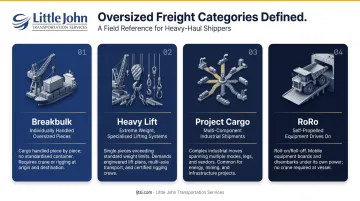
- Breakbulk: The broad category — any individually handled oversized piece
- Heavy lift: Extreme weight-focused moves requiring specialized lifting systems
- Project cargo: Multi-component, multi-leg shipments for a defined industrial project
- RoRo: Self-propelled or wheeled equipment that drives onto vessels or trailers
Breakbulk is the parent category. Understanding where your cargo falls within these definitions determines which equipment, permits, and carrier certifications apply to your move.
How Breakbulk Cargo Shipping Works: A Step-by-Step Process
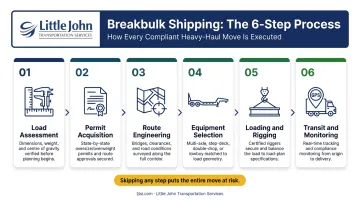
Breakbulk shipping is a coordinated sequence where errors in early steps cascade into compliance violations and cost overruns at every stage that follows. Here's how each step works in practice.
Step 1: Load Intelligence and Cargo Assessment
Before anything else, the team needs verified, as-built dimensions — not design drawings. That means confirmed measurements for:
- Length, width, and height
- Gross weight (including packaging and rigging gear)
- Center of gravity
- Lift points
Working from preliminary engineering specs instead of finished-unit measurements is one of the most expensive mistakes in breakbulk shipping. A transformer that ships 3 inches wider than its design spec invalidates every permit in the packet.
Step 2: Permit Acquisition and Regulatory Compliance
Oversized cargo requires a separate permit for each state, county, and sometimes each city along the route. The federal government does not issue OS/OW permits — states do, and each jurisdiction has its own requirements.
Critical realities to build into every project schedule:
- Permit lead times range from same-day (simple single-state moves) to several weeks (superloads requiring engineering review in states like Colorado or California)
- Any discrepancy between the permit and the actual load can pull the truck off the road at a weigh station
- Cross-border moves into Mexico operate under a different regulatory framework entirely — Mexico's NOM-040-SCT-2-2012 governs oversized objects on federal roads, with special authorizations issued by the federal transport authority (SICT/SCT)
Permit acquisition should start at the same time as load assessment — not after equipment is lined up.
Step 3: Route Engineering and Risk Assessment
FHWA defines a route survey as turn-by-turn documentation of restrictions: every bridge clearance, overhead utility, weight-posted road, turning radius, and access condition at origin and destination must be documented before the truck moves.
Minnesota, for example, requires a physical survey for loads exceeding 16 ft high, 20 ft wide, or 175 ft long, with documented vertical and lateral clearances. The consequences of skipping this step are severe: in 2013, a 15-ft-9-in oversize combination struck the I-5 Skagit River Bridge in Washington and collapsed a span. A permit had been issued — but it didn't guarantee physical clearance at every lane position.
Common route hazards to document:
- Low overpasses and bridge height restrictions
- Bridge weight limits (governed by the Federal Bridge Gross Weight Formula)
- Overhead utility lines
- Soft shoulders and grade changes
- Seasonal road weight restrictions (New Hampshire, for example, can post highways at 30,000 lbs GVW during spring thaw)
Step 4: Equipment Selection and Configuration
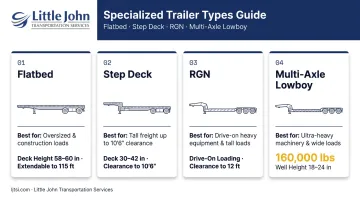
Equipment selection is driven by cargo dimensions, weight distribution, road access, and permit conditions — not by what's sitting in a yard. The major trailer types for breakbulk moves:
| Trailer Type | Best For | Notes |
|---|---|---|
| Flatbed | Long, flat loads; standard oversized freight | Standard deck height 58–60 inches; extendable versions reach 115 ft |
| Step deck | Taller cargo that needs lower ride height | Lower deck at 30–42 inches; cargo clearance up to 10'6" |
| RGN / Removable Gooseneck | Wheeled or tracked equipment; tall heavy machinery | Gooseneck detaches for drive-on loading; clearance up to 12 ft |
| Multi-axle lowboy | Extreme weights requiring axle distribution | Capacities to 160,000 lbs; well heights as low as 18–24 inches |
Fleet depth matters here. Little John Transportation Services operates 2,700+ specialized trailers across 12+ configurations — with extendable lowboy combinations reaching well lengths of 87 feet and capacities up to 160,000 lbs on a single bill of lading. When a specific configuration isn't available in the owned fleet, access to 7,000+ specialized trailers through the Landstar network prevents sourcing delays from holding up the move.
The Federal Bridge Gross Weight Formula also governs trailer configuration decisions: heavier loads require longer chassis with more axles to distribute weight legally across consecutive axle groups.
Step 5: Loading, Rigging, and Securing
Rigging crews work from approved lift plans with confirmed lift points and center-of-gravity data. Once loaded, cargo must be blocked, braced, and secured to resist the forces FMCSA requires: 0.8g forward and 0.5g laterally and rearward, with aggregate working-load limit at least half the cargo weight.
Some states and ports require inspection of the secured load before transport begins. Improper securing is both a safety risk and a compliance violation — one that will generate out-of-service orders and liability exposure if discovered at roadside.
Step 6: Transit, Escort, and Real-Time Monitoring
During the actual move, multiple operational factors must be managed simultaneously:
- Escort and pilot car requirements vary by state and load dimensions; Texas may require both private and law-enforcement escorts depending on width and road type
- Travel window restrictions (daylight-only movement, weekend blackouts, holiday restrictions) must be built into the schedule before departure, not discovered mid-transit
- Communication protocols between driver, escort vehicles, and dispatch must be confirmed before the move begins
- 24/7 tracking enables immediate response to route deviations, permit discrepancies at weigh stations, or access issues at the delivery site
Key Factors That Affect Breakbulk Shipping Cost and Success
Cargo Dimensions and Weight
These are the primary cost drivers. They determine:
- Trailer type and axle configuration
- Permit complexity and fees (Colorado charges $800 for a superload single-trip permit; Iowa charges $35 for a standard OS/OW single trip — the range is wide)
- Escort vehicle requirements
- Available travel windows
Even a few inches of miscalculated width or a few hundred pounds of underreported weight can force permit rewrites, equipment changes, and route re-surveys — all on a compressed timeline.
Route Characteristics
Every additional jurisdiction crossed adds another permit, another set of escort requirements, and another approval timeline. Route-specific factors that drive cost:
- Number of states, counties, and municipalities crossed
- Seasonal weight restrictions (spring thaw restrictions can dramatically limit routing in northern states)
- Bridge clearance and weight-limit constraints requiring detours
- Urban vs. rural routing (urban corridors add complexity, restricted travel windows, and often require law-enforcement escorts)
Carrier Expertise and Verification
No authoritative national study comparing specialist versus generalist carrier damage rates exists — but the pattern holds up under scrutiny. A carrier without hands-on experience in oversize permitting, route surveys, and specialized equipment selection introduces risk at every step of the process.
FMCSA's free Company Snapshot tool and Licensing & Insurance Carrier Search provide verifiable carrier records — safety ratings, out-of-service percentages, crash history, and insurance status. For breakbulk freight, verifying these records is not optional.
Cross-Border Considerations
Carrier expertise matters even more once a load crosses the border. U.S.–Mexico oversized moves require navigating two distinct regulatory frameworks: NOM-012-SCT-2-2017 sets the standard freight dimension framework, while NOM-040 governs special authorizations for indivisible objects of great weight or volume. Escort requirements, documentation standards, and permit authority are handled by Mexico's federal transport authority — not state agencies as in the U.S.
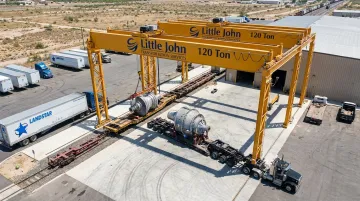
For companies moving heavy industrial or energy equipment across the border, a carrier with dedicated cross-border infrastructure makes a concrete difference. Little John's 50-acre Laredo facility includes a custom-built 120-ton bridge crane engineered specifically for superload transloading, capable of transferring heavy cargo between U.S. and Mexican trailers in under two hours. That's backed by 250+ Mexican interchange agreements and bilingual operations teams in Laredo, Monterrey, and Guadalajara.
Common Mistakes to Avoid When Shipping Breakbulk Cargo
Inaccurate Dimensions and Weight
The most costly mistake in breakbulk. Common errors include:
- Submitting estimated or design-drawing dimensions instead of as-built measurements
- Failing to account for packaging, crating, and rigging hardware weight
- Not measuring the load in its transport configuration (some equipment ships with attachments that add height or width)
These errors lead to permit rejections, loads pulled at weigh stations, missed ship dates, emergency re-routing fees, and potential liability for bridge or infrastructure damage.
Permit and Documentation Shortcuts
- Assuming a state permit covers municipal roads (it often doesn't)
- Not building permit lead time into the project schedule — then treating a two-week approval process as a one-day task
- Failing to update permits when dimensions or routing change after initial filing
This isn't hypothetical — loads get stranded over weekends when a weigh station flags a permit discrepancy on Friday afternoon. It happens on real jobs where permits were treated as paperwork instead of operational requirements.
Using the Wrong Carrier
A carrier without specialized equipment, permit expertise, or route survey capability may accept the load — but will struggle to execute it legally and safely. Signs to watch for:
- No in-house permitting capability (permits are outsourced or filed by the driver)
- Vague answers about route survey methodology
- Fleet limited to standard flatbeds with no multi-axle or RGN inventory
- No documented experience with superloads or loads requiring engineering review
For loads of this complexity, verify the carrier's FMCSA records and ask specifically about their permitting volume and in-house capability. Confirm equipment configurations before committing to a schedule.
Getting these three areas right — dimensions, documentation, and carrier selection — is what separates a breakbulk move that executes cleanly from one that stalls mid-route.
Conclusion
Breakbulk cargo shipping is a disciplined, multi-step process where accuracy, planning, compliance, and carrier expertise are not optional — they are the variables that determine whether the load moves on time, on budget, and without incident.
The right partner matters more in breakbulk than in any other freight category. For companies moving oversized industrial, energy, or machinery freight across the U.S. and into Mexico, Little John Transportation Services brings the operational depth that complex moves require:
- 30+ years of specialized heavy-haul experience
- 7,000+ specialized trailers — flatbed, RGN, multi-axle, double-drop, and lowboy configurations
- 100,000+ oversize permits handled annually through in-house permitting teams
- Dedicated cross-border infrastructure in Laredo, Monterrey, and Guadalajara
When breakbulk freight crosses state lines, weight limits, or international borders, that infrastructure isn't a differentiator — it's the prerequisite. Generalist carriers often discover those gaps mid-move. Little John has spent three decades making sure that doesn't happen.
Frequently Asked Questions
What is considered oversized cargo?
Any load exceeding 102 inches (8'6") wide or 80,000 lbs gross vehicle weight on the National Network requires permits under federal guidelines, though state and local thresholds may be stricter. Height and length triggers are state-specific and must be verified for each jurisdiction the load passes through.
How much does oversized shipping cost?
No single national average exists for oversized freight. Cost is driven by cargo dimensions, permit fees across each jurisdiction, trailer configuration, and route complexity. Work with a specialized carrier using verified load data to get an accurate quote.
What is the difference between breakbulk cargo and containerized cargo?
Containerized cargo is loaded into standard shipping containers and moves on conventional equipment. Breakbulk cargo is too large, heavy, or irregularly shaped to fit a standard container and must be loaded, secured, and transported individually using specialized open-deck equipment.
What permits are required to ship oversized cargo?
Permit requirements vary by state, county, and city based on the load's exact dimensions, weight, and planned route. Every jurisdiction the load passes through requires its own permit. There is no single national oversized cargo permit.
What equipment is typically used for breakbulk and oversized cargo?
Primary trailer types include flatbeds, step decks, RGN/removable gooseneck trailers, and multi-axle lowboys. Equipment selection is determined by cargo dimensions, weight distribution, site access conditions, and permit requirements — not by carrier preference or availability.
How far in advance do you need to plan a breakbulk shipment?
Planning timelines depend on cargo complexity and permit approval lead times. Single-state moves can clear same-day; superloads requiring engineering review can take several weeks. Start the permitting process as early as possible — that timeline cannot be shortened once it's in motion.