Yet many pharma companies still treat temperature-controlled logistics as a transportation category rather than a risk management discipline. That distinction matters — because the failure modes are different, the mitigation strategies are different, and the consequences of getting it wrong extend far beyond a damaged shipment.
This guide covers the four primary cold chain risks pharma companies face today, a practical mitigation framework, the regulatory standards you must satisfy, and what to look for when selecting a logistics partner.
Key Takeaways
- Cold chain failure risks product potency, regulatory standing, and patient outcomes — not just cargo value
- Temperature excursions, handoff failures, documentation gaps, and theft each require distinct mitigation strategies
- Risk assessment must cover every lane segment — primary carrier, handoffs, and last-mile
- Regulatory compliance requires an unbroken, auditable temperature record from origin to destination
- Carrier vetting depth and cross-border expertise are the two most underweighted partner selection criteria
Why Temperature-Controlled Logistics Is a Risk Management Issue
Having a refrigerated truck is not a cold chain program. A real cold chain program treats every transfer point, storage handoff, customs inspection, and routing decision as a discrete exposure window. Each one can invalidate an otherwise well-controlled shipment.
Biologics Are Not Forgiving
Small-molecule drugs can tolerate moderate temperature swings without irreversible damage. Biologics cannot. Vaccines, monoclonal antibodies, mRNA therapies, and specialty biologics have complex molecular structures that undergo irreversible denaturation, aggregation, or potency loss from even brief excursions. WHO documentation on mRNA and mAb stability confirms that hydrolysis, oxidation, and physical stress from agitation or temperature fluctuation all represent distinct degradation pathways — and none of them can be undone.
Temperature Tiers Require Different Programs
Each pharmaceutical temperature category demands a different equipment standard, monitoring protocol, and contingency plan:
| Category | Temperature Range | Examples |
|---|---|---|
| Refrigerated | 2–8°C | Vaccines, insulin, mAbs |
| Frozen | –25°C to –15°C | Plasma products, some biologics |
| Ultra-low | –85°C to –60°C | mRNA vaccines, cell therapies |
| Cryogenic | Below –150°C | Cell and gene therapies |
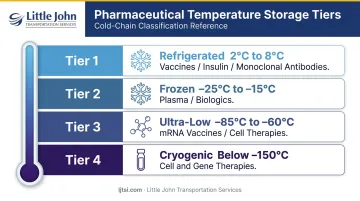
Misaligning a logistics program to the wrong product tier — say, using a refrigerated carrier for an ultra-low product — is itself a risk event, regardless of how well that carrier performs.
Risk Compounds Across the Lane
Risk doesn't live only in the primary carrier leg. A well-controlled long-haul move can fail at a staging dock, during a customs hold, or at a final-mile handoff. Pharmaceutical Commerce notes that delays and disruptions can threaten both product integrity and patient well-being — which is why risk assessment must cover the entire lane, not just the truck.
The Four Primary Cold Chain Risks Pharma Companies Face Today
Temperature Excursions and Product Degradation
A temperature excursion occurs when a product is exposed outside its prescribed storage or transport range. Under EU GDP requirements, any excursion must be documented, evaluated for its effect on product quality, and reported to the distributor and recipient. The FDA's warning letter record includes enforcement actions under 21 CFR 211.142 for failing to maintain appropriate storage and temperature conditions.
Common excursion causes:
- Pre-cooling failures (trailer not at set-point before loading)
- Loading dock dwell time in ambient conditions
- Equipment malfunction during transit
- Packaging validated for standard conditions but used on a lane with extreme heat or unexpected delays
- Missed sensor alerts with no defined response protocol
Temperature data logging provides visibility — it does not protect a shipment on its own. Protection comes from what happens after an alert fires.
Supply Chain Delays and Handoff Failures
Delays are dangerous not because of the time lost, but because temperature integrity degrades as products spend more time outside an actively controlled environment. A customs hold that adds four hours to a shipment can push a validated packaging system past its thermal endurance, even when nothing went mechanically wrong.
Handoff failures are a distinct category. When a shipment passes between a carrier, a customs broker, a last-mile provider, and a receiving facility, accountability gaps open. Alerts go unacknowledged. Corrective actions are delayed. No single party feels responsible.
Chain-of-custody clarity at every transfer point is as operationally critical as the temperature equipment itself.
Regulatory Non-Compliance and Documentation Gaps
Those chain-of-custody gaps carry direct regulatory consequences. Under FDA's 21 CFR Part 211 and EU GDP requirements, arriving on time with an intact product is not sufficient proof of compliance. Pharma companies must demonstrate, through a complete auditable record, that temperature and handling conditions were maintained throughout the entire distribution journey.
Key documentation requirements:
- FDA 21 CFR 211.150: Written distribution procedures and lot-level recall traceability
- FDA 21 CFR 211.196: Consignee, date, quantity, and lot records for each shipment
- EU GDP Chapter 4: Contemporaneous records retained for at least five years
- EU GDP 9.2: Transport excursions documented, investigated, and reported
Incomplete chain-of-custody records are a consistent audit failure point. A shipment with no documented temperature gap can still fail an inspection if the handoff record is missing.
Theft, Security Breaches, and Physical Damage
High-value pharmaceutical cargo is a known theft target. TAPA recorded 67 pharmaceutical theft incidents in EMEA in 2020, with 10 major incidents totaling EUR 9.89 million in losses. The consequences extend beyond financial loss — stolen pharmaceutical products create supply shortages, patient treatment delays, and counterfeit product risk entering the market.
Vibration and mechanical shock pose an under-discussed risk. Peer-reviewed research on monoclonal antibodies shows that flow, air-liquid interfaces, and physical agitation can promote aggregation even when temperature is maintained. A complete pharma logistics risk assessment must include vibration and shock exposure, not just thermal monitoring.
A Practical Framework for Cold Chain Risk Mitigation
Start with Risk Scoring
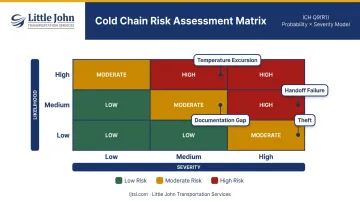
ICH Q9(R1) defines risk as the combination of the probability of occurrence of harm and its severity. That two-factor model — likelihood × severity — is the starting point for any cold chain risk program. Not all risks are equal, and mitigation resources should go to the scenarios with the highest combined score, not just the most obvious ones.
Map your product and lane hazards against both dimensions before designing your controls.
Validate the Lane Before You Use It
Lane validation means testing your actual shipping route — including real-world dwell times, seasonal temperature extremes, altitude changes, and expected customs delays — to confirm that your chosen packaging and carrier combination will maintain product integrity for the entire duration.
Three regulatory frameworks set the bar for lane qualification:
- WHO TRS 961 Annex 9 requires route profiling and qualification
- USP <1079> includes weather, traffic, and customs delay as lane-profile factors
- ISTA 7E evaluates thermal packaging against heat and cold profiles from real-world parcel data
A packaging system validated under standard lab conditions may fail on a lane with a summer heat wave and a four-hour border delay. Validate the actual lane, not the theoretical one.
Monitoring Means Nothing Without a Response Protocol
Real-time temperature monitoring is a given. The mitigation value comes from what happens when an alert fires. Before a shipment leaves the facility, you need documented answers to:
- Who receives the alert?
- What is the response time threshold?
- Who has authority to authorize a reroute or equipment swap?
- What corrective actions are pre-approved?
Without pre-established escalation protocols, live monitoring data becomes a forensic record of a failure that could have been stopped.
Optimize Packaging for the Actual Lane
Insulated containers, phase-change materials, dry ice, and liquid nitrogen systems each have appropriate use cases. Selection should be based on the product's specific stability profile and the lane's total transit duration — including reasonable delay scenarios.
A common, avoidable gap: using a validated packout on a route that has been extended by a delay. If your packaging system is designed for a 48-hour transit and your shipment sits at a border crossing for six additional hours, you have a problem that better packaging selection could have prevented.
Build Formal Contingency Plans
Contingency planning is not improvisation. WHO TRS 961 requires documented emergency plans covering equipment failure, power loss, and vehicle breakdown. Formal programs include:
- Pre-approved alternate routes
- Backup carriers on standby
- Redundant cooling equipment
- Dispatch authority pre-delegated to make rerouting decisions in real time
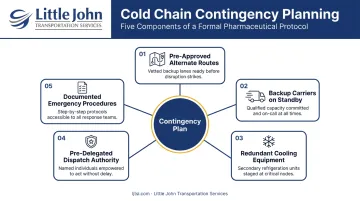
Recovery speed depends on preparation. A response plan written before the shipment departs gives your team authority, options, and time — none of which are available when you're building the plan mid-disruption.
What to Look for in a Temperature-Controlled Logistics Partner
Core Vetting Criteria
Any logistics partner handling pharmaceutical cold chain shipments should demonstrate:
- GDP compliance history with documented audit performance
- ISO 9001 or equivalent quality management certification
- 100% thermally mapped equipment with calibrated monitoring devices
- 24/7 communication capability with defined escalation contacts
- Audit-ready chain-of-custody documentation structured for FDA and GDP review
- FMCSA Satisfactory safety rating — held by fewer than 6% of U.S. carriers
Certifications are a floor, not a guarantee. Ask for documented compliance history, not just current certification status.
Carrier Network Depth Matters More Than People Realize
A single-carrier arrangement is a single point of failure. A logistics partner with a deep, rigorously vetted carrier pool provides redundancy that becomes critical when a primary carrier is unavailable — which happens more often than pharma shippers expect.
Little John Transportation Services maintains a network of 65,000+ vetted and audited carriers, with nightly compliance checks against legal, insurance, and performance standards. That continuous vetting is what keeps backup capacity qualified and ready — not just listed.
Their pharmaceutical cold chain program operates across 2,400+ thermally mapped reefer trailers with continuous temperature logging, live exception alerts to dispatch, and audit-ready documentation designed to satisfy FDA, USDA, and GDP requirements. ISO 9001:2015 certification and a 99.9% claim-free delivery rate across the network reflect the accountability structure that makes this redundancy operationally meaningful.
Cross-Border Expertise Is a Separate Competency
Carrier depth gets product moving. Getting it across the border without a temperature excursion is a different challenge entirely.
For pharma companies shipping between the U.S. and Mexico, customs dwell time is one of the most common triggers of temperature excursions. It is not a transportation problem — it is a regulatory and documentation problem that requires a logistics partner with dedicated cross-border expertise.
Specifically, look for:
- In-house customs brokerage on both sides of the border (not outsourced)
- C-TPAT and FAST certification for expedited crossing access
- Bilingual dispatch teams physically stationed at key border crossings, not managing remotely
- Familiarity with both FDA and COFEPRIS documentation requirements
Little John's 50-acre Laredo facility — CTPAT-validated, with 30 cross-dock bays and teams stationed in Laredo, Monterrey, and Guadalajara — is specifically built for this kind of cross-border continuity.
Frequently Asked Questions
What is third-party risk management (TPRM) in the pharmaceutical industry?
TPRM in pharma covers identifying, assessing, and monitoring risks posed by external vendors, including logistics partners handling regulated products. Under EU GDP Chapter 7, pharma companies retain full regulatory accountability for outsourced activities. Carrier compliance is the shipper's responsibility, not just the carrier's.
What are the 7 C's of supply chain management?
The 7 C's — Connect, Create, Customize, Coordinate, Consolidate, Collaborate, and Contribute — are a logistics framework for evaluating supply chain effectiveness. For pharmaceutical cold chain, Coordinate, Customize, and Collaborate matter most: aligning handoffs, matching packaging to lane conditions, and establishing carrier escalation protocols.
What causes temperature excursions during pharmaceutical shipments?
The most common causes are equipment malfunction, loading dock dwell time in ambient conditions, packaging that was not validated for the actual lane conditions, customs or transit delays that extend beyond thermal endurance limits, and missed monitoring alerts with no predefined response protocol.
What regulatory standards govern pharmaceutical cold chain logistics in the U.S. and internationally?
Key frameworks include FDA 21 CFR Part 211 (cGMP), EU GDP guidelines from the EMA, WHO TRS 957 and TRS 961, USP General Chapter <1079>, and IATA Temperature Control Regulations for air freight. International shipments must satisfy multiple overlapping standards simultaneously. Build your audit trail to the strictest requirement across all markets served.
How should pharma companies evaluate a temperature-controlled logistics provider?
Prioritize these six criteria:
- GDP compliance documentation (not just certification claims)
- 100% thermally mapped equipment
- Carrier network depth and vetting rigor
- 24/7 bilingual communication capability
- Audit-ready chain-of-custody documentation
- Demonstrated cross-border expertise for U.S.–Mexico lanes
What is a cold chain risk matrix and how is it used?
A cold chain risk matrix plots potential risk events — excursions, delays, documentation gaps, theft — against their likelihood and severity to prioritize mitigation resources. It is built before shipments are designed, identifying the highest-consequence gaps in packaging, routing, monitoring, and carrier selection. ICH Q9(R1) defines this probability × severity framework as the standard for pharmaceutical quality risk management.