Introduction
If you've ever tried to budget a lowboy move before getting a quote, you already know the problem: rates aren't published anywhere, the variables are endless, and the gap between an initial estimate and the final invoice can easily run $2,000–$5,000 on a single load. Lowboy trucking — moving excavators, bulldozers, drilling rigs, and oversized industrial machinery — is priced differently than any other freight category.
The challenge: lowboy trucking rates are not posted anywhere. Every load is quoted individually, and the gap between a base-rate quote and your actual invoice can run into thousands of dollars. Shippers who treat heavy-haul pricing like standard flatbed pricing routinely underbudget — or pick the wrong carrier.
This guide breaks down current rate ranges, every cost component that appears on a real invoice, the variables that move prices up or down, and exactly what to have ready when requesting a quote.
TL;DR
- Standard legal loads: roughly $3.50–$5.00/mile; local hauls under 100 miles often flat-rated at $300–$800
- Permitted oversize/overweight loads: $5.00–$10.00+/mile, including permits, escorts, and route adjustments
- Superloads and complex moves: always custom-quoted — engineering, bridge surveys, and multi-state approvals vary too much for standard per-mile pricing
- What drives cost up: load weight, oversized dimensions, multi-state permits, escort vehicles, and tight timelines
- What keeps cost down: standard dimensions, longer hauls, flexible timing, and advance booking
How Much Does Lowboy Trucking Cost?
No carrier publishes a rate sheet for lowboy transport. Every quote reflects the specific load, route, and permit requirements — which is why comparing headline numbers across carriers without understanding what each includes leads to bad decisions.
Two costly mistakes happen repeatedly:
- Accepting a low base-rate quote that later balloons once permits, pilot cars, and fuel surcharges are added as separate line items
- Using standard flatbed rates as a benchmark for a load that requires a specialized lowboy trailer, overweight permits, and escort coordination
Here's how rates break down by load category.
Standard Legal Loads (No Permits Required)
For loads within federal legal limits — under 80,000 lbs gross vehicle weight, under 8'6" wide, and under 13'6" tall — expect rates in the $3.50–$5.00/mile range. Short local hauls under 100 miles are typically flat-rated at $300–$800.
This tier usually covers:
- Base transport and a fuel surcharge component
- Equipment that fits within legal dimensions (skid steers, compact excavators, smaller agricultural machinery)
- Short-to-mid-range hauls on standard routes
What it excludes: crane loading, extended detention, and any permit-related costs if dimensions are borderline.
Oversize or Overweight Loads (Permitted)
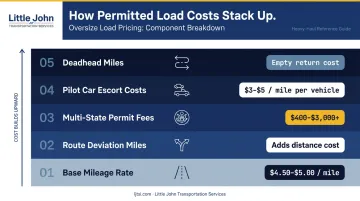
Once your load exceeds legal thresholds — width over 8'6", height over 13'6", or gross weight over 80,000 lbs — you're in permitted territory. A Truckstop case study on heavy-haul pricing shows how fast costs compound: a 750-mile move with a 14-foot-wide, 98,000-lb generator opened at a $4.50–$5.00/mile mileage-only quote, then layered on:
- 80 miles of route deviation
- $400–$1,000+ in four-state permits
- Escort costs at $3–$5/mile per pilot car
- 200 miles of deadhead
Permits across multiple states can add $500–$3,000+ to a move, depending on load dimensions and the states crossed. This tier covers mid-size to large excavators, bulldozers, cranes, and industrial equipment exceeding legal dimensions across one or more categories.
Superloads and Complex Permitted Moves
At the high end — loads above 200,000 lbs gross, or those requiring bridge structural analysis — moves are typically quoted as all-in project costs rather than per-mile rates. Texas triggers superheavy review for loads above 254,300 lbs gross weight, requiring third-party engineering reports and state DOT bridge evaluations. Other states use different thresholds entirely.
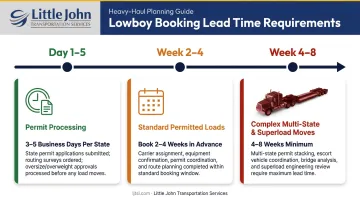
These moves require state-by-state route approval, police escorts in many jurisdictions, and planning timelines measured in weeks. Build in 4–8 weeks of lead time minimum; some multi-state corridors run longer depending on permit backlogs and bridge study requirements.
Key Factors That Affect Lowboy Trucking Rates
Lowboy rates respond to technical, regulatory, and market variables. Knowing what drives each cost lets you evaluate quotes on substance, not just headline numbers.
Load Weight and Axle Configuration
Federal Interstate limits set clear thresholds: 20,000 lbs on a single axle, 34,000 lbs on a tandem, and 80,000 lbs gross. The Federal Bridge Formula governs how those limits interact with axle spacing , so trailer configuration matters as much as total weight.
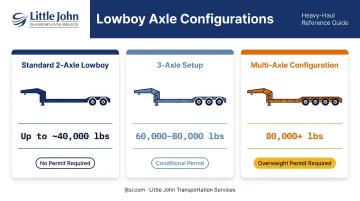
Each step up in weight requires a heavier trailer configuration:
- Standard 2-axle lowboy: handles loads up to approximately 40,000 lbs
- 3-axle setup: extends capacity toward 60,000–80,000 lbs
- Multi-axle configurations: required above 80,000 lbs, with overweight permits in most states
Weight distribution across axles (not just total weight) also affects route approvals and securing requirements. A load that's technically under the gross limit can still require permits if axle group weights are distributed poorly.
Load Dimensions and Permit Triggers
Federal rules establish 102 inches (8'6") as the standard width on National Network highways. There is no federal vehicle height limit; most states set limits between 13'6" and 14'. Escort requirements are state-specific : Texas requires escorts above certain width thresholds, while Indiana triggers its superload escort process for loads exceeding 17 feet wide, 15 feet high, 110 feet long, or 108,000 lbs.
Each oversized dimension compounds cost:
- Width over legal threshold: oversize permit required
- Wider loads: pilot car requirements activate at state-specific thresholds
- Very wide loads: dual escorts required in many states
- Certain superloads: police escort required, at rates such as Alabama's $100/hour per officer with a four-hour minimum
Every additional escort vehicle adds per-mile costs on top of base transport.
Distance and Route Complexity
Fixed costs (permit acquisition, deadhead miles to the pickup, loading time) are the same whether the haul is 100 or 1,000 miles. This creates a declining per-mile rate curve: short hauls cost more per mile because those fixed costs are divided over fewer miles.
Route complexity adds further cost:
- Urban routing with bridge weight restrictions forces detours that add both miles and time
- State-specific travel windows (restrictions on night moves or weekend travel) extend transit time and increase driver costs
- Bridge surveys on superload routes can add weeks to planning and carry separate engineering fees
Seasonal Demand and Market Availability
Construction seasonality drives meaningful rate fluctuation in the lowboy market. Spring months see the heaviest demand as contractors mobilize equipment to job sites ; carrier availability tightens and rates follow. FreightWaves notes that construction-season activity causes the specialized flatbed market to tighten sharply. Winter months (December through February) consistently offer the best carrier availability and most competitive rates for shippers with timing flexibility.
Fuel Surcharges
Diesel prices affect total cost. As of the week of July 13, 2026, the EIA reported U.S. on-highway diesel at $4.796/gallon. Carriers calculate fuel surcharges using a formula based on three inputs:
- Current EIA diesel price (updated weekly)
- Carrier baseline price (commonly $1.10–$1.30/gallon)
- Vehicle MPG (determines per-mile surcharge amount)
The surcharge is added per mile on top of the base rate. When comparing quotes, confirm whether the fuel surcharge is embedded or itemized separately. Embedded quotes appear lower but aren't.
Full Cost Breakdown: What Goes Into Your Bill
The base transport rate is only one component of what you'll actually pay. Here are the distinct cost elements to confirm in any quote.
| Cost Component | Typical Range | Notes |
|---|---|---|
| Base Transport Rate | $3.50–$5.00/mile (legal); $5.00–$10.00+/mile (permitted) | The number carriers lead with — rarely the final number |
| State Oversize Permits | $15–$500+ per state | Colorado lists $15 for single-trip; Texas charges $60 plus highway maintenance fees of $150–$375 depending on weight band |
| Pilot Car Services | $3–$5/mile per vehicle | A cross-country move with dual escorts adds up quickly across 5–6 states |
| Police Escorts | $100/hour per officer + minimums (state-dependent) | Alabama sets a 4-hour minimum; rates vary by state |
| Fuel Surcharge | Calculated per carrier formula | Based on EIA weekly diesel price, carrier baseline, and vehicle MPG — confirm whether embedded or separate |
| Detention | Charged after free time expires | General trucking average runs approximately $85/hour after 2 free hours; confirm the carrier's specific terms |
| Deadhead Miles | Quote-dependent | Charged when carrier travels empty a long distance to reach your pickup location |
| Storage Fees | Charged if delivery site is not ready | Confirm terms in advance to avoid unplanned costs |
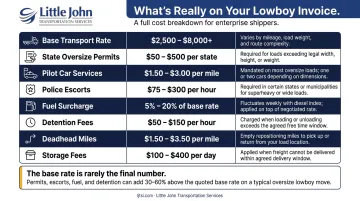
The most common source of sticker shock is accepting a quote that covers only the base transport rate, then receiving a final invoice with permits, escorts, fuel surcharge, and detention added as separate line items.
Have your site ready before the truck arrives, communicate loading requirements clearly, and confirm free-time allowances in your quote — detention, deadhead, and storage charges are avoidable with that groundwork done upfront.
Budget Carriers vs. Specialized Carriers: What's the Real Cost?
A lower quote does not mean a lower total cost in heavy haul — the difference shows up when something goes wrong.
Here's how the comparison typically looks:
| Factor | Budget Carrier | Specialized Carrier |
|---|---|---|
| Equipment quality | Standard lowboy, limited axle options | Full range of axle configurations, RGN, multi-axle |
| Driver experience | General freight background | Heavy-haul securement, oversize load protocols |
| FMCSA safety rating | Conditional or unrated | Satisfactory rating, clean safety record |
| Permit management | Third-party or shipper-managed | In-house coordination across states |
| Cargo insurance | Federal minimum ($750,000 public liability) | Higher limits appropriate to equipment value |
| Claims history | Often undocumented | Trackable, audited |
The federal minimum public liability requirement for interstate for-hire property carriers is $750,000 — not a cargo insurance floor. For equipment worth $500,000 or more, that coverage leaves significant exposure. Shippers should set cargo coverage contractually at a minimum equal to the equipment's declared replacement value and verify exclusions before the truck rolls.
When a lower-cost carrier goes wrong on a $300,000 excavator — damage during transport, missed delivery window on a project-critical timeline, or inadequate insurance to cover the claim — the "savings" from the lower rate disappear fast.
That's the case for choosing on criteria beyond price. Little John Transportation Services maintains a 99.9% claim-free delivery rate across 100,000+ loads annually and holds an FMCSA Satisfactory rating.
Their 2,700+ specialized trailers — lowboy, RGN, multi-axle, and double-drop — cover the full range of heavy-haul configurations, so equipment matches the load rather than the other way around.
Before signing with any carrier, confirm three things in writing:
- FMCSA safety rating (Satisfactory is the standard to require)
- Cargo insurance limits relative to your equipment's declared value
- References on comparable load types and weights
How to Budget Accurately and Get Competitive Quotes
Vague requests produce vague quotes. To get an accurate all-in number, provide:
- Exact equipment weight including all attachments and fluid loads
- Precise transport dimensions — height with boom lowered, width at widest point, length with any overhang
- Full pickup and delivery addresses including site access (paved vs. dirt road, turning radius, crane availability at origin)
- Preferred move date and any flexibility in timing
- Loading assistance needs — whether the carrier needs to arrange crane service or if it's available on-site
Always request an all-in quote that explicitly lists:
- Base transport rate
- Permits (per state)
- Escort vehicles
- Fuel surcharge
- Any applicable accessorial fees
Comparing a quote that includes permits and escorts against one that excludes them will lead you to the wrong carrier every time.
Planning timeline matters:
- Standard permitted loads: book 2–4 weeks in advance
- Complex multi-state or superload moves: 4–6 weeks minimum
- Permit processing takes 3–5 business days per state
- Route feasibility must be confirmed before pricing is final
For companies with recurring heavy-haul needs, building a relationship with a specialized carrier simplifies every subsequent move. Little John Transportation Services moves 100,000+ FTL loads annually across the full range of lowboy load categories — meaning the quoting, permitting, and compliance work is handled by people who do it every day.
Frequently Asked Questions
What is the average lowboy rate per mile?
Standard legal loads (under 80,000 lbs GVW, standard dimensions) typically run $3.50–$5.00/mile. Oversize or overweight loads requiring permits and escorts run higher once all costs are included. Local hauls under 100 miles are usually flat-rated at $300–$800 for standard loads.
How much can a 35-ton lowboy haul?
A 35-ton lowboy has a rated capacity of 70,000 lbs, but the legally permitted weight on public roads depends on axle configuration and state weight limits. Exceeding 80,000 lbs gross typically requires overweight permits and can restrict your routing options.
What does a lowboy trucking quote typically include?
Some quotes cover only the base transport rate; others bundle permits, escort vehicles, and fuel surcharge. Always ask for an all-in quote that itemizes every included and excluded cost. Without that, you're comparing apples to oranges across carriers.
How far in advance should I book lowboy transport?
Two to four weeks for standard permitted loads; four to six weeks for complex multi-state or superload moves. Booking later limits carrier options and typically increases the quoted rate, since permit processing timelines constrain how quickly a move can be executed.
What's the difference between a standard lowboy and an RGN trailer for pricing?
An RGN (Removable Gooseneck) trailer allows equipment to drive directly onto the deck — the right choice for self-propelled equipment or very low ground clearance. RGN trailers carry higher equipment and maintenance costs than fixed-gooseneck lowboys, so get equipment-specific pricing rather than assuming a flat premium.
Who handles permits for lowboy transport, and what do they cost?
Experienced carriers or permit services typically manage permit applications on behalf of shippers. Per-state fees vary widely — Colorado charges as little as $15 for a single-trip permit, while Texas runs $60 plus $150–$375 in highway maintenance fees. A multi-state cross-country move can add $1,500–$3,000+ in permit costs depending on load dimensions and the states crossed.