
Heavy haul transport exists precisely for this gap. But the category comes with its own regulatory framework, a patchwork of state-by-state permit requirements, and operational variables that can derail a move before a wheel turns. This article covers the three things every shipper needs to understand: what qualifies as heavy haul, the federal and state regulations that govern it, and the best practices that separate successful moves from expensive failures.
Key Takeaways
- Any load exceeding federal weight, width, height, or length limits qualifies as heavy haul — not just heavy loads
- Permits are issued by states, not the federal government — each state traversed requires its own authorization
- Superload moves require direct DOT coordination, structural bridge analysis, and police escorts
- Multi-state move timelines often run several weeks due to permit processing and route surveys
- Carrier credentials determine whether a heavy haul move stays legal, compliant, and arrives intact
What Is Heavy Haul Transport?
Heavy haul transport covers the movement of loads that exceed federally established legal limits for weight, width, height, or length. Cross any one of those thresholds and you're outside standard freight territory, even if every other dimension is within legal range.
"Heavy haul" and "oversized" are often used interchangeably, but they're not the same thing. A load can be overweight without being oversized — and either condition triggers permit requirements, specialized equipment, and routing coordination that standard carriers aren't equipped to manage.
Federal Thresholds That Trigger Classification
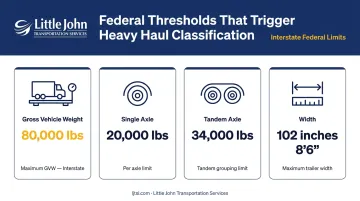
According to FHWA's federal size regulations, the interstate limits that push a shipment into heavy haul territory are:
- Gross vehicle weight: 80,000 lbs
- Single axle: 20,000 lbs
- Tandem axle: 34,000 lbs
- Width: 102 inches (8'6") on the National Network
Height and length have no single federal maximum — states set their own limits, though most cap height at 13'6" to 14'. States must allow at least 48 feet for semitrailers on the National Network, with many grandfathered limits extending to 53 feet or longer.
Those thresholds define the regulatory trigger. What drives actual demand is a separate question — and it traces back to a handful of industries where scale makes size unavoidable.
Industries That Generate Heavy Haul Freight
Demand concentrates in sectors where components are built at scale and can't be broken down for transport:
- Energy and power generation — wind turbine nacelles, tower sections, and large power transformers. The DOE reports most transformers weigh 150–400 tons, making single-unit moves a standard project logistics challenge
- Oil and gas — drilling rigs, BOP stacks, pressure vessels, frac tanks
- Construction — cranes, precast structural components, modular facilities
- Industrial machinery — CNC equipment and full plant relocation packages
- Military and defense — tactical vehicles, communications shelters, AA&E freight
- AI infrastructure — data center switchgear and large-scale server equipment
A single wind project illustrates the volume this generates: according to the Arkansas DOT, one 30-tower wind installation required 360 separate oversize/overweight permitted loads.
Federal Regulations Governing Heavy Haul Transport
Federal regulation sets the baseline. The FHWA establishes weight and width limits for the interstate system, while the FMCSA governs carrier authority, insurance, and driver compliance. One point that catches many shippers off guard: the federal government does not issue oversize/overweight permits. That authority belongs entirely to individual states.
The Federal Bridge Formula
Weight limits aren't just about total gross weight. The Federal Bridge Formula B governs how weight must be distributed across axle groups to protect bridge infrastructure. A vehicle can satisfy the 80,000 lb gross limit and still violate the formula if axle spacing doesn't match the load they carry.
The formula: W = 500[(L × N)/(N − 1) + 12N + 36]
Where W is the allowable weight on a consecutive axle group, L is the distance between outer axles, and N is the number of axles. This is why axle spacing is a core engineering concern in heavy haul planning — not just an administrative detail.
FMCSA Requirements for Heavy Haul Carriers
Carriers operating interstate for-hire heavy haul freight must maintain:
- MC number (operating authority): required for interstate carriage of regulated commodities for compensation
- Public liability insurance: FMCSA minimums are $750,000 for nonhazardous property carriers at GVWR over 10,001 lbs; hazardous material categories require $1M or $5M
- FMCSA Hazardous Materials Safety Permit (HMSP): required when the shipment includes specified hazardous materials in regulated quantities
The HMSP is relevant when heavy haul freight also involves hazardous materials — a common combination in energy, chemical, and military freight. Little John Transportation Services holds the FMCSA HMSP, a credential that fewer than 1% of U.S. carriers maintain, which is why clients moving loads that sit at the intersection of heavy haul and hazmat specifically seek them out.
Hours-of-Service in Heavy Haul Context
Federal HOS rules apply to heavy haul drivers without exemption: 11 hours of driving time after 10 consecutive hours off, no driving after the 14th consecutive on-duty hour, and a 30-minute non-driving break after 8 cumulative driving hours.
The operational challenge is that permit conditions — travel windows, curfews, approved routes — interact directly with HOS. A permit delay that pushes a driver past their 14-hour window can trigger a violation before the load moves another mile. State-mandated nighttime travel requirements create the same problem when available drive time doesn't align.
Managing this requires dispatch teams who track both permit status and driver hours in real time — not sequentially, but simultaneously.
State-Level Permits & Route Planning Requirements
Every state the load travels through issues its own permit. There is no national permit, no single application, and no uniform processing timeline. A five-state corridor can require anywhere from five to fifteen or more individual authorizations depending on route complexity, local jurisdictions, and load classification.
Permit Categories
| Type | Description |
|---|---|
| Single-trip | Covers one specified movement, route, and validity window (e.g., Tennessee: 10-day validity) |
| Annual/continuous | Repeated movements within an approved dimensional envelope (e.g., California: up to 12 ft wide, 14 ft high) |
| Superload/variance | Loads beyond automated thresholds requiring manual structural and route review |
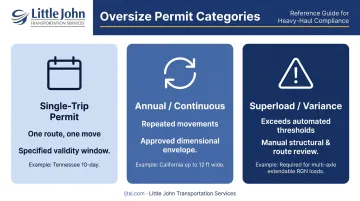
"Superload" has no universal federal definition — states set their own triggers. New York designates loads over 200,000 lbs, 16 ft wide, or 16 ft high. Tennessee uses 165,000 lbs or 16 ft wide. California's variance review kicks in above 15 ft wide or 17 ft high.
A load qualifying as a superload in one state may be processed as a standard oversize in the next.
Route Survey Requirements
Before any permit is issued for complex moves, the route must be evaluated for:
- Bridge weight ratings — every structure along the corridor must be rated for the axle group loads
- Overhead clearances — bridges, power lines, traffic signals, railroad crossings
- Turning radius constraints — off-tracking behavior of long or wide loads at intersections
- Road surface quality — pavement condition affects both the load and potential infrastructure liability
States codify these requirements into enforceable law. Minnesota, for example, requires a physical route survey for loads exceeding 16 ft high, 20 ft wide, or 175 ft long, completed within 14 days before the permit start date. Miss a single bridge restriction mid-route and you don't just face a delay — you can strand a multi-million dollar load with no legal path forward.
Seasonal and Time-Based Restrictions
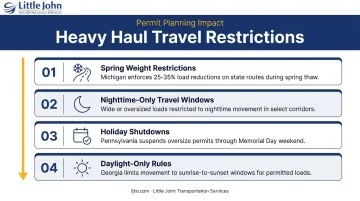
These compound planning timelines significantly:
- Spring weight restrictions — Michigan imposed 25–35% weight reductions on seasonal routes in 2026 during freeze-thaw season, plus a 35 mph maximum for affected vehicles
- Nighttime-only travel windows — certain wide loads are restricted to nighttime movement to minimize traffic disruption
- Holiday shutdowns — Pennsylvania's 2026 Memorial Day restriction ran from noon May 22 through sunrise May 26
- Daylight-only rules — Georgia requires permitted movement from 30 minutes after sunrise to 30 minutes before sunset
Each restriction adds days to a planning timeline — sometimes weeks. A move crossing six states during spring thaw season, with one state requiring a three-week superload review, needs to be on the permit coordinator's desk well before the scheduled load date. Build the calendar backward from delivery, not forward from departure.
Equipment Types Used in Heavy Haul Logistics
Trailer selection is an engineering decision, not a commodity one. The wrong configuration for a load's weight distribution, center of gravity, or fragility creates permit violations, road damage liability, and load damage risk.
Primary Trailer Configurations
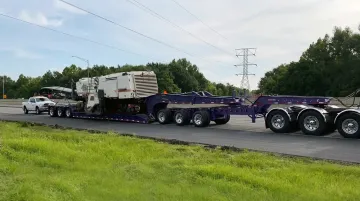
- RGN (Removable Gooseneck) / Lowboy — detachable front section allows tall machinery to be driven directly onto a low deck; controls vertical clearance for height-sensitive loads
- Stretch RGN — extendable deck for cargo that exceeds standard well lengths
- Multi-axle RGN — additional axles distribute weight across more points; Trail King's multi-axle configurations list capacities from 70,000 to 120,000 lbs depending on axle count and spacing
- Schnabel and perimeter trailers — for extreme-dimension loads requiring the cargo itself to become part of the structural support
- Self-Propelled Modular Transporters (SPMTs) — hydraulic, multi-directional platforms for the heaviest superloads; Goldhofer's PST/SL-E series rates 45 metric tons per axle line at slow travel speeds
- Standard flatbed — appropriate for loads near but not exceeding dimensional limits
Matching equipment to load requirements is a pre-move engineering step, not a day-of decision. Little John Transportation Services runs a fleet of 2,700+ specialized trailers — RGN, double-drop, multi-axle, and Schnabel — plus a 120-ton bridge crane at the Laredo facility built specifically for superload transloading.
Securement Requirements
Once the right trailer is confirmed, how the load is secured on it carries equal legal weight. Under 49 CFR 393.130, wheeled or tracked heavy vehicles and equipment weighing 10,000 lbs or more individually require at least four tiedowns. The securement system's aggregate working-load limit must equal at least one-half the cargo weight. Articulated equipment must be independently restrained.
These requirements are audited at weigh stations and reviewed following any incident — non-compliance creates liability exposure that extends beyond the load itself.
Best Practices for Heavy Haul Transport
Start With Lead Time
Heavy haul moves don't tolerate short notice. Permit acquisition alone ranges from minutes (for automated routine permits) to three weeks or more (for superloads requiring outside engineering review in states like Georgia). Factor in route surveys, equipment scheduling, pilot car coordination, and state-specific travel windows, and the realistic planning window for a complex multi-state move runs two to six weeks.
Inadequate planning runway — not the transit itself — is the most common reason heavy haul moves fail.
Documentation Discipline
Every heavy haul move should travel with a complete permit packet. Based on FHWA pre-trip guidance, that includes:
- Issued permits with approved route, dates, and curfew conditions
- Load securement records confirming tiedown ratings and configuration
- Driver qualifications and license credentials
- Equipment inspection reports
- Insurance documentation
- Escort credentials and contact information
An unauthorized route deviation voids a permit entirely. Audit-ready paperwork protects shippers from liability if a load is flagged at a weigh station or involved in an incident — and it's the first thing investigators request.
Communication Protocols
Heavy haul moves involve more parties than any other freight category. A single coordinator needs to manage:
Heavy haul moves involve more parties than any other freight category. A single coordinator needs to manage:
- Shipper and carrier dispatch
- Pilot car operators
- State DOT contacts
- Utility companies for wire lifts
- Law enforcement escorts (where required)
Owning that coordination from first call to final delivery is a risk management requirement, not a luxury.
Little John Transportation Services assigns dedicated account managers who manage this coordination, backed by 24/7 dispatch and real-time load tracking. When a permit delay, road closure, or weather event changes conditions, the assigned manager already has full load context and acts immediately — no scrambling across multiple parties to reconstruct the picture.
How to Choose a Heavy Haul Carrier
The vetting criteria matter more here than in any other freight category. A compliance failure in heavy haul — wrong permit, incorrect axle weight, missing escort — results in fines, potential load seizure, or structural damage liability that dwarfs the freight cost.
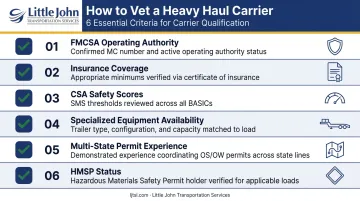
When evaluating carriers, verify:
- FMCSA operating authority — confirmed MC number in good standing
- Insurance coverage — appropriate minimums for load type and hazmat status
- CSA safety scores — checked against FMCSA's SMS thresholds (Unsafe Driving and HOS Compliance thresholds are 65% for general carriers; exceeding them triggers federal intervention review)
- Specialized equipment availability — not just "we can find a trailer"
- Multi-state permit experience — in-house permit acquisition versus brokering out
- HMSP status — required when heavy haul intersects with regulated hazardous materials
Before committing, ask three specific questions:
- How many heavy haul loads do you execute annually?
- Do you pull permits in-house or outsource them?
- What's your protocol when a permit is delayed mid-move?
Carriers without dedicated heavy haul infrastructure routinely broker loads to unknown third parties, creating accountability gaps that only surface when something goes wrong. The answers to those questions tell you whether you're working with a carrier built for this freight or one improvising around it.
Little John Transportation Services processes over 100,000 oversize/overweight permits annually, maintains a DOT crash frequency near half the national average, and has built a 30+ year track record, ranked #1 in North America on the ACT Transport 50 for 16 consecutive years, in exactly the freight category where that operational discipline is non-negotiable.
Frequently Asked Questions
What is heavy haul logistics?
Heavy haul logistics is the planning, permitting, and execution of moving loads that exceed standard legal weight or dimensional limits. It requires specialized equipment, state-issued permits for every jurisdiction traversed, and carriers with specific operational expertise that standard freight providers don't maintain.
What permits are required for heavy haul transportation?
Each state the load travels through issues its own oversize/overweight permit — there's no single national authorization. Permits may be single-trip, annual, or superload classification depending on dimensions and weight, with some states requiring several days to several weeks of advance processing.
What are the federal weight limits for heavy haul trucks?
The federal interstate limits are 80,000 lbs gross vehicle weight, 20,000 lbs single axle, and 34,000 lbs tandem axle. The Federal Bridge Formula also governs how weight must be distributed across axle groups to protect bridges — a vehicle can satisfy the gross weight limit and still fail axle-group calculations.
What equipment is used in heavy haul transport?
Primary configurations include RGN/lowboy trailers for height-sensitive machinery, stretch RGNs for long loads, multi-axle trailers for weight distribution, Schnabel and perimeter trailers for extreme dimensions, and SPMTs for the heaviest superloads. Equipment selection is based on the load's weight, height, length, and structural characteristics.
How far in advance should a heavy haul shipment be planned?
Multi-state heavy haul moves typically require two to six weeks of lead time. State permit processing ranges from same-day (automated routine permits) to three weeks for superloads requiring engineering review — and spring thaw restrictions or state travel bans can push timelines even further.
What is a superload, and how is it different from standard oversize freight?
Superloads exceed standard oversize thresholds; New York, for example, designates loads over 200,000 lbs or 16 ft wide as superloads. These moves require manual DOT review, structural bridge analysis for every route crossing, and police escorts beyond standard pilot car requirements.