Dedicated contract carriage (DCC) has emerged as a structured answer to these compounding problems. Rather than competing for trucks on the open market or absorbing the full burden of a private fleet, shippers can lock in exclusive capacity, transfer compliance responsibilities, and build predictable cost structures — all under a single long-term contract.
This guide covers what DCC actually is, how it compares to private fleet and spot market alternatives, which industries benefit most, what key benefits to expect, and what to scrutinize before signing with any provider.
Key Takeaways
- DCC dedicates drivers, equipment, and fleet management exclusively to one shipper under a multi-year contract
- Compliance, maintenance, and driver management transfer to a specialist — the entire operational burden, not just the equipment
- Cost predictability, capacity reliability, and compliance transfer are the operational advantages that drive most DCC decisions
- Cross-border DCC requires specialized credentials most standard providers don't hold
- Evaluate providers on safety data, certifications, and contract transparency; fleet size alone tells you nothing about execution capability
What Is Dedicated Contract Carriage?
Dedicated Contract Carriage (DCC) is a transportation arrangement where a third-party carrier assigns drivers, equipment, and fleet management resources exclusively to a single shipper under a long-term contract. Unlike common carriage or freight brokerage — where your freight competes with hundreds of other shippers for available trucks — DCC gives you capacity that works only for you.
The "Dedicated" Difference
In practice, the shipper receives trucks, drivers, and dispatch resources operating under their lanes and schedules. Equipment is often branded with the shipper's livery. Drivers are trained to company standards. The carrier functions as an extension of the shipper's operation, not a vendor juggling competing customers.
This exclusivity is what separates DCC from every other transportation model. Capacity isn't allocated based on market conditions — it's contractually reserved.
What DCC Actually Covers
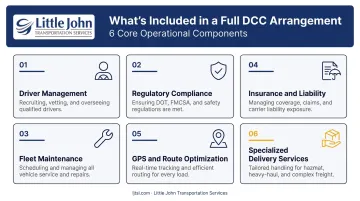
A full DCC arrangement goes far beyond the truck itself. Standard provider scope includes:
- Recruiting, hiring, training, payroll, and driver retention
- HOS monitoring, ELD tracking, CDL qualification, and DOT audits
- Scheduled inspections, repairs, and roadside breakdown support
- Insurance and liability carried under the carrier's authority
- GPS tracking, route optimization, and performance reporting
- White-glove delivery, cross-docking, and chain-of-custody documentation
Contract Structure
DCC agreements are typically structured as 3–5 year contracts, covering agreed volumes, lanes, equipment specifications, service standards, and compliance responsibilities. The multi-year term allows both parties to refine lane assignments, right-size the fleet, and build driver familiarity with the shipper's facilities — improvements that typically surface within the first 6–12 months of operation.
DCC vs. Private Fleet vs. Spot Market: Key Differences
Understanding where DCC fits requires comparing it honestly against the two most common alternatives.
| Factor | Private Fleet | DCC | Spot Market |
|---|---|---|---|
| Capital investment | Shipper funds all assets | Provider-owned, contracted | None |
| Driver/compliance burden | Shipper's responsibility | Provider-managed | Per-load carrier |
| Cost structure | Internal variable costs | Fixed contract pricing | Market-rate exposure |
| Capacity assurance | Owned | Contractually reserved | No guarantee |
| Branding/livery | Shipper-controlled | Dedicated, can be branded | Not applicable |
| Scalability | Rigid | Flexible within contract | High, but unreliable |
Why Private Fleet Ownership Has Gotten Harder
New Class 8 trucks have climbed toward $170,000 as a baseline price, with tariff-related pressures pushing projections higher. On top of the equipment cost, running a compliant fleet means absorbing:
- Driver recruiting and retention programs
- Regulatory compliance and Hours of Service management
- Commercial insurance and risk exposure
- Fleet maintenance and DOT inspection readiness
- Internal management overhead across all of the above
DCC transfers that entire burden to a carrier whose core business is managing it — compliance, drivers, and all.
Where the Spot Market Falls Short
Spot market capacity works for occasional or unpredictable freight. For businesses with consistent lanes and high service standards, it creates exactly the problems DCC solves: rate swings, uncertain capacity, and no accountability to brand or service standards. Contract rates swung nearly 40% upward between mid-2020 and early 2022, then dropped nearly 20% through 2023 — the kind of volatility that makes multi-year lane planning nearly impossible on spot.
Key Benefits of Dedicated Contract Carriage
Cost Predictability and Overhead Reduction
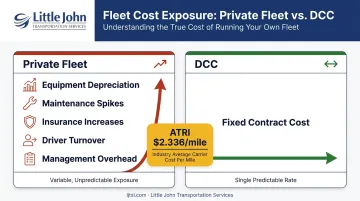
DCC converts variable fleet costs — equipment depreciation, maintenance spikes, insurance increases, driver turnover expenses — into a structured contract cost. Rather than absorbing unpredictable swings, shippers lock in a known operating cost tied to agreed volumes and lanes.
This matters especially given current market conditions. ATRI pegged Class 8 operating costs at $2.336 per mile in 2025, up 3.4% year-over-year. For shippers managing a private fleet, those increases flow directly to the bottom line. Under DCC, the provider absorbs and manages that exposure.
Compliance and Liability Transfer
This is one of DCC's most underappreciated advantages. The provider handles:
- Driver qualification and background checks
- DOT compliance and FMCSA audits
- ELD tracking and HOS record-keeping
- Vehicle inspection and maintenance documentation
- Accident liability under their carrier authority
For shippers moving regulated freight — hazardous materials, pharmaceuticals, defense cargo — the compliance stakes are severe. FMCSA compliance interventions can trigger automatically on certain violations, and penalties attach at the load level. Having a specialist carrier own that burden is a fundamentally different risk profile than managing it in-house.
Capacity Reliability and Scalability
Private fleets are rigid by nature. When demand surges, you either turn away business or scramble for spot capacity. When demand drops, you're carrying fixed asset costs on underutilized equipment.
DCC providers can scale fleet size to match seasonal peaks or planned expansion — procuring, financing, and deploying equipment without the shipper absorbing the capital risk. That flexibility is genuinely difficult to replicate in a private fleet model without significant infrastructure investment.
Brand Consistency and Customer Experience
Delivery is the final touchpoint of the customer relationship. When that's handled by a rotating carrier pool with no accountability to your standards, inconsistent service follows.
DCC trucks branded in your livery, driven by personnel trained to your service protocols, represent your company at the dock. For shippers in retail, consumer goods, or any industry where last-mile experience shapes customer perception, that consistency directly affects repeat business and customer retention.
Technology and Visibility
Reputable DCC providers bring operational technology that reduces blind spots and strengthens accountability across your lanes:
- GPS tracking and real-time location visibility
- Route optimization to improve on-time performance
- Performance dashboards for SLA management and dispute resolution
- Chain-of-custody documentation for regulated freight
For industries like pharmaceuticals or defense, where documentation is a compliance requirement — not just a nice-to-have — provider-side technology capability is a selection criterion, not a bonus feature.
Which Industries Benefit Most from Dedicated Contract Carriage
DCC performs best when freight has consistent volume, specific equipment requirements, regulatory complexity, or high service-level expectations. Several industries fit that profile precisely:
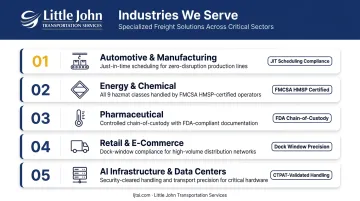
Automotive and Industrial Manufacturing — Just-in-time parts delivery tolerates almost no schedule variance. A missed delivery window can stop an assembly line. Dedicated capacity with fixed schedules and trained drivers is the only model that reliably supports JIT without costly buffer inventory.
Energy and Chemical — Hazmat-compliant transport for all nine hazard classes requires specific certifications, not just capable trucks. The FMCSA's Hazardous Materials Safety Permit is held by fewer than 1% of U.S. carriers — meaning provider selection for chemical and energy freight starts with certifications, not rate sheets.
Pharmaceutical and Life Sciences — FDA regulations under 21 CFR Part 211 require storage under appropriate conditions and lot-level distribution traceability. Temperature-controlled, chain-of-custody DCC is the standard for compliant pharmaceutical distribution.
Retail and E-Commerce — Delivery window compliance and branded driver presence matter for consumer-facing shippers. Retailers running high-frequency replenishment lanes — where a missed dock appointment triggers a chargeback — need scheduling reliability that spot capacity can't consistently deliver. DCC supports both predictable routing and brand identity at the dock.
AI Infrastructure and Data Centers — An emerging but fast-growing use case. Moving servers, switchgear, and high-value electronics requires handling precision, security protocols, and chain-of-custody documentation that spot carriers rarely provide. FreightWaves projects 18.9 million incremental truckloads from AI infrastructure construction between 2026 and 2031 — dedicated capacity arrangements will become a structural requirement for this freight category.
Cross-Border Operations: A Specialized DCC Case
Trucks carried 72.5% of all US–Mexico freight in 2024, with total truck freight between the US and both neighboring countries reaching $1.0 trillion — up 3.6% year-over-year. For shippers operating cross-border lanes, a standard DCC provider is rarely sufficient.
Cross-border DCC demands infrastructure that most domestic providers simply don't have:
- Bilingual dispatch with in-country personnel on both sides of the border
- C-TPAT validation and FAST certification for expedited crossing
- In-house customs coordination (US and Mexican brokerage)
- Equipment pre-positioned at active border crossings
Most domestic DCC providers lack all of it.
Little John Transportation Services operates dedicated teams in Laredo, Monterrey, and Guadalajara — with a 50-acre C-TPAT-validated facility at the Laredo crossing, in-house US and Mexican customs brokerage, a 30-bay cross-dock, and bilingual 24/7 dispatch. For shippers with consistent US–Mexico lanes, that level of in-country infrastructure is what separates functional cross-border DCC from a carrier that technically crosses the border.
Understanding which industries benefit most from DCC is the foundation. The next step is knowing what to look for when evaluating providers — and where the gaps between a capable carrier and the right partner actually appear.
How to Choose the Right DCC Provider: Best Practices
Prioritize Certifications Over Fleet Size
A large fleet with mediocre compliance credentials is a liability, not an asset. Credentials to verify before signing:
- FMCSA Satisfactory safety rating — the highest classification FMCSA issues. Signals functional, adequate safety management across the operation
- CSA/SMS compliance scores — FMCSA groups comparable carriers by percentile across seven safety BASICs; request these scores directly
- C-TPAT validation — required for cross-border lanes; CBP reports 11,400+ certified partners, but validated status (higher tier) confirms physical security review
- FMCSA HMSP — required for certain hazmat categories; held by fewer than 1% of US carriers
- ISO 9001:2015 — confirms audited quality management processes, not just stated commitments
- TWIC credentials — required for unescorted access to maritime facilities, ports, and certain industrial sites
Little John holds all six of these credentials — including the FMCSA HMSP and C-TPAT validation — which collectively protect shippers across safety, cross-border security, and facility access dimensions.
Evaluate Safety Records With Hard Data
Marketing language about "safety-focused culture" tells you nothing. Ask for:
- DOT crash frequency data, benchmarked against comparable carriers using FMCSA records
- Claim-free delivery rates across total load volume
- Driver retention figures (high turnover correlates with inexperienced drivers and service inconsistency)
Little John maintains a DOT crash frequency near half the national average and a 99.9% claim-free delivery rate across its specialized freight operations. Once you have those numbers, you're ready to evaluate what the contract actually guarantees.

Scrutinize Contract Terms Before Signing
DCC contracts are multi-year commitments. The terms deserve careful review:
- Volume commitment thresholds — what happens if your volumes fall short?
- Pricing escalation clauses — how are fuel, labor, and insurance cost increases handled?
- Performance KPIs and remedies — what metrics govern service levels, and what recourse exists if they're missed?
- Termination conditions — under what circumstances can either party exit?
- Equipment standards — what specifications are guaranteed, and who decides when equipment is replaced?
- Backhaul revenue sharing — some providers share revenue from backhaul moves, which can meaningfully offset contract costs
Look for Long-Term Partnership Indicators
The best DCC relationships function as operational partnerships, not vendor transactions. What to look for in a provider built for the long term:
- Named account contact with direct access (not a rotating service desk)
- Proactive communication when issues arise — before you ask
- Client retention rate over 5+ years — ask for it directly
Little John's top-25 customer tenure averages 33 years, with 100% retention among their top 100 customers in FY2024. That kind of tenure doesn't happen by accident — it's the result of named contacts, answered phones, and problems resolved before they escalate.
Signs Your Business Is Ready for DCC
Not every shipper is a DCC candidate. The model works best when specific operational conditions are present.
Signals that DCC makes sense:
- Recurring capacity shortfalls on key lanes
- Driver turnover above industry norms
- Rising insurance costs on an existing private fleet
- Inconsistent delivery performance affecting customer relationships
- Planned expansion into new markets or cross-border routes without supporting infrastructure
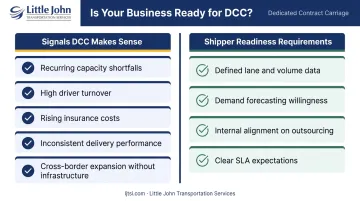
Readiness requirements on the shipper side:
- Defined freight volumes and lane data to right-size the fleet
- Willingness to share demand forecasting with the provider
- Internal alignment on outsourcing day-to-day transportation execution
- Clear service-level expectations to build contract terms around
As a general industry benchmark, modeling at least two weeks of operating data before engaging a DCC provider gives both sides enough to work with. Routes under 250 miles with four or more stops per run tend to be particularly well-suited for dedicated programs.
When DCC Isn't the Right Fit
- Highly unpredictable or seasonal-only freight volumes
- One-off shipments or early-stage logistics operations
- Businesses without defined lane data to structure a contract around
When volumes are inconsistent or lane data is thin, freight brokerage or hybrid models are a more practical starting point. Once you're moving consistent freight on defined routes, the economics of a dedicated arrangement start to make sense.
Frequently Asked Questions
What is dedicated contract carriage?
Dedicated contract carriage is a third-party transportation model where a carrier dedicates drivers, equipment, and fleet management exclusively to one shipper under a long-term contract. Unlike shared or spot-market options, the shipper has reserved, exclusive capacity — not competing with other customers for trucks or priority.
What is the difference between dedicated contract carriage and a private fleet?
With a private fleet, the shipper owns, staffs, insures, and maintains all equipment — absorbing the full capital and compliance burden. DCC outsources all of those responsibilities to a specialized provider, shifting capital costs and regulatory obligations while the shipper retains control over service standards and scheduling.
How long are dedicated contract carriage contracts typically?
DCC agreements are typically structured as multi-year contracts, commonly 3–5 years. The longer term gives both the shipper and provider time to optimize the program and justify the equipment and staffing investments required to set it up properly.
What industries benefit most from dedicated contract carriage?
Industries with consistent volumes, regulated freight, or high service-level requirements benefit most — including automotive manufacturing, energy and chemical, pharmaceutical, retail, and cross-border logistics between the US and Mexico. AI infrastructure and data center hardware represent a growing use case.
Is dedicated contract carriage more cost-effective than managing a private fleet?
DCC typically reduces total transportation cost by eliminating capital expenditure on equipment, lowering driver management overhead, and stabilizing insurance and maintenance costs. The degree of savings depends on your current fleet size, lane consistency, and which provider you select — no universal benchmark applies across all transitions.
What should I look for when choosing a dedicated contract carriage provider?
Start with the fundamentals: FMCSA Satisfactory rating, strong CSA scores, and C-TPAT validation for any cross-border lanes. Beyond certifications, verify claim-free delivery rates, driver retention figures, and contract transparency on volume commitments, escalation clauses, and KPI remedies. For regulated or cross-border freight, confirm the provider holds cargo-specific credentials — not just general transportation authority. A carrier like Little John Transportation Services, for example, holds FMCSA HMSP certification, CTPAT validation, and a 99.9% claim-free delivery rate — the kind of verifiable benchmarks worth holding any shortlisted provider to.