This guide covers exactly what information to gather before contacting a carrier, how the quoting process works for dangerous goods, what drives hazmat pricing, and the mistakes that derail loads before they ever leave the dock.
Key Takeaways
- Quotes require your UN number, proper shipping name, hazmat class, packing group, and emergency contact (all sourced from your SDS).
- Hazmat must be declared during the quoting phase, not at pickup. Late disclosure leads to carrier refusals and potential DOT violations.
- Only 898 U.S. carriers hold an FMCSA Hazardous Materials Safety Permit (HMSP) — fewer than 1% of active carriers — so verifying certification before quoting is essential.
- Hazmat quotes include surcharges above base rates driven by material class, packing group, route restrictions, and equipment type.
- Carriers holding FMCSA HMSP with 100% hazmat-endorsed drivers eliminate the certification vetting burden for shippers.
How to Get a Freight Quote for Hazmat Shipments
Step 1: Identify and Classify Your Hazardous Material
Start with the product's Safety Data Sheet (SDS). This document contains everything a carrier needs to evaluate whether they can legally accept the load.
From the SDS, extract these four core identifiers required by DOT under 49 CFR 172.202:
- Identification number (UN or NA four-digit code)
- Proper shipping name (must match the DOT Hazardous Materials Table exactly; informal product names are not acceptable on BOLs)
- Hazmat class (one of nine DOT classes)
- Packing group (I, II, or III — where I indicates the greatest danger)
The nine DOT hazmat classes are:
- Class 1 — Explosives
- Class 2 — Gases
- Class 3 — Flammable liquids
- Class 4 — Flammable solids
- Class 5 — Oxidizers
- Class 6 — Toxic and infectious substances
- Class 7 — Radioactive materials
- Class 8 — Corrosives
- Class 9 — Miscellaneous hazardous materials
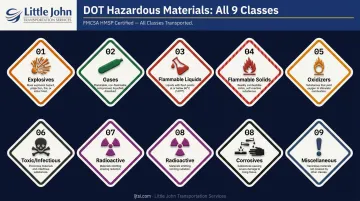
Some classes carry additional permitting requirements. Class 1 Divisions 1.1, 1.2, and 1.3 require an FMCSA HMSP above 25 kg net explosive weight, as do certain poison-by-inhalation and radioactive materials at specified quantities. Verify whether your material triggers HMSP requirements before requesting a quote: it directly determines which carriers can legally accept the load.
Step 2: Gather All Required Shipment Details
Carriers and brokers need more than classification data to price a hazmat load. Have the following ready before reaching out:
- Origin and destination (city, state, zip)
- Total shipment weight and dimensions
- Piece count and packaging type
- Freight mode (FTL or LTL)
- UN/NA identification number
- Proper shipping name
- Hazmat class and division
- Packing group
- Emergency response company name and 24/7 phone number
That last item is non-negotiable. Under 49 CFR 172.604, the offeror must provide a numeric emergency telephone number monitored throughout transport, staffed by someone who knows the material or has immediate access to emergency response guidance. Services like CHEMTREC qualify, but you must have an active service arrangement in place. Simply listing a number without authorization is not compliant — in 2023, PHMSA cited five separate enforcement cases involving Section 172.604 violations alone.
Step 3: Contact a Hazmat-Certified Carrier or Broker
Hazmat must be declared during the quoting process — not as a note at pickup. Carriers that are not hazmat-certified will decline the load outright, and late disclosure can result in detention charges, carrier refusals mid-route, or regulatory violations.
The quoting process typically works like this:
- Submit shipment details via email, online form, or phone — include all classification data and the emergency response contact upfront
- A hazmat-experienced rep reviews the classification, checks equipment availability and routing, and confirms carrier eligibility
- A rate is returned that reflects the base rate, all applicable hazmat surcharges, fuel surcharges, and any permit fees for the specific material and lane
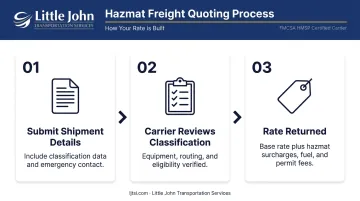
If a carrier asks clarifying questions about the material before returning a rate, that's a good sign. It means they're verifying eligibility and routing — not just filling a slot.
Little John Transportation Services handles quote requests directly at quotes@ljtsi.com or by phone, with hazmat-experienced specialists reviewing classification data before pricing the load.
Step 4: Review the Quote and Confirm Compliance Documentation
A properly structured hazmat freight quote should include:
- Base rate for the lane and equipment type
- Hazmat surcharge (sometimes labeled as a dangerous goods fee) — this reflects compliance costs: certified drivers, emergency response service, routing complexity, HMSP qualification, and specialized equipment
- Fuel surcharge
- Permit fees, where applicable for specific material categories or restricted routes
Once a quote is accepted, the carrier generates a Bill of Lading (BOL) with hazmat fields formatted in the DOT-required order: (1) identification number → (2) proper shipping name → (3) hazard class or division → (4) packing group. No unrelated information may interrupt this sequence. That ordering is a DOT documentation requirement under 49 CFR 172.202, not a formatting preference — and BOLs with incorrect sequences have been cited in PHMSA enforcement actions.
What You Need Before Requesting a Hazmat Freight Quote
Preparation determines whether you receive an accurate quote quickly or get stuck in back-and-forth requests for missing information — or face a rejection at pickup.
Required Regulatory Identifiers
Your SDS is the starting document. Pull these fields before making any carrier contact:
- UN or NA identification number
- Proper shipping name (cross-reference with the DOT Hazardous Materials Table — informal trade names are not acceptable)
- Hazmat class and division
- Packing group
- Any special handling, segregation, or quantity limits noted in the SDS
The proper shipping name matters more than most shippers realize. Quotes built on incorrect commodity descriptions will require revision, and BOLs with wrong nomenclature can trigger DOT violations at roadside inspection.
Emergency Response Information
Carriers legally require a 24/7 emergency response contact for all hazmat shipments. Shippers who don't have one on file cannot book hazmat freight through a compliant carrier. If you don't have an existing arrangement with a registered provider, that needs to be resolved before requesting any quote.
Carrier Certification Verification
Not all licensed carriers are authorized to haul hazmat. For the highest-risk material categories — certain gases, explosives, poison-by-inhalation materials, and radioactive quantities — the carrier must hold an FMCSA Hazardous Materials Safety Permit (HMSP).
According to FMCSA's 2024 statistical data, only 898 carriers out of 787,189 active USDOT carriers hold an HMSP (0.114% of the carrier population). Verify HMSP status through the FMCSA SAFER system before requesting a quote; otherwise you may receive pricing from a carrier that legally cannot haul your material.
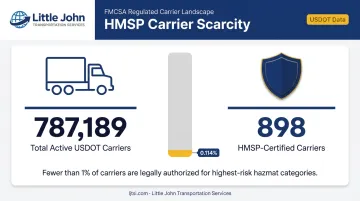
Little John Transportation Services holds FMCSA HMSP certification and operates with 100% hazmat-endorsed drivers across its BCO network. For shippers moving high-risk categories, that certification check is already resolved before the first call.
Key Factors That Affect Hazmat Freight Quote Pricing
Hazmat quotes are not standard freight rates plus a flat fee. Several variables tied to the specific material, route, and equipment drive what you'll actually pay.
Hazmat Class and Packing Group
Higher-risk classes — explosives, poison gas, toxic-by-inhalation — require specialized equipment, permitting, and routing, all of which increase carrier cost. Packing Group I (greatest danger) commands higher surcharges than Packing Group III.
Route and Regulatory Restrictions
Under 49 CFR Part 397, placarded hazmat loads must follow applicable state and tribal route designations. Where no designation exists, carriers are generally directed away from tunnels, heavily populated areas, narrow streets, and places where crowds gather.
Specific restrictions from FMCSA's National Hazardous Materials Route Registry include:
| Location | Restriction |
|---|---|
| Holland Tunnel, NY/NJ | All hazmat prohibited |
| Liberty Tunnel, PA | Table 1 materials and explosives prohibited |
| Verrazzano-Narrows Bridge, NY | Explosives prohibited |
| San Francisco-Oakland Bay Bridge, CA | Classes 1 and 7 restricted |
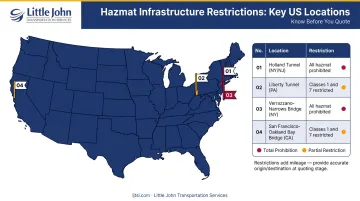
These detours add mileage. Shippers who provide accurate origin and destination details upfront get more reliable quotes — vague routing data leads to rate adjustments after booking.
Equipment Requirements
Some hazmat loads require tanker trailers, specialized containment, or temperature control — not standard dry van or flatbed. Equipment availability varies by lane. A carrier with dedicated specialized equipment delivers more stable hazmat quotes than a broker sourcing from the spot market, where availability and pricing shift daily.
Key equipment considerations:
- Tanker and specialized containment trailers are not universally available in all lanes
- Temperature-controlled equipment adds cost and limits carrier eligibility
- Spot-market sourcing introduces pricing volatility; dedicated carrier networks do not
Freight Mode: FTL vs. LTL
Hazmat LTL is significantly more restricted than FTL — many carriers decline it entirely or limit acceptance to lower-risk classes. FTL provides dedicated handling, clearer compliance documentation, and fewer eligibility issues, though it carries higher minimum costs.
For recurring chemical or high-packing-group shipments, FTL is often the more reliable choice even when volume doesn't strictly require a full trailer.
When to Use a Specialized Hazmat Carrier vs. a General Freight Broker
The distinction matters most when the material is high-risk, volume is ongoing, or the route crosses the US-Mexico border.
A general broker may source a one-time hazmat load, but if they're relying on the spot market to find a certified carrier, the shipper absorbs the risk of certification mismatches, last-minute rejections, and rate volatility.
A specialized hazmat carrier makes sense when:
- Shipments involve FMCSA HMSP-required materials
- The load is recurring — chemicals, petrochemicals, flammables, or classified goods on a regular schedule
- The route is multi-stop or crosses into Mexico, where both US DOT and Mexican SICT regulations apply
- The material falls in a high packing group classification (Group I or II)
For cross-border hazmat specifically, US transport documents must be in English and provided in Spanish for the Mexican leg. Mexico uses UN identification numbers rather than domestic NA numbers, and the transport document must comply with NOM-043-SCT-SEMAR-ARTF-2023 alongside US HMR requirements. That's not paperwork a spot-market carrier handles consistently or reliably.
Little John Transportation Services operates as a direct specialized carrier, with teams stationed in Laredo, Monterrey, and Guadalajara. The network includes 8,500+ hazmat-endorsed BCOs and FMCSA HMSP certification — a credential held by fewer than 1% of carriers. For shippers moving hazmat on a recurring basis, that's the difference between a carrier who owns the compliance process and a broker who hopes the spot market delivers one.
Common Mistakes When Requesting Hazmat Freight Quotes
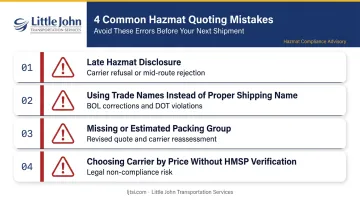
Most quoting errors aren't random — they follow predictable patterns. These four come up repeatedly and each one has real consequences.
Disclosing hazmat after booking or at pickup forces carriers to refuse the load or renegotiate on the spot. Hazmat determines equipment, routing, carrier eligibility, and documentation format — it has to be declared at the quoting stage, not after.
Quoting under informal or trade names instead of the DOT proper shipping name leads to revised quotes and BOL corrections. Pull the exact proper shipping name from the SDS and verify it against the DOT Hazardous Materials Table before submitting.
Leaving packing group blank or estimating it changes the quote. Packing group directly affects carrier acceptance, required packaging, and surcharge calculation — carriers will revisit the price once they review the actual SDS.
Selecting a carrier based on price without verifying HMSP certification is the most costly shortcut. Only 898 carriers in the US hold FMCSA hazmat safety permits. The gap between the lowest bid and a legally authorized carrier is wider than most shippers expect.
Conclusion
Getting an accurate hazmat freight quote starts well before you contact a carrier. It starts with correct classification, complete documentation, and a firm grasp of what drives dangerous goods pricing.
The biggest failures in hazmat quoting trace back to two root causes: incomplete preparation — missing UN number, no emergency response contact, wrong proper shipping name — and working with carriers that aren't actually equipped to haul the material safely and legally.
Before you reach out, make sure you have:
- Correct UN number and proper shipping name
- Hazard class, packing group, and quantity per package
- SDS (Safety Data Sheet) and emergency response contact
- Origin, destination, and any special handling requirements
Shippers moving chemicals, petrochemicals, flammables, or other classified goods can contact Little John Transportation Services at quotes@ljtsi.com or +1 (479) 264-6501. Little John holds FMCSA HMSP certification — a credential fewer than 1% of carriers carry — with hazmat-endorsed drivers on every load and 30+ years moving the freight most carriers refuse.
Frequently Asked Questions
How do I get a freight quote for a hazmat shipment?
Gather your UN number, proper shipping name, hazmat class, packing group, and emergency response contact from your SDS, then submit those details to a hazmat-certified carrier. A qualified rep reviews the classification, confirms equipment and routing availability, then returns a rate that accounts for all compliance costs.
What information do I need to get a hazmat freight quote?
At minimum: UN or NA identification number, proper shipping name, hazmat class and division, packing group, emergency response company name and 24/7 phone number, shipment weight and dimensions, and origin/destination details. Missing any of these will delay or invalidate the quote.
Why are hazmat freight quotes higher than standard freight?
Hazmat quotes include surcharges above the base rate to cover certified drivers, DOT routing restrictions, specialized equipment, emergency response service, and HMSP compliance — plus the elevated liability carriers assume for dangerous goods. Exact costs shift depending on material class, packing group, and the specific lane.
How do I know if a carrier is certified to haul hazmat?
Verify the carrier holds an FMCSA Hazardous Materials Safety Permit (HMSP) for applicable material types, and confirm drivers carry hazmat endorsements. You can verify both through the FMCSA SAFER system using the carrier's USDOT number.
Can hazardous materials be shipped across the US-Mexico border?
Yes, but cross-border hazmat shipments must meet both US DOT regulations and Mexican SICT requirements, including bilingual documentation and Spanish-language emergency information for the Mexican leg. A carrier with established cross-border hazmat infrastructure is required — domestic hazmat experience alone is not sufficient.
What is an FMCSA Hazardous Materials Safety Permit (HMSP)?
The HMSP is a federal permit required for carriers transporting the highest-risk hazmat categories, including certain gases, explosives, and toxic-by-inhalation materials above specified thresholds. Fewer than 1% of US carriers hold it — confirm HMSP status before awarding any hazmat shipment.