Choose the wrong mode and you're looking at damaged goods from excess handling, missed production deadlines, or an oversized freight bill for a half-empty trailer. The right choice depends on shipment size, cargo sensitivity, delivery urgency, and whether your freight has compliance requirements that standard carriers can't meet.
This article breaks down both modes clearly: what they are, how they work, what they cost, and a practical framework for deciding which fits your freight.
Key Takeaways
- FTL gives you the full truck — faster transit, minimal handling, predictable delivery windows
- LTL shares trailer space with other shippers — lower cost for small loads, but more handling and less delivery certainty
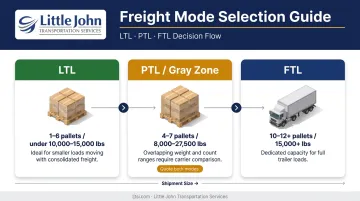
- Pallet count and weight are the primary mode-selection triggers: under 6 pallets favors LTL, 10+ pallets favors FTL
- The 4–7 pallet gray zone warrants quotes for both modes — partial truckload (PTL) is often the better middle ground
- Specialized freight (hazmat, heavy-haul, cross-border) requires carrier credentials beyond standard FTL or LTL networks
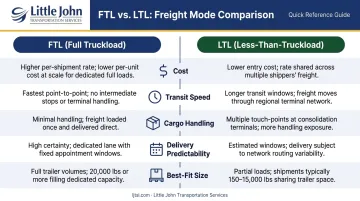
FTL vs LTL: Quick Comparison
| Factor | FTL | LTL |
|---|---|---|
| Cost | Higher upfront; more cost-effective at scale | Pay only for space used; accessorial fees add up |
| Transit Speed | Direct route, no stops | |
| Cargo Handling | Loaded once, sealed, delivered direct | Multiple terminal transfers; reloaded at each stop |
| Delivery Predictability | Firm delivery windows | Estimates, not guarantees |
| Best-Fit Size | 10–12+ pallets or ~15,000 lbs | 1–6 pallets or under 10,000–15,000 lbs |
What Is FTL Shipping?
FTL (Full Truckload) means one shipper's cargo occupies the entire trailer — whether it fills the space or not. You're paying for exclusive use of the truck, not just the cubic footage your freight takes up.
Operationally, the process is straightforward: freight loads at origin, the trailer seals, and the truck drives directly to the destination. No intermediate stops. No terminal transfers. The trailer doesn't open again until delivery.
FTL Pricing
FTL rates are primarily priced per mile. DAT reported a $2.32/mile seven-day national dry-van linehaul average (excluding fuel) as of June 2026. Lane, distance, equipment type, and market conditions all move that number.
According to C.H. Robinson, shipments above 10–12 pallets — or roughly 15,000 lbs — are generally considered FTL. As shipment size grows, FTL's per-unit cost drops, making it increasingly competitive against LTL for mid-to-large loads.
Core Advantages of FTL
- Direct routing cuts transit time by eliminating network stops
- Freight stays untouched from load to delivery, reducing damage exposure
- Firm delivery windows support production timelines and customer SLAs
- Sealed trailers reduce tampering and commingling risk throughout the haul
FTL Use Cases
FTL suits any scenario where load size, urgency, or cargo sensitivity rules out shared transport:
- Replenishing regional distribution centers on defined schedules
- Moving production components between manufacturing plants on tight deadlines
- Transporting large industrial equipment requiring dedicated flatbed or specialized trailers
- Shipping time-sensitive goods to a single consignee
FTL is the default mode across industries where load density, compliance requirements, or delivery timing leaves no room for a shared network: industrial machinery, automotive, chemical and petrochemical, energy, military and defense, and high-value retail.
Little John Transportation Services moves 100,000+ FTL loads annually across the U.S., México, and Canada — primarily flatbed, heavy-haul, hazmat, and specialized equipment loads that general carriers typically decline. With 8,000+ dedicated owner-operators and access to 17,000+ trailers, the company serves energy, automotive, chemical, and defense shippers where compliance and schedule integrity are mandatory, not optional.
What Is LTL Shipping?
LTL (Less-than-Truckload) means your freight shares a trailer with other shippers' cargo. You pay only for the space and weight your shipment occupies — the carrier fills the rest with other customers' freight.
Operationally, LTL uses a hub-and-spoke model. Your cargo is picked up, consolidated with other shipments, and routed through one or more carrier terminals — where it's unloaded, sorted, and reloaded — before reaching its final destination. The number of terminal transfers depends on distance and the carrier's network design.
LTL Pricing
LTL rates are calculated using the NMFC (National Motor Freight Classification) system, which classifies freight based on density, handling difficulty, stowability, and liability. NMFTA assigns commodity classes from 50 to 500. Denser, easier-to-handle freight earns a lower class and lower rate.
Beyond base rates, accessorial fees often drive up the final cost:
- Liftgate service: ~$20–$100+
- Residential delivery: ~$20–$150+
- Inside delivery: ~$50–$150
- Appointment scheduling: ~$10–$100+
For shipments in the 4–7 pallet range, always get LTL and FTL quotes side by side — accessorial fees can close the gap faster than expected.
Core Advantages of LTL
- Lower cost for small shipments — no need to pay for unused trailer space
- Flexibility — ship when freight is ready, not when a truck is full
- Access to national carrier networks for broad geographic reach
The tradeoffs are real: longer and less predictable transit times, more handling exposure at each terminal, and higher cargo damage risk compared to FTL.
LTL Use Cases
LTL works well for:
- Replenishing service centers or branch locations with spare parts
- Distributing smaller quantities of consumer goods to retail locations
- Shipping samples, partial orders, or seasonal inventory
- Businesses with variable shipping volumes that don't regularly fill a full truck
Industries that lean on LTL most include retail and fashion, furniture, HVAC equipment, and smaller consumer goods manufacturers shipping to distributed locations.
FTL vs LTL: Which Is Right for Your Freight?
No single rule applies universally. Five questions narrow it down fast:
- How many pallets, and what's the total weight?
- How firm is the delivery deadline?
- How fragile or high-value is the cargo?
- Are there security or compliance requirements?
- Is the priority lowest unit cost or lowest total risk?
The Pallet and Weight Rule of Thumb
- 1–6 pallets or under 10,000–15,000 lbs → LTL is typically the better fit
- 10–12+ pallets or ~15,000 lbs+ → FTL becomes more competitive
- 4–7 pallet gray zone → Quote both modes; also evaluate partial truckload (PTL)
PTL is a middle-ground option — typically 6–18 pallets or 8,000–27,500 lbs — where freight may share space but moves with fewer terminal transfers and faster transit than standard LTL. It doesn't require a freight class and often delivers a meaningful cost-to-speed improvement over LTL for mid-size shipments.
Delivery Timeline
If you need a firm delivery date, FTL is the only reliable choice. LTL transit times are estimates — multi-stop routing and terminal handling introduce variability that carriers can't guarantee. For production deadlines, retail launch windows, or anything time-critical, FTL's predictability is worth the cost premium.
Cargo Sensitivity and Damage Risk
With LTL, freight passes through multiple terminal transfers. Each handling point is an opportunity for damage — particularly for fragile, irregularly shaped, or high-value goods. Industry data consistently shows that LTL's multi-stop routing through multiple trailers and warehouses creates significantly more mishandling exposure than direct truckload movement.
FTL eliminates intermediate handling entirely: the trailer seals at origin and opens at delivery.
Situational Recommendations
Choose LTL when:
- Shipment is small (under 6 pallets)
- Delivery timeline is flexible
- Cargo is durable, palletized, and low-value
Choose FTL when:
- Shipment is large (10+ pallets) or fills more than half a trailer
- Delivery window is firm
- Cargo is fragile, high-value, or compliance-regulated
Real-world examples:
- An industrial equipment manufacturer shipping 8 pallets of components to a plant with a production deadline → FTL. No terminal stops, no schedule variability, no exposure risk.
- A retailer replenishing a branch location with 3 pallets of durable goods on a flexible schedule → LTL works well and keeps cost per pallet low.
When the shipment sits in the gray zone — say, 6–9 pallets with moderate deadline pressure — get quotes for both modes and run a PTL comparison before committing.
When Standard FTL or LTL Isn't Enough: Specialized Freight
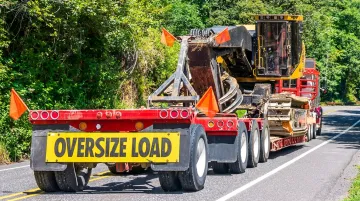
Some freight exceeds what standard FTL and LTL carrier networks are legally or physically equipped to handle. Hazardous materials, oversized heavy-haul loads, and cross-border U.S.–Mexico shipments often fall into this category — requiring specialized permits, certified drivers, and purpose-built equipment.
What Specialized FTL Looks Like in Practice
- Flatbed, step-deck, RGN, double-drop, and multi-axle trailers for heavy-haul and oversized loads — industrial machinery, wind energy components, and oilfield equipment — with state oversize/overweight permits and route engineering
- Hazmat shipments require FMCSA HMSP authorization, certified drivers, and segregation compliance under 49 CFR 177.848 for incompatible materials
- Cross-border U.S.–Mexico freight demands bilingual operations teams, CTPAT-validated facilities, in-house customs brokerage, and mirror carrier networks on both sides of the border
The FMCSA Hazardous Materials Safety Permit (HMSP) covers specified quantities of particularly hazardous materials — explosives, radioactive substances, and poison-inhalation-hazard goods. Fewer than 1% of carriers hold this permit, which is why most shippers moving this freight can't rely on standard carrier networks.
Where Little John Transportation Services Fits
Little John Transportation Services has specialized in the freight most carriers decline for 30+ years — heavy-haul, hazmat across all 9 classes (including AA&E), and U.S.–Mexico cross-border loads. Their capabilities include:
- FMCSA HMSP holder with 100% Hazmat-endorsed drivers
- CTPAT-validated 50-acre Laredo facility with a 120-ton bridge crane for superload transloading
- TPS-approved and AA&E-certified for military and defense freight
- Bilingual operations teams in Laredo, Monterrey, and Guadalajara
- 99.9% claim-free delivery rate
For freight that exceeds standard carrier capabilities, contact Little John Transportation Services at quotes@ljtsi.com or +1 (479) 264-6501.
Frequently Asked Questions
What is the difference between LTL and FTL?
FTL means one shipper's cargo occupies the full truck, which drives directly from origin to destination. LTL means multiple shippers share trailer space and costs, with freight routed through carrier terminals — resulting in more stops, more handling, and less predictable delivery windows.
What is the maximum weight limit for an FTL truck?
The federal gross vehicle weight limit is 80,000 lbs, subject to axle configuration and the Federal Bridge Formula. A standard 53-foot dry van typically carries 44,000–45,000 lbs of freight, varying by trailer and tractor tare weight. Heavy-haul configurations can exceed that limit with proper state permits.
Is FTL or LTL cheaper?
LTL is cheaper for small shipments because you only pay for the space you use. FTL becomes more cost-effective as shipment size grows — and for loads exceeding half a truckload, FTL often wins on total cost when you factor in LTL's accessorial fees, longer transit time, and higher damage exposure.
How many pallets before switching from LTL to FTL?
The general rule: LTL for 1–6 pallets, FTL for 10–12+ pallets. In the 4–7 pallet gray zone, quote both modes. Partial truckload (PTL) — typically 6–18 pallets or 8,000–27,500 lbs — is worth evaluating as a middle-ground option that trades some cost savings for faster transit.
Can hazardous materials be shipped via LTL?
Some LTL carriers accept certain hazmat freight, but restrictions on hazard class, commingling rules under 49 CFR 177.848, and carrier certification requirements create significant compliance exposure. For most hazmat shipments — particularly those requiring FMCSA HMSP authorization — dedicated FTL with a certified carrier is the safer, more compliant choice.
What is a partial truckload (PTL) and how is it different from FTL and LTL?
PTL is a middle-ground option for shipments of roughly 6–18 pallets or 8,000–27,500 lbs. Freight may share trailer space but typically moves with fewer terminal transfers than standard LTL, delivering faster transit at a lower cost than FTL.