Introduction
Moving a wind turbine from factory to field is nothing like standard freight. The components — tower sections, nacelles, and rotor blades — exceed legal load limits in every dimension simultaneously: length, width, height, and weight. That combination is rare even in specialized heavy-haul, and it means every move requires purpose-built equipment, engineering-grade route planning, and permits across multiple state jurisdictions before a single truck departs.
According to LBNL's 2025 Land-Based Wind Energy Technology Data Update, the average rotor diameter on newly installed U.S. turbines grew from 99 meters in 2014 to 137 meters in 2024. Blades are getting longer. Roads are not getting wider.
That gap between what turbines demand and what public infrastructure can handle keeps widening — and for energy developers, logistics managers, and procurement teams, transport delays directly stall commissioning schedules and inflate project costs.
This guide walks through the full transport process: what makes these components uniquely difficult to move, how experienced carriers sequence the work, and why choosing the wrong carrier often means missed permits, failed route surveys, and turbines sitting on the side of a highway.
Key Takeaways
- Wind turbine components exceed legal limits in length, width, height, and weight all at once, requiring specialized trailers and oversized load permits for every move
- Modern blades can exceed 80 meters in length, forcing route modifications and purpose-built trailer systems
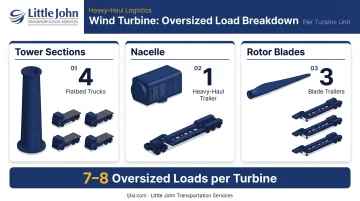
- A single turbine typically requires seven to eight core oversized truckloads, not counting support vehicles
- Every transport move begins with a route survey, engineering assessment, and multi-jurisdiction permit applications — weeks before departure
- Wind turbine transport requires carriers with dedicated heavy-haul fleets, oversize permitting expertise, and experience coordinating multi-load, multi-state moves — not general freight operators
Wind Turbine Components and What Makes Transporting Them Uniquely Complex
The Three Components That Drive Logistics Complexity
A utility-scale wind turbine ships in pieces. The primary oversized components are:
- Tower sections — typically three to four cylindrical steel segments that stack to 80–120+ meters total height; each section ships individually on a flatbed or lowboy
- Nacelle — the generator housing at the top of the tower, one of the heaviest single pieces in the assembly
- Rotor blades — the most logistically demanding element; three blades per turbine, each transported separately
According to NREL's transportation review, trucking a single turbine requires up to eight oversized loads — one nacelle, three blades, and four tower sections. Washington State's 2024 utility-scale wind transportation analysis puts the figure at seven flatbed trucks for the core components. Either way, one turbine equals multiple coordinated convoy moves, and a wind farm with 50–100 turbines multiplies that across an entire construction schedule.
What Separates This From Other Heavy-Haul
Most oversize loads exceed legal limits in one or two dimensions. Wind turbine components push past standard limits in all four — length, width, height, and weight — at the same time. That's uncommon even in specialized freight.
These components also impose strict handling constraints that don't apply to most heavy cargo:
- Cannot be stacked or bundled — each piece moves on its own dedicated trailer
- Cannot be repositioned mid-transit once secured
- Require engineered tie-down systems specific to each component's geometry
Wind farms are typically sited in rural, remote, or elevated terrain where road infrastructure was never designed for this cargo class. That's a different challenge than moving heavy industrial equipment to a port-adjacent facility or an urban construction site. Access roads frequently require temporary reinforcement, bridge load surveys, or full re-routing before the first truck ever rolls.
The scale problem is only getting worse. DOE data shows that average turbine capacity has grown from approximately 1.9 MW in 2014 to 3.5 MW in 2024, with hub heights rising from 82 to 106 meters over the same period. Larger capacity means larger components across every dimension.
How Wind Turbines Are Transported: The End-to-End Process
Wind turbine transport is a phased project, not a pickup request. Each phase must be completed before the next begins, and the full sequence — from initial survey to final delivery — can span weeks to months depending on route complexity and jurisdictional permitting timelines.
Step 1: Route Survey and Engineering Assessment
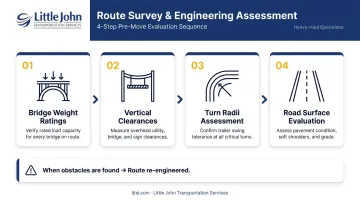
A qualified engineering team physically surveys every mile of the proposed transport route before any load moves. They're identifying and documenting:
- Bridge weight ratings — does the structure support the gross combination weight?
- Vertical clearances — overhead utility lines, signal heads, highway structures
- Turn radii at intersections — blade trailers require significantly more geometry than a standard truck
- Road surface condition — can the pavement handle repeated axle loadings?
When obstacles can't be navigated, routes get re-engineered. That can mean selecting alternate roads, arranging temporary utility line lifts, or widening existing road turns to accommodate blade truck geometry.
A 2021 Environmental Impact Statement for the Rail Tie Wind Project in Wyoming required a minimum 200-foot turn radius for blade and nacelle delivery vehicles and contemplated widening existing county roads to meet that standard. Projects of this scale routinely require road modifications — it's built into the engineering scope from the start.
Step 2: Permitting and Regulatory Coordination
The federal government does not issue oversize/overweight permits — permitting is administered entirely at the state level, with each state setting its own rules on escort requirements, travel windows, speed limits, and route pre-approval. County-level requirements layer on top of that in some jurisdictions.
A multi-state wind turbine transport can require simultaneous permit applications across several jurisdictions, each with different processing timelines. Some states process routine permits in one to two days; others have extended review periods for superloads. Tennessee, for example, requires approximately 15 days for superloads between 250,000–500,000 lbs and 30 days above 500,000 lbs.
Travel windows add another layer — some states restrict movement to daylight hours, others prohibit weekend travel entirely.
For carriers like Little John Transportation Services, permitting is handled entirely in-house. With 100,000+ oversized/overweight permits processed annually, multi-state permit sequencing is a core operational function — not something outsourced to a third party while the project waits.
Step 3: Equipment Selection and Load Securement
Mismatched equipment creates load securement failures, permit violations, and scheduling delays. The primary trailer types by component:
| Component | Primary Trailer Type |
|---|---|
| Tower sections | Multi-axle lowboy or flatbed with steerable rear axles |
| Nacelle | Heavy-haul multi-axle trailer with hydraulic suspension |
| Rotor blades | Extendable blade trailer with articulating rear dolly |
Blade trailers are the most specialized piece of equipment in the fleet. The rear dolly — sometimes called a blade tip dolly — allows the blade to pivot mid-turn, which is the only way to navigate curves and intersections with an 80-meter load. All loads are secured using engineered tie-down systems specific to each component's geometry; standard chain-and-binder configurations used for industrial machinery don't apply here.
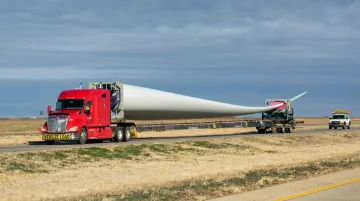
This equipment is not widely available. Carriers serving the wind industry maintain dedicated fleets for these components, and fleet availability directly affects project scheduling. When a carrier leases rather than owns this equipment, that dependency runs through every step that follows — equipment delays push permit windows, which push crane crew schedules, which push the entire project timeline.
Step 4: Escorted Transport and On-Road Execution
Once permits are in hand and equipment is staged, the convoy moves with pilot and escort vehicles leading and following the load. Escorts communicate with the driver, manage traffic, and navigate real-time obstacles. Law enforcement escorts are required in many jurisdictions — in Tennessee, for example, state highway patrol escorts are mandatory for loads exceeding 18 feet in width or height.
Delivery windows at wind farm sites are tightly coordinated with crane crews and installation teams on-site. A late blade delivery doesn't just mean waiting at the gate — it means a crane crew standing by at significant cost while the project schedule shifts. Transport timing sits on the critical path of the build, which is why experienced carriers treat on-time delivery as an operational discipline, not a best effort.
Key Challenges in Wind Turbine Transport
Extreme Blade Dimensions
Modern utility-scale blades are among the longest objects moved on public roads. Vestas's V163 platform uses blades measuring 80.1 meters — longer than a 737 fuselage. NREL identifies 52–63 meters as the point where road transport begins creating serious infrastructure conflicts; current blades have exceeded that threshold by a wide margin.
Even with purpose-built trailers, certain road geometries — tight roundabouts, switchbacks, short-radius intersections — are physically incompatible with blade lengths. Some projects require temporary road construction or modified turning geometry before delivery can proceed.
Infrastructure Incompatibility
Bridges are the most common conflict point. Weight ratings, vertical clearances, and span geometry all require analysis before a route is confirmed. Beyond bridges:
- Overhead utility and telecom lines require pre-arranged lifts with utility companies
- Traffic signals and signal heads may need temporary removal
- Highway on/off ramps are often too tight for blade trailers to navigate
None of these solutions happen day-of. Each requires pre-coordination, its own permit or utility agreement, and sometimes scheduled traffic control — all before the convoy departs.
Multi-Jurisdiction Permitting Complexity
U.S. oversize/overweight permitting has no federal equivalent. Each state administers its own system with different escort rules, travel hour restrictions, seasonal windows, and processing timelines. A cross-regional wind turbine transport can involve applications across five or more states simultaneously, and a single delayed permit can hold the entire convoy.
States in high-wind corridors — across the central and southern U.S. — are the most common jurisdictions for wind component moves, and experienced carriers build permit relationships and workflows within those corridors over years of repeated projects.
Weather and Timing Constraints
Wind, rain, ice, and extreme temperatures all affect transport safety and load integrity. Blades present a particular wind sensitivity: their surface area acts as a sail in crosswind conditions, making convoy movement unsafe above certain thresholds.
Transport teams must monitor conditions along the full route corridor — origin conditions don't reflect what the convoy encounters 200 miles in. Seasonal transport windows in northern and mountainous regions are often narrow, and weather delays compound against installation schedules set months in advance.
Supply Chain Coordination Across Multiple Parties
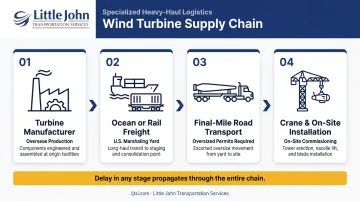
A wind farm build requires tight synchronization across every leg of the supply chain:
- Turbine manufacturers (often overseas) coordinating production and export schedules
- Ocean or rail freight to a U.S. marshaling yard
- Final-mile road transport with permitted oversize equipment
- Crane operators and on-site construction teams ready on arrival
A delay in any single leg propagates through the chain. Project owners increasingly require logistics partners who can manage the full transport sequence — rather than coordinating multiple disconnected vendors with no single point of accountability.
Specialized Equipment and What to Look for in a Carrier
The Equipment Required
The primary trailer categories for wind component transport:
- Extendable blade trailers with rear articulating dollies, allowing blades to pivot on curves — the core trailer for any blade move
- Multi-axle hydraulic modular trailers for nacelles and heavy assemblies, with steerable axle configurations for turn navigation
- Multi-section lowboys for tower segments, sized to the weight and geometry of each section
Self-propelled modular transporters (SPMTs) handle marshaling yard and confined-site delivery. GPS tracking and real-time dispatch communication are now standard tools in professional convoy management.
What Qualifies a Carrier for This Work
Equipment is only part of the equation. The carrier operating it matters just as much. When evaluating who handles a wind turbine move, the relevant questions are:
- Does the carrier own dedicated blade and heavy-haul trailers, or lease from a third party when a project arrives?
- Does the carrier process 100,000+ permits annually — or is each OS/OW application a one-off effort without established regulatory relationships?
- Can the carrier assess bridge ratings, clearances, and turn geometry before the load departs, rather than discovering conflicts mid-route?
- Are escort vehicles and law enforcement relationships already in place, or does each project require building those connections from scratch?
- What do DOT crash frequency and claim rates actually show? Those numbers are measurable indicators of operational discipline, not just credentials on a certificate.
Little John Transportation Services answers each of these questions with documented capability: 2,700+ specialized trailers, 30+ years of heavy-haul experience, in-house permitting for OS/OW moves, and route engineering that works through bridge clearances, turn radii, and infrastructure conflicts before a convoy departs. Every load is dispatched and tracked by human teams with direct accountability from first call to final delivery.
Frequently Asked Questions
What company transports wind turbine blades?
Wind turbine blade transport requires specialized heavy-haul carriers with dedicated blade trailer fleets, multi-state permitting expertise, and engineering-grade route assessment — capabilities general freight carriers don't have. Companies like Little John Transportation Services operate within this category with in-house permitting, route engineering, and purpose-built heavy-haul fleets.
How long can wind turbine blades be, and how does that affect transport?
Modern utility-scale blades can exceed 80 meters (the Vestas V163 platform uses 80.1-meter blades). At those lengths, standard road infrastructure is incompatible with blade geometry, requiring extendable trailers with articulating tip dollies, detailed route surveys, and in some cases road modifications or turn widenings before transport can proceed.
What permits are needed to transport wind turbine components?
Each U.S. state issues its own oversize/overweight load permits with different escort requirements, travel hour restrictions, and review timelines. A multi-state move requires simultaneous applications across all jurisdictions — processing times range from same-day automated issuance to 15–30 days for superload-class reviews in states like Tennessee.
What type of trailer is used to transport wind turbine blades?
Extendable blade trailers with an articulating rear dolly are the primary equipment for blade moves — the rear dolly allows the blade to pivot mid-turn to navigate curves and intersections. Nacelles and tower sections use different equipment: multi-axle lowboys and hydraulic modular trailers sized to the weight and dimensions of each component.
How long does it take to transport wind turbine components from manufacturer to installation site?
Pre-planning alone (route survey, permitting, equipment staging) can take several weeks to months depending on route complexity and state permit review timelines. Actual over-road transit ranges from days to weeks based on distance and the jurisdictions the route crosses.
What factors affect the cost of transporting wind turbine components?
According to NREL, transport typically represents approximately 3–8% of total U.S. land-based wind project capital cost. The primary cost drivers are component size and weight, total route distance, number of jurisdictions requiring permits, required escort configurations, specialized trailer type needed, and infrastructure modification costs such as utility line lifts or road widening.