Oversized load route planning is the structured pre-transport process of confirming a legal, safe, and physically viable path for cargo that exceeds standard size or weight thresholds — before a single wheel turns. Get it wrong, and you're looking at permit violations, infrastructure strikes, project delays, and fines that dwarf the cost of proper planning.
This article walks through the step-by-step process, the factors that shape routing decisions, and the failure points that experienced teams avoid.
Key Takeaways
- Exceeding any federal dimension or weight threshold triggers the full OS/OW process, with each state layering its own requirements on top
- Load dimensions must be confirmed first; every downstream decision depends on accurate measurements
- Multi-state moves require separate permit coordination with each jurisdiction along the route
- Physical route surveys catch hazards that GIS tools and state DOT databases miss
- Permit rejections, infrastructure strikes, and forced detours are preventable with early planning and mapped contingency routes
What Qualifies as an Oversized Load?
Federal law sets the baseline thresholds that trigger the OS/OW permit process:
| Dimension | Federal Threshold |
|---|---|
| Width | 102 inches (8.5 ft) on the National Network |
| Height | No federal maximum; state limits generally range from 13 ft 6 in to 14 ft |
| Gross Weight | 80,000 lbs on Interstate highways |
| Single Axle | 20,000 lbs |
| Tandem Axle | 34,000 lbs |
Exceeding any single threshold (width, height, length, or weight) activates the full permit and route planning process. There is no federal height maximum — Indiana requires permits above 13 ft 6 in while Texas and Washington use a 14 ft threshold.
On length, federal law protects operation of at least 48-ft semitrailers on the National Network, but 53 ft is not a universal federal trigger. State-specific trailer and kingpin rules govern from there.
Those thresholds are just the starting point. Once a load crosses any one of them, standard GPS-based routing no longer applies. Oversized moves require permit-by-permit approval, physical clearance verification, escort scheduling, and infrastructure analysis — each of which varies by state, county, and load type.
How Oversized Load Route Planning Works: Step-by-Step
This is not a linear checklist. Each step informs the next, and errors early in the sequence compound into major delays or compliance failures downstream.
Step 1: Confirm Load Dimensions and Equipment Requirements
Accurate measurement of length, height, width, and weight — including overhangs, securement attachments, and axle configuration — is the non-negotiable starting point. These figures determine:
- Trailer type required (flatbed, lowboy, extendable, RGN, multi-axle)
- Permit categories triggered in each state
- Which routes are physically viable before any other analysis begins
Little John Transportation Services operates within the Landstar network's 2,700+ specialized trailers across 30+ configurations — load dimensions get matched to the right equipment from the first call, not retrofitted to whatever's available.
Step 2: Identify Infrastructure Constraints
With confirmed dimensions, planners map the entire corridor for:
- Bridge weight ratings along the proposed path
- Vertical clearances at overpasses and utility crossings
- Road width and turning radii at critical intersections
- Pavement load ratings and grade/slope challenges
According to the ASCE's 2025 Infrastructure Report Card, 6.8% of more than 623,000 US bridges are currently in poor condition. That figure makes pre-move bridge analysis non-negotiable — static route assumptions based on historical data carry real risk.
Infrastructure constraints can eliminate otherwise logical routes entirely. This analysis must be completed before permit applications are filed.
Step 3: Conduct a Physical Route Survey
GIS tools and state DOT databases are useful screening tools. They are not physical clearance certification.
FHWA guidance identifies what a proper route survey must document: bridges, overhead wires, traffic signals, work zones, narrow shoulders, railroad crossings, steep grades, low clearances, and turns with inadequate radius. MnDOT requires surveys to be conducted by the OS/OW driver or a certified pilot-car operator.
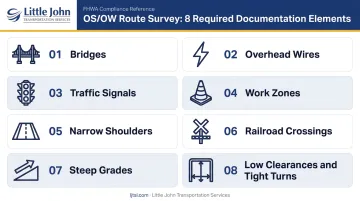
Real-world hazards that frequently don't appear in digital records include:
- Recently posted bridge weight reductions
- Low-hanging utility wires not updated in state databases
- Construction entrances narrowing a travel lane
- Soft or deteriorated shoulders on rural corridors
Survey findings should be documented and shared with pilot car operators and the permit office before applications are submitted.
Step 4: Apply for All Required Permits Across Every Jurisdiction
Each state, county, and municipality along the route may require a separate permit specifying approved roads, allowed travel hours, load dimensions, and escort requirements.
A May 2024 FHWA baseline assessment found 40 states had automated OS/OW permitting systems as of December 2021 — but only 22 could auto-issue within the common envelope of 14 ft high, 14 ft 6 in wide, 110 ft long, and 150,000 lbs.
Having an online application portal does not mean automatic approval.
Permit timelines vary significantly:
- Standard loads in automated states: same day to 1–2 business days
- Superloads requiring engineering review: weeks (Washington requires applications for loads over 200,000 lbs at least 30 days before movement)
Multi-state routes require sequential or simultaneous coordination. One rejected application delays the entire move. That's why in-house route engineering — resolving bridge clearances, turn radii, and low-overpass alternates before submission — matters at this stage. Little John's team processes 100,000+ oversize/overweight permits annually with that work done upfront.
Step 5: Schedule Escorts, Utility Notifications, and Law Enforcement
Many permits legally require pilot cars, and some moves require law enforcement escorts or utility company coordination to temporarily raise lines.
Escort requirements vary by state and load dimensions:
- Texas: Private escorts required when width exceeds 14 ft, height exceeds 17 ft, or length exceeds 110 ft
- New York: No escort required if all dimensions are under 12 ft wide, 80 ft long, and 14 ft high; police escort applies at superload thresholds (over 16 ft wide, 16 ft high, 160 ft long, or 200,000 lbs)
- Washington: Pilot/escort requirements begin at 12 ft wide, 14 ft 6 in high, or 105 ft overall length
Escort vehicles carry height poles, radios, and warning signs. The lead escort pre-clears the path ahead of the load — identifying clearance conflicts before the convoy reaches them.
Step 6: Monitor in Real Time and Maintain Contingency Plans
Route execution requires continuous communication between driver, escort vehicles, and dispatch. Weather changes, construction closures, and permit time-window constraints all create mid-transit decision points.
A pre-approved alternate route must be identified before departure. Any mid-transit route change requires permit compliance evaluation before the driver proceeds — an oversized load cannot reroute on GPS like a standard vehicle.
Key Factors That Affect Route Planning
State and Jurisdictional Regulatory Variation
No two states operate the same OS/OW framework. A direct comparison illustrates the gap:
| Requirement | Texas | New York |
|---|---|---|
| Overwidth permit limit | 13 ft on 30/60/90-day permits; route survey required above 20 ft | Width over 16 ft = superload requiring enhanced review |
| Travel hours | Permit- and jurisdiction-specific; holiday moves capped at 14 ft wide, 16 ft high, 110 ft long | Sunrise to sunset, excluding Sundays/holidays; additional AM/PM restrictions for larger dimensions |
| Escort trigger | Width over 14 ft, height over 17 ft, or length over 110 ft | No escort under 12 ft wide, 80 ft long, 14 ft high; police escort at superload thresholds |
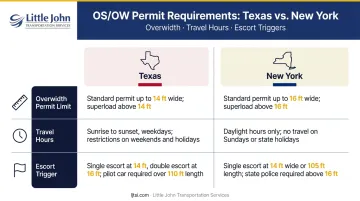
County and municipal restrictions layer on top of state rules. New York state parkways generally prohibit OS/OW vehicles entirely. Metropolitan areas frequently impose peak-hour travel bans not captured in state permit systems.
Seasonal and Weather-Related Restrictions
Spring thaw laws in northern states temporarily reduce axle weight limits to protect pavement from freeze-thaw damage:
- Michigan: 25% reduction on rigid pavement and 35% reduction on flexible pavement on designated seasonal routes
- Minnesota: Six frost zones with route-specific restrictions; the 2026 North-zone seasonal load restriction ran March 20–May 15
- Wisconsin: Zone- and segment-specific restrictions with route-specific tonnage limits
Route plans finalized weeks in advance must be re-verified within 24–48 hours of departure. Flooding, ice, high winds, and extreme temperatures can close corridors mid-transit.
Cross-Border Complexity for US–Mexico Routes
Domestic variability is manageable with the right systems. Adding an international border introduces an entirely separate regulatory layer.
Loads crossing into Mexico fall under Mexico's SCT (Secretaría de Comunicaciones y Transportes) and NOM-040-SCT-2-2012 — a framework that diverges from US permitting in several key ways:
- Axle weight configurations: Limits vary by road classification, not just load weight
- Operating windows: Restricted travel hours differ based on road class designation
- Documentation: Bilingual paperwork required, including a load-distribution plan; cargo above 90 metric tons requires a SICT route opinion (Dictamen de Ruta) with at least 24 hours' notice to authorities before transit
Laredo handled 38.8% of southern-border truck traffic in 2025 according to BTS data — the dominant crossing point for US–Mexico freight. Little John's teams in Laredo, Monterrey, and Guadalajara handle bilingual documentation and SCT compliance directly, with no handoffs to third-party agents at the border.
Common Challenges — and How to Solve Them
Over-Reliance on Digital Mapping
Problem: GIS tools and state DOT databases are powerful — but they have gaps. Temporary construction, recently lowered bridge postings, and unmarked utility clearances can invalidate a digitally approved route.
Solution: Mandatory physical or drone-assisted route surveys before permit submission, plus a pre-departure re-check at critical clearance points.
Permit Delays from Incomplete Applications
Problem: Small errors in load dimensions or route descriptions trigger rejections. Multi-jurisdictional moves amplify this — each state's rejection delays the whole move.
Solution: Engage experienced permit coordinators, submit with full documentation early, and build buffer time into project schedules — especially for superloads.
Underestimating Local and Municipal Restrictions
Problem: State-level permits don't override county or city restrictions. Local bridge bans, seasonal road limits, and curfews are often absent from state DOT systems.
Solution: Proactively contact county engineers and municipal transportation departments at every jurisdiction on the route — not just state DOT offices.
No Workable Contingency Route
Teams often plan a primary route without identifying an alternate. When the primary route is blocked mid-transit, rerouting isn't simple — the alternate path may lack permits, carry different clearance constraints, or fall outside approved travel windows.
Identify, survey, and where possible pre-permit at least one alternate corridor before departure.
Communication Breakdowns During Transit
Problem: Oversized moves involve multiple parties — drivers, lead and rear pilot car operators, dispatch, permit issuers, law enforcement. Unclear protocols lead to missed clearances or uncoordinated stops.
Solution: Pre-trip briefings establishing channel protocols, emergency signals, and a single point of contact at dispatch who tracks the load throughout.
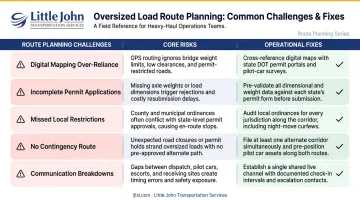
Quick Reference: Common Challenges and Solutions
| Challenge | Core Risk | Fix |
|---|---|---|
| Over-reliance on digital mapping | Undetected clearance changes invalidate approved routes | Physical or drone survey + pre-departure re-check |
| Incomplete permit applications | Rejections cascade across multi-state moves | Early submission with full documentation and buffer time |
| Local/municipal restrictions missed | County and city rules override state permits | Direct outreach to county engineers and municipal departments |
| No contingency route | Mid-transit blockage with no legal rerouting option | Survey and pre-permit at least one alternate corridor |
| Communication breakdowns | Missed clearances, uncoordinated stops | Pre-trip briefings with defined channels and single dispatch contact |
Conclusion
Successful oversized load route planning combines accurate load data, thorough infrastructure analysis, multi-jurisdictional permit coordination, physical route verification, and real-time contingency management. Miss any one of these and you're looking at permit violations, equipment damage, or a load that doesn't reach its destination on schedule.
Companies moving complex, heavy freight consistently benefit from working with carriers who manage this process end-to-end. Little John Transportation Services has handled heavy-haul and oversized freight for 30+ years, with in-house route engineering and a vetted network of 65,000+ carriers. Dedicated cross-border teams in Laredo, Monterrey, and Guadalajara manage the permit coordination, infrastructure analysis, and contingency planning that these moves require.
Contact Little John for oversized load moves across the US and into México: quotes@ljtsi.com or +1 (479) 264-6501.
Frequently Asked Questions
What is the best route optimizer for oversized loads?
No single software tool handles the full process. The most effective approach combines state DOT GIS tools — such as California's CalRoute or New York's OS/OW pre-screening dashboard — with physical route surveys and experienced human coordinators who know how to reconcile data gaps and local restrictions.
What qualifies as an oversized load in the US?
The federal baseline is any cargo over 8.5 ft wide, over 13.5–14 ft tall (varies by state), or over 80,000 lbs gross weight on Interstate highways. Exceeding any single threshold triggers the permit and route planning process.
How long does it take to get an oversized load permit?
Standard loads in states with automated systems can receive permits within hours or 1–2 business days. Superloads or multi-state moves requiring engineering review can take several weeks (Washington requires 30 days for loads over 200,000 lbs), so build timeline buffers into project schedules from the start.
How many escort vehicles does an oversized load require?
Requirements vary by state and load dimensions. Most states require at least one pilot car beyond certain width or length thresholds, with some mandating both lead and rear escorts plus law enforcement for the widest or heaviest loads. The specific permit defines the requirement for each jurisdiction.
What happens if an oversized load route is blocked mid-transit?
The driver cannot reroute freely like standard freight. Any alternate path must be evaluated for clearance, permit coverage, and travel window compliance before the load moves. This is why pre-approved contingency routes are a required component of any oversized route plan.
Do oversized load rules change when crossing from the US into Mexico?
Yes. Mexico's SCT operates under a separate permit framework with different axle weight configurations, road classifications, and documentation requirements. Loads above 90 metric tons require a formal SICT route opinion with advance notice to authorities — and carriers without bilingual, cross-border infrastructure consistently underestimate what that requires in practice.