LTL — less-than-truckload — lets shippers pay only for the trailer space their cargo actually occupies, splitting the truck (and the cost) with other shippers moving freight in the same direction. It's a well-established mode that accounts for roughly 10–15% of U.S. trucking industry volume, with major carriers like FedEx Freight, Old Dominion, and Estes collectively generating tens of billions in annual revenue.
This guide covers everything you need to make smart LTL decisions: how it works, how rates are calculated, when to use it, and when to look elsewhere.
Key Takeaways
- LTL handles freight between roughly 150 and 15,000 pounds that doesn't fill a full trailer
- Shippers pay only for the space they use, sharing cost with other shippers on the same truck
- Rates are driven by freight class, weight, distance, and accessorial charges
- LTL works well for frequent, moderate-volume shipments, though transit times are longer and freight changes hands more often
- Hazmat and oversized freight typically fall outside what standard LTL carriers will handle
What Is LTL Freight Shipping?
LTL (Less-Than-Truckload) shipping is a freight mode where cargo from multiple shippers is consolidated onto one truck. Each shipper pays only for the portion of trailer space their freight occupies — not the whole vehicle.
According to Old Dominion, the standard LTL weight range runs from 150 to 15,000 pounds. Shipments lighter than 150 lbs typically move more cost-effectively via parcel carriers. Loads heavier than 15,000 lbs — or those filling more than roughly half a trailer — usually qualify for full truckload or volume LTL pricing instead.
How LTL Carriers Move Freight
LTL carriers operate on a hub-and-spoke terminal network, not point-to-point routes. Here's what that looks like in practice:
- Carrier picks up freight at the shipper's location
- Freight moves to a local origin terminal
- Terminal consolidates shipments heading in the same direction
- Consolidated loads move via linehaul to regional distribution hubs
- Freight is sorted again at destination terminals
- Local delivery to the consignee
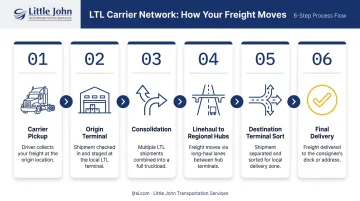
This network structure is what makes shared-cost shipping possible. That shared infrastructure comes with a tradeoff: freight touches multiple hands and terminals before final delivery, which matters for damage-sensitive or time-critical loads.
Who Uses LTL?
Transport Topics identifies industrial manufacturing as the backbone of LTL demand, with manufacturing output and LTL volumes closely correlated. Industries that rely on LTL tend to share one trait: recurring, moderate-volume freight on predictable lanes. Heavy users include:
- HVAC and building systems
- Automotive parts and components
- Chemical and petrochemical
- Retail distribution
- Industrial machinery
For all of them, LTL works because they're not filling full trailers consistently enough to justify dedicated capacity.
Standard LTL Shipment Size
Most LTL shipments consist of 1–6 pallets. Beyond 6–8 pallets (or roughly 12 linear feet of trailer space), carriers typically apply volume LTL pricing or recommend full truckload.
Carriers prefer palletized freight. Standard 48" × 40" GMA pallets stack cleanly, reduce terminal handling time, and lower damage exposure compared to loose or floor-loaded freight. Loose shipments can also be harder to rate accurately, since carriers need a consistent footprint to calculate density and assign the correct freight class.
How Does LTL Shipping Work?
LTL shipping runs on a hub-and-spoke network — your freight shares truck space with other shippers' cargo, moving through a series of terminals before reaching its destination. Here's what that looks like end to end.
The LTL Process, Step by Step
Quote and booking → Shipper provides freight details (weight, dimensions, freight class, origin/destination) to get a rate. Accuracy here matters — carriers will reweigh and remeasure at the terminal.
Shipment preparation → Freight must be palletized, properly packaged, and labeled before the driver arrives. The shipper prepares a Bill of Lading (BOL), which the driver picks up at the time of collection.
Carrier pickup → The driver arrives during a scheduled window. Standard LTL pickup does not include driver loading assistance for freight that requires special equipment or multiple personnel — that's a separately quoted accessorial service.
Origin terminal → Freight is unloaded, sorted, and consolidated with other shipments heading in the same direction.
Linehaul and cross-docking → Consolidated loads travel between regional hubs. Freight may transfer between trucks at intermediate terminals — this cross-docking is what allows one truck to carry shipments from many different shippers efficiently.
Destination terminal → Final delivery → Freight is sorted at the destination terminal and dispatched for local delivery.
Tracking Your LTL Shipment
Carriers assign a PRO number to each shipment at pickup — Estes defines this as a 10-digit freight-bill number used to track the shipment and retrieve delivery receipts, BOLs, weight certificates, and invoices. You'll use this number throughout the transit.
Transit Time Expectations
LTL transit is longer than full truckload because of those intermediate terminal stops. According to C.H. Robinson, a shipment that takes 1–2 days via FTL may take 3–7 days via LTL, depending on distance and network design. Several variables push that range toward the longer end:
- Distance and lane density — longer hauls cross more terminals; less-dense lanes see fewer linehaul departures
- Cross-docking frequency — each intermediate transfer adds a handling cycle and potential delay
- Accessorial requirements — liftgate, appointment delivery, or residential stops add scheduling time at the destination end
If your shipment has a hard delivery deadline, get the transit estimate in writing before booking — and factor in one buffer day for terminal processing.
LTL vs. FTL vs. Parcel: How to Choose
The right mode depends on shipment size, time sensitivity, and budget. Here's a direct comparison:
| Factor | Parcel | LTL | FTL |
|---|---|---|---|
| Weight range | Under 150 lbs | 150–15,000 lbs | 10,000+ lbs or 10+ pallets |
| Pricing model | Per piece | Per hundredweight + class | Per mile or flat rate |
| Transit speed | Fast | Moderate (3–7 days) | Fastest (direct) |
| Handling risk | Low | Higher (multiple stops) | Lowest (direct) |
| Cost for small loads | Best | Good | Expensive |
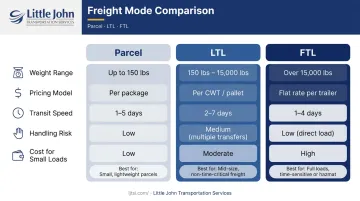
Where the Crossover Points Are
- Under 150 lbs: Parcel wins on price and simplicity
- 150 lbs to ~15,000 lbs, less than 12 linear feet of trailer space: LTL is usually the right call
- Over 10–12 pallets or 10,000+ lbs: FTL often becomes more cost-competitive than LTL, once you factor in accessorials and class-based multipliers
Volume LTL sits in between — it's an intermediate option when freight has too many pallets for traditional LTL but doesn't quite fill a truck.
When Standard LTL Doesn't Work
Weight and pallet count aren't the only variables. Freight that involves regulated hazardous materials, oversized dimensions, or cross-border movement often falls outside what standard LTL carriers will accept — regardless of weight.
Carriers like Little John Transportation Services are built precisely for this gap. Little John holds an FMCSA Hazardous Materials Safety Permit (HMSP) — a credential fewer than 1% of U.S. motor carriers carry — along with TPS approval, AA&E certification, and 100% hazmat-endorsed drivers.
That combination means they regularly handle the chemical, industrial, and military freight that standard LTL networks decline. When your shipment checks the weight box but fails the hazmat or oversize test, you need a specialized carrier, not a standard LTL quote.
How LTL Freight Rates Are Calculated
LTL pricing is more complex than full truckload — four variables interact to produce your final invoice, and understanding each one is how you avoid billing surprises.
1. Freight Class (NMFC Classification)
The National Motor Freight Classification (NMFC) system assigns every commodity to a freight class — ranging from class 50 to class 500 — based on four transportation characteristics:
- Density — how much space your freight occupies relative to its weight; denser freight earns lower classes
- Stowability — whether it can be safely loaded alongside other freight or requires special positioning
- Handling — how much labor and care moving it across docks actually requires
- Liability — the carrier's exposure to damage, theft, or spoilage risk
Higher class = higher rate per hundredweight. Dense, low-risk freight (class 50, like steel rebar) costs far less per pound to ship than light, fragile, or hazardous freight at class 300 or above.
Important update: NMFTA's classification changes took effect July 19, 2025, expanding to a 13-subprovision density scale with more than 2,000 items moving to full density-based classification. FedEx Freight began enforcing the revised system on December 1, 2025. If you haven't rechecked your commodity classifications recently, now is the time.
2. The Base Rate Formula
LTL carriers calculate rates as: base rate (cost per hundredweight) × shipment weight × class multiplier × distance factor.
Carriers will physically reweigh and remeasure shipments at the terminal. If your stated dimensions or weight are off, expect a freight bill correction — which almost always means a higher invoice than originally quoted.
3. Accessorial Charges
These add-ons can push your final invoice 20–40% above the base rate — sometimes more:
- Liftgate service — required when the delivery location has no loading dock
- Residential delivery — higher rate for non-commercial addresses
- Inside pickup or delivery — freight moved beyond the dock door
- Limited access locations — construction sites, military bases, rural areas
- Hazardous materials handling — separate surcharge for regulated commodities
- Guaranteed or expedited delivery — when you need a specific delivery date
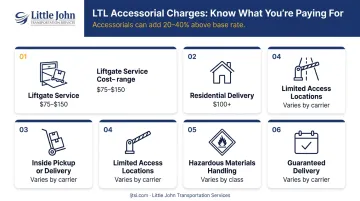
Always ask for a full accessorial list before booking — a liftgate fee alone can run $75–$150, and residential delivery surcharges often exceed $100 per shipment.
4. Tips to Keep LTL Costs Down
- Measure accurately — round up to the next full inch and weigh precisely to avoid reweigh fees
- Palletize properly — reduces handling charges and damage risk
- Know your freight class before booking — misclassification leads to invoice corrections
- Consolidate when possible — combining smaller shipments into fewer, heavier moves often triggers a better rate per hundredweight
When to Use LTL (and When Not To)
LTL is the Right Call When:
- Shipment falls between 150 and 15,000 lbs and occupies less than half a trailer
- You ship regularly in smaller quantities and don't need dedicated trailer space
- Delivery timeline is flexible — 3–7 days is acceptable
- Per-shipment cost reduction matters more than transit speed
LTL is the Wrong Call When:
- Freight is time-critical and cannot absorb multi-terminal transit
- Cargo is highly fragile and can't withstand multiple handling events
- The shipment is large enough that FTL rates are competitive with LTL plus accessorials
- Freight involves hazmat, oversized dimensions, or cross-border requirements
Quick Decision Checklist
| Situation | Best Option |
|---|---|
| Under 150 lbs | Parcel |
| 150 lbs–15,000 lbs, fills less than half a trailer | LTL |
| Over 15,000 lbs or over 10–12 pallets | FTL or volume LTL |
| Time-sensitive freight | FTL |
| Hazmat, oversized, or cross-border | Specialized carrier |
How to Prepare an LTL Shipment
Preparation directly affects cost and whether your freight survives multiple terminal touches intact — which is the reality of LTL's shared-trailer environment.
Measuring and Labeling
- Round all dimensions up to the next full inch
- Weigh freight on a calibrated scale — estimated weights cause reweigh fees
- Classify your commodity using the NMFC before booking, not after
- Place labels on the sides and top of pallets, both inside and outside the stretch wrap, so they're visible and scannable at terminals
- Each label should include the PRO number, full consignee address, piece count (for example, "1 of 3"), and BOL or PO reference
Packaging for Multiple Handling Events
LTL freight is loaded and unloaded several times before delivery. Packaging needs to handle that reality:
- Place heaviest items on the bottom of the pallet
- Keep all freight within the pallet perimeter — no overhang
- Stretch-wrap the full pallet from bottom to top in multiple layers
- Band or strap the load for additional security
- Cushion fragile items adequately on the interior
- Avoid loose, non-palletized freight; it increases damage risk and may be refused at pickup
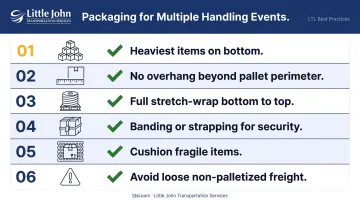
The Bill of Lading (BOL)
The BOL is legally required for interstate shipments and serves as the contract between shipper and carrier. Errors here are the leading cause of billing disputes and delivery delays.
A complete BOL includes:
- Shipper and consignee name, address, and contact information
- Accurate freight description and NMFC item number
- Piece count and packaging type
- Declared weight
- Freight class
- Hazmat designation (if applicable)
- Special handling instructions
- Signatures from both parties
Get this right before the driver shows up. Correcting a BOL after pickup can trigger freight holds, carrier correction fees, and disputed charges that take weeks to resolve.
Frequently Asked Questions
What is a less-than-truckload shipment?
An LTL shipment is freight that's too large for parcel services but doesn't fill an entire trailer — typically between 150 and 15,000 pounds. The shipper pays only for the trailer space their cargo occupies, sharing the truck with other shippers moving freight in the same direction.
What is LTL vs. FTL freight?
LTL consolidates multiple shippers' freight on one truck — lower cost per shipment, but longer transit and more handling stops. FTL dedicates an entire trailer to one shipper's cargo — faster, less handling, higher cost. The right choice depends on shipment size, time sensitivity, and budget.
How much is truckload freight per mile?
FTL rates vary significantly by lane, market conditions, equipment type, and fuel. DAT reported a Q1 2026 national dry-van spot average of $2.56 per mile including fuel. LTL doesn't use a per-mile rate — it's priced per hundredweight based on freight class and distance.
What is freight class and how does it affect LTL shipping?
Freight class is an NMFC category ranging from 50 to 500, assigned based on density, stowability, handling ease, and liability. A higher class means a higher rate per hundredweight. Misclassifying freight before booking almost always results in a higher corrected invoice after the carrier reweighs and inspects.
How many pallets can I ship via LTL?
Most LTL shipments range from 1 to 6 pallets. Beyond 6–8 pallets, or when freight exceeds roughly 12 linear feet of trailer space, carriers typically apply volume LTL pricing or recommend full truckload — at which point FTL becomes more cost-competitive.
Can I ship hazardous materials via LTL?
Yes, but only through carriers with proper FMCSA authorization and hazmat-endorsed drivers. Most standard LTL carriers accept limited hazmat categories under restricted conditions; higher-risk materials across all nine hazard classes, AA&E freight, or TPS-restricted commodities require a specialized carrier. Little John Transportation Services holds the FMCSA Hazardous Materials Safety Permit (HMSP) — held by fewer than 1% of U.S. motor carriers — along with AA&E and TPS certifications for the most regulated freight categories.