Key Takeaways
- DNA degradation during transit is driven by nucleases, hydrolysis, freeze-thaw cycling, and oxidative stress — all preventable with the right prep.
- Preservation method must match sample type (blood, tissue, purified DNA), not just transit duration.
- Triple-layer UN3373 / IATA PI650 packaging is mandatory for biological specimens shipped by air or ground.
- Temperature data loggers and chain-of-custody records are your proof of compliance — not optional extras.
- Carrier selection is a compliance decision — verify hazmat endorsements, ISO 9001:2015 certification, and documented audit trails before booking.
Why DNA Degrades During 3-Day Transit
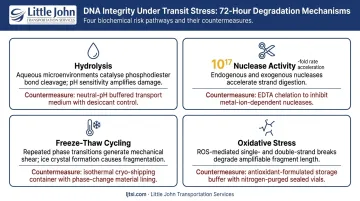
A 72-hour shipment window gives four distinct degradation mechanisms significant opportunity to cause harm. Each mechanism points to a specific countermeasure — skip one, and your sample may not survive the route intact.
Hydrolysis and pH Sensitivity
Water molecules cleave the phosphodiester bonds in the DNA backbone — a process that accelerates sharply under acidic conditions or when DNA is stored in plain water. Research on phosphodiester bond chemistry estimates a 30-million-year half-life per bond at neutral pH and 25°C, but depurination rates increase dramatically as pH drops. At pH 1.6 and 37°C, the measured rate is roughly 125,000 times higher than at pH 7.1.
The practical takeaway: buffer your DNA at pH ~8.0 (Tris-HCl or TE buffer) before it enters any transport container. This single step slows hydrolytic breakdown across the full 72-hour window.
Nuclease Contamination and Enzymatic Degradation
Nucleases accelerate phosphodiester cleavage by approximately 10¹⁷-fold compared to spontaneous hydrolysis. Residual DNases from the biological matrix, microbial contamination, or improper handling — bare hands, unclean tools, non-nuclease-free consumables — can introduce active enzymes that continue degrading DNA even at low temperatures.
Use nuclease-free containers, tips, and buffers at every stage before the sample is sealed. EDTA in the storage buffer inhibits metal-dependent nucleases and adds a second layer of protection.
Freeze-Thaw Cycling and Physical Shearing
This is one of the most common and preventable causes of sample loss on multi-day routes. Studies on repeated freeze-thaw effects show that DNA above 100 kb is most susceptible to physical shearing; after 18 cycles, average fragment sizes converged near 25–35 kb regardless of starting size.
On a 72-hour shipment, freeze-thaw cycles typically happen when:
- Dry ice sublimates faster than expected due to insufficient packing
- A transfer is delayed and the container warms temporarily
- The outer packaging is opened and resealed mid-route
Consistent thermal control and correct coolant volume prevent this entirely. Aliquoting samples into single-use volumes also eliminates repeat cycling at the destination.
Oxidative Stress
Reactive oxygen species cause base damage and strand breaks. In solid-state DNA, atmospheric water and oxygen accelerate this degradation — especially when samples undergo temperature swings or are stored in containers with compromised seals. Oxidative damage is harder to measure across a single 72-hour window than nuclease activity, but the risk compounds whenever thermal control fails. Sealed, inert containers and stable temperatures limit exposure throughout transit.
Pre-Shipment Preparation: Choosing the Right Preservation Method
Pre-shipment decisions are where sample integrity is won or lost. The preservation approach must match both the sample type and whether a verified cold chain is available for the entire 72-hour duration.
Cold Chain Preservation (Refrigerated and Frozen)
| Temperature Tier | Coolant | Best For |
|---|---|---|
| 2–8°C | Wet ice or gel packs | Short refrigerated windows; not ideal for 72-hour transit without stability confirmation |
| −20°C | Dry ice | Most purified DNA and tissue samples across 3-day transit |
| −80°C | Dry ice (higher volume) | Long-haul, high-value samples requiring maximum integrity |
Blood samples require a separate check: QIAGEN's Puregene handbook permits EDTA whole blood at 4°C for up to 5 days before extraction, but this depends on the collection tube and downstream workflow. That figure is not universal. Confirm stability data for your specific collection tube and assay before planning a refrigerated 72-hour blood shipment.
For purified DNA, QIAGEN's standard storage bands are −30 to −15°C or −90 to −65°C, in Tris-HCl or TE near pH 8 — which corresponds to nominal −20°C and −80°C transport conditions.
Room Temperature Preservation Alternatives
When a reliable cold chain is unavailable for the full route — remote collection sites, international customs delays, or multi-leg ground transfers — validated chemical stabilizers are an option:
- DESS buffer: Protects high-molecular-weight DNA effectively, but EDTA is the active component. Formulations lacking EDTA recovered less than 5.71% of HMW DNA after just one day in controlled testing.
- Longmire/NAP buffers: Validated for specific applications (environmental water samples, fecal swabs) but not broadly validated for clinical NGS or PCR workflows.
- FTA cards: Chemically treated paper matrices that support ambient collection, shipment, and archiving after drying — validated for PCR and STR amplification.
Check each stabilizer's published validation data against your specific assay — compatibility is not assumed across sample types or downstream workflows.
Sample Preparation Before Packaging
Before the outer container is sealed:
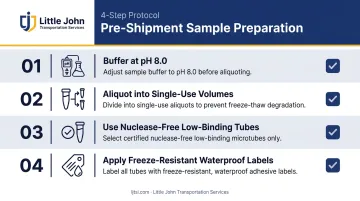
- Buffer at pH ~8.0 — use Tris-HCl or TE; plain water accelerates DNA degradation
- Aliquot into single-use volumes — prevents repeated freeze-thaw cycles at the destination
- Use nuclease-free, low-binding tubes — reduces enzymatic degradation and wall adsorption, especially for dilute samples
- Freeze-resistant, waterproof labels — include Sample ID, preservation medium, collector name, and collection date before sealing
Packaging and Temperature Control for Multi-Day Transit
Packaging failure and temperature excursions are the two most common causes of sample loss in transit. Getting the physical and thermal containment right is non-negotiable — and it breaks down into three areas: packaging standard, coolant selection, and temperature verification.
Triple Packaging Requirements (UN3373 / IATA PI650)
The 2026 IATA Dangerous Goods Regulations, Packing Instruction 650, requires three layers for Category B biological specimens (UN3373):
- Primary receptacle: Leak-proof, sealed tube or vial; liquid containers must withstand 95 kPa pressure
- Secondary packaging: Leak-proof, pressure-tested container with sufficient absorbent material to contain the full primary volume if it leaks
- Outer rigid packaging: Minimum 100 mm on the smallest dimension; marked with the UN3373 diamond, "Biological Substance, Category B," responsible party contact, and biohazard labeling for human-derived samples
Important classification note: UN3373 and PI650 apply to Category B infectious specimens. Noninfectious purified DNA sits outside Division 6.2 entirely. Classification is based on the pathogen risk of the biological matrix — not simply the presence of DNA. Classify the specimen before selecting the packaging standard, and confirm with your institutional biosafety officer.
For air shipments, the outer package must pass a 1.2-meter drop test, and liquid volume limits apply: ≤1 L per primary receptacle, ≤4 L total per outer package (excluding refrigerant).
Coolant Selection for 72-Hour Transit Windows
Dry ice sublimates at −78.5°C and, according to CDC guidance, commonly at 5–10 lb per 24 hours — but this figure is container- and payload-specific, not a universal calculation baseline.
Published hold times from commercial qualified shippers vary considerably: Peli BioThermal's Sherpa dry-ice systems publish up to 96 hours at −20°C; ThermoSafe FreezeTherm configurations show 54–158 hours depending on configuration.
For 72-hour or longer windows:
- Use a shipper-qualified container with a published hold time that exceeds your planned transit window — build in a buffer for delays, customs holds, or route changes
- Never calculate dry ice based on ideal conditions; route disruptions can turn a 48-hour shipment into a 72-hour one without warning
- For ultra-low temperature needs, liquid nitrogen shippers are an option but subject to strict carrier restrictions — confirm before booking
Gel packs at 2–8°C are not reliably suitable for 72-hour DNA transit without confirmed qualification data for the specific container.
Temperature Monitoring and Data Loggers
Correct packaging without verification is incomplete. A calibrated temperature data logger placed inside the secondary container records the full thermal history of the shipment.
Key specifications to confirm when selecting a logger:
- Sensitech TempTale Ultra BIO operates at ±0.22°C from −10 to +25°C; Berlinger Q-tag CLm doc covers −25 to +55°C with 1,500 measurement capacity
- ISO/IEC 17025-accredited, NIST-traceable calibration provides defensible audit documentation
- On receipt, the receiving lab reconciles logger data against the validated temperature range before accepting the sample
Any temperature excursion, even a brief one, should trigger a sample integrity assessment before committing to extraction or downstream analysis.
Regulatory Compliance and Chain-of-Custody Documentation
Regulatory Framework
The regulatory landscape for DNA shipments involves multiple overlapping frameworks:
- IATA PI650 / UN3373 — Air freight of Category B biological specimens
- 49 CFR 173.199 — U.S. DOT ground transport of Category B infectious substances
- 49 CFR 173.196 — Category A infectious substances (UN2814/UN2900) if applicable
- Dry ice by air — Classified UN1845, Class 9; requires vented packaging, Class 9 label, and net weight declared in kg
- Human biological samples — Must be labeled as potential biohazards regardless of preservation method
- Cross-border shipments — CDC import permits apply to infectious agents; APHIS/CBP requirements apply to animal-derived materials. Noninfectious purified DNA alone does not trigger CDC permit requirements, but always confirm with your biosafety officer and carrier compliance team before shipping
What a Complete Chain-of-Custody Record Requires
A defensible record for a 72-hour DNA shipment should include:
- Unique Sample ID
- Collection date, time, and location (ISO format)
- Preservation medium and storage conditions at collection
- Transfer timestamps — who handed off the sample and when, at each stage
- Temperature logger data reconciled against validated range
- Receiving lab acknowledgment with condition assessment on arrival
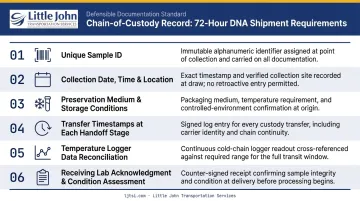
ISO 9001:2015 requires controlled documented information with traceable records wherever traceability is required — but it does not prescribe specimen-specific form fields. Combine ISO controls with CAP or ISBER specimen documentation standards to build a complete custody record.
This documentation isn't just a compliance formality. If a sample arrives compromised, chain-of-custody records are the only way to diagnose where the failure occurred and whether the data can still be used.
For multi-day pharmaceutical and life sciences shipments, carrier credentials matter here. Little John Transportation Services holds both ISO 9001:2015 certification and an FMCSA Hazardous Materials Safety Permit (HMSP), alongside CTPAT validation and hazmat endorsements across its entire owner-operator network — credentials fewer than 1% of carriers carry. That combination means chain-of-custody documentation is built into operations, not assembled after the fact.
Ethanol-Preserved Samples
Beyond documentation, the preservative itself can create carrier restrictions. Ethanol-preserved samples fall under flammable liquid classifications, so drain excess ethanol before shipment or switch to silica gel or a validated buffer. Confirm carrier-specific rules for any liquid preservative before packing.
Common Cold Chain Mistakes to Avoid
Underestimating Coolant Duration
Packing the minimum dry ice for scheduled transit conditions ignores customs holds, route changes, and transfer delays that can quietly add 24+ hours to any shipment. Plan for the worst-case scenario. Use a container with a qualified hold time that exceeds your full planned window — not just the expected one.
Skipping Stabilizer Validation
Chemical stabilizers like DESS, NAP buffer, or Longmire are not universally applicable across sample types. Confirm with your lab team that the stabilizer is validated for your specific sample type and 72-hour transit duration before shipping. Don't assume published validation data covers your assay or collection method.
Routing Through an Unqualified Carrier
Temperature-sensitive biological materials require a carrier with confirmed dry ice handling capability, hazmat endorsements, and real-time tracking with 24/7 support. These aren't optional add-ons — they're the minimum for a recoverable cold chain.
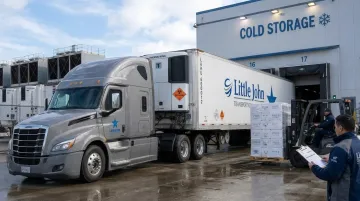
A missed transfer or undetected temperature excursion can render a sample unrecoverable. Without a calibrated data logger on board, you have no evidence that anything went wrong and no way to assess whether the sample is still viable.
Frequently Asked Questions
How long can you store DNA at 4°C?
Storage window at 4°C depends on sample type and tube — QIAGEN's Puregene handbook supports EDTA whole blood at 4°C for up to 5 days before extraction, but validated proprietary tubes vary. For purified DNA, 4°C is not appropriate for 3-day transit unless confirmed stability data exists for that specific sample type.
Can DNA be shipped at room temperature for 3 days?
Only when using validated chemical stabilizers — DESS, Longmire/NAP buffers, or FTA cards — designed for ambient preservation. Untreated biological samples are not stable at room temperature over 72 hours. Confirm the stabilizer is validated for your sample type and downstream application before shipping.
What temperature should DNA be kept at during transport?
Use 2–8°C for very short refrigerated windows with confirmed stability data. For most 3-day purified DNA or tissue shipments, −20°C to −80°C via dry ice is appropriate. Always store in a slightly basic buffer (pH ~8.0) to slow hydrolysis regardless of temperature tier.
What packaging is required to ship DNA samples?
UN3373 / IATA PI650 triple packaging: a leak-proof primary tube, an absorbent secondary container, and a rigid outer box with UN3373 diamond marking. Human-derived samples require biohazard labeling. Classify the specimen first — noninfectious purified DNA may fall outside PI650 requirements entirely.
What happens if the cold chain is broken during DNA shipping?
A cold chain break can trigger freeze-thaw cycling, enzymatic activity, and hydrolysis that degrade DNA, sometimes permanently. Temperature data loggers allow receiving labs to identify excursions and assess viability before downstream analysis — without one, there is no way to confirm a break occurred.
Do you need special permits to transport human DNA samples?
Human biological samples must be labeled as potential biohazards and shipped under appropriate biological substance classifications. Cross-border shipments may require import/export permits depending on jurisdiction and sample classification. Consult your institutional biosafety officer and the carrier's compliance team before any international shipment.