Introduction
A shipment of industrial machinery held at the U.S.-Mexico border for four days doesn't just miss a delivery window. It freezes a production line, triggers storage fees, and tests a client relationship that took years to build. For hazmat freight or oversized loads, the stakes compound further — wrong documentation means immediate holds, not just slower processing.
If you're a logistics manager or operations leader moving specialized, high-value freight across North America, this guide covers what you need to know:
- The root causes of customs delays — and how to address them upstream
- Documentation and classification practices that prevent holds before they happen
- How trade certifications like C-TPAT and FAST accelerate border crossings
- What contingency planning actually looks like for the U.S.-Mexico corridor
Key Takeaways
- Incomplete or inaccurate documentation is the single most common trigger for customs holds
- Misclassified HS codes trigger inspections, penalties, and added costs — get classification right upfront
- Prepaying duties and taxes before freight arrives removes one of the most preventable delay causes
- C-TPAT and FAST certifications give carriers access to expedited lanes and fewer inspections at the border
- Carriers with physical teams, bilingual operations, and in-house brokerage on both sides of the border prevent recurring delays
Why Customs Clearance Delays Cost More Than Time
Border delay costs don't arrive as a single line item. They stack across multiple fronts simultaneously, and most logistics teams don't grasp the full exposure until they're already inside one.
The Direct Cost Layer
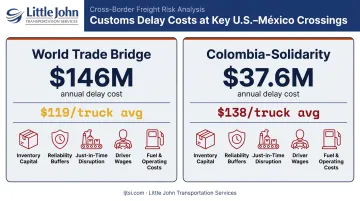
A 2023 TTI study estimated average shipper delay costs of $119 per northbound truck at World Trade Bridge and $138 at Colombia-Solidarity, with total annual direct costs reaching nearly $146M and $37.6M at those two crossings respectively. These figures capture inventory capital, reliability buffers, just-in-time schedule disruption, driver wages, fuel, and operating cost. Each element compounds the next.
Beyond modeled delay costs, held freight also generates real-time storage charges and additional user fees for extended dwell time at the port of entry.
The Supply Chain Ripple Effect
For industries like automotive, chemical processing, and industrial machinery, a single delayed component can halt an entire production run. Just-in-time supply chains have almost no tolerance for unplanned border holds. The downstream consequences include:
- Forced inventory imbalances on both sides of the border
- Expediting costs to source replacement components or shipments
- Project delivery deadline slippage with contractual implications
- Emergency freight charges that dwarf the original transportation cost
The Compliance Reputation Problem
Repeated customs delays signal poor compliance management to customs authorities — and that perception compounds. Carriers and shippers with a history of documentation errors or holds are flagged for increased inspection frequency, creating a self-reinforcing cycle of increased scrutiny. A clean compliance record is what keeps a shipper out of that cycle — and out of the slow lane at the border.
The Root Causes of Cross-Border Customs Clearance Delays
Understanding where delays originate is the first step to preventing them. Most holds trace back to a small number of predictable failure points.
Documentation Errors
Inaccurate or incomplete paperwork is the leading cause of customs holds. A single mismatch between a commercial invoice and a packing list can trigger a secondary inspection. Common error types include:
- Wrong HS codes that assign incorrect duty rates or flag restricted goods
- Vague product descriptions — "parts" instead of "hydraulic pump components"
- Mismatched declared values between the invoice and the packing list
- Missing certificates of origin, particularly USMCA certificates when claiming preferential tariff treatment
Evolving Regulations
Trade agreement changes, tariff adjustments, and shifting import rules mean that what cleared last quarter may not clear today. USMCA updates, new product-specific permit requirements, and regulatory changes on the Mexican side all create compliance exposure for shippers who aren't monitoring actively. The Section 232 steel and aluminum tariff adjustments in early 2025, for example, caught several importers off-guard after classifications they had used for years required reclassification under revised rules.
Targeted Cargo Inspections
Customs authorities flag certain cargo categories more frequently: hazardous materials, oversized loads, electronics, and pharmaceutical goods. When the paperwork doesn't precisely match what inspectors find during a physical examination, the hold extends for hours or days. For hazmat shipments, even minor discrepancies in shipping paper descriptions can result in immediate detainment.
Laredo Congestion
According to BTS data, Laredo handled 2,850,400 incoming commercial trucks in 2025, representing 39.48% of total U.S.-Mexico freight value — approximately $344.6 billion. That concentration creates real congestion risk. When volumes spike, wait times at World Trade Bridge and Colombia-Solidarity extend substantially, and shippers without alternate crossing strategies absorb those delays with no flexibility.
Language and Communication Gaps
Congestion and documentation problems compound when the teams resolving them can't communicate clearly. On the U.S.–Mexico corridor, bilingual operations are not a given. Communication breakdowns between origin teams, customs agents, and destination-side logistics providers produce documentation errors that coordinated bilingual oversight would have prevented. Carriers without Spanish-language operations at the border introduce a friction point that slows down problem resolution when speed matters most.
Best Practice 1: Build an Airtight Documentation Process Before the Freight Moves
The most effective customs strategy starts before the freight leaves the origin facility. Pre-departure documentation review is where the majority of preventable delays are stopped.
Core Required Documents for U.S.-Mexico Cross-Border Freight
| Document | Notes |
|---|---|
| Commercial invoice | Must match packing list exactly — values, weights, descriptions |
| Packing list | Discrepancy with invoice triggers secondary inspection |
| Bill of lading | Required for all commercial freight |
| USMCA Certificate of Origin | Required when claiming preferential tariff treatment; no prescribed form, but nine specific data elements must be included |
| Hazmat shipping papers | Identification number, proper shipping name, hazard class, packing group, quantity, and monitored emergency contact |
| HMSPs | Required only for specified high-risk hazmat categories (not all hazmat loads) |
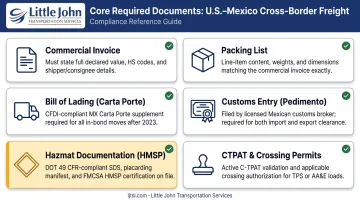
For hazmat shipments, missing or incomplete shipping papers result in immediate holds, not routine delays. The distinction matters: a documentation hold stops the load entirely until deficiencies are corrected. Every field must precisely match the physical cargo — no exceptions and no after-the-fact corrections at the crossing.
Consistency Across All Documents
Every document in the package must reflect identical values, weights, and descriptions. Inspectors cross-reference commercial invoices against packing lists as a standard step. Any discrepancy — even a rounding difference in declared weight — creates grounds for a secondary inspection.
Pre-Arrival Filing: ACE e-Manifest
For ground freight crossing into the U.S., CBP requires electronic advance filing via ACE 1 hour before arrival, or 30 minutes for qualifying FAST loads. Pre-arrival filing allows customs to pre-screen shipments before the truck reaches the crossing, cutting dwell time to minutes rather than hours for compliant loads. Waiting until the freight is already at the border to submit documentation eliminates this advantage entirely.
Treat the Checklist as a Living Document
Build a shipment-specific checklist tailored to the destination country and cargo type. Update it every time a regulation changes, a trade agreement is revised, or a new permit requirement is introduced. USMCA data element requirements, CBP system updates, and new hazmat classification amendments are all common triggers — build a review cycle into your compliance calendar, not just your pre-shipment routine.
Little John Transportation Services handles in-house U.S. and Mexican customs brokerage directly from their 50-acre Laredo facility, with documentation managed on both sides of the border by the same team. That single-team structure removes the coordination gaps that routinely occur when brokerage is split between separate parties on each side of the border.
Best Practice 2: Classify Goods Correctly and Stay Ahead of Compliance Changes
Why HS Code Accuracy Matters
Harmonized System (HS) codes determine duty rates, flag restricted goods, and signal compliance posture to inspectors. The wrong HS code doesn't just delay a shipment — it can trigger a penalty. In 2025, the DOJ reported that misclassification of automotive bearing components resulted in collection of more than $53 million, including over $30 million in civil penalties. The underlying issue — deliberately or negligently assigning the wrong code to reduce duty exposure — exposes importers to False Claims Act liability, not just clearance delays.
Classification Complexity for Specialized Freight
Industrial machinery, hazmat chemicals, automotive components, and energy sector equipment often have narrow, overlapping HS code ranges. A hydraulic pump used in an automotive assembly line, for example, may fall under completely different classifications depending on its primary function, specifications, and end use. When inspectors find a mismatch between the declared code and the physical cargo, there is no fast resolution pathway — the shipment sits until the discrepancy is resolved.
Common misclassification triggers for specialized freight:
- Multi-function equipment where primary use isn't obvious from specs alone
- Components that straddle two tariff schedules (e.g., industrial vs. automotive)
- Goods with dual-use potential that trigger additional review flags
- Updated HS code revisions that outpace internal classification databases
USMCA Rules of Origin
To claim preferential tariff treatment under USMCA, goods must meet specific regional content thresholds. For automotive freight, requirements vary by component category:
- Passenger vehicles and light trucks: 75% net cost
- Core parts: 75% net cost or 85% transaction value
- Heavy trucks: 64% from 2024, rising to 70% in 2027
Failing to document compliance correctly means paying duties that could have been avoided — or facing post-entry audits that are far more disruptive than the original shipment.
Assign Ownership of Regulatory Monitoring
Documenting USMCA compliance is a one-time task per shipment — but the rules themselves keep changing. Someone needs to own the ongoing job of tracking tariff updates, new permit requirements, and changes to restricted goods lists on both sides of the border.
In 2025, that workload has intensified: Section 301 tariff actions, USMCA enforcement ramp-up, and shifting restricted goods designations have all added layers that didn't exist three years ago. Assign this to a dedicated internal compliance function, or work with a logistics partner that monitors regulatory changes in real time and flags relevant updates before they affect your shipments — not after.
Best Practice 3: Use Trade Program Certifications to Cross Faster
C-TPAT: Fewer Inspections, Priority Processing
C-TPAT (Customs-Trade Partnership Against Terrorism) is a CBP-led voluntary supply chain security program. Once validated, C-TPAT partners receive reduced cargo examination frequency and front-of-line processing at ports of entry.
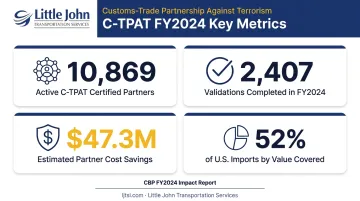
CBP's FY2024 Impact Report puts the program's scale in concrete terms:
- 10,869 active partners enrolled nationwide
- 2,407 validations completed in FY2024
- $47.3 million in partner savings from reduced cargo examinations
- 52% of U.S. imports by value move through C-TPAT-certified supply chains
Validation involves CBP reviewing a carrier's supply chain security profile against Minimum Security Criteria. CBP targets a certification decision within 90 days and a validation within one year.
FAST: Dedicated Lanes at High-Volume Crossings
FAST (Free and Secure Trade) is a bilateral U.S.-Mexico-Canada program that provides access to dedicated expedited lanes at eligible land border crossings. For the U.S.-Mexico corridor, FAST lanes are available at key crossings including Laredo World Trade Bridge and Colombia-Solidarity — the two crossings handling the majority of commercial truck volume through Texas.
FAST eligibility requires:
- C-TPAT certified importer
- C-TPAT certified carrier
- FAST-approved driver (all three must qualify independently — a common gap that disqualifies otherwise compliant loads)
CBP e-Manifest filing clock for FAST loads: 30 minutes before arrival (versus 60 minutes for standard loads).
Little John Transportation Services holds both C-TPAT validation and FAST certification. For clients moving freight through their carrier network, this means access to dedicated lanes at Laredo and reduced inspection frequency — a concrete advantage at a port that handles over 40% of all U.S.–México trade volume.
ISF for Ocean Freight
These land border programs don't extend to ocean freight. Importers using vessel shipments face a parallel pre-clearance requirement: Importer Security Filing (ISF 10+2), due 24 hours before lading at the foreign port. This is a vessel-specific rule — it does not apply to truck crossings at land borders.
Best Practice 4: Plan for Duties, Taxes, and Disruptions Before They Happen
Prepay Duties and Structure Shipments Correctly
Unpaid or miscalculated duties are an entirely preventable cause of clearance delays. Calculate duties before the freight departs and, where possible, prepay them before arrival at the border.
Delivered Duty Paid (DDP) transfers full responsibility to the seller — covering all transport costs, export and import clearance, and duties through to the named destination. For the receiver, this removes the customs clearance variable entirely. The tradeoff is that the seller assumes full responsibility for accurate classification and payment — which requires solid compliance infrastructure on the seller's side.
Financial preparation only goes so far. The other half of delay prevention is having an operational plan ready before a disruption hits.
Build Contingency Plans for Predictable Disruptions
Laredo handles nearly 40% of U.S.–Mexico freight value. When that corridor surges, shippers without alternate routing strategies absorb the full impact of the delay.
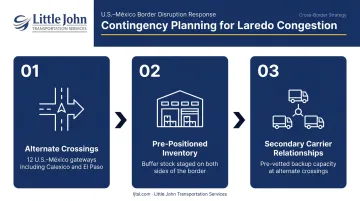
Practical contingency strategies include:
- Alternate crossings: Little John operates across 12 U.S.-Mexico border gateways, including dedicated offices in Calexico, El Paso, and other corridors — enabling rerouting when Laredo volumes spike
- Pre-positioned inventory: Buffer stock on both sides of the border for time-sensitive production inputs
- Secondary carrier relationships: Pre-vetted backup capacity at alternate crossings, not just Laredo-dependent options
The Value of 24/7 Bilingual Dispatch
When a hold does occur, the difference between a one-day delay and a five-day delay often comes down to response speed. A carrier with 24/7 bilingual dispatch (staffed in-house at the border, not routed through an outsourced call center) can identify the hold reason, communicate with customs agents in real time, and mobilize a documentation correction immediately.
Little John maintains staffed bilingual operations teams in Laredo, Monterrey, and Guadalajara, with in-house customs brokerage on both sides of the border.
When a shipment is flagged, the same team that filed the original documentation can respond directly — without the handoff delays that come with third-party brokerage arrangements.
Frequently Asked Questions
How to avoid customs clearance delays?
Submit complete, accurate documentation before the freight departs, verify HS code classification against both U.S. and Mexican requirements, and prepay duties before arrival at the border. Working with a C-TPAT and FAST-certified carrier and maintaining current USMCA compliance documentation significantly reduces hold probability.
What are the best practices for ensuring compliance with Incoterms and minimizing delays in cross-border transactions?
Agreed-upon Incoterms define who holds responsibility for customs clearance, duties, and risk at each point in transit. Always document the full Incoterm with named port, country, and specific delivery point — "FOB" without that detail creates ambiguity that stalls resolution at the border.
What to do if a shipment is stuck in customs for two weeks?
Contact your customs broker or carrier's compliance team immediately to identify the specific hold reason — documentation error, unpaid duties, inspection flag, or missing permit. Once identified, submit corrected documents or outstanding payments and request an expedited review.
What documents are required for U.S.-Mexico cross-border freight?
Core required documents include: commercial invoice, packing list, bill of lading, and USMCA Certificate of Origin when claiming preferential tariff treatment. Hazmat shipments require shipping papers with the full DOT-mandated elements and, for high-risk materials, an HMSP permit. All documents must match exactly across every form.
How does C-TPAT certification help speed up customs clearance?
C-TPAT-validated carriers have passed rigorous CBP security vetting, resulting in fewer random inspections and priority processing at the border. Combined with FAST certification, shipments access dedicated lanes at U.S.-Mexico crossings, cutting wait times at high-volume ports like Laredo's World Trade Bridge and Colombia-Solidarity.
How long does customs clearance typically take for cross-border freight?
Compliant, pre-filed shipments with certified carriers can clear in a matter of hours. Shipments flagged for secondary inspection or missing documentation can be held for days or, in complex cases, weeks. Pre-arrival ACE e-manifest filing and C-TPAT/FAST certification are the two factors that most reliably shorten clearance time for ground freight on the U.S.-Mexico corridor.