Introduction
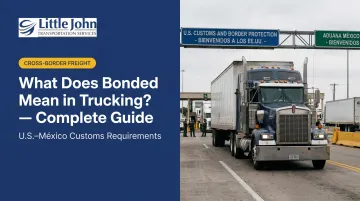
Picture this: a shipment of automotive components arrives at Laredo — the busiest commercial land port in North America — from a manufacturer in Monterrey. The parts need to reach an assembly plant in Ohio, but customs duties haven't been settled yet. Can the truck just drive through? Only if the carrier is bonded.
That single word, "bonded," determines whether goods can move inland under customs control or must stop dead at the border for immediate clearance. For anyone managing cross-border freight on U.S.-Mexico and U.S.-Canada lanes, understanding what bonded actually means is the difference between a supply chain that flows and one that stalls.
According to BTS data, trucks carried over $1 trillion in U.S.-Mexico and U.S.-Canada freight in 2025 alone. A significant share of that cargo moves under bond. This guide breaks down exactly what bonded status covers, how in-bond movement works, and what to look for when selecting a carrier.
Key Takeaways
- A bonded carrier holds CBP authorization (Activity Code 2) to transport goods that haven't yet cleared customs duties
- Goods traveling "in-bond" remain under customs control until they reach the designated clearance point
- The surety bond is a financial guarantee to the U.S. government — not insurance
- Bonded carriers can move freight inland or across multiple borders; non-bonded carriers cannot
- C-TPAT validation, FAST certification, and ISO 9001 signal compliance depth that goes beyond the bond itself
What Does "Bonded" Mean in Trucking?
The Bonded Carrier Definition
A bonded carrier is a transportation company authorized by U.S. Customs and Border Protection (CBP) to take custody of goods that have not yet cleared customs — and move them from a port of entry to an inland facility, another crossing, or a bonded warehouse without paying duties upfront.
That authorization comes from a customs bond filed under Activity Code 2: Custodian of Bonded Merchandise on CBP Form 301. It is not a generic business bond or insurance certificate. If you're vetting a carrier, ask specifically for evidence of an active Activity Code 2 bond — proof of general business insurance is not a substitute.
How the Surety Bond Works
The bond is a three-party financial guarantee:
- Principal — the carrier, who takes on custodial responsibility for the goods
- Surety — a CBP-approved financial institution that backs the guarantee
- Obligee — the U.S. government (CBP), which is protected if duties go unpaid
The bond guarantees that duties will be paid at the right time and place. If the carrier fails to deliver goods properly or duties go unresolved, CBP can call on the surety to collect. The bond protects CBP, not the shipper.
What "In-Bond" Means in Practice
When goods travel "in-bond," they remain under CBP custody throughout transit. They are not released into U.S. commerce and cannot be sold or used domestically until they reach their designated destination — an inland customs facility, bonded warehouse, or export port — and formal entry or exportation is completed.
This is where the terminology gets confusing. "Bonded" refers to two distinct things:
| Usage | What It Means |
|---|---|
| Bonded carrier | The trucking company holding CBP custodial bond authority |
| In-bond shipment | Cargo traveling under customs control with duties deferred |
A shipment can be "in-bond" only if a bonded carrier is handling it.
Bond Types: Single-Transaction vs. Continuous
- Single-transaction bonds cover one specific shipment
- Continuous bonds cover all eligible activity under one bond filing, with no fixed 12-month legal expiration — they remain effective until properly terminated under 19 CFR Part 113
High-volume cross-border shippers almost always work with carriers holding continuous bonds, eliminating the administrative burden of filing a new bond for every load.
How Does Bonded Trucking Work?
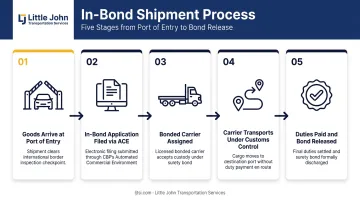
The In-Bond Process Step by Step
From a shipper's perspective, here's how a typical bonded move unfolds:
- Goods arrive at a port of entry or border crossing
- In-bond application filed electronically through CBP's Automated Commercial Environment (ACE) — this is required; paper filing is only permitted in limited exceptions
- A bonded carrier is assigned and takes physical and legal custody of the cargo
- Carrier transports goods under customs control to the designated inland port, bonded warehouse, or export point
- Duties are paid (or goods are exported), and the bond obligation is released
What the Application Covers
The in-bond application draws on the CBP Form 7512 data set and must include:
- HTSUS commodity code (six-digit minimum)
- Cargo description, quantity, and value
- Container and seal numbers
- Origin and destination (or export) port
- Bonded carrier identification
- Any applicable licenses or permits
Errors in this filing can trigger CBP holds, delay transit, or create bond liability — accuracy isn't optional.
Transit Time Rules
Filing errors and timing violations create the same compliance exposure — which is why the clock matters as much as the paperwork. Under 19 CFR 18.1, highway in-bond shipments must reach the destination or export port within 30 days of the movement beginning.
Arrival must be reported electronically within two business days — not 48 clock hours, since weekends and federal holidays affect this deadline.
Missing either deadline creates compliance exposure for the carrier and, depending on contract terms, the shipper.
The Role of the Customs Broker
Most shippers don't manage in-bond filings directly. A licensed customs broker typically handles:
- Filing the ACE in-bond application and ensuring data accuracy
- Coordinating documentation with the bonded carrier before transit
- Managing formal entry at the destination port
- Responding to CBP holds or requests for additional information
Working with a carrier that maintains its own compliance infrastructure — rather than outsourcing entirely to third-party brokers — reduces hand-off risk and keeps documentation tighter.
CBP conducts audits and spot inspections on in-bond shipments, and carriers must maintain chain-of-custody records for every move. That documentation discipline separates reliable bonded carriers from the ones that create compliance problems.
Bonded vs. Non-Bonded Carriers: Key Differences
The Core Legal Distinction
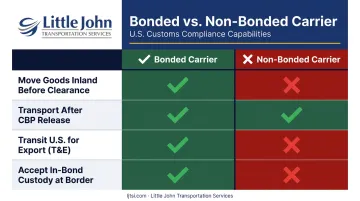
A bonded carrier can accept custody of unreleased goods and transport them past the first port of entry. A non-bonded carrier legally cannot. Once CBP releases the cargo — duties paid, entry filed — any carrier can haul it. But until that release happens, only a bonded carrier can touch it.
| Scenario | Bonded Carrier | Non-Bonded Carrier |
|---|---|---|
| Move goods inland before clearance | ✅ Yes | ❌ No |
| Transport after CBP release | ✅ Yes | ✅ Yes |
| Transit U.S. for export (T&E) | ✅ Yes | ❌ No |
| Accept in-bond custody at border | ✅ Yes | ❌ No |
Practical Impact for Shippers
With a non-bonded carrier, goods must undergo full customs clearance at the first point of entry before any further movement. That means:
- Waiting for CBP release at the border, which can take hours or days during peak congestion
- No flexibility to clear at an inland facility closer to the final destination
- No option for through-transit movements across the U.S.
A bonded carrier eliminates that hard stop. Goods flow through to where clearance makes operational sense — once, at the right place.
When You Specifically Need a Bonded Carrier
Three scenarios make bonded carrier status non-negotiable:
- Cross-border transit: Goods moving from Mexico to Canada (or vice versa) through the U.S. — the T&E mechanism under 19 USC 1553 — require a bonded carrier because the goods aren't entering U.S. commerce
- Inland clearance: When a shipper prefers (or is required) to clear customs at an interior facility rather than at the port of entry
- Bonded warehouse operations: Goods moving to or from a bonded warehouse for staging, processing, or re-export must travel under a bonded carrier
Security Credentials: Separate from the Bond
C-TPAT validation and FAST certification are often mentioned alongside bonded carrier status, but they solve a different problem. The bond creates legal custody authority. C-TPAT and FAST provide security validation and lane facilitation.
- C-TPAT members receive fewer inspections, front-of-line treatment, and FAST eligibility — but this doesn't create bonding authority
- FAST gives eligible carriers and drivers access to dedicated expedited lanes at participating ports — but only when the carrier, driver, and supply chain parties all qualify
The practical procurement hierarchy: verify Activity Code 2 bond authority first, then evaluate security credentials separately.
That credential stack matters in practice. Little John Transportation Services holds C-TPAT validation, FAST certification, and an FMCSA Satisfactory rating, covering the full compliance picture for U.S.-Mexico bonded freight. Their 50-acre Laredo facility operates to C-TPAT standards, with restricted access, full-coverage surveillance, and 30-bay cross-dock capacity built to hold up under CBP audit.
Key Benefits of Using a Bonded Carrier
Cash Flow Through Duty Deferral
In-bond status defers duty payment until goods reach their final destination and formal entry is filed. For high-value cargo — automotive components, electronics, industrial equipment — this timing difference has real financial weight. Duties on goods that won't be consumed domestically (T&E movements) may not be assessed at all.
That deferral is real, though how much it matters depends on shipment value, applicable duty rates, financing costs, and final disposition. The mechanism is consistent; the dollar impact is specific to each lane.
Supply Chain Flexibility
Bonded movement removes the requirement for multiple customs stops when goods cross more than one country. A shipment originating in Monterrey, transiting through Texas, and destined for a Canadian OEM can move under a single in-bond authorization — no U.S. consumption entry, no redundant clearance at intermediate points.
On automotive and electronics lanes — where components cycle across the border multiple times before final assembly — that single authorization eliminates compounding delays at every intermediate stop.
Reduced Administrative Burden
Working with a carrier that holds its own bond and manages compliance documentation shifts the filing burden off the shipper. When that carrier also holds audit-ready records, chain-of-custody documentation, and established CBP system relationships, the shipper gets a pre-qualified compliance partner — not just a truck and a paperwork problem.
A carrier that operates at this level brings more than capacity. Look for:
- Own surety bond — no reliance on third-party bonding agents
- Audit-ready documentation — chain-of-custody records maintained throughout transit
- CBP system integration — established relationships with port and border processes
- Documented compliance processes — certifications like ISO 9001:2015 that show systematic, auditable discipline

ISO 9001:2015 certification, for example, demonstrates that compliance is built into the process — not assembled shipment-by-shipment when CBP asks for it.
Frequently Asked Questions
What does it mean if a trucking company is bonded?
A bonded trucking company holds a customs bond (Activity Code 2) issued through a CBP-approved surety, authorizing it to transport goods that haven't yet cleared customs. It acts as a financial guarantor to the U.S. government that duties will be paid at the appropriate time and place.
How does a trucking company become bonded?
The carrier establishes legal operating authority, then works with a CBP-approved surety to complete CBP Form 301, selecting Activity Code 2. Once CBP approves the filing, the carrier can accept in-bond custody — though ongoing compliance (audits, record-keeping, arrival reporting, seal requirements) is mandatory to keep that authority active.
What is the difference between bonded and non-bonded trucking?
A bonded carrier can move goods inland or across multiple borders without customs clearance at the first port of entry — duties deferred to the destination. A non-bonded carrier must stop at the first point of entry and wait for full CBP release before the cargo can move domestically.
What documents are required for a bonded shipment?
Core documents include the in-bond application filed via ACE (using CBP Form 7512 data), customs bond, commercial invoice, bill of lading, and packing list. The ACE filing must include accurate HTSUS codes, seal numbers, and container details.
Can any type of freight be shipped using a bonded carrier?
Most freight types can move in-bond: FTL, flatbed, dry van, and specialized equipment. Certain categories — explosives, live animals, and goods subject to health or conservation regulations — may require inspection even under bond, and hazmat endorsements may be required depending on the carrier.
What is the difference between a bonded carrier and a bonded warehouse?
A bonded carrier is the transportation company authorized to move in-bond goods between locations. A bonded warehouse is a CBP-authorized storage facility where in-bond goods can be held, processed, or staged before duties are assessed. Both operate under CBP oversight with duties deferred — the carrier moves the goods, the warehouse holds them.