Introduction
Tendering hazardous freight to the wrong carrier isn't just a logistics mistake — it's a federal violation. Under 49 CFR 173.22(b), shippers cannot legally offer certain high-risk materials to a motor carrier that doesn't hold a valid Federal Hazardous Materials Safety Permit. The practical challenge: according to the FMCSA's 2024 Pocket Guide, only 898 active carriers held an HMSP as of December 29, 2023 — roughly 0.114% of active USDOT-registered carriers.
The HMSP exists because the most dangerous materials in transportation demand a higher standard than standard hazmat operations can deliver.
This guide covers:
- What an HMSP is and why it exists
- Which materials trigger the permit requirement
- What carriers must do to earn and keep one
- Why permit status matters when evaluating a carrier for compliance-sensitive freight
Key Takeaways
- HMSP (Hazardous Materials Safety Permit) is a federal credential the FMCSA issues to motor carriers authorized to transport specific high-risk hazardous materials.
- Coverage is limited to specific materials and quantities under 49 CFR 385.403; not every hazmat shipment triggers the requirement.
- Shippers bear a direct legal duty under 49 CFR 173.22(b) not to offer covered materials to a carrier without a valid HMSP.
- Holding an HMSP requires a satisfactory safety rating, PHMSA registration, a documented security plan, and ongoing FMCSA monitoring.
- An HMSP covers a motor carrier as a company, not an individual driver; a hazmat endorsement on a CDL is a separate, driver-level credential.
What Is a Federal Hazardous Materials Safety Permit?
The HMSP is a permit issued by the Federal Motor Carrier Safety Administration under 49 CFR Part 385, Subpart E, authorizing motor carriers to transport certain high-risk hazardous materials in interstate, intrastate, and international commerce.
The program has been in effect since January 1, 2005. FMCSA created it because the most dangerous materials in highway transportation (bulk explosives, radioactive shipments, toxic-by-inhalation chemicals) require a documented minimum standard of safety that standard hazmat operations don't mandate on their own.
How It Differs from Standard Hazmat Registration
An HMSP is not the same as a USDOT number, a hazmat endorsement, or PHMSA registration. Those are separate requirements. The HMSP goes further by requiring carriers to:
- Meet documented safety performance benchmarks
- Maintain an active, written security and communications plan
- Remain under continuous FMCSA oversight between renewals
PHMSA registration under 49 CFR Part 107, Subpart G is actually a prerequisite for the HMSP — not a substitute for it.
How Rare Is the HMSP?
The numbers put the credential in context. The FMCSA's December 2023 snapshot shows:
| Metric | Count |
|---|---|
| Active HMSP holders | 898 |
| Active USDOT-registered carriers | 787,189 |
| Ratio | ~1 per 877 carriers |
For shippers evaluating carrier qualifications, that ratio defines how selective the standard is.
The Shipper's Legal Obligation
Under 49 CFR 173.22(b), no person may offer a motor carrier any hazardous material covered under 49 CFR 385.403 unless that carrier holds a valid FMCSA safety permit. The prohibition applies to the shipper directly, making HMSP verification a legal responsibility before tendering a covered load. This is a compliance issue for shippers, not just a qualification issue for carriers.
Which Hazardous Materials Require an HMSP?
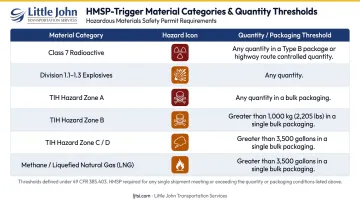
Not every hazmat shipment triggers the HMSP requirement. The regulation targets specific materials and quantity thresholds defined in 49 CFR 385.403 — the categories that carry the highest consequence in a transportation incident.
Covered Material Categories
| Material Category | HMSP Trigger |
|---|---|
| Class 7 Radioactive | Highway Route Controlled Quantity (HRCQ), as defined in 49 CFR 173.403 |
| Division 1.1, 1.2, or 1.3 Explosives | More than 25 kg (55 lbs) net weight; or any Division 1.5 material requiring placarding |
| TIH Hazard Zone A | More than 1 liter (1.08 qt) per package |
| TIH Hazard Zone B | Any quantity in bulk packaging |
| TIH Hazard Zone C or D | Packaging capacity of 13,248 L (3,500 gal) or more |
| Methane/LNG (85%+ methane) | Bulk packaging with capacity of 13,248 L (3,500 gal) or more |
Why Thresholds Matter
A material can be classified as hazardous without triggering HMSP requirements. The permit is only required when the type and amount meet the thresholds above.
Packaging configuration matters just as much as material classification. The TIH zones make this concrete: Zone A materials hit the HMSP threshold at just over one liter per package (a relatively small amount), while Zones C and D don't trigger the requirement until the shipment reaches bulk packaging at 3,500 gallons or more.
Shippers moving chemicals, gases, or radioactive materials in industrial or bulk quantities should cross-reference their shipment profiles against these thresholds. When the classification is unclear, verifying carrier HMSP status before tendering is both a compliance requirement and a practical safeguard.
What Carriers Must Do to Earn and Keep an HMSP
The Application Process
Carriers apply by filing Form MCS-150B with the FMCSA. Applicants without an existing safety rating may receive a temporary HMSP (T-HMSP) valid for up to 180 days while FMCSA completes a compliance review — extendable by 60 additional days if no rating has been assigned by then.
Eligibility Requirements at the Time of Initial Application
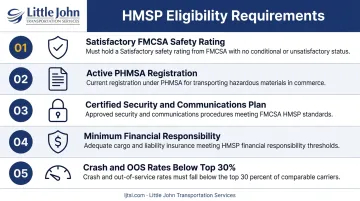
Five criteria must be satisfied before FMCSA will issue an HMSP:
- Satisfactory FMCSA safety fitness rating from a compliance review
- Active PHMSA registration under 49 CFR Part 107, Subpart G
- Certified security and communications plan under 49 CFR Parts 172 and 385, including driver communication protocols and hazmat employee security training
- Minimum financial responsibility as required by 49 CFR 387.9
- Crash and OOS rates not in the top 30% of national averages across driver, vehicle, hazmat, and total out-of-service categories
Ongoing Compliance to Maintain the Permit
The HMSP is valid for two years and requires biennial renewal. The two-year cycle doesn't reduce the oversight burden. FMCSA reviews HMSP holders' Safety Measurement System (SMS) scores monthly across seven BASICs:
- Unsafe Driving
- Crash Indicator
- Hours-of-Service Compliance
- Vehicle Maintenance
- Controlled Substances/Alcohol
- HM Compliance
- Driver Fitness
Enhanced oversight is triggered when the HM Compliance BASIC exceeds the 80th percentile for two consecutive months, or when any two other BASICs exceed their thresholds for the same period.
Passing the ratings check is only part of the picture. Carriers must also keep the following in order at all times:
- A satisfactory safety rating (loss of this rating can support revocation)
- A documented hazmat security plan with verified employee training
- Driver communication records retained for six months
- Written route plans for HRCQ Class 7 and Division 1.1–1.3 shipments
- Notification to FMCSA of qualifying business changes within 30 days
Carriers that fail these ongoing requirements face permit suspension or revocation under 49 CFR 385.421T. Those operating without a required permit face separate civil enforcement actions under Part 386.
HMSP vs. Hazmat Endorsement: Key Differences
These two credentials are frequently confused — both relate to hazmat transportation, but they apply to entirely different entities and serve distinct functions.
| HMSP | Hazmat Endorsement (H) | |
|---|---|---|
| Issued to | Motor carrier (the company) | Individual CDL driver |
| Issued by | FMCSA under 49 CFR Part 385 | State licensing authority under 49 CFR Part 383 |
| Covers | Specific high-risk material categories per 49 CFR 385.403 | Any CDL driver transporting any placarded hazardous materials |
| Background check | Carrier-level safety review | TSA security threat assessment (49 CFR Part 1572) |
| Renewal | Every 2 years | Tied to CDL renewal cycle |
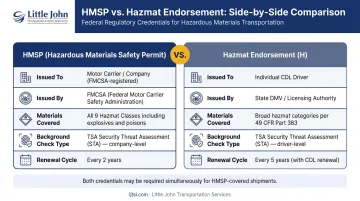
The two credentials are not mutually exclusive — for a shipment covered by the HMSP, both may be required simultaneously. The carrier must hold the permit, and the driver operating the vehicle must hold a hazmat-endorsed CDL. When evaluating carrier qualifications, shippers should verify both credentials independently.
Why HMSP Status Matters When Choosing a Hazmat Carrier
Fewer than 1 in 877 registered carriers hold an active HMSP. That number reflects a federal bar most carriers never clear — and an ongoing monitoring obligation that requires them to maintain it month after month.
What HMSP Status Signals in Practice
- The carrier has a satisfactory safety rating — a designation held by roughly 6% of U.S. carriers
- The carrier maintains an audited security plan with documented employee training
- FMCSA reviews their safety data monthly and can act on declining performance before the next renewal
- The carrier's crash and OOS rates must stay below the top 30% of national averages — continuously, not just at application
For shippers with audit obligations, EHS programs, or procurement standards that require carrier certification, HMSP status is a meaningful differentiator precisely because it can't be self-reported — it's publicly verifiable.
Where HMSP Status Is Most Relevant
- Chemical and petrochemical shippers moving TIH materials in bulk
- Energy sector companies transporting LNG or handling radioactive materials
- Defense and industrial clients managing multi-facility shipment networks under regulatory scrutiny
- Organizations that require verified carrier certification as part of contractual or insurance requirements
Verifying HMSP Status Before Tendering
The FMCSA provides a dedicated Shipper Verification of Carrier Hazardous Material Safety Permit tool. Shippers enter the carrier's USDOT number and receive confirmation of current HMSP status. Under 49 CFR 173.22(b), running this check before tendering a covered load isn't optional — it's a legal obligation.
Little John Transportation Services holds an active FMCSA HMSP alongside an FMCSA Satisfactory safety rating, AA&E certification, TPS approval, and CTPAT validation. That compliance stack exists specifically for the freight categories most carriers can't legally accept.
Frequently Asked Questions
What does HMSP stand for?
HMSP stands for Hazardous Materials Safety Permit. It is issued by the FMCSA to motor carriers authorized to transport specific categories of high-risk hazardous materials under 49 CFR Part 385, Subpart E — and it has been required for covered carriers since January 1, 2005.
How often does a Federal Hazardous Materials Safety Permit expire?
An HMSP is valid for two years from the date of issuance. Carriers renew via Form MCS-150B and must continue meeting all FMCSA safety, security, and compliance requirements to remain eligible.
What does HMR mean in hazmat?
HMR stands for Hazardous Materials Regulations — the federal rules found at 49 CFR Parts 171–180, administered by PHMSA. The HMR governs classification, packaging, labeling, marking, and documentation of hazardous materials in transportation and applies to all modes, not just highway.
Do all hazmat shipments require an HMSP-certified carrier?
No. The HMSP applies only to specific categories and quantities defined in 49 CFR 385.403, including certain explosives, TIH materials, HRCQ radioactive materials, and bulk LNG or methane. Standard hazmat shipments that don't meet those thresholds do not trigger the HMSP requirement.
What is the difference between an HMSP and a hazmat endorsement?
An HMSP is issued to a motor carrier as a company and authorizes transportation of certain high-risk regulated materials. A hazmat endorsement is added to an individual driver's CDL for any driver transporting placarded hazardous materials — and for HMSP-covered shipments, both are typically required.
How can I verify that a carrier holds a valid HMSP?
Use the FMCSA's Shipper Verification of Carrier HMSP tool — enter the carrier's USDOT number to confirm active permit status. Under 49 CFR 173.22(b), completing this verification before tendering covered materials is a legal obligation for shippers.