Introduction
Wind farms now span hundreds of square miles. Substations serving grid-scale solar installations house transformers the size of houses. The equipment powering this buildout is massive, precision-engineered, and completely impossible to break into smaller shipments.
According to the EIA, developers plan to add 86 GW of utility-scale generating capacity in 2026 alone — including 43.4 GW solar, 24 GW battery storage, and 11.8 GW wind. Every one of those projects depends on components that exceed standard freight limits by orders of magnitude.
A single delayed turbine blade or transformer can halt an entire project. When a crane crew is on-site and the nacelle isn't, that's a direct cost to the EPC contractor, not just a schedule slip.
This guide gives energy project managers, EPC contractors, and procurement teams a clear picture of what over-dimensional (OD) freight involves, why it's uniquely complex for energy infrastructure, and what separates a qualified OD carrier from one that's simply permitted.
Key Takeaways:
- Any load exceeding 8'6" wide, 13'6" tall, 53' long, or 80,000 lbs gross triggers OD permit requirements
- Power transformers weigh 150–400 tons with lead times up to 60 months, making them the most schedule-critical component on any energy project
- Multi-state OD moves require separate permits per jurisdiction — processing takes days to weeks each
- Vet carriers for FMCSA Satisfactory rating, HMSP credentials, and energy project experience
- Plan OD moves 4–12 weeks out; permit and route survey timelines directly drive project schedules
What Qualifies as Over-Dimensional Freight in Energy Projects
Federal Thresholds and Superloads
Federal regulations set the baseline for when a shipment becomes over-dimensional:
- Width: exceeding 102 inches (8'6") on the National Network
- Gross weight: exceeding 80,000 lbs on the Interstate System
- Axle limits: 20,000 lbs single axle; 34,000 lbs tandem axle
- Height and length: No federal maximums — states set their own limits
Exceeding even one of these thresholds triggers permit requirements and operational protocols. But most energy infrastructure cargo doesn't just exceed these limits — it obliterates them.
Superloads are the relevant category here. There's no single national superload definition. Arkansas classifies a load as a superload above 16'6" wide, 15'6" high, 100' long, or 180,000 lbs gross. Texas requires structural bridge evaluation for loads exceeding 200,000–254,300 lbs depending on configuration. Both states can require formal engineering studies that add weeks to planning timelines.
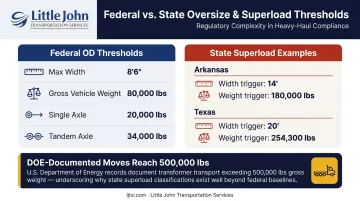
The DOE has documented 500,000-lb transformer road moves — well above both states' superload triggers. That weight class is the norm for large power transformers, not the exception.
Why Energy Infrastructure Generates So Much OD Freight
Energy infrastructure components are built to performance specs, not transportation specs. A wind turbine nacelle, a large power transformer, a reactor vessel — none can be disassembled into legal-dimension shipments. They move whole or not at all.
That constraint is locked in at the design stage, which means by the time a shipper is planning a move, the dimensions are fixed. Route engineering, permit sequencing, and equipment selection have to work around the load — not the other way around.
Common Energy Infrastructure Cargo That Requires OD Transport
Wind Energy Components
A single wind farm can involve hundreds of individual OD moves. The three primary component categories:
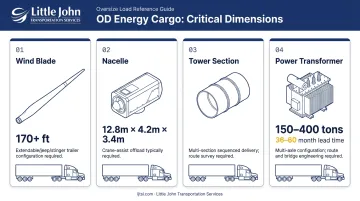
- Tower sections: Heavy, cylindrical segments that must be delivered sequentially and staged in order. DOE notes that tower diameter can conflict with bridge and overpass clearances.
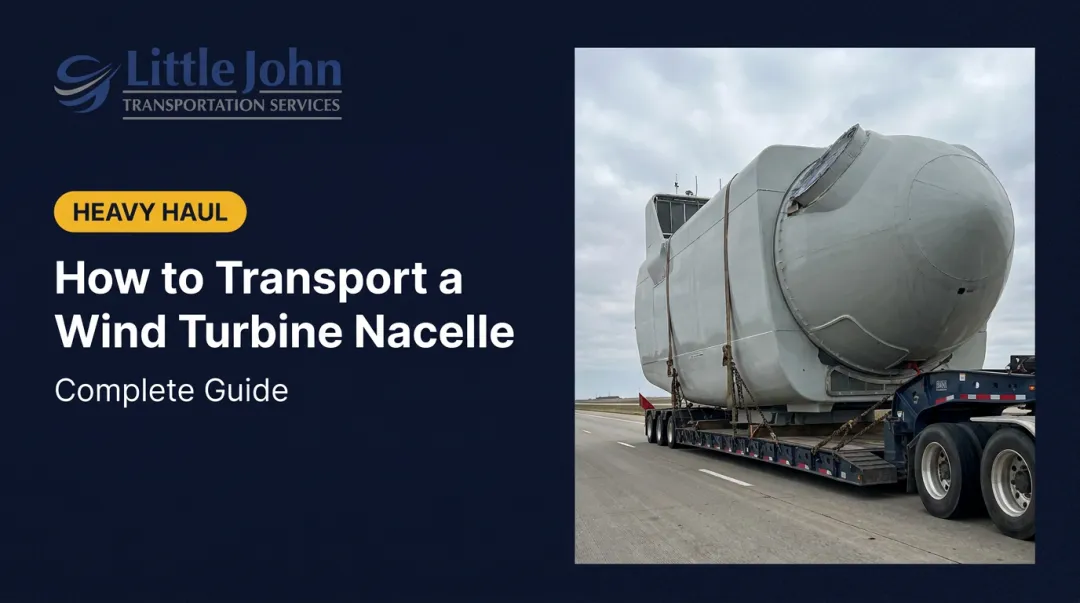
- Nacelles: The generator housing sits atop the tower. The Vestas V150-4.2 MW nacelle, for example, measures 12.8m long × 4.2m wide × 3.4m high — well outside standard freight dimensions.
- Blades: The defining OD challenge in wind energy. A typical modern land-based blade exceeds 170 feet. Purpose-built blade trailers like Goldhofer's VENTUM — a five-times extendable semi that accepts loads well over 230 feet — exist specifically because nothing else can move them.
Power Transformers and Substation Equipment
According to the DOE's Large Power Transformer Resilience Report, large power transformers typically weigh 150–400 tons, with acquisition lead times commonly quoted at 36 months and maximums reaching 60 months.
Wood Mackenzie reported average transformer lead times rising from roughly 50 weeks in 2021 to 120 weeks in 2024, with up to 25% of global renewable projects potentially exposed to delay. Each move requires:
- Multi-axle hydraulic trailers rated for the load
- Precise weight distribution planning across axles
- Detailed route surveys, especially for bridge weight restrictions
Transformer logistics need to be planned alongside procurement — not after the equipment ships.
Solar and Battery Energy Storage Systems
Large-scale solar projects require OD moves for prefabricated racking structures, inverter skids, and oversized BESS containers. The Tesla Megapack 2 XL, for example, weighs up to 38,100 kg (approximately 84,000 lbs) — enough to exceed the federal gross weight limit before the trailer is factored in.
While lighter than transformer or wind moves, the volume of BESS shipments and compressed project timelines create coordination challenges that compound across multi-MW installations.
Oil, Gas, and Petrochemical Infrastructure
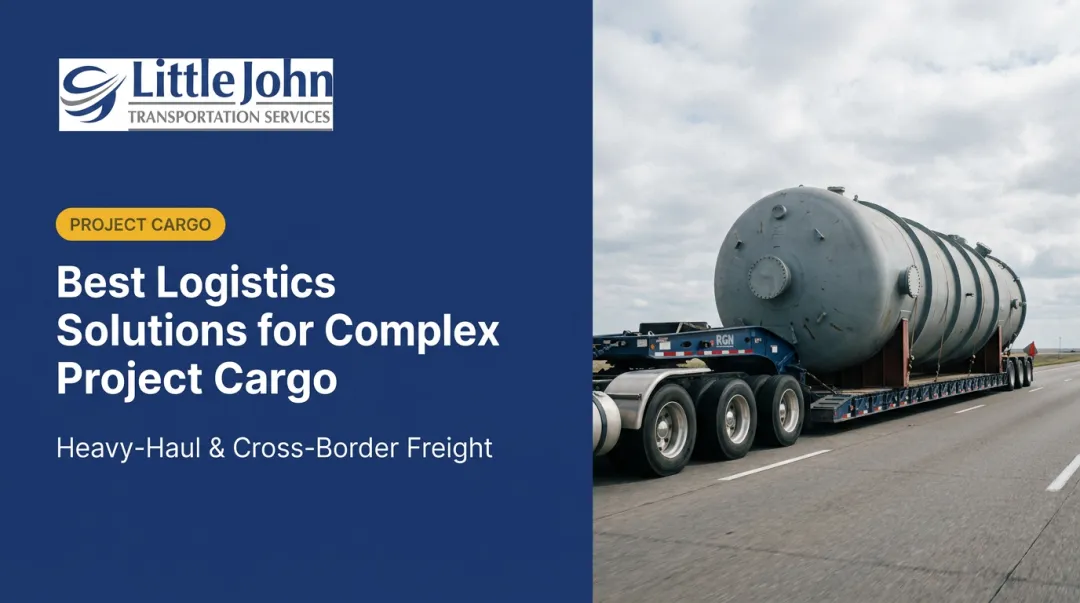
Fossil fuel and petrochemical infrastructure share many of the same OD transport demands as renewables — just with different cargo profiles. Pressure vessels, refinery modules, BOP stacks, and large pipeline components routinely exceed legal dimensions. Most of these moves originate from or transit Gulf Coast manufacturing corridors, where pre-positioned carriers with Gulf Coast permit-route familiarity shorten response times and reduce deadhead exposure.
Little John Transportation Services' Houston office handles complex industrial and energy freight specifically throughout Texas and the southern U.S. — generators, heat exchangers, industrial pumps, well service equipment, and refinery components among them.
Permit and Compliance Complexity for Energy OD Moves
Multi-State Permit Coordination
An OD load crossing multiple states requires individual permits from each state's DOT. There's no federal OD permit — FHWA explicitly confirms that permitting is a state function. Each jurisdiction has its own:
- Dimensional limits and fee structures
- Escort vehicle requirements
- Application timelines and processing speeds
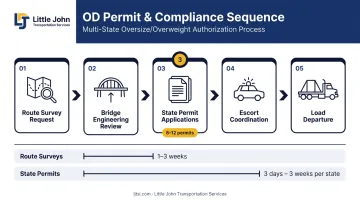
A cross-country transformer move may require 8–12 individual state permits, all of which must be sequenced and active before the load departs. Colorado, for example, quotes 3–5 business days for standard oversize permits — but 2–3 weeks when a route survey is required.
Route Surveys and Engineering Assessments
Before a heavy energy load moves, carriers must conduct route surveys that assess:
- Bridge weight ratings along the entire corridor
- Overhead utility and structure clearances
- Road surface conditions and turn radius constraints
- Alternative routing for low-clearance structures
For superloads, state DOTs may require formal structural engineering analysis of individual bridges. That review adds weeks to the planning timeline — time that's rarely recoverable once a project schedule slips.
Little John conducts in-house route engineering before any truck rolls, covering bridge clearances, turning radii, and low-overpass alternates as part of the standard service package. With 100,000+ permits processed annually, this is a systematized internal process, not an ad-hoc coordination task.
Escort Requirements and Travel Restrictions
Route engineering clears the path — escort coordination fills it in. Most states mandate pilot cars above certain load dimensions, with requirements varying for front escort, rear escort, or law enforcement accompaniment. For energy projects moving through rural corridors, sourcing certified escort providers can itself become a logistics bottleneck.
Travel restrictions compound that complexity further:
- Many states prohibit OD moves during peak traffic hours
- Weekend and holiday restrictions vary by state
- Some permits specify no night travel; others allow 24/7 movement on specific routes
- Adverse weather can halt moves mid-corridor
For EPC contractors managing tight delivery windows, these restrictions are concrete schedule inputs that need to be built into project planning from day one.
FMCSA Credentials and Certifications
Two credentials matter most when evaluating energy OD carriers:
- FMCSA Hazardous Materials Safety Permit (HMSP): Required for certain high-consequence hazardous materials. Fewer than 1% of U.S. carriers hold this permit — making it a genuine differentiator, not a standard qualification.
- TWIC (Transportation Worker Identification Credential): Required by TSA for unescorted access to secure maritime facilities, port terminals, and certain energy installations. Access to regulated energy sites depends on it.
Little John holds both the FMCSA HMSP and an FMCSA Satisfactory safety rating — the highest possible designation, held by roughly 6% of U.S. carriers. The network includes 8,000+ TWIC-certified, hazmat-endorsed operators positioned across key corridors.
Equipment, Route Planning, and Project Coordination
Specialized Trailer Selection
Equipment choice directly determines permit dimensions, bridge compliance, and whether the load can access the delivery site. The primary trailer types for energy OD freight:
| Trailer Type | Best For | Key Capability |
|---|---|---|
| RGN (Removable Gooseneck) | Tall equipment, transformers, generators | Front-load access, low deck height |
| Multi-axle lowboy | Extreme weight distribution | Up to 160,000 lbs; configurations like LOW6/LOW7/LOW9 |
| Extendable flatbed | Wind turbine blades, long structural components | Deck extends 45'–115'; purpose-built for blade length |
| Double-drop | Very tall industrial equipment | Well heights of 18"–26" for height-sensitive loads |
| SPMT | Heaviest superloads, on-site positioning | Up to 60 tons per axle line; electronically steered |
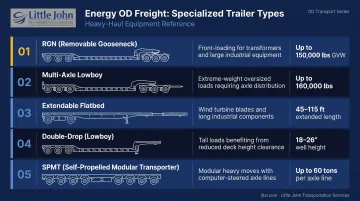
Little John's network provides access to 2,700+ specialized trailers spanning all of these configurations — RGN, multi-axle lowboy, extendable flatbed, double-drop, and SPMT — matched to load specifications and permit requirements for energy OD freight.
Project-Phase Coordination with EPC Timelines
Energy OD freight doesn't operate independently of the construction schedule. A transformer arriving two days before the crane is on-site creates standby costs. A blade delivery that can't be staged because the site road hasn't been graded cascades into crew scheduling delays and crane idle time.
Carriers with energy project experience understand this interdependency. Delivery windows are coordinated around crane availability and construction sequencing, with route optimization as one input — not the only one.
Key coordination points where timing directly affects project cost:
- Transformer deliveries: Crane must be staged and ready; early arrival triggers standby fees
- Wind blade staging: Site access roads must be graded and confirmed before load dispatch
- Substation equipment: Delivery sequenced against civil work completion to avoid ground-storage penalties
- Heavy-haul permits: Multi-state permits often have expiration windows tied to construction milestones
Real-Time Tracking and Communication
That sequencing depends on accurate, real-time load position data. Project managers, crane crews, and site coordinators need live visibility to adjust schedules based on where the freight actually is — not where it was projected to be 12 hours ago. This reduces standby costs and lets teams respond to weather delays or permit complications before they become full-day disruptions.
Little John operates 24/7 dispatch with bilingual English/Spanish support under a single point of contact model: the same dispatcher who knows the load specifications handles every status call. For energy projects spanning the U.S.–México corridor, bilingual capability is operationally critical when coordinating superload handoffs at border crossings where documentation, sequencing, and real-time communication happen simultaneously across two languages.
How to Choose the Right OD Carrier for Energy Infrastructure Projects
Verify Credentials and Compliance Standing
Start with the basics, then go deeper:
- FMCSA Satisfactory rating — verifiable through FMCSA SAFER
- HMSP certification — held by fewer than 1% of carriers; essential for hazmat-adjacent energy cargo
- TWIC-certified operators — required for port access and certain industrial terminal deliveries
- Safety record — Little John's DOT crash frequency runs near half the national average, a metric that holds year-over-year through continuous training programs including its 26-year M.U.S.T. safety initiative
Assess Equipment Depth and Carrier Network
A single-phase energy project might require a handful of OD moves. A multi-phase wind farm can involve hundreds. The carrier's ability to scale without equipment gaps depends on the depth of their specialized fleet and the breadth of their vetted carrier network.
Little John operates within the Landstar network, which provides access to:
- 17,000+ specialized trailers configured for heavy-haul, oversized, and energy-specific cargo
- 8,000+ dedicated BCO owner-operators, all hazmat-endorsed and TWIC-certified
- 65,000+ approved carriers vetted nightly against legal, insurance, and performance standards
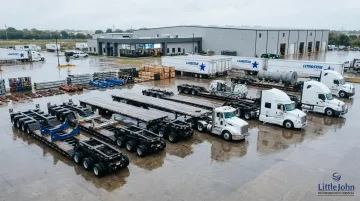
When project phases ramp up, that network depth is what prevents equipment availability from becoming the critical path.
Evaluate Project Experience and Communication Practices
General freight experience doesn't transfer to energy OD projects. Carriers familiar with wind, substation, and O&G moves understand:
- EPC delivery window constraints
- Site-specific access challenges at remote locations
- Permit lead times that can govern the project schedule
- Documentation requirements for high-value, non-replaceable cargo
Ask specifically about dedicated account management, 24/7 availability, and whether audit-ready documentation is standard or an add-on service. When you're justifying carrier selection to an EPC client, those questions have measurable answers — and the right carrier will have them ready.
Frequently Asked Questions
What are asset-based trucking companies?
Asset-based carriers own their equipment directly rather than brokering through third parties, giving them more control over specialized trailer availability. Many leading OD specialists — including Little John — combine owned specialized trailers with a vetted owner-operator network, providing both equipment depth and surge capacity when project volumes spike.
What permits are required for over-dimensional energy freight?
OD freight requires state-level oversize/overweight permits from each jurisdiction the load travels through. Superloads — common in energy infrastructure — may additionally require engineering studies, utility coordination permits, and law enforcement escort approvals. All permits must be secured before the load departs, and each state has its own application timeline and fee structure.
How far in advance should OD freight for energy projects be planned?
Permit processing alone can take 3 days to 3 weeks per state, depending on whether a route survey is required. For energy OD loads — especially superloads — route surveys, escort coordination, and equipment reservation typically require 4–12 weeks of lead time. Early carrier engagement isn't optional; it's a project schedule input.
What trailers are used to transport wind turbine components?
Blades require extendable flatbeds or purpose-built blade trailers capable of carrying loads over 170 feet. Nacelles and tower sections use multi-axle lowboys or RGN configurations. The heaviest components may require SPMTs for on-site positioning. Trailer selection is driven by weight, dimensions, and site access conditions — not just the load itself.
What makes energy OD freight more complex than standard oversized loads?
Energy OD freight combines extreme weight and dimensions with project-critical delivery windows, multi-state permit requirements, remote site access challenges, and high-value cargo that cannot be replaced quickly — transformer lead times alone can reach 60 months. Moving that cargo successfully requires carriers with deep OD experience, not just a permit and a flatbed.
Can over-dimensional energy equipment be transported across the U.S.–Mexico border?
Cross-border OD moves require permits on both sides of the border, compliance with Mexico's NOM-040-SCT-2-2012 regulations alongside U.S. DOT requirements, and a carrier with bilingual teams and established border infrastructure. The Laredo corridor handles more than six of every ten commercial truck crossings on the Texas-Mexico border. Little John's 50-acre Laredo facility — including a 120-ton bridge crane that can transload superloads in under two hours — was built specifically for these moves.