Introduction
Port congestion, rising inland transport costs, and state weight restrictions have made moving international containers directly to final destinations more complicated and expensive than most shippers budgeted for. Import volumes keep climbing, and the logistics complexity behind each shipment grows with them.
Container transloading is frequently cited as a solution to these pressures — but its actual value only shows up in specific operational outcomes: fewer inland truck moves, shorter container dwell times, and the ability to redirect freight after it's already in transit.
This article breaks down what container transloading actually is, where it delivers measurable results, and what goes wrong when it's skipped or handed to the wrong provider.
Key Takeaways
- Transloading moves freight from international ocean containers into domestic trailers or rail equipment sized for inland distribution
- Consolidating into 53-foot domestic trailers reduces total inland truck moves, directly cutting transportation spend
- Freight can be sorted and re-routed mid-journey rather than locked into a single destination weeks before arrival
- Returning ocean containers promptly at a transloading facility eliminates demurrage and detention fees before they compound
- Provider location near key ports and verified compliance credentials (CTPAT, bonded facility status) determine whether transloading actually cuts costs
What Is Container Transloading?
Container transloading is the physical transfer of freight from an international ocean container into domestic transportation equipment — typically 48- or 53-foot domestic trailers or intermodal rail containers — at a facility near a port, border crossing, or inland rail ramp.
Standard maritime containers (20- or 40-foot) and domestic equipment differ significantly in dimensions and operational flexibility. A 40-foot ocean container holds roughly 2,391 cubic feet of internal volume, while a Utility 53-foot domestic dry van provides approximately 4,080 cubic feet. That gap matters when you're moving cube-limited cargo at scale.
Transloading happens close to the point of entry — at the port or border crossing — for two practical reasons:
- International containers were not designed for deep inland distribution in the domestic network
- Shippers often need to split one inbound container's contents across multiple destinations, something that can't happen if the container stays sealed until it reaches a single DC
That physical move also draws a clear line between transloading and intermodal shipping. In intermodal, cargo stays in the same container across multiple modes. In transloading, the goods move between containers. That additional handling step is the trade-off — and the reason its value depends entirely on what happens afterward.
Transloading only delivers results when it connects cleanly with drayage, on-site warehousing, and outbound trucking or rail. Treated as a standalone service disconnected from the full move, it adds cost without offsetting it.
Key Advantages of Container Transloading
These advantages are operational and measurable. The sections below cover cost reduction, routing control, and compliance risk — with the highest impact concentrated in high-volume, time-sensitive, or multi-destination freight.
Cost Efficiency Through Load Consolidation
Three standard 40-foot ocean containers provide approximately 7,173 cubic feet of usable space. Two 53-foot domestic trailers provide roughly 8,160 cubic feet. For cube-limited cargo — apparel, appliances, electronics, furniture — that math makes a real difference.
In practice, freight from multiple maritime containers is unloaded, sorted, and consolidated into fewer outbound domestic loads. Each truckload rate prices a dedicated trailer movement, so removing even one inland load eliminates that trip's full cost plus its accessorial charges.
When consolidation works best:
- Floor-loaded consumer goods that require palletization post-arrival
- High-volume retail imports moving to multiple distribution centers
- Manufacturers importing components across several product lines
A 2012 Cambridge Systematics study commissioned by the Ports of Los Angeles and Long Beach found that transloading Chinese-origin goods to Memphis and Harrisburg was hundreds of dollars cheaper per container than direct international-box movement. That same study found a nearly $1,000 disadvantage for Chicago, where ocean carriers discounted inland rates to recover 40-foot boxes for export. The lesson: consolidation savings are real, but they're lane-specific. Model each corridor before assuming a universal benefit.
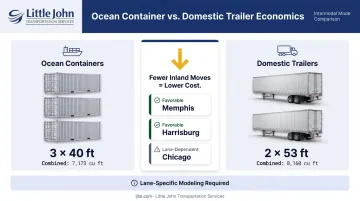
KPIs affected: Transportation cost per load, total inland moves, load utilization rate, cost per unit of imported goods.
Supply Chain Flexibility and Routing Control
Without transloading, a container's destination is committed before the goods leave the origin port — weeks before demand conditions are known. Transloading changes that. Once freight arrives at the facility, it can be sorted, split, and loaded into separate outbound loads for different distribution centers or customers, letting shippers respond to real-time inventory signals before executing the last mile.
Inventory imbalances are expensive. McKinsey reported approximately $740 billion in unsold U.S. retail goods in May 2023, following a period of rigid pre-committed routing that left some DCs overstocked while others ran short. Secondary correction moves compound cost across shipments.
For cross-border freight, the routing flexibility advantage is more concentrated. Trucks carried 73.6% of 2025 U.S.–Mexico freight value, with Laredo alone handling $296.245 billion in truck freight — making it the dominant gateway for domestic re-allocation of Mexican and cross-border imports.
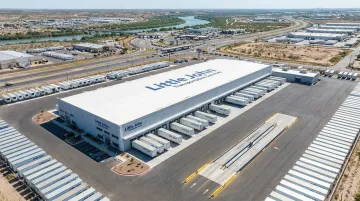
Little John Transportation Services operates a 50-acre CTPAT-compliant facility in Laredo with a 30-bay cross-dock and 1,200 trailer-space staging capacity. Teams and customs brokerage capabilities are positioned on both sides of the border, so inbound loads can be sorted and re-allocated across multiple inland destinations without moving the original international container further into the domestic network. One accountable operation handles it all.
KPIs affected: Inventory distribution accuracy, order fulfillment speed, number of post-departure destination changes, supply chain responsiveness.
Highest impact for: Multi-DC shippers, cross-border freight from Mexico or Canada, and peak seasons where destination allocation needs to stay flexible late in the transit window.
Demurrage, Detention, and Compliance Risk Reduction
Demurrage and detention are among the fastest-growing accessorial costs in freight. Nine FMC-monitored carriers collected approximately $15.4 billion in detention and demurrage fees from April 2020 through March 2025, with Q4 2024 billed amounts still running 85% above Q2 2020 levels — a sustained increase, not a pandemic anomaly.
Transloading addresses this directly. Unloading the ocean container at a nearby facility and returning it to the terminal promptly keeps it out of the inland network, where dwell time accumulates. Port Houston's Tariff No. 15 allows seven free days for loaded imports; after that, demurrage runs $34.25/day for 20-foot containers and $68.48/day for 40-foot-or-longer equipment. At congested ports, those charges start accruing before the container clears the terminal area.
Beyond cost, there's a compliance dimension that shippers moving regulated freight can't afford to ignore. At a transloading handoff point, chain-of-custody integrity either holds or it doesn't. CBP's CTPAT security criteria govern how partners are vetted, how conveyances are inspected, how seals are controlled, and how manifests and piece counts are documented — all of which apply directly at a transloading facility.
Little John holds CTPAT validation, FAST certification, TWIC credentials, and an FMCSA Hazardous Materials Safety Permit held by fewer than 1% of U.S. motor carriers. At the Laredo facility, those credentials translate into physical controls:
- Restricted perimeter access with full-coverage video surveillance
- 24/7 monitored entrances and ISO 9001:2015-audited documentation processes
- Documented chain-of-custody at every handoff point
For hazmat, bonded cargo, or any freight where chain-of-custody cannot have gaps, this infrastructure matters at every transfer point.
KPIs affected: Demurrage and detention charges per shipment, container dwell time, compliance incident rate, cargo claim rate.
What Happens When Transloading Is Ignored or Mismanaged
Skipping transloading or using an unqualified provider creates a predictable set of problems:
- International containers moving deep inland stay in carrier possession longer, generating demurrage and detention charges that compound fast — especially at congested ports
- Receiving bottlenecks at the DC — floor-loaded, unpalletized freight creates labor inefficiencies and elevated damage rates. NIOSH recommends palletized arrival wherever feasible to reduce ergonomic risk and handling delays
- Shippers locked into pre-committed routing miss demand shifts, leaving overstocked locations that require costly secondary moves to correct
- Compliance exposure — Unverified handoff points for hazmat, cross-border, or high-value cargo create gaps in chain-of-custody documentation, exposing shippers to regulatory penalties and potential loss of CTPAT status
- Structural cost accumulation — unplanned accessorial charges, re-routing costs, and reactive labor stack up as import volume grows, turning a simple avoidance decision into a recurring cost problem
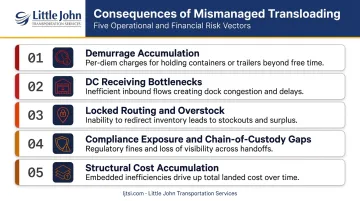
The Chicago case study cited earlier is a useful counterpoint: intact movement can still be cheaper than transloading in specific lanes where carrier pricing favors returned boxes. The real failure mode is skipping the lane-by-lane analysis and defaulting to one approach without running the numbers.
How to Get the Most Value from Container Transloading
Transloading delivers its full value only when it's integrated into the shipment plan before goods leave the origin port — not treated as a reactive fix when problems arise at the terminal.
Before the vessel arrives:
- Test cube and weight against domestic equipment specifications for each lane
- Compare full intact-container versus transload economics per corridor
- Reserve drayage, labor, door appointments, and domestic equipment in advance
- Set palletization and packing standards at origin so the transloading facility can execute without delays on arrival
Provider Selection
Provider selection is where outcomes are determined. Look for a partner with:
- Facilities or positioned teams near the relevant port, border crossing, or rail ramp
- Verifiable compliance credentials matched to the freight profile (CTPAT, TWIC, hazmat endorsements, FAST)
- In-house customs brokerage on both sides of the border for cross-border freight
- Integrated drayage, warehousing, and outbound trucking so handoffs don't become exception management exercises
That's the model Little John Transportation Services runs in practice — teams positioned at Laredo, Houston, and Memphis, with bilingual operations in Monterrey and Guadalajara. The Laredo facility's 30-bay cross-dock handles high-volume transloading and cargo consolidation. The custom-built 120-ton bridge crane manages superload transfers, completing heavy-haul transloads in under two hours to minimize dwell time for time-sensitive project freight.
Track Performance Consistently
Monitor container dwell time, demurrage charges, and load utilization before and after implementing a transloading program. The Cambridge corridor study supports lane-specific modeling; FMC fee data drives strict time controls. Without closing the measurement loop, there's no way to quantify improvements or refine the program over time.
Conclusion
Container transloading delivers value across three measurable areas:
- Lower cost per inland move through freight consolidation at port or rail
- Greater routing control through flexible mid-journey allocation
- Reduced accessorial and compliance exposure through disciplined container return and certified handling
These advantages grow with volume and consistency. A transloading program applied to every qualifying import shipment delivers more measurable impact than one used reactively — making it an ongoing operational discipline, not a contingency measure.
Who executes the transloading matters as much as whether it gets used. Shippers moving regulated, time-sensitive, or high-value freight need a partner with people physically positioned at the points where cargo transfers — and compliance credentials that hold up to regulatory scrutiny. That means CTPAT validation, certified hazmat handling, and the cross-border infrastructure to support full-spectrum freight without handoff gaps.
Frequently Asked Questions
What is container transloading?
Container transloading is the physical transfer of freight from an international ocean container into domestic transportation equipment (such as a 53-foot trailer or domestic rail container) at a facility near a port or border crossing. This moves freight through the inland distribution network using equipment purpose-built for domestic lanes.
What are the different types of transloading?
The main transfer types are ocean container to domestic truck (most common for imports), rail to truck, truck to rail, and truck to truck. The type depends on the shipment's mode combination and how freight needs to be distributed inland.
How is container transloading different from intermodal shipping?
In intermodal shipping, cargo stays in the same container as it moves across multiple transportation modes. In transloading, cargo is physically unloaded from one container and reloaded into different domestic equipment. Transloading offers more flexibility over routing and load configuration but requires additional handling at the transfer point.
What types of freight benefit most from container transloading?
Floor-loaded consumer goods (apparel, electronics, appliances, furniture) gain the most from consolidation into larger domestic equipment. High-volume retail imports, freight bound for multiple distribution centers, and regulated shipments requiring certified handling and chain-of-custody documentation at the transfer point all benefit as well.
How does transloading help avoid demurrage and detention fees?
By unloading the ocean container at a transloading facility near the port and returning it to the terminal promptly, shippers avoid the fees that accumulate when containers sit idle at terminals or travel inland before being emptied. The container never enters the inland network, eliminating the main driver of both demurrage and detention charges.
What should I look for in a container transloading service provider?
Prioritize providers with teams positioned near relevant ports, border crossings, or rail ramps, along with compliance credentials matched to your freight type (CTPAT, TWIC, hazmat endorsements). Providers that integrate transloading with drayage and inland transportation keep handoffs within a single accountable operation — reducing the risk of gaps between disconnected vendors.