The concept is straightforward: a driver arrives at a facility, drops a loaded trailer, and immediately hooks to a pre-staged trailer — all without touching the cargo. No waiting at the dock while warehouse crews work through a load. No scheduling bottlenecks. The driver is back on the road in under an hour.
This guide breaks down exactly what drop and hook is, how each stage of the process works, how it compares to live loading, and how to determine whether it's the right model for your freight.
Key Takeaways
- Drop and hook means a driver swaps trailers at a facility without waiting for loading or unloading — typically completed in 30 to 60 minutes
- Also called "drop and pick," it works best for dry van and refrigerated freight at high-volume facilities with an active trailer pool
- Live loads can take two hours or more, driving detention costs for both carriers and shippers
- Flatbed, oversized, and hazmat freight often require live loads with driver oversight
- Facilities need sufficient yard space and a staged trailer pool for drop and hook to work as designed
What Is Drop and Hook Trucking?
Drop and hook is a freight transfer method where a driver arrives at a facility, disconnects their loaded trailer, and immediately connects to a pre-staged trailer — either loaded for the next run or empty for pickup at the next shipper. The driver has zero involvement in loading or unloading cargo.
The operational problem it solves is straightforward: traditional live-load processes forced drivers to sit idle at docks for hours while warehouse staff worked through unloading and reloading. That waiting burned driver hours, reduced daily miles, and created scheduling bottlenecks for shippers managing dock labor and appointment windows.
What Drop and Hook Is NOT
A few terms get conflated with drop and hook. Here's how they differ:
- Drop and hook involves over-the-road trailers, not rail or ocean containers — it's not intermodal container swapping
- Relay trucking swaps drivers mid-route; drop and hook swaps trailers at a facility
- It's a freight transfer method, not a contract structure — don't confuse it with dedicated fleet arrangements
Alternate Names for the Same Process
Shippers and drivers use several terms interchangeably:
- Drop and pick — DAT explicitly uses this term as a synonym
- Drop and hook freight — refers to freight handled through the trailer-exchange method
- No-touch freight — the driver doesn't physically handle cargo (though technically, a live load can also be no-touch if facility employees handle the freight)
The core concept is consistent across all three names. Execution varies by assignment: some facilities have a pre-loaded replacement trailer on-site; others send the driver to pick up an empty trailer at the next shipper. The specifics are defined in the load tender.
How Does Drop and Hook Trucking Work?
Drop and hook follows a three-stage sequence: drop the loaded trailer, hook a pre-staged one, and move. Each stage depends on coordination between the carrier, driver, and facility — when that alignment breaks down, the time savings disappear.
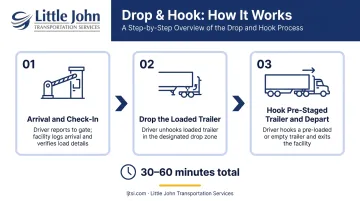
Arrival and Scheduling Window
Unlike live loads with tight appointment windows, drop and hook facilities typically give drivers a broader arrival window. The driver's obligation is to deliver the trailer — not to wait for unloading to complete.
On arrival, the driver checks in at the gate, confirms the designated drop location in the yard, and positions the trailer in the assigned slot. Dispatch coordinates this ahead of time with the facility team.
Dropping the Loaded Trailer
The physical drop process involves:
- Set trailer brakes and chock wheels if required
- Disconnect air and electrical lines
- Release the fifth wheel kingpin to separate the tractor from the trailer
At that point, the driver walks away. The facility handles unloading on its own schedule, decoupling dock labor management from driver arrival times. That's the core operational advantage for shippers.
Hooking Up the Next Trailer
The driver locates the pre-staged trailer, backs the tractor under it, locks the fifth wheel, reconnects air and electrical, and performs a pre-trip inspection before departing.
This is where complications tend to arise:
- The replacement trailer may be inaccessible behind other units
- The facility may need a spotter truck to reposition it
- The trailer may have equipment discrepancies the driver needs to document
One point that matters legally: regardless of who loaded the trailer, the driver is accountable for ensuring weight and securement comply with DOT regulations before pulling out. Under 49 CFR 392.9, a driver may not operate unless cargo is properly distributed and adequately secured. The rule creates no exception because another party loaded the trailer.
The driver must also review any prior Driver Vehicle Inspection Report (DVIR) per 49 CFR 396.13 before departing.
Drop and Hook vs. Live Load Trucking
In a live load, the driver backs into a loading dock and remains on-site while warehouse staff physically load or unload the trailer. The driver cannot leave until the work is complete.
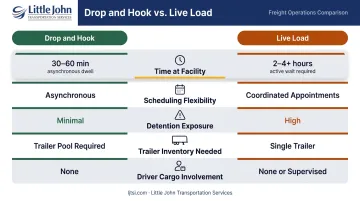
Here's how the two methods compare across the dimensions that matter most:
| Factor | Drop and Hook | Live Load |
|---|---|---|
| Time at facility | 30–60 minutes | 2–4+ hours |
| Scheduling flexibility | Asynchronous — driver and facility work independently | Requires coordinated appointment windows |
| Detention exposure | Minimal to none | High — delays generate detention pay liability |
| Trailer inventory required | Multiple trailers pre-staged in yard | One trailer processed at a time |
| Driver cargo involvement | None | None (if no-touch) or supervised |
The Detention Problem Live Loads Create
ATRI's 2024 research using 2023 operating data found that drivers experienced detention at 39.3% of stops, losing between 117 and 209 hours per year depending on sector. For-hire trucking lost more than 135 million driver-productivity hours in 2023 — $3.6 billion in direct expenses and $11.5 billion in lost productivity industrywide.
Drop and hook doesn't eliminate detention entirely. But it removes the primary cause: waiting for a single trailer to be loaded or unloaded before a driver can depart.
The Infrastructure Tradeoff
Live loads require less trailer inventory — the facility processes one load at a time using the arriving trailer. Drop and hook requires a shipper or carrier to maintain an available pool of trailers in the yard continuously.
That's a real operational cost. Shippers evaluating drop and hook need to account for trailer availability, yard space, and the operational planning to keep that pool stocked — especially during peak seasons.
When Live Loads Remain the Better Option
Drop and hook doesn't work for every freight type or facility. Live loads are often the practical or required choice for:
- Flatbed freight where the driver is involved in tarping and securement
- Oversized or heavy-haul cargo requiring on-site compliance oversight
- Hazmat freight subject to attendance requirements under 49 CFR 397.5
- Facilities without sufficient yard space or trailer pool to support the model
Benefits and Challenges of Drop and Hook Trucking
Benefits
For drivers, the primary gains are time and miles:
- More road time per day, which translates directly to higher per-mile earnings
- Reduced exposure to unpaid waiting time at facilities
- Less stress from dock congestion and scheduling uncertainty
For shippers and distribution operations, the advantages show up at scale:
- Drivers cycle in and out without tying up dock doors, increasing throughput
- No driver waiting means no detention clock — and no detention liability
- Warehouse labor works independently of driver arrival windows, giving schedulers more control
- Multiple drops can be processed without stacking drivers at the gate
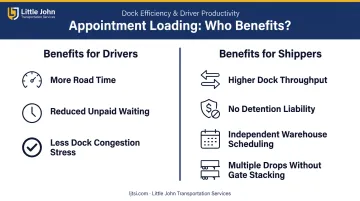
That decoupling of driver arrival from warehouse activity is what makes the model scale.
Challenges
The model has limitations that both drivers and shippers need to manage:
For drivers:
- Replacement trailers buried behind other units in a disorganized yard
- Mechanical issues or unclear documentation on a pre-staged trailer discovered at pickup
- Compliance risk when facility staff loaded the trailer without driver verification of weight or securement
For shippers and carriers:
- Maintaining an adequate trailer pool is an ongoing operational cost — without enough trailers in the yard, drivers end up waiting anyway
- Facilities with limited yard space or inconsistent inbound volumes may find live loads more practical
- Carriers often require trailer-interchange coverage — a trailer left in another party's yard is at risk during yard-tractor handling
Is Drop and Hook the Right Fit for Your Freight?
Freight Type Criteria
Drop and hook is best suited for:
- Dry van freight — general commodities that can be pre-staged in an enclosed trailer
- Temperature-controlled (reefer) freight — pre-loaded and sealed units that don't require driver oversight
It's generally not appropriate for:
- Flatbed and open-deck loads requiring driver-involved securement and tarping
- Oversized or heavy-haul shipments with specialized compliance requirements
- Hazardous materials freight where attendance rules or security plans govern each transfer point
Facility and Volume Criteria
Drop and hook makes operational sense when a facility:
- Moves enough freight daily to justify keeping multiple trailers pre-staged
- Has yard space to manage a trailer pool without blocking access
- Has warehouse labor that operates independently of driver arrival schedules
- Can provide or rent a yard spotter truck to reposition trailers between dock doors and staging areas
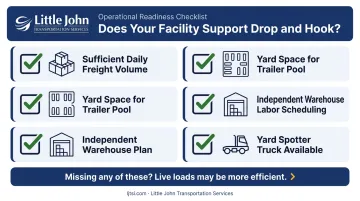
If any of these conditions are missing, live loads are often more efficient — a half-empty trailer pool creates waiting time that defeats the purpose of the model.
Choosing a Carrier Partner for Drop and Hook at Scale
For shippers with high-volume, time-sensitive freight across automotive, retail, consumer goods, and industrial manufacturing, the carrier you choose matters as much as the model itself. Four questions worth asking before committing to a program:
- Does the carrier have enough trailer units to cover your volume and seasonal swings without gaps?
- Is dispatch reachable around the clock when a pre-staged trailer has a problem?
- Can the carrier produce audit-ready paperwork for each trailer exchange?
- What happens to your freight when volume spikes beyond the dedicated pool?
Little John Transportation Services offers drop trailer and dedicated fleet programs as part of a broader specialized freight network built over 30+ years. With a 50-acre CTPAT-compliant Laredo facility, 24/7 bilingual dispatch, and confirmed partnerships with Honda and Whirlpool, they support continuous operations across the U.S.–Mexico corridor. Pool configurations are sized to individual shipper volume and seasonal demand — with audit-ready documentation at every trailer exchange.
Frequently Asked Questions
What does drop and hook mean in trucking?
Drop and hook means a truck driver delivers a loaded trailer to a facility and immediately hooks to a pre-staged trailer — either loaded or empty — without waiting for the facility to load or unload cargo. The driver handles zero cargo; the facility manages all loading and unloading on its own schedule.
How long does a drop and hook typically take?
According to DAT, drop and hook wait times average less than one hour when the yard is organized and the replacement trailer is accessible. A live load, by comparison, takes around two hours in most cases, with some stretching to three or four hours.
What is the difference between drop and hook and live load?
In a live load, the driver waits on-site while warehouse staff load or unload the trailer — the driver cannot leave until that work is complete. Drop and hook lets the driver swap trailers and return to the road immediately, with the facility handling cargo on its own schedule.
What types of freight are best suited for drop and hook?
Dry van and refrigerated shipments are the best fit. Flatbed, oversized, and specialized or hazmat freight typically require live loads with driver oversight and tighter compliance coordination at each transfer point.
Do drivers get paid more for drop and hook loads?
Drop and hook typically allows drivers to accumulate more miles per day, which translates to higher per-mile earnings. It also reduces unpaid waiting time. Specific rate structures vary by carrier and load assignment.
What equipment does a facility need to support drop and hook?
A facility needs adequate yard space, a trailer pool (owned, leased, or provided by the carrier), and a yard spotter truck (also called a yard dog) to reposition trailers between staging areas and dock doors. Without a spotter, the facility depends on the over-the-road driver to move trailers — which defeats the purpose of the model.