For logistics managers and supply chain directors evaluating how to structure their freight networks, two models keep coming up: dedicated freight and managed transportation. They're often confused, occasionally conflated, and almost always serve different strategic purposes.
This guide covers the structural differences between both models, how their cost structures work, which freight types belong in each, and a practical framework for deciding — including when combining both makes the most sense.
Key Takeaways
- Dedicated freight reserves contracted trucks and drivers exclusively for your lanes — best for high-volume, predictable lanes and specialized cargo
- Managed transportation outsources full network oversight to a third party through a multi-carrier approach, built for complex, multi-lane networks
- Cost structures differ fundamentally: dedicated is largely fixed; managed transportation scales with freight activity
- Specialized cargo (hazmat, heavy-haul, cross-border) often requires dedicated freight with verified certifications — not all providers qualify
- Many enterprise shippers run both: dedicated for core lanes, managed for overflow and secondary lanes
Dedicated Freight vs. Managed Transportation: At a Glance
| Dimension | Dedicated Freight | Managed Transportation |
|---|---|---|
| Model Type | Asset-based, contracted fleet | Non-asset, outsourced network management |
| Cost Structure | Fixed (reserved capacity regardless of daily volume) | Variable (tied to transaction volume or management fee) |
| Carrier Relationship | Provider owns/manages equipment and drivers | Shipper owns carrier contracts; provider manages them |
| Best For | High-volume, consistent, specialized lanes | Multi-lane, multi-mode, complex networks |
| Flexibility | Lower — capacity is committed in advance | Higher — scales with demand fluctuations |
| Compliance Ownership | Provider holds certifications (hazmat, permits, etc.) | Shipper/provider share depending on contract structure |
| Ideal Freight Type | Hazmat, oversized, JIT, cross-border | Retail, CPG, industrial — broad distribution networks |
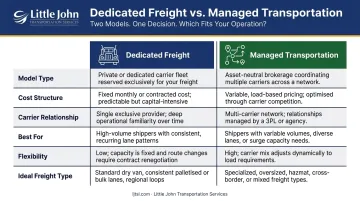
The right choice depends on shipment volume, freight complexity, regulatory requirements, and your internal logistics capacity.
For specialized freight — hazmat, oversized loads, U.S.–México cross-border — dedicated freight with verified certifications is the baseline requirement, not a preference. Carrier qualification depth matters here in ways that standard dry van lanes simply don't demand.
What Is Dedicated Freight?
Dedicated freight (formally called Dedicated Contract Carriage, or DCC) is a contractual arrangement where trucks and drivers are reserved exclusively for one shipper's routes or lanes under a long-term agreement. Armstrong & Associates estimates the U.S. DCC market at $32.0 billion in gross revenue for 2025 — a scale that reflects how deeply embedded dedicated capacity has become in North American supply chains.
This is distinct from spot market trucking, where you're competing for available capacity at market rates, and from standard freight brokerage, where a broker matches individual shipments to available carriers. In dedicated freight, the capacity is yours — contracted, committed, and consistently operated.
How the Operational Structure Works
DCC providers supply the drivers, equipment, and fleet management personnel. Agreements typically run one to seven years. The operational structure typically includes:
- Specialized routing schedules built around your distribution centers or plant locations
- Driver management programs with assigned operators who know your freight, your docks, and your timing requirements
- Equipment configured for your specific cargo type — flatbed, step-deck, RGN, reefer, hazmat-compliant trailers
- Performance reporting and KPI tracking tied to your operational metrics
Predictable capacity follows — even when the broader market tightens. That predictability has a cost structure attached to it: regional dedicated fleets should target no more than 10–20% empty miles to remain cost-effective, which means the model works best on lanes with consistent, high-density freight flows.
How Pricing Works — and the Core Trade-Off
Dedicated freight operates on fixed-cost pricing. You pay for reserved capacity — equipment, drivers, and management — regardless of whether every load runs on a given day. For time-sensitive or compliance-intensive freight, that stability is worth paying for.
The trade-off: you need consistent freight volume to justify the commitment. If your lanes are irregular or seasonal, you may end up paying for capacity you're not using. Managed transportation or spot market capacity tends to be the better fit in those cases.
Where Dedicated Freight Earns Its Premium
Dedicated freight makes the most sense when compliance, equipment specialization, or driver continuity are non-negotiable — not just operationally convenient. The clearest triggers:
The certification depth required for these moves matters more than most shippers realize until a carrier can't perform. Little John Transportation Services, for example, maintains 100% hazmat endorsement across all nine hazard classes for every operator in their network — not as a subset, but as a baseline standard.
Industries Where Dedicated Freight Is the Clear Fit
- Energy and oilfield: Drilling rig moves, frac tanks, and superload permits — freight that requires multi-axle configurations and state-by-state route engineering
- Chemical and petrochemical: Bulk liquid transport and hazmat compliance across multiple classes with audit-ready chain-of-custody documentation
- Automotive OEM and Tier-1: Stamping dies, assembly robots, and sequenced JIT parts where a missed delivery shuts down a line, not just delays it
- U.S.–México cross-border: CTPAT-validated carriers, bilingual dispatch, and mirror fleet operations on both sides of the border
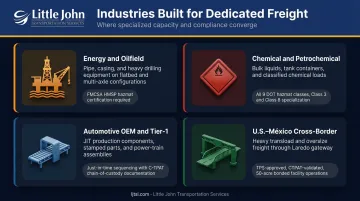
PHMSA data shows approximately 3.3 billion tons of hazardous materials move through U.S. transportation annually — roughly 12% of total freight tonnage. For shippers operating in that space, the carrier's certification depth isn't a secondary consideration; it determines whether a move can happen at all.
What Is Managed Transportation?
Managed Transportation Services (MTS) is a logistics model where a third-party provider — typically a non-asset-based 3PL — takes over planning, execution, carrier selection, route optimization, and reporting for a shipper's entire freight network. The shipper retains strategic oversight; the provider handles day-to-day operations.
Armstrong & Associates defines managed transportation as occurring when a non-asset-based 3PL uses a systems-based TMS and automation to manage transportation between shippers and carriers, including planning, carrier selection, tendering, and routing.
Core Operational Components
A true managed transportation arrangement typically includes:
- Carrier network management — maintaining and optimizing a portfolio of carriers across modes and regions
- Shipment tendering — typically via a waterfall process (primary carrier → backup carriers in sequence)
- TMS integration — Transportation Management System for planning, routing, and visibility
- Freight audit and payment — validating carrier invoices and managing payment processes
- KPI tracking and reporting — continuous performance measurement and improvement cycles
This is different from freight brokerage. A broker matches individual shipments to carriers on a transactional basis. Managed transportation covers your entire network — strategy, execution, and optimization — as an ongoing operational function.
How Pricing Works
MTS pricing is typically variable — tied to transaction volume or structured as a management fee. This gives shippers cost flexibility during demand fluctuations, which matters for operations with seasonal or unpredictable volume patterns.
One key distinction from brokerage: in true managed transportation, the shipper owns the carrier contracts. The provider manages them on the shipper's behalf. In freight brokerage, the broker holds the contracts and earns a margin on rate spreads. That difference has direct implications for cost transparency and long-term carrier relationship ownership.
Use Cases for Managed Transportation
Managed transportation outperforms when:
- Network complexity is high — multiple lanes, multiple carriers, multiple modes that are difficult to manage internally
- Internal logistics capacity is limited — companies without a fully staffed transportation department benefit from outsourcing planning and execution
- Scaling into new regions — a managed provider brings pre-established carrier relationships without requiring the shipper to build them from scratch
- Data visibility and procurement leverage are priorities — TMS-driven analytics identify consolidation opportunities, carrier performance gaps, and cost reduction levers
Two provider-reported examples show what well-structured managed transportation can produce:
- Global CPG producer (Uber Freight): Centralized inbound, transfer, and outbound North American transportation — more than 100% first-year ROI, on-time performance reaching 97% within two years, and $25M in savings from dedicated-fleet projects within the managed program
- Pet products retailer (1,650+ U.S. and Canadian stores): $4.1M in outbound savings year-to-date and a 10% increase in truck utilization
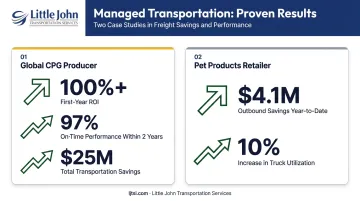
These are program-specific figures, not universal benchmarks — but they reflect the scale of improvement achievable when the model is executed well.
Dedicated Freight vs. Managed Transportation: Which Model Is Right for You?
The decision comes down to four variables:
- Freight volume consistency on specific lanes — Do you move predictable, high-frequency volume on defined routes, or does volume fluctuate significantly?
- Cargo type and regulatory requirements — Does your freight require specific certifications, equipment, or compliance documentation?
- Network complexity — Are you managing 3 lanes or 30? One mode or five?
- Internal logistics capacity — Do you have a team capable of managing carrier relationships and network optimization, or would outsourcing that function create more value?
Clear Situational Guidance
Choose dedicated freight if:
- You run high-volume, consistent lanes where capacity predictability is non-negotiable
- Your cargo requires specific equipment, hazmat certification, oversized permits, or cross-border compliance
- Driver continuity matters — your freight has specific handling requirements or your operations depend on time-definite windows
Choose managed transportation if:
- You operate a complex, multi-lane network across multiple carriers and modes
- You want network-wide visibility, consolidated reporting, and procurement leverage without building an internal transportation management function
- Your volume fluctuates enough that committing to fixed dedicated capacity would create waste
The Hybrid Model Most Enterprise Shippers Use
Many large shippers don't choose one model exclusively. The practical approach: dedicated fleets handle core, high-volume lanes with predictable demand and specialized requirements; managed transportation oversees the remaining carrier network.
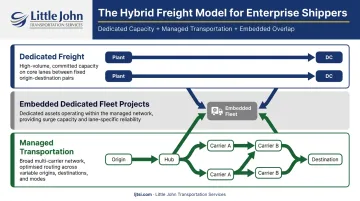
This balances guaranteed capacity where you need it most with flexibility and cost optimization across the broader network. In practice, dedicated-fleet projects are commonly embedded within a larger managed transportation program — the two models complement each other rather than compete.
A Scenario Worth Walking Through
Consider a chemical manufacturer running spot market trucking for their hazmat lanes. Capacity is inconsistent, carrier qualification verification happens shipment by shipment, and compliance documentation is reactive.
The operational risk is real — not just delivery failures, but regulatory exposure when a carrier's hazmat credentials lapse mid-contract.
The fix involves two layers:
- Transition core hazmat and heavy-haul lanes to a dedicated freight provider with HMSP certification and 100% hazmat-endorsed drivers
- Add managed transportation for the broader dry van and regional network, where dedicated capacity isn't justified
The result: fewer carrier compliance failures on specialized lanes, improved on-time performance, and a consolidated view of the full network instead of fragmented carrier management.
If your freight involves hazmat, heavy-haul, or cross-border moves — where carrier qualification isn't optional — Little John Transportation Services handles exactly this work. With 30+ years of experience, FMCSA HMSP certification, and 65,000+ vetted carriers, we can help you structure the dedicated freight side of your network. Reach out at quotes@ljtsi.com or call +1 (479) 264-6501.
Conclusion
There's no universal winner between dedicated freight and managed transportation — the right answer depends on what your freight actually demands.
Dedicated freight wins on reliability, compliance depth, and control for specialized, high-frequency lanes. Managed transportation wins on flexibility, network optimization, and cost scalability for complex, multi-carrier operations.
For most enterprise shippers, the real question isn't which model to use — it's which lanes belong in each. High-volume, specialized routes with compliance requirements belong in dedicated freight. Complex, variable distribution networks benefit from managed transportation's planning and procurement infrastructure.
Assign each lane to the model it's built for, and both capacity predictability and cost control follow. For specialized lanes involving hazmat compliance, heavy equipment, or cross-border requirements, carriers like Little John Transportation Services are built specifically for that work — with the certifications, equipment, and operator network to back it up.
Frequently Asked Questions
What does "dedicated freight" mean?
Dedicated freight refers to a contracted arrangement where trucks and drivers are exclusively reserved for one shipper's routes or lanes under a long-term agreement. Unlike spot market or shared carrier capacity, dedicated freight guarantees the same equipment and drivers on your lanes, regardless of broader market conditions.
What is the difference between TMS and FMS?
A TMS (Transportation Management System) is software used to plan, execute, and optimize freight shipments — covering route analysis, load planning, carrier selection, and tendering. An FMS (Freight Management System) is a narrower tool focused on freight booking, invoicing, documentation, and tracking. In practice, TMS is the more widely used term in shipper and carrier contexts.
What is the difference between freight forwarding and managed transportation?
Freight forwarding coordinates the international movement of goods across carriers and customs, typically for cross-border or ocean/air shipments. Managed transportation is a broader outsourcing model where a 3PL handles all transportation planning, execution, and network optimization — covering domestic and cross-border operations as an ongoing function, not a single shipment transaction.
What types of freight are best suited for dedicated transportation?
Dedicated freight fits high-volume, time-sensitive, or heavily regulated cargo. That includes hazmat shipments, oversized and heavy-haul loads, automotive JIT lanes, and regular cross-border routes where compliance depth, specialized equipment, and consistent driver relationships are non-negotiable.
Can a company use both dedicated freight and managed transportation at the same time?
Yes — many enterprise shippers run a hybrid model. Dedicated fleets cover high-volume or specialized core lanes; managed transportation oversees the broader carrier network. This combination delivers capacity reliability where it matters most while maintaining flexibility and cost optimization across the full network.
How do I choose between dedicated freight and managed transportation?
Start with four factors: volume consistency on key lanes, cargo type and regulatory requirements, network complexity, and your internal logistics capacity. Dedicated freight suits predictable, compliance-intensive operations; managed transportation fits multi-lane networks where centralized planning and carrier procurement drive down costs.