Introduction
The pharmaceutical pipeline has changed dramatically. According to IQVIA, cold-chain medicines grew at a 13% CAGR from 2017 to 2022 — more than double the 6% rate for the overall medicine market — driven by biologics, mRNA therapies, and cell and gene therapies that all require strict temperature control to remain viable. By 2021, cold-chain medicines represented $384 billion, or 32% of the global medicine market (excluding vaccines).
At that scale, a single logistics failure carries serious consequences: drugs that degrade silently, regulatory holds that interrupt supply, and product losses reaching into the millions per shipment. Most discussions focus on the hardware — sensors, packaging, reefer trailers. What gets less attention is what those systems are actually protecting against.
This article covers the three core operational advantages of pharmaceutical cold chain logistics — product integrity, regulatory compliance, and financial risk reduction — along with what goes wrong when it's handled poorly and how to identify a logistics partner capable of holding the chain together.
Key Takeaways
- Cold-chain medicines are growing at twice the rate of the overall pharmaceutical market, which means temperature-controlled logistics now carries direct revenue and patient-safety implications
- Temperature excursions can degrade drugs with no visible signs — compromised product can reach patients undetected
- Cold chain logistics delivers three core advantages: product integrity, regulatory compliance, and financial risk reduction
- Cold chain failures create compounding costs: product loss, regulatory investigation, recalls, and supply gaps
- Carrier selection matters more than equipment choice — it's where the real value or risk in a cold chain program is determined
What Is Cold Chain Logistics in Pharmaceuticals?
Cold chain logistics is the end-to-end management of temperature-sensitive pharmaceutical products through a controlled environment — from manufacturer to patient — with no excursion from required temperature ranges at any handoff, storage point, or transit leg.
It applies across a wide range of product types, each with distinct infrastructure requirements:
| Product Type | Typical Temperature Range |
|---|---|
| Vaccines and most biologics | 2°C–8°C (refrigerated) |
| Certain biologics and frozen products | -20°C |
| mRNA vaccines and therapies | -80°C to -60°C (ultra-cold) |
| Ambient-sensitive oral pharmaceuticals | 15°C–25°C (controlled room temperature) |
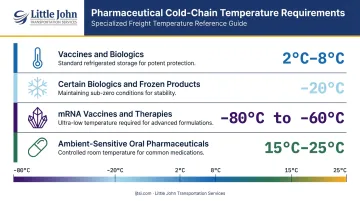
The specific required range is determined by the product label and manufacturer stability data — not by category alone. WHO and USP both define storage and transport conditions on a product-specific basis.
Those regulatory requirements have direct operational consequences. Every mile of the supply chain must maintain those conditions — because a single excursion can compromise product potency, trigger a regulatory violation, and put patients at risk at the same time.
Key Advantages of Cold Chain Logistics in Pharmaceuticals
The advantages below focus on measurable, operational impact — each tied to outcomes pharmaceutical companies and their logistics partners actively track.
Advantage 1: Product Integrity Protection
Product integrity means a pharmaceutical compound arrives with the same potency, stability, and safety profile it had when it left the manufacturer. Cold chain logistics is the primary mechanism for achieving that.
In practice, it does this through:
- Continuous IoT-based temperature monitoring that generates timestamped data at every transit stage
- Validated packaging that maintains required ranges through delays, transfers, and ambient temperature swings
- Pre-qualified lanes that account for seasonal variance and route-specific exposure risk
- Documented handoff protocols at every transfer point to eliminate gaps in custody
The risk cold chain logistics addresses is not always visible. A 2024 peer-reviewed review published in PMC confirms that temperature breaches can cause loss of potency or stability and may compromise patient treatment — with no outward sign of damage. A degraded vaccine or biologic can pass visual inspection and still deliver reduced or zero therapeutic effect.
The patient safety consequences are documented. In 2021, Sandoz recalled a lot of Enoxaparin Sodium Injection after a shipping temperature excursion that the FDA stated may have significantly affected effectiveness — with potential consequences including thrombosis, stroke, and pulmonary embolism. That same year, Novo Nordisk recalled 1,468 samples across five insulin and GLP-1 products after storage below 32°F, with FDA citing potential hyperglycemia or hypoglycemia as patient-level risks.
Neither recall had reported adverse events at announcement. That's the nature of cold chain failures: the risk exists before anyone knows the product is compromised.
KPIs this affects: product spoilage rate, temperature excursion frequency, batch rejection rate, on-time delivery of intact product, patient safety incident rate linked to product quality.
This advantage is highest-stakes for biologics, vaccines, cell and gene therapies, and any product moving across multiple climate zones or international borders — where ambient temperature variance is unpredictable and transit windows can stretch across days or weeks. Those same conditions are precisely where regulatory scrutiny intensifies.
Advantage 2: Regulatory Compliance and Audit Readiness
Pharmaceutical cold chain logistics operates within a tightly governed regulatory framework. Compliance is not optional: it's the condition under which products can be sold, distributed, and imported.
Key frameworks include:
- WHO GDP (TRS 961 Annex 9) — requires temperature mapping, continuous monitoring, documented excursion handling, and transport qualification
- FDA 21 CFR Part 211 — mandates appropriate warehousing and transport conditions and stability testing to support storage requirements
- EU GDP Guidelines (2013/C 343/01) — covers thermal mapping, calibrated monitoring, qualified vehicles, and seasonal transport risk assessment
- Mexico NOM-059-SSA1-2015 and NOM-073-SSA1-2015 — require qualified thermal equipment, continuous monitoring, route risk assessment, and documented excursion records
- DSCSA — addresses electronic serialization and traceability for prescription drugs (separate from thermal control requirements, but complementary)
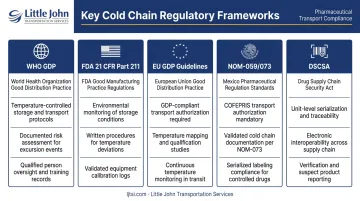
Cold chain logistics creates audit readiness through four operational layers:
- Continuous, timestamped temperature logs at every transit stage
- Chain-of-custody documentation at each handoff point
- End-to-end traceability from batch number to delivery confirmation
- Carriers and facilities that hold validated, audit-ready records
The compliance gap matters commercially, not just legally. A logistics partner without proper documentation can trigger a batch hold, customs seizure, or import rejection at the point of entry — creating supply gaps that affect patient access and generate significant revenue disruption. Audit-ready documentation also accelerates regulatory submissions, speeds batch release, and reduces the internal burden of preparing compliance evidence after the fact.
KPIs this affects: regulatory inspection pass rate, documentation completeness score, customs clearance time, batch release timeline, cold chain-related deviations filed per quarter.
This advantage is especially critical for cross-border pharmaceutical shipments — particularly into the US, EU, and Mexico — and for products subject to serialization mandates under DSCSA. The financial exposure when compliance fails is what makes the next advantage equally important.
Advantage 3: Financial Risk Reduction Through Spoilage and Recall Prevention
Cold chain logistics is one of the most direct mechanisms for protecting margin.
The financial protection comes from several operational layers:
- Route optimization that reduces transit time and temperature exposure risk
- Proactive excursion alerts that allow corrective action before product is lost
- Validated packaging that provides a buffer against delays at border crossings or staging facilities
- Contingency protocols — backup carriers, rerouting options, pre-positioned teams — that prevent single-point-of-failure losses
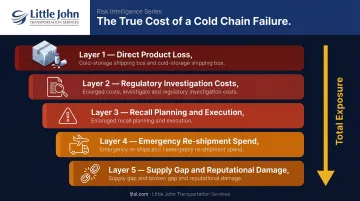
The cost of a cold chain failure is not limited to the lost batch. The full exposure includes:
- Regulatory investigation costs
- Recall planning and execution
- Reputational damage with healthcare systems and regulators
- Emergency re-shipment spend if replacement product must be expedited
- Supply gap costs if replacement product is unavailable
IQVIA data provides useful context on the financial stakes: during the pandemic-era demand shock, shipping container costs increased 400–500% and transportation costs 100–200%. For pharmaceutical companies without validated cold chain infrastructure already in place, that cost surge hit hardest.
The industry response to these risks is measurable: the advanced therapy medicinal product market reached $6.8 billion in 2021 after a 76% CAGR from 2016 to 2021, and investment in cold chain infrastructure continues to scale in step with that product pipeline.
Companies that invest in verified cold chain infrastructure and compliant carriers reduce claims, write-offs, and emergency freight spend — cold chain logistics is a cost-containment strategy, not a compliance overhead.
KPIs this affects: total cold chain logistics cost as a percentage of goods value, claim rate per shipment, product write-off rate, recall frequency, emergency re-shipment spend, insurance premium trends.
This advantage is most tangible for high-value products — biologics, specialty drugs, CAR-T therapies — where a single shipment can represent hundreds of thousands or millions of dollars in product value.
What Happens When Cold Chain Logistics Fails
Cold chain failures are operationally deceptive. Products that experience unmonitored temperature excursions often pass visual inspection but deliver reduced or zero therapeutic effect — a risk that surfaces only after patient harm or regulatory investigation.
The compounding business consequences when cold chain logistics is poorly executed:
- Product write-offs and emergency re-shipments — immediate financial exposure, often at premium freight rates
- Regulatory holds and customs rejections — supply gaps that affect patient access and revenue
- Batch recalls affecting entire production lots — not just the compromised shipment
- Erosion of trust with health systems and regulators — a reputational cost that takes years to rebuild
The scaling problem compounds this risk. Inconsistent cold chain controls that are manageable at low shipment volumes become catastrophic as distribution networks expand across regions or international borders. What starts as an occasional process gap becomes a systemic vulnerability — one that is expensive to remediate and slow to unwind once it's embedded in an operating model.
How to Get the Most Value from Pharmaceutical Cold Chain Logistics
Pharmaceutical cold chain logistics delivers the most value when it's treated as an integrated, continuously monitored process — not a point-in-time service. Temperature visibility, documentation, and contingency protocols must operate end-to-end, not just in segments.
Carrier Selection Is Where Most of the Risk Is Locked In
The carrier selection decision determines most of the downstream value or exposure. Pharmaceutical shippers should evaluate logistics partners on:
- Verify certifications: ISO 9001:2015, GDP compliance, and CTPAT validation as baseline requirements
- Confirm chain-of-custody documentation: continuous temperature logs, pre-cool confirmation records, and audit-ready handoff paperwork
- Assess cross-border presence: physically positioned teams at key crossing points, not remote coordination
- Request claims history: documented claim-free delivery rates across pharmaceutical freight specifically
- Require bilingual capability for US-Mexico corridor shipments: customs documentation and real-time communication on both sides of the border
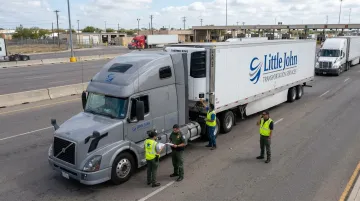
For US-Mexico corridor shipments, Little John Transportation Services positions dedicated teams in Laredo, Monterrey, and Guadalajara — directly at the crossing points where temperature excursions most often occur during customs dwell.
Their compliance infrastructure includes ISO 9001:2015 certification, CTPAT validation, and 24/7 live temperature monitoring with exception alerts. That combination of physical positioning and documented compliance is the standard pharmaceutical shippers should hold all partners to.
Make Cold Chain Performance a Managed Process
Outcomes must be reviewed regularly and acted upon:
- Temperature log audits after each shipment cycle
- Excursion trend analysis to identify recurring lane or carrier-level issues
- Carrier performance scorecards tracking claim rate, documentation completeness, and excursion frequency
- Quarterly lane reviews to adjust for seasonal variance and route risk
Carriers who can't support this review cycle aren't equipped for pharmaceutical freight — regardless of what their certifications say on paper.
Conclusion
The critical role of cold chain logistics in pharmaceuticals comes down to control, consistency, and the ability to prove — at every point in the chain — that a product was handled correctly.
These principles compound when applied consistently. Companies that build cold chain capability into their carrier selection, documentation standards, and review processes see lower claims, fewer regulatory events, and stronger supply chain resilience. Companies that treat it as a procurement line item discover the real cost only after something goes wrong — usually in the form of a recall, a failed audit, or a product that never makes it to the patient.
Cold chain logistics is an ongoing operational practice, not a one-time infrastructure decision. It requires active management at every handoff. For pharmaceutical shippers, that means working with carriers who understand GDP requirements, maintain audit-ready documentation, and treat temperature control as a non-negotiable — not an upgrade. Little John Transportation Services operates a dedicated Pharmaceutical & Life Sciences vertical built around exactly those standards, supporting cold chain freight where the handling requirements leave no room for improvisation.
Frequently Asked Questions
What temperature ranges are required for pharmaceutical cold chain logistics?
Standard pharmaceutical ranges include refrigerated (2°C–8°C for most vaccines and biologics), frozen (-20°C for certain biologics), and ultra-cold (-80°C to -60°C for mRNA vaccines and cell/gene therapies). The required range is always determined by the product label and manufacturer stability data — no single range applies universally.
What regulations govern pharmaceutical cold chain transport?
Key frameworks include WHO GDP (TRS 961 Annex 9), FDA 21 CFR Part 211, EU GDP Guidelines, and Mexico's NOM-059-SSA1-2015 and NOM-073-SSA1-2015 — all requiring documented temperature control and chain-of-custody traceability. The Drug Supply Chain Security Act (DSCSA) also applies, though it specifically governs serialization rather than thermal control.
How do cold chain failures affect pharmaceutical companies financially?
The financial impact layers quickly: direct product loss (especially high-value biologics), regulatory investigation and recall execution costs, emergency re-shipment expenses at premium freight rates, and long-term reputational cost with health authorities and hospital systems. For a single high-value shipment, total exposure can reach into the millions.
What is the difference between active and passive cold chain packaging in pharma?
Passive packaging uses insulated containers with phase change materials: no power required, best suited for shorter transit times or temperature-stable products. Active packaging uses powered refrigeration units, required for longer hauls or ultra-cold products like mRNA therapies. Selection depends on the required temperature range, transit duration, and product stability profile.
How does cross-border transport affect pharmaceutical cold chain requirements?
Cross-border shipments into the US, EU, and Mexico introduce customs dwell time and documentation review, both of which create temperature exposure risk. Managing this requires validated border protocols, in-house customs brokerage on both sides, and teams physically positioned at crossing points to contain excursion risk during delays.
What certifications should a pharmaceutical logistics carrier hold?
At minimum: ISO 9001:2015 for quality management, GDP certification for distribution practice compliance, and CTPAT validation for secure cross-border operations. IATA CEIV Pharma certification applies to air cargo facilities; Hazmat endorsements are required for products classified as hazardous goods. Each credential reflects documented audit readiness, not just stated capability.