Chassis pools emerged as the structural fix. Rather than each carrier sourcing equipment independently, pools concentrate shared fleets at or near port and rail terminals — making the right chassis available when a container is ready to move.
This article explains how chassis pools work in practice, what they cost, what breaks down when they're absent, and how to choose a drayage partner positioned to use them effectively.
Key Takeaways
- Chassis pools are shared fleets of intermodal trailer frames that multiple carriers access at port and rail terminals under a usage-based fee model.
- Three pool types exist — single-carrier, gray/neutral, and hybrid — with different cost structures and access rules.
- Pool access cuts detention exposure, repositioning costs, and chassis-related compliance risk.
- When pools are missing or inaccessible, drayage moves face chassis hunts, chassis splits, and compounding dwell fees.
- Carrier credentials (TWIC, C-TPAT) and geographic footprint determine whether pool benefits are accessible on a given lane.
What Is a Chassis Pool?
A chassis pool is a shared inventory of intermodal chassis — the wheeled steel frames that carry shipping containers — made available to multiple drayage carriers at a terminal or depot. Instead of each carrier or ocean line owning and deploying equipment individually, the pool functions as shared infrastructure managed by a pool operator or IEP.
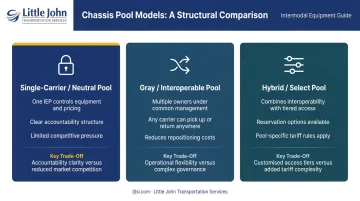
The Three Main Pool Models
| Pool Type | How It Works | Key Trade-Off |
|---|---|---|
| Single-carrier / neutral | One IEP controls equipment, pricing, and network access at participating terminals | Clear accountability; limited competition |
| Gray / interoperable pool | Multiple equipment owners place chassis under common management; any carrier can pick up or return at any network location | Reduces repositioning costs; box rules and provider contracts can still fragment access |
| Hybrid / select pool | Combines interoperable features with tiered access or reservation options | More flexibility, but pool-specific tariff rules still apply |
Real-world examples show how these models play out across major U.S. ports:
- SACP 3.0 (CCM, launched October 2023) — hybrid model covering Savannah and Jacksonville with mandatory participation
- SC Ports SMART Pool — single-provider pool operated at Charleston
- TRAC — manages 13 marine chassis pools nationally
- DCLI — publishes rates across Gulf, Northeast, Pacific Southwest, Southeast, and other regions
One term worth clarifying: "neutral pool" doesn't mean multiple competing providers. In practice, it means one IEP sets the rules and is the only provider permitted at participating terminals. True interoperability — where any chassis can serve any container regardless of branding — is a separate concept that only some pool structures actually deliver.
Key Advantages of Chassis Pools in Container Drayage
The benefits below are operational and financial. They show up in dwell times, cost-per-move, compliance outcomes, and the ability to handle volume spikes without equipment bottlenecks.
Equipment Availability Where and When It's Needed
Gray and neutral chassis pools concentrate large fleets of 20', 40', and 45' chassis at or adjacent to major port and rail terminals. The practical result: drivers don't waste hours searching for available equipment before a container can move.
The scenario pools are designed to prevent is the chassis hunt: a driver arrives at a terminal with a valid container release but can't find a compatible, roadworthy chassis. The container sits, the detention clock runs, and driver hours disappear on an unproductive wait.
The 2023 USDOT-sponsored assessment of chassis availability documents chassis shortages, extended street dwell, and repositioning problems as persistent operational realities at major U.S. ports. A precise national cost figure for chassis hunts isn't available in verified data, but the operational drag is well-documented.
When a chassis is ready and waiting at pickup, the free time window stays intact and demurrage/detention exposure drops accordingly.
This matters most during:
- Peak import seasons and post-holiday surges
- Port congestion events — vessel bunching, labor actions, weather disruptions
- Periods of elevated intermodal volume when individual carrier chassis supply would be exhausted
KPIs directly affected: terminal dwell time, detention and demurrage charges per container, driver hours lost to equipment search, container turn times.
Cost Efficiency Through Shared Utilization
Chassis pools operate on a usage-based model. Carriers and shippers pay a per-diem fee for the time a chassis is in use rather than absorbing the capital cost of owning a dedicated fleet — or paying for that fleet when it sits idle between moves.
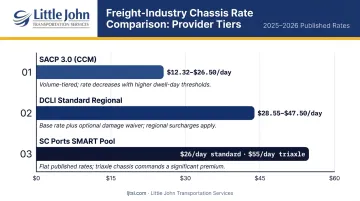
Published 2025–2026 per-diem rates give a concrete range:
- SACP 3.0 (CCM): $12.32–$26.50/day depending on volume tier
- DCLI standard regional rates: $28.55–$47.50/day (base plus damage waiver)
- SC Ports SMART Pool: $26/day for standard chassis; $55/day for triaxle
For comparison, dedicated chassis ownership means the motor carrier absorbs acquisition, financing, maintenance, insurance, storage, and idle time — plus repositioning runs when equipment ends up in the wrong location. CCM reports that interoperable pools can move the same freight with 25% fewer assets because equipment returns anywhere in the network rather than back to a branded depot. That's an operator-reported figure, not an independent benchmark — shared assets simply don't accumulate idle time the way proprietary fleets do when freight demand shifts geographically.
Gray pools specifically eliminate repositioning costs. Because any participating carrier can pick up or return a chassis at any pool location, the chassis flows with freight demand rather than requiring carriers to deadhead to retrieve their own equipment.
Highest impact for:
- Carriers operating across multiple port regions
- Shippers with variable import volumes — where owning enough chassis for peak demand creates significant idle capacity in slower periods
Compliance, Maintenance, and Liability Consistency
Under 49 CFR 396.17, an IEP may not tender intermodal equipment unless it passed an annual inspection within the preceding 12 months. The IEP — not the motor carrier — carries the maintenance and compliance burden for pool chassis. Carriers pulling pool equipment report discovered defects but don't bear the maintenance liability of an aging proprietary fleet.
This matters for CSA scores. FMCSA's Vehicle Maintenance BASIC uses roadside violations from a 24-month window, with OOS events receiving a severity weight multiplier of 2. A chassis-related OOS event at roadside doesn't just delay a load — it affects the carrier's safety score and, by extension, their ability to serve compliance-sensitive shippers.
National Academies' analysis of 2018–2022 FMCSA records found approximately 14.9% OOS violations for motor-carrier-controlled chassis versus 19.6% for non-motor-carrier-controlled chassis. The data doesn't establish causation. It does, however, suggest that equipment control and accountability correlate with lower OOS rates — the same accountability pool IEPs hold under federal inspection requirements.
KPIs affected: CSA Vehicle Maintenance BASIC score, roadside OOS rate, chassis-related claim frequency, on-time delivery rate for compliance-sensitive freight.
What Happens When Chassis Pool Access Is Missing or Inadequate
The Chassis Hunt
A driver arrives at port with a valid container release. No compatible, inspectable chassis is available. The container sits, the free time window burns down, and the detention clock starts. The driver's hours of service erode on an unproductive wait — time that can't be recovered downstream.
This isn't a theoretical scenario. The USDOT chassis availability assessment identifies chassis shortages and extended street dwell as documented problems at major terminals. Port Houston's Tariff 15 lists a $46.44/day sustained import dwell fee on top of demurrage for containers sitting past free time — charges that compound quickly.
The Chassis Split Problem
A chassis split occurs when the container and its chassis originate from different locations or providers. The driver picks up the chassis at one facility and the container at another, adding an extra trip leg with real cost and time consequences on every affected move.
Charleston's rate schedule illustrates the fee exposure: a $280 non-SMART chassis retrieval fee and a $150 improper-return dray fee apply when chassis aren't returned correctly within the pool. These fees aren't hypothetical — they're published tariff items.
The Compounding Effect
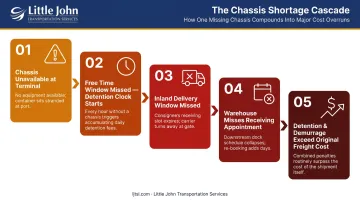
Chassis shortages during peak periods don't just affect one container. Each delay triggers a sequence of downstream failures:
- Containers miss inland delivery windows
- Warehouses miss receiving appointments
- Detention and demurrage charges on a single container can exceed its original freight cost
The FMC received 189 charge complaints in FY2024 and reported $1.874 million in charges voluntarily refunded or cancelled. Even in a normal operating year, these disputes are routine.
How to Get the Most Value from Chassis Pools
Know What Your Carrier Actually Has Access To
Chassis pool access isn't automatic. Carriers must maintain active accounts or participation agreements with pool operators at each terminal region they serve. A carrier with TRAC access in the Northeast may have no equivalent arrangement in the Gulf or Southeast. When vetting a drayage partner, confirm pool participation by region — not just by capability.
Geographic coverage matters in specific ways:
- Multi-port shippers need a drayage partner whose footprint spans active import and export terminals, including inland intermodal ramps
- Pool structures vary by port — SACP 3.0 requires participation at Savannah and Jacksonville; LA/LB's Pool of Pools has been restructuring since Flexi-Van's May 2025 exit and TRAC's announced departure effective June 2026
- Some port programs are terminal-use only — Port Houston's terminal chassis program doesn't satisfy all demand for general drayage
Credentials Are Prerequisites, Not Extras
TWIC certification and C-TPAT validation aren't just compliance checkboxes — they're prerequisites for terminal access at many of the ports where major chassis pools operate. A carrier without these credentials faces access delays that defeat pool benefits at the point of pickup.
Little John Transportation Services holds TWIC certification and C-TPAT validation across its network, with active operations in key drayage hubs including Houston, Charlotte, Reno, and Laredo. Its broader intermodal network spans 65,000+ approved drayage carriers.
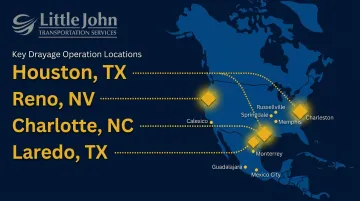
The Laredo facility operates on a trailer-interchange model suited to cross-border freight rather than containerized chassis-pool drayage. For shippers who need to confirm pool-specific access at a particular terminal, the operations team handles those questions directly — real staff who own the answer.
Conclusion
Chassis pools exist because equipment fragmentation creates real, measurable operational costs — detention fees, chassis hunts, driver hours burned on unproductive waits, and compliance events that ripple through carrier scorecards. Pools solve those problems by concentrating shared equipment where freight moves, under maintenance and inspection standards that individual carriers don't have to manage themselves.
The benefits compound when a shipper partners with a drayage carrier that has the terminal access, certifications, and geographic positioning to activate those pools consistently. At Little John Transportation Services, that groundwork is already in place — so chassis access is confirmed before a container reaches the terminal gate, not improvised after the driver arrives.
Frequently Asked Questions
What is a drayage chassis?
A drayage chassis is the wheeled steel frame — essentially a trailer undercarriage — used to transport an intermodal shipping container by truck from a port, rail terminal, or depot to its next destination. The chassis is not the container itself — it's the road equipment that carries the container on public highways.
What is a chassis split in drayage?
A chassis split occurs when a container and its chassis originate from different locations or providers, requiring the driver to pick up the chassis at one point and the container at another. This adds an extra trip leg, additional cost, and time to the drayage move — and often triggers fees at the terminal.
What is a chassis flip in drayage?
A chassis flip is the transfer of a container from one chassis to another mid-move — typically because the original chassis isn't permitted at a destination terminal or belongs to a different pool that doesn't interoperate at that location. It results in additional handling time and potential fees.
What are the main types of chassis pools?
Three primary models exist in U.S. drayage:
- Single-carrier pools: Controlled by one IEP with exclusive terminal access
- Gray/interoperable pools: Multiple equipment owners under common management, open to any participating carrier
- Hybrid pools (like SACP 3.0): Tiered access with reservation options and pool-specific tariff rules
How does a chassis pool reduce drayage costs?
Pools replace idle dedicated chassis ownership with usage-based per-diem fees, eliminate repositioning runs for branded equipment, and cut detention exposure by ensuring chassis are available when containers are ready to move. Per-diem rates in active pools currently range from approximately $12 to $55 per day depending on equipment type and region.
Who manages chassis pools at major U.S. ports?
The primary operators are TRAC Intermodal (13 marine pools nationally), Consolidated Chassis Management (CCM, overseeing SACP 3.0 at Savannah and Jacksonville), and DCLI across Gulf, Northeast, and Southeast markets. SC Ports manages its own port-owned SMART Pool at Charleston.