Volume LTL and Partial Truckload both exist to solve this problem — but they're built on different carrier networks, price differently, and serve different freight profiles. Picking between them without understanding those differences is how shippers end up paying too much, or watching sensitive cargo move through five terminal transfers when it didn't need to.
This guide covers what Volume LTL is, how it works, its real pros and cons, and how it compares directly to Partial Truckload — so you can make a confident, cost-effective decision for your next shipment.
Key Takeaways
- Volume LTL covers roughly 6–12 pallets: too large for standard LTL pricing, but not enough freight to justify a full trailer.
- Discounted rates come at a cost: Volume LTL transit times are less predictable and cargo liability limits are lower than standard LTL.
- Partial Truckload skips freight class entirely, moves on truckload networks, and typically delivers faster with fewer handling touches.
- The right mode depends on shipment size, urgency, cargo value, and budget .
- A freight partner with access to both LTL and truckload networks can compare both options and price them side by side.
What Is Volume LTL?
Volume LTL Defined
Volume LTL is a shipping method for freight that has outgrown standard LTL but doesn't require a full trailer. There's no single industry-wide threshold — carriers define their own parameters — but published ranges from major carriers give a workable picture:
- RXO: 6–12 pallets, more than 12 linear feet, or more than 5,000 lbs
- Coyote Logistics: 7–12 pallets or 12–24 linear feet
- Estes: At least 5,000 lbs or eight linear feet, with typical loads running 5,000–15,000 lbs
- FedEx Freight: Volume Services spans 2,500–44,000 lbs and at least 7 feet of trailer space
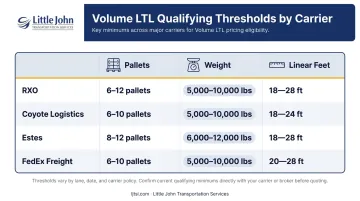
Thresholds vary by carrier — a shipment that qualifies at one may not at another, so always confirm before you quote.
That variability aside, one rule holds everywhere: Volume LTL requires a freight class, assigned based on density, stowability, handling requirements, and liability under the NMFC standard.
That freight class directly affects your rate. Partial Truckload, by contrast, has no freight class requirement — which is a meaningful operational difference when it comes to pricing complexity.
How Volume LTL Works
Volume LTL runs on LTL carrier networks, which use a hub-and-spoke model: freight is picked up locally, sorted at a regional hub, transferred to a destination hub, and delivered by a local driver. Standard LTL shipments can pass through multiple terminal touches along the way.
Volume LTL shipments often experience fewer of those transfers, because their size makes them harder to break up and re-consolidate at intermediate terminals. According to RXO, these shipments frequently remain on one trailer from pickup to delivery — though this depends on available capacity and routing.
The economics that make Volume LTL possible come from backhaul availability. After completing a full-load delivery, carriers face a choice: drive the return route empty or fill available trailer space with volume shipments at a discount.
Carriers accept lower rates in exchange for scheduling flexibility from the shipper. That's why Volume LTL pricing is generally quoted as a discounted rate off standard tariff, tied to current lane capacity — and why same-day pickup isn't always guaranteed.
The Pros of Volume LTL Shipping
Cost Efficiency
The primary reason shippers use Volume LTL is cost. Carriers offer discounted rates to fill backhaul space, and for qualifying loads, the per-hundredweight (CWT) rate is typically lower than standard LTL on the same lane. FedEx Freight describes its Volume Services as economical transportation for larger, less-urgent shipments using otherwise unused space.
How much you save depends on freight class, lane, and the carrier's current capacity position. Treat any specific discount figures from carriers or brokers as lane-specific — not universal.
Reduced Cargo Damage
Standard LTL cargo can pass through multiple terminals before reaching its destination. Each transfer is an opportunity for mishandling. Volume LTL shipments move more directly, which reduces that exposure. Coyote Logistics reports a typical 1–2% damage ratio for standard LTL carriers — fewer terminal touches means fewer freight claims.
Access to Supplemental Capacity
Beyond damage protection, Volume LTL draws from carrier backhaul availability — a separate capacity pool from both standard LTL and truckload markets. When tight capacity makes standard options hard to place, it offers a viable alternative for mid-sized loads that might otherwise sit waiting.
Sustainability Advantage
Filling available trailer space with volume shipments cuts the total number of truck movements needed for equivalent freight. Fewer empty miles means lower fuel consumption and reduced carbon emissions per unit — directly relevant for shippers with ESG reporting requirements or active sustainability commitments.
The Cons of Volume LTL Shipping
Unpredictable Transit Times
Volume LTL moves on carrier convenience, not shipper deadlines. Because pickup and delivery depend on backhaul availability, transit windows are less reliable than standard LTL with contracted service commitments. Shippers with hard must-arrive-by dates need to factor this in — guaranteed service upgrades are available but come at a cost that often offsets the savings.
Lower Cargo Liability Limits
Cargo liability limits are the most financially significant risk with Volume LTL — and they vary widely by carrier:
| Carrier | Volume/Spot Quote Liability |
|---|---|
| XPO (CNWY 199-AJ.5) | $1/lb per lost or damaged piece |
| Saia (170-D, Item 495) | $5/lb, maximum $50,000 per shipment |
| Old Dominion (ODFL 100-Q) | $5/lb or $50,000 per occurrence |
The $1/lb figure is sometimes cited as a general standard, but it's carrier-specific — not universal. For any high-value freight, verify the applicable tariff before booking, and evaluate supplemental cargo insurance. Estes, for example, offers Full Value Coverage at $0.75 per $100 of covered value for shippers who need it.
Freight Class Complexity
Volume LTL requires an accurate NMFC freight class designation, and errors are expensive. Carrier inspection fees for reclassification include:
- ODFL: $25 when inspection triggers reclassification
- XPO: $47.85 when inspection corrects classification data and increases linehaul charges
Beyond fees, reclassification can delay your shipment at the terminal. Shippers unfamiliar with NMFC classification should verify their commodity's class before tendering — or confirm it with their 3PL or broker before the load is tendered.
Volume LTL vs. Partial Truckload: Key Differences
Volume LTL and Partial Truckload (also called Partial TL, shared truckload, or co-loading) both solve the in-between load size problem, but they operate on entirely different networks and follow different pricing rules. Understanding where they diverge helps you pick the right mode before you're locked into the wrong one.
| Factor | Volume LTL | Partial Truckload |
|---|---|---|
| Carrier network | LTL carriers (hub-and-spoke) | Truckload carriers (OTR, owner-operators) |
| Typical size range | ~6–12 pallets, 5,000–15,000 lbs | 6–18 pallets, 8,000–27,500 lbs |
| Freight class required | Yes | No |
| Pricing structure | Discounted tariff, based on weight/class/lane | Space-based (linear feet or load), spot-negotiated |
| Terminal handling | Fewer than standard LTL; may still use terminals | Rarely stops at distribution terminals |
| Transit time | Variable; dependent on backhaul availability | Generally faster; fewer stops |
| Cargo liability | Varies by carrier; can be as low as $1/lb | Governed by carrier contract; typically higher |
| Best for | Cost-sensitive, non-urgent, standard freight | Time-sensitive, fragile, or high-value freight |
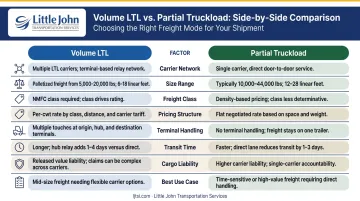
The rows that warrant the closest attention — rate structure, transit time, and cargo liability — are broken down below.
Carrier Network and Rate Structure
Volume LTL rates come from LTL carrier tariffs, discounted off standard rates but rooted in an existing pricing structure. That relative stability is one advantage. Partial TL rates are negotiated on the spot market through truckload carriers and owner-operators with open trailer space.
According to FreightWaves, Partial TL capacity is spotty and highly dependent on market conditions and niche-carrier availability, so rates shift more sharply with freight market cycles.
Size, Weight, and Space Requirements
There's meaningful overlap at the 9–12 pallet range. A shipment that fits Volume LTL may also qualify for Partial TL. When that's the case, get quotes for both before committing.
According to Echo Logistics, Partial TL typically covers 6–18 pallets and 8,000–27,500 lbs, with pricing based on trailer space used rather than freight class or weight. For shippers who want to sidestep freight class designation and reclassification risk, that simpler model matters.
Transit Time and Cargo Handling
Partial TL loads share a trailer with one or two other shipments at most. There's no hub network and no multi-stop routing to work around. For fragile cargo, high-value goods, or shipments with firm delivery windows, the reduced handling and more direct routing of Partial TL makes a practical difference.
When to Use Each Mode
Choose Volume LTL when:
- Cost is the priority and the shipment is not time-sensitive
- The freight class is well-established and accurately documented
- The load fits carrier volume thresholds and the commodity is standard-density
- You need access to LTL backhaul capacity during tight truckload markets
Choose Partial TL when:
- Delivery timing is critical or a must-arrive-by date is in play
- The cargo is fragile, high-value, or sensitive to handling
- The shipment is on the larger end (8–18 pallets) where Partial TL pricing may be more competitive
- You want to avoid freight class designation and its associated reclassification risk
How to Choose the Right Freight Mode for Your Shipment
No formula covers every case, but this four-step framework narrows it down fast:
- Measure the shipment — Count pallets, total weight, and linear feet of trailer space needed. Confirm whether the load falls within carrier volume thresholds.
- Assess urgency — Is there a hard delivery deadline? If yes, Volume LTL's flexibility requirement is a risk. Partial TL or guaranteed LTL service may be more appropriate.
- Evaluate cargo sensitivity — Is the freight fragile, high-value, or regulated? High-value freight exposed to low liability limits and multiple terminal touches deserves a closer look at Partial TL or supplemental insurance.
- Compare rates on the same lane — Get quotes for both modes before committing. The overlap zone between Volume LTL and Partial TL is real, and the better option changes by lane, season, and carrier capacity.
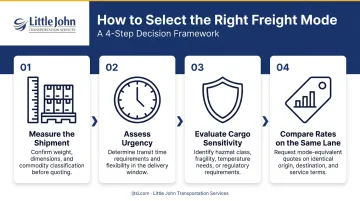
Even after running through those steps, lane availability, carrier relationships, and seasonal capacity swings can shift the math in ways that aren't visible from a rate card alone. A freight partner with access to both LTL and truckload carrier networks can price both modes on the same lane and give you an objective comparison — rather than defaulting to whatever's easiest to book.
Little John Transportation Services, with 65,000+ vetted and audited carriers and 30+ years of specialized freight experience, helps clients across industrial, energy, and manufacturing sectors navigate exactly these kinds of mode decisions. That's particularly relevant for complex loads — industrial machinery, hazmat, or cross-border freight into Mexico — where standard Volume LTL and Partial TL options may not apply at all.
For specialized freight, the mode selection question shifts entirely. Oversized industrial equipment, hazardous materials, and U.S.–Mexico cross-border shipments each carry requirements — permitting, FMCSA certifications, CTPAT validation, cross-border transloading — that standard Volume LTL and Partial TL carriers aren't built to handle.
Shippers in those categories need a partner with the right certifications and infrastructure, not just an available trailer.
Frequently Asked Questions
What is considered volume LTL?
Volume LTL generally applies to shipments that exceed standard LTL thresholds but don't require a full trailer. Carrier definitions vary: RXO uses 6–12 pallets, more than 12 linear feet, or more than 5,000 lbs as a baseline, while Estes starts at 5,000 lbs or eight linear feet. Always confirm the specific carrier's qualifying criteria before quoting.
Is volume LTL cheaper than standard LTL?
Typically yes, on a per-hundredweight basis for qualifying loads. Carriers discount rates to fill backhaul capacity, so larger shipments that offer scheduling flexibility can secure lower rates than standard LTL. Actual savings vary by freight class, lane, and the carrier's current capacity position — no universal percentage applies.
What is the difference between volume LTL and partial truckload?
Volume LTL uses LTL carrier networks and requires a freight class; Partial TL uses truckload networks with space-based pricing and no freight class requirement. Partial TL generally delivers faster transit and fewer handling points, making it better suited for time-sensitive or fragile freight.
Does volume LTL require a freight class?
Every Volume LTL shipment requires an NMFC freight class designation. Incorrect classification can trigger reclassification fees — from $25 to nearly $50 depending on the carrier — and delays at the terminal. Partial TL has no freight class requirement.
What is the cargo liability limit for volume LTL shipments?
It varies by carrier. XPO limits spot and pallet-rated shipments to $1/lb per piece, while Saia and Old Dominion publish limits of $5/lb up to $50,000 for named volume-quote services. Shippers with high-value freight should verify the applicable tariff and consider supplemental cargo insurance before booking.
When should I use volume LTL instead of partial truckload?
Volume LTL fits best when cost is the primary driver, the freight is not time-sensitive, and the shipment meets carrier thresholds. Partial TL is the better call when delivery timing is firm, cargo is fragile or high-value, or you want to sidestep freight class requirements entirely.