Live loading is one of the most common freight scenarios in North American trucking, yet shippers and logistics managers often underestimate how much the decision to live load (versus drop-and-hook) affects cost, scheduling, and cargo security. Understanding the mechanics isn't just useful terminology — it directly shapes how you plan dock capacity, set appointment windows, and structure carrier relationships.
This guide covers everything you need to know: what a live load is, how the process works step by step, how it compares to drop and hook, the real pros and cons, and how to avoid the detention fees that drain both shipper budgets and driver earnings.
Key Takeaways
- A live load keeps the driver on-site, attached to their trailer, while cargo is loaded or unloaded in real time
- Most live loads take approximately two hours; detention fees typically begin after that window
- Drop-and-hook moves faster but requires pre-staged equipment — live load does not
- Detention exceeded two hours at 39.3% of stops in 2023, per ATRI research — facility preparation is the only reliable fix
- Live load is often the right call for hazmat, high-value, or space-constrained shipments requiring direct chain-of-custody oversight
What Is a Live Load in Trucking?
A live load is a shipment method where the driver remains on-site, attached to their trailer, while warehouse or facility staff loads or unloads cargo in real time. The truck does not leave until the process is complete.
The term covers two directions:
- Live load — cargo is loaded onto the trailer while the driver waits at the origin facility
- Live unload — the driver waits at the destination while freight is removed from the trailer
Both fall under the "live load" umbrella in carrier and broker communications.
What Makes a Load "Live"
The defining characteristic is continuity of equipment: the same trailer that arrived is the same trailer that departs — no swaps, no drops, no pre-staged units. Driver and equipment stay connected throughout the entire cargo-handling process.
This contrasts sharply with drop-and-hook arrangements, where a driver detaches their trailer and immediately hooks to a different one. In a live load, there is no handoff. The driver owns the load from arrival to departure.
That accountability makes live loading the default choice for freight where custody matters. Common applications include:
- Standard palletized dry goods requiring dock-to-dock continuity
- Temperature-sensitive cargo where trailer exposure time must be minimized
- Hazmat shipments that require on-site verification before departure
- Specialized freight where chain-of-custody documentation is completed at the point of loading
Understanding when live loading is required — versus simply preferred — shapes how shippers plan appointments, allocate dock time, and price carrier agreements.
How Does a Live Load Work? Step-by-Step
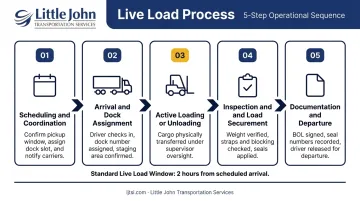
Step 1 — Scheduling and Coordination
The carrier and shipper agree on a specific appointment window before the driver ever leaves the terminal. Under 49 CFR 395.2, time spent waiting at a facility counts as on-duty time unless the carrier formally relieves the driver from duty.
That clock does not pause. A late appointment, a disorganized dock, or a queue backing up three trucks deep can consume hours from a driver's non-extendable 14-hour window — making precise scheduling an operational necessity, not a formality.
Step 2 — Arrival and Dock Assignment
The driver arrives, checks in at the guard shack or receiving office, and is assigned to a specific dock door. Many facilities operate on scheduled appointments; others use first-come, first-served queues. Scheduled appointments are strongly preferred because unmanaged queues create detention exposure before the trailer is even opened.
Step 3 — Active Loading or Unloading
Warehouse staff begin moving cargo once the trailer is positioned. In practice, this looks like:
- Forklifts staging and moving pallets from the floor to the trailer
- Workers verifying item counts against the bill of lading
- Cargo being positioned, blocked, and braced within the trailer
According to DAT, most live loads take around two hours. Actual time varies based on shipment complexity, crew size, and how well freight was staged before the truck arrived.
Step 4 — Inspection and Load Securement
Before the trailer is sealed, both the driver and the shipper's team inspect the freight for accuracy, visible damage, and proper labeling. This is one of the genuine operational advantages of live loading: problems surface at the dock, while there's still time to fix them.
For hazmat cargo, this step carries additional weight. Under 49 CFR 177.834, a qualified person must attend the loading and covered unloading of cargo tank motor vehicles, making on-site driver presence a regulatory requirement in those scenarios.
Step 5 — Documentation and Departure
The driver receives the bill of lading and any required supporting documents (weight certifications, hazmat shipping papers, chain-of-custody forms). Once paperwork is confirmed and the load is secured, the trailer is sealed and the truck departs — same driver, same trailer, same load.
Live Load vs. Drop and Hook vs. Dead Load
Drop and Hook
In a drop-and-hook (also called a drop load), the driver arrives, detaches their empty or loaded trailer, and immediately hooks to a pre-staged trailer. No waiting for cargo handling — the driver is back on the road within minutes.
Here's how the two methods compare:
| Factor | Live Load | Drop and Hook |
|---|---|---|
| Driver wait time | Required — driver stays on-site | Minimal — driver swaps and departs |
| Equipment needs | No extra trailers required | Requires pre-loaded trailers staged in yard |
| Cargo visibility | Real-time oversight during loading | Cargo was loaded before driver arrived |
| Yard space needed | Low | High — must accommodate staged trailers |
Drop and hook is faster for drivers and keeps hours-of-service exposure low. Live load requires no trailer pool overhead but demands the driver's time.
What "Dead Load" Means in Trucking
The term "dead load" comes from structural engineering, where it refers to permanent static weight on a structure. In trucking, it is not a formal industry classification — you will not find it in the ATA or DAT glossary.
When the term appears in freight conversations, it typically refers informally to a trailer that is staged or sitting idle without a driver present: pre-loaded and waiting, but not actively being worked. Think of it as the opposite of a live load in conversational shorthand, not as a defined operational category.
When Drop-and-Hook Becomes a Live Load
Scheduled drop-and-hook moves can revert to unplanned live loads when a pre-staged trailer is not ready when the driver arrives. The driver now waits — on-duty time accumulates, and what was a quick swap becomes an unscheduled detention event.
It happens more often than most shippers budget for. ATRI's 2023 Operational Costs of Trucking report found:
- Detention exceeded two hours at 39.3% of stops
- $3.6 billion in direct expenses attributed to detention industry-wide
- $11.5 billion in lost productivity — costs that work their way back into carrier rates over time
When a drop-and-hook becomes an unplanned live load, those losses don't disappear. They get absorbed by the carrier, the driver, or repriced into the next contract.
Pros and Cons of Live Load Trucking
Advantages of Live Loading
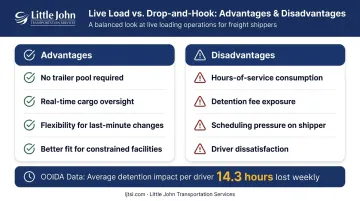
- No trailer pool required — shippers without yard space or extra equipment can still move full truckloads without maintaining a drop trailer inventory or dedicating yard space to staged equipment
- Real-time cargo oversight: labeling errors, count discrepancies, and damage get caught before the truck leaves — not discovered at the receiver's dock
- Flexibility for last-minute changes — the driver is on-site while loading, so adjustments are still possible; once a sealed trailer rolls out, those options disappear
- Better fit for constrained facilities — urban warehouses, cross-border transload points, and smaller distribution centers often cannot accommodate multiple staged trailers in a yard
Live loading works well when the facility is ready. When it isn't, the same setup that gives you control can quickly work against you.
Disadvantages and Risks
- Hours-of-service consumption: wait time counts as on-duty time, which cuts directly into the driver's available driving hours for the rest of the day
- Detention fee exposure — if a facility is not ready when the driver arrives, detention charges begin accumulating after the standard two-hour free-time window
- Scheduling pressure on the shipper — the warehouse owns the clock; a slow start at the dock doesn't just delay one load, it cascades into missed downstream appointments
- Driver dissatisfaction — OOIDA's 2023 survey found drivers wait an average of 7.2 hours per week just to load, and 7.1 hours to unload — 14.3 total hours weekly lost to detention
When Does Live Loading Make Sense?
Live load is often the practical or only choice in these scenarios:
- Limited yard space — facilities that cannot stage pre-loaded trailers have no drop-and-hook option; the driver must wait
- Temperature-sensitive or time-sensitive cargo — minimizing trailer dwell time between loading and departure protects product integrity
- Cargo requiring real-time verification — hazmat shipments, high-value goods, and loads subject to chain-of-custody documentation benefit from having both driver and shipper present to sign off simultaneously
- No shunting equipment available — facilities without yard tractors or dedicated switcher trucks cannot move pre-staged trailers without a driver attached
What Does "40 Live Load" Mean?
In carrier and broker dispatch communications, "40 live load" is shorthand indicating a 40-foot trailer that requires a live load appointment rather than a drop-and-hook arrangement. The "40" typically refers to the trailer length specification. Terminology varies by region and carrier, so shippers should confirm the exact meaning with their carrier when this notation appears on a load tender — do not assume the interpretation is universal.
For regulated freight — oversized loads, hazardous materials, shipments requiring escort or permitting — live loading is often the only structure that satisfies compliance requirements. When documentation, chain-of-custody sign-off, and safety verification all need to happen at once, having the driver and shipper on-site at the same time isn't a preference. It's the requirement.
Best Practices to Manage Live Load Efficiently
Detention is almost always preventable on the shipper's side. These practices make the difference:
Prepare Before the Truck Arrives
- Stage freight at the dock before the driver checks in — not after
- Assign specific warehouse staff to the load so there is no scrambling when the truck backs in
- Complete all documentation in advance: bill of lading, hazmat papers if applicable, weight certifications, chain-of-custody forms
- Know your dock capacity and do not book appointments you cannot honor on time
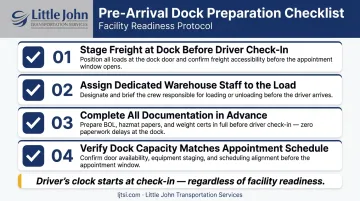
Unprepared facilities are the primary cause of detention fees. The driver's clock starts running at check-in regardless of whether the warehouse is ready.
Schedule Accurately and Communicate Early
- Avoid overbooking dock appointments — build realistic time buffers between scheduled trucks
- If a delay is developing, notify the carrier as early as possible; early notice often allows rescheduling without penalty
- Use appointment windows that reflect actual loading time, not optimistic best-case scenarios
Work With Carriers Built for Coordination
Live load operations run best when the carrier has dedicated dispatch support — someone who tracks the appointment, keeps the driver informed, and resolves issues as they happen rather than routing problems through an automated system.
For complex or specialized freight, this matters more than pricing. Little John Transportation Services operates 24/7 bilingual dispatch with teams physically positioned at key freight hubs including Laredo, Monterrey, and Guadalajara.
When a live load appointment involves hazmat cargo, cross-border documentation, oversized equipment, or tight appointment windows, you need dispatchers who own the outcome and pick up the phone when something changes. That responsiveness is what separates a smooth load from a missed delivery window and a detention bill.
Frequently Asked Questions
How long does a live load take?
Most live loads take approximately two hours for standard shipments, per industry standard practice. Actual time depends on cargo type, crew size, and how well freight was staged before the driver arrived. Most carriers begin charging detention after two hours of free time.
What is the difference between a dead load and a live load?
In trucking, a "live load" means the driver is on-site and active while cargo is being handled. "Dead load" is informal shorthand for a trailer that is staged or sitting idle without a driver present. It is not a formal industry term in trucking the way "live load" is.
What is the difference between a drop load and a live load?
A drop load (drop and hook) means the driver swaps trailers without waiting for cargo handling, with no dwell time. A live load requires the driver to stay on-site through the entire loading or unloading process. Drop loads move faster overall but require pre-staged equipment on the shipper's end.
What does "40 live load" mean?
In dispatch shorthand, "40 live load" typically refers to a 40-foot trailer requiring a live load appointment rather than a drop-and-hook arrangement. Notation conventions vary by carrier and region — confirm the meaning with your carrier before booking.
What are detention fees and how do you avoid them?
Detention fees are charges applied when a driver waits beyond the standard free-time window — usually two hours. The most reliable way to avoid them is straightforward: have freight staged, staff assigned, and paperwork complete before the driver checks in. Accurate scheduling that reflects real loading time is equally important.
When should shippers choose live load over drop and hook?
Live load is the better choice when yard space is limited, cargo requires real-time inspection or compliance documentation, or pre-staged trailers are unavailable. Drop and hook is preferable when driver efficiency and speed are the priority and the facility has the trailer inventory to support it.