Introduction
Trucks queued at the gate. Docks backed up with no clear assignments. Trailers parked somewhere in a 40-acre yard — location unknown. This is what happens when yard management breaks down, and the costs are staggering.
According to ATRI's 2024 research, U.S. trucking incurred $3.6 billion in direct expenses and $11.5 billion in lost productivity from driver detention in 2023 alone — with detention occurring at 39.3% of all stops. Every hour a truck sits waiting is an hour the carrier charges for, the warehouse can't staff efficiently, and the customer's shipment falls behind.
Yard management services are the operational link between inbound transportation and warehouse execution. When they work, freight moves predictably, trucks turn faster, and documentation holds up under audit. When they don't, both sides of that equation pay for it.
This guide covers what yard management services are, their core components, the costs of getting them wrong, and what to look for in a service partner — particularly for hazmat, heavy-haul, and cross-border freight.
Key Takeaways
- Yard management covers gate entry, trailer tracking, dock scheduling, personnel coordination, and compliance documentation
- Detention and dwell inefficiency cost the U.S. trucking industry $15+ billion annually
- Over 55% of supply chain professionals cite manual processes as their biggest yard management challenge
- Hazmat and cross-border freight require a higher compliance standard than most carriers can meet
- The right service partner combines human accountability with credentials that hold up under regulatory scrutiny
What Are Yard Management Services?
Yard management services are the coordinated set of processes, people, and systems responsible for overseeing the movement of vehicles, trailers, and cargo within a facility's yard — from gate entry through parking and staging to dock assignment and departure.
The yard occupies a specific position in the supply chain: it's the physical handoff point between inbound trucking and warehouse operations. When that handoff is managed well, both sides operate at capacity. When it breaks down, the warehouse idles and carriers sit on the clock.
Services vs. Software
Two commonly conflated concepts are worth separating:
- Yard management services — the operational discipline: the people, processes, and practices that govern what happens in the yard
- Yard Management System (YMS) — the software used to execute and monitor those practices. Gartner defines a YMS as software supporting gate oversight, dock scheduling, check-in and validation, seal verification, parking and door assignments, yard audits, asset tracking, and driver-task assignment
In practice, most operations blend both. Some companies outsource yard management entirely to a carrier or 3PL; others manage it in-house with a YMS platform. The most effective setups pair structured human accountability with technology that maintains visibility across the yard.
Core Components of Yard Management Services
Gate Management
Every yard operation starts and ends at the gate. Effective gate management covers:
- Driver check-in and check-out
- Identity verification and credential review
- Documentation inspection (BOL, seal records, hazmat placarding)
- Vehicle-to-dock or vehicle-to-staging-area assignment
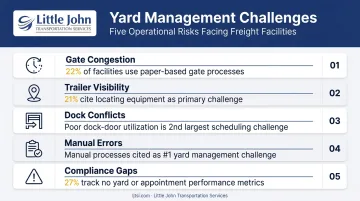
Manual gate processes are a primary source of queue buildup. In a survey of 375 supply chain professionals, 22% reported managing gate processes on paper, while only 5% had automated gate operations. When a gate check-in takes 15 minutes instead of 3, every truck behind it absorbs that delay — and it cascades through dock scheduling, warehouse labor, and carrier relationships.
Trailer and Asset Tracking
Yard management services maintain real-time visibility of every trailer, container, and piece of equipment in the yard. GPS, RFID, and digital yard maps are the standard tools for this.
Without visibility, facilities experience "ghost trailers" — assets that are physically present but untracked. That same report found 21% of supply chain professionals identified locating equipment as their primary yard challenge. The consequences are concrete: delayed dock assignments, missed SLAs, and detention charges accumulating before anyone notices a trailer has been sitting idle for two days.
Dock Scheduling and Door Assignment
Dock scheduling coordinates which truck arrives at which door, at what time, and for how long. When it's managed manually or disconnected from transportation data, conflicts multiply fast:
- Multiple trucks arriving simultaneously for limited dock doors
- A truck occupying a dock beyond its scheduled window
- Warehouse labor staged for a load that's running two hours late
That survey also cited poor dock-door utilization as the second-largest appointment management challenge, trailing only manual processes. Idle docks mean idle labor. Overbooked docks mean cascading delays across the entire shift.
Task Management and Yard Personnel Coordination
Yard jockeys — the truck drivers who move trailers within the yard — are only useful when they're assigned the right task at the right moment. Effective task management means:
- Real-time assignment based on dock priority
- Coordination between ground crews, equipment operators, and dispatch
- Clear visibility into which trailers need to move and where
A yard jockey repositioning an empty trailer while a loaded one blocks a dock door is a coordination failure, not an equipment shortage.
Documentation, Compliance, and Reporting
Yard management includes the full paper trail. Key records cover:
- Bills of lading (BOLs) and seal records
- Gate logs and weight tickets
- Inspection records and chain-of-custody documentation
These records support regulatory compliance, carrier audits, billing accuracy, and performance analytics. Digital documentation creates a defensible audit trail across every yard transaction and shift.
For facilities handling regulated freight, this isn't administrative overhead: it's a legal requirement.
Common Yard Management Challenges — and Why They're Costly
Gate Congestion
Paper-based check-in processes create queues that delay every downstream operation. With 22% of facilities still managing gate processes manually, the compounding effect on dwell time is significant. One delayed gate check-in doesn't just affect one truck — it shifts dock availability for every vehicle in the queue.
Lack of Trailer Visibility
Ghost trailers are more common than most facilities admit. When trailers aren't tracked in a system, they get lost in a sea of identical assets. The results:
- Unnecessary yard searches that consume staff time
- Dock assignments delayed while someone physically walks the yard
- Detention deadlines missed because nobody knew the trailer was already on-site
Scheduling Conflicts and Dock Congestion
A truck that occupies a dock 45 minutes past its scheduled window creates a ripple effect — the next carrier misses its appointment, warehouse labor shifts get disrupted, and the carrier relationship frays. When this happens across multiple doors simultaneously, the entire facility loses throughput for hours.
Manual Processes and Human Error
Clipboard-and-radio coordination introduces predictable failure points: dock doors misassigned, weights recorded incorrectly, trailers mislabeled, safety checks skipped. These errors aren't random — they're structural. Manual processes don't scale as freight volume grows, and the error rate compounds under pressure.
27% of surveyed professionals reported not maintaining yard or appointment performance metrics at all. If you can't measure the problem, you can't fix it.
Compliance Gaps and Documentation Failures
Those documentation gaps carry their heaviest cost in regulated environments. In hazmat, temperature-sensitive, pharmaceutical, and defense operations, incomplete yard records are a legal and safety liability. The consequences include:
- Fines and failed audits
- Shipment holds at the facility or border
- Carrier deauthorization
- Reputational damage with enterprise customers
The stakes are highest at facilities handling complex or specialized cargo, where every yard transaction must be traceable from gate entry to final departure.
The Business Benefits of Effective Yard Management Services
Cost Reduction
The financial case is anchored in detention. DAT Freight & Analytics puts total annual detention cost to the industry at over $15 billion. Every improvement to gate flow, dock scheduling, and trailer visibility reduces time trucks spend waiting — and reduces the detention fees that result.
Beyond detention, effective yard management reduces:
- Equipment idle time and associated wear
- Overtime labor caused by scheduling gaps
- Carrier penalty fees from missed appointment windows
Operational Efficiency and Throughput
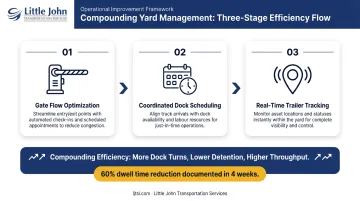
A FreightWaves case study documented a 60% dwell time reduction in four weeks at individual facilities when operations were optimized using facility-level data. Dwell reductions of this scale directly translate into more dock turns per shift and greater volume throughput with the same labor headcount.
Optimized gate flow, coordinated dock scheduling, and real-time trailer tracking don't just reduce costs individually — they compound. Each improvement removes a constraint that was limiting the others.
Customer and Carrier Satisfaction
Efficient yard operations translate to downstream outcomes that shippers and customers notice. The operational improvements are tangible on both sides of the relationship:
- On-time delivery and better SLA adherence that customers can measure
- Fewer detention disputes, which carriers factor into which facilities they prioritize
- More predictable lead times that reduce expediting costs downstream
Yard Management in Specialized and High-Stakes Freight Operations
Standard yard management requirements are demanding enough. When freight includes hazardous materials, oversized loads, cross-border shipments, or time-critical cargo, those requirements escalate — and the consequences of failure scale proportionally.
Hazmat Yard Requirements
Hazmat freight introduces specific yard-level obligations governed by federal regulation:
- Placarding verification at the gate (49 CFR 172.504 — required on all sides and ends of covered transport vehicles)
- Trailer segregation for incompatible materials (49 CFR 177.848 — certain hazmat classes cannot be stored in the same vehicle or area)
- Shipping paper custody requirements (49 CFR 177.817 — papers must be immediately accessible at all times)
- Loading and unloading controls (49 CFR 177.834 — handbrakes set, qualified attendant present, no vehicle movement while lines are connected)
The barrier to entry for hazmat yard operations is high. Only 898 carriers hold FMCSA Hazardous Materials Safety Permit (HMSP) certification — representing 0.677% of active hazmat carriers and less than 0.114% of all active motor carriers, based on FMCSA's 2023 data. Selecting a non-HMSP carrier for applicable loads isn't a quality decision — it's a regulatory exposure.
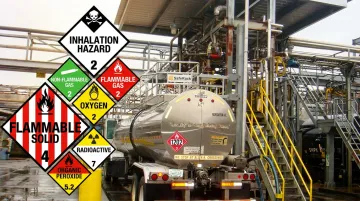
Little John Transportation Services holds FMCSA HMSP certification and maintains a 100% hazmat-endorsed BCO fleet across 8,500+ owner-operators, meaning any operator dispatched to a hazmat staging area is pre-qualified before the assignment is made. That eliminates a common bottleneck at the gate.
Cross-Border Yard Complexity
U.S.-Mexico freight corridors add layers of operational complexity that most standard yard operations aren't built to handle. Laredo alone processed 3,026,632 incoming trucks from Mexico in 2024, representing 50.9% of all Southern-border truck volume — and freight moving through the port was valued at over $296 billion in 2025, per BTS data.
Managing yard operations at or near a port of entry requires:
- Documentation accuracy for customs clearance (CTPAT, FAST compliance)
- Bilingual gate operations for clear driver communication
- Physical teams stationed on both sides of the border
- Seal controls meeting ISO 17712 standards, per CBP CTPAT Highway Carrier requirements
- Documented seven-point empty trailer inspections
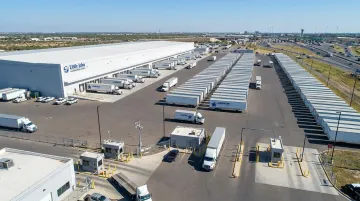
Little John Transportation Services' 50-acre CTPAT-validated Laredo facility is configured specifically for high-volume border operations: with 1,200 trailer staging spaces, a 30-bay cross-dock, 24/7 monitored access, and bilingual teams across Laredo, Monterrey, and Guadalajara. The facility's 120-ton bridge crane enables superload transloading between U.S. and Mexican trailers in under two hours, compressing dwell time on the most complex cross-border movements.
Audit-Ready Documentation at Every Stage
For specialized freight operations, documentation cannot wait until after the load departs. Auditors, customs officials, and safety regulators will ask for it — and gaps in the record are findings.
At minimum, a compliant specialized freight yard operation maintains:
- Chain-of-custody records from gate entry to departure
- Seal logs with timestamps and inspector credentials
- Weight certifications for oversize and overweight loads
- Hazmat manifests with carrier and shipper signatures
- Inspection reports for empty trailer checks and placarding verification
Maintaining this standard across every transaction, every shift requires structured workflows and trained personnel — not a manual process that depends on individual memory.
What to Look for in a Yard Management Service Partner
Real People, Real Accountability
Technology is only as effective as the human execution behind it. A strong yard management partner — whether a carrier, logistics operator, or 3PL — should provide:
- Dedicated points of contact who know your freight
- Real-time communication during exceptions and delays
- 24/7 dispatch availability for after-hours issues
Automated systems without human accountability create blind spots at exactly the wrong moments. A compliance exception, a missed appointment, a hazmat incident at 2 a.m. — those are when a real person on the other end of the line matters most.
Compliance Credentials and Certifications
For serious yard management operations, credentials are verifiable evidence that a partner has built the operational systems to meet regulatory requirements — not just claimed it. Look for:
- FMCSA Satisfactory Rating — held by approximately 6% of carriers
- FMCSA HMSP — required for high-hazard materials transport; held by fewer than 1% of carriers
- CTPAT Validated — the highest tier of CBP's cargo security program
- ISO 9001:2015 — confirms audited quality management systems across all processes
- TWIC Certification — required for access to ports and secure terminals
- Hazmat Endorsement — across the driver fleet, not just at the carrier level
Little John Transportation Services holds all six, with 100% of BCOs carrying hazmat endorsements and TWIC certification — a network-wide standard that removes credential-matching delays from every dispatch.
Track Record and Scalability
Evaluate a partner's operational history:
- Average client tenure: Little John's top-25 customers average 33 years, with 100% retention among Top 100 customers in FY24
- Volume capacity: 100,000+ FTL loads annually across the U.S., Mexico, and Canada
- Safety record: DOT crash frequency near half the national average; 99.9% claim-free delivery rate
- Network reach: 12 office locations, including Laredo, Monterrey, and Guadalajara for cross-border coordination
Those numbers tell you something specific: a partner operating at this scale, with this retention rate, isn't surviving on contracts alone — they're earning them every year.
Frequently Asked Questions
What do yard management services do?
Yard management services coordinate the movement of trucks, trailers, and cargo within a facility's yard — including gate check-in, trailer tracking, dock scheduling, task assignment, and compliance documentation. In practice, they connect inbound transportation to warehouse operations, making sure nothing stalls between the gate and the dock.
What are the main components of yard management services?
The five core components are: gate management, trailer and asset tracking, dock scheduling and door assignment, yard personnel task coordination, and compliance documentation and reporting. These functions cover everything from a truck's arrival at the gate to its departure after loading or unloading.
What does a yard manager do?
A yard manager oversees all activity within the facility yard — directing incoming and outgoing trucks, coordinating dock assignments, monitoring trailer status, managing yard personnel, and ensuring compliance with safety and regulatory requirements.
What is the difference between yard management and warehouse management?
Warehouse management governs operations inside the building — inventory control, picking, packing, and fulfillment. Yard management governs the movement of vehicles and cargo outside, in the yard between the gate and the dock door. The two are interdependent but cover distinct operational domains.
How does yard management affect detention and demurrage fees?
Poor yard management — slow gate check-ins, dock conflicts, and untracked trailers — keeps trucks waiting beyond contracted time windows, triggering detention charges. When gate, staging, and dock processes run on schedule, dwell time drops and detention exposure shrinks with it.
What industries benefit most from yard management services?
Industries with high freight volume and complex cargo flows see the greatest impact: automotive, chemical and petrochemical, pharmaceutical, industrial manufacturing, retail distribution, and energy. The stakes are highest when shipments are time-sensitive, hazardous, or require continuous compliance documentation.