Introduction
Moving oversized freight without proper escort vehicles is not just a paperwork problem — it's a safety failure with real consequences. The 2013 I-5 Skagit River bridge collapse, documented in NTSB report HAR-14/01, was triggered when an oversized combination vehicle struck the bridge structure — an incident that investigators traced back to failures in pilot car operation, route planning, and clearance verification.
Beyond safety, the financial exposure is direct. North Carolina law specifies a $1,500 fine for operating without the proper number of certified escorts. Florida treats an off-route or non-compliant permit as null and void, with dimensional penalties reaching $1,000 per vehicle.
Escort vehicles are an active safety system with legal teeth. Miss the requirements and consequences follow fast — mid-route permit revocation, civil liability exposure, or worse. This guide covers what triggers escort requirements, what equipment is mandatory, how lead and chase roles differ, and where state rules diverge in ways that catch carriers off guard.
Key Takeaways
- Escort requirements are state-enforced; thresholds vary significantly, and every state on a route must be verified independently
- Width, height, length, and overhang can each independently trigger escort requirements
- Lead escorts warn oncoming traffic; chase escorts protect the load from behind — and many loads require both types
- Driver certification, equipment standards, and insurance minimums are state-specific and don't transfer automatically across state lines
- Non-compliance risks include fines, permit voidance, forced stops, and civil liability
What Are Oversized Load Escort Vehicles?
Escort vehicles — called pilot cars, flag cars, or escort flag vehicles depending on the state — are specially equipped vehicles that travel ahead of or behind an oversized load. Their job is to warn other motorists, monitor route hazards in real time, and maintain continuous radio communication with the load driver.
The FHWA designates the operator as a Pilot/Escort Vehicle Operator (P/EVO) — someone responsible for warning road users, communicating hazards, flagging traffic when authorized, and helping the load negotiate obstructions.
The Four Escort Roles
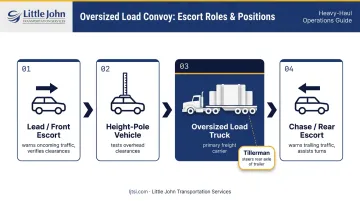
Each escort position serves a specific function within the convoy:
- Lead (front) escort — Runs ahead of the load to warn oncoming traffic, verify route clearances, and operate the height pole when required. Most critical on two-lane roads and for over-height loads.
- Chase (rear) escort — Follows behind to warn approaching traffic, assists with lane changes and turns, and watches for load shifts the driver can't see.
- Height-pole vehicle — A front escort equipped with a flexible, nonconductive measuring pole set 3 to 6 inches above the load's highest point, used to physically test overhead clearances before the load passes through.
- Tillerman — A person who steers an axle of an articulated trailer during complex maneuvers; this is a distinct operational role, not a separate escort vehicle class.
Escort drivers are not part of the truck crew. They are contracted professionals with a separate, defined responsibility — route safety, hazard communication, and traffic control. Their role and liability are distinct from the oversize load driver's.
When Are Escort Vehicles Legally Required?
There is no single federal escort trigger. The FHWA provides guidance, but individual states set and enforce their own dimensional thresholds. That means carriers must comply with the rules of every state on the route — not just the origin or destination.
Dimensional Triggers by State
The table below shows verified escort triggers across six states. These are state-specific rules, not national minimums.
| State | Width | Height | Length | Overhang |
|---|---|---|---|---|
| Texas | Over 14–16 ft: front (two-lane) or rear (multilane); over 16 ft: both | Over 17 ft: front height-pole; over 18 ft: both | Over 110–125 ft: front (two-lane) or rear (multilane); over 125 ft: both | Front or rear over 20 ft: rear escort |
| California | Yellow routes: one over 12 ft; Brown routes: one over 10 ft, two over 12 ft | Route/permit controls apply | Yellow routes: one over 120 ft | Front or rear projection over 25 ft |
| Georgia | Over 12 ft on two-lane: front; over 16 ft all roads: both | 15 ft 6 in or more: front pole car | Over 75–100 ft: rear; over 125 ft: both | Included in overall length |
| New York | Over 12 ft | 14 ft or more | 80 ft or more | 10 ft or more |
| Washington | Over 11 ft (two-lane); over 14 ft (multilane) | Over 14 ft 6 in: front pole car | Over 105 ft (two-lane); over 125 ft (multilane) | Front over 20 ft; trailer rear over one-third trailer length |
| North Carolina | Over 12 ft | Over 14 ft 5 in | Over 110 ft | Flags required over 4 ft |
Length triggers verified across these states range from 75 ft (Georgia) to 125 ft. The "90–100 ft" figure sometimes cited has no federal basis.
Convoy Exception
Some states allow overlength loads to share escorts when traveling in convoy. Texas permits:
- Up to four loads between 110–150 ft to share one front and one rear escort
- Two loads between 150 ft 1 in and 180 ft to share escorts under the same arrangement
Convoy rules vary by state. Confirm requirements individually for each state on the route before planning a multi-load project move.
When Law Enforcement Escorts Are Required
Private pilot cars don't satisfy every situation. Police escorts are required in specific circumstances:
- New York: Required above 16 ft wide, 16 ft high, 160 ft long (or 200 ft on the Thruway), or 200,000 lb gross
- Utah: Required above 17 ft wide on secondary routes, 17 ft 6 in high, or 175 ft long — with 48-hour advance notice to Utah Highway Patrol
- Texas: TxDMV may add law-enforcement escorts to a permit; authorized police motorcycles may serve as primary escorts inside incorporated cities
Route-Specific Triggers
Load dimensions alone don't determine escort requirements. A load that moves legally without escort on an interstate can trigger requirements the moment it diverts onto a two-lane highway, passes through an urban corridor, crosses a low-clearance structure, or enters a construction zone with reduced lane widths. Verify the full route before finalizing your escort plan.
Escort Vehicle Equipment and Driver Standards
Required Equipment
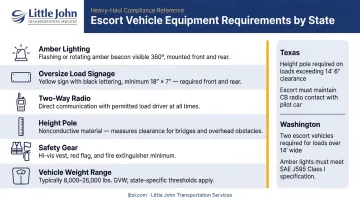
Every state has its own equipment list, but verified requirements across major states include:
- Amber lighting: Washington requires a flashing or rotating amber light visible 500 feet in all directions (360 degrees). Georgia requires an 8-inch beacon with specified visibility minimums.
- "Oversize Load" signage: Texas requires signs 5–7 ft long and 12–18 inches high with 8–10 inch black letters on yellow. Washington requires at least 5 ft by 10 in with 8-inch black letters. Remove signs when not actively escorting a permitted load.
- Two-way radio: Continuous communication with the load driver and all other escort vehicles is a standard requirement across states.
- Height pole: Required on the front escort vehicle when loads exceed height thresholds — over 17 ft in Texas, over 14 ft 6 in in Washington, generally 15 ft 6 in in Georgia. Must be nonconductive and flexible at the top, set 3–6 inches above the load's highest point.
- Safety gear: Many states also require reflective vests, emergency flags on vehicle corners, fire extinguishers, and first aid kits.
- Vehicle weight: Texas requires escort vehicles to have a GVW of 1,000–10,000 lb. Most states require single-unit vehicles within defined weight ranges — the escort vehicle itself cannot become a road hazard.
Driver Certification
Certification requirements differ by state:
| State | Requirement |
|---|---|
| Washington | 8-hour course, 80% written exam score |
| Florida | FDOT-approved 8-hour course, 80% exam score |
| North Carolina | 8-hour course, 80% exam; CDL Class A holders may skip the course; 4-year certification |
| Georgia | 8-hour course, 80% exam, 4-year certification |
| New York | Written test, 70% minimum — no out-of-state certification recognized |
| Utah | Certification required under Utah Rule R909-2 |
Reciprocity is not universal across these states. Washington recognizes certifications from Arizona, Colorado, Georgia, Minnesota, North Carolina, Oklahoma, Utah, and Virginia. Colorado accepts certifications from Arizona, Florida, Minnesota, Oklahoma, Utah, Washington, and SC&RA. New York accepts none — operators need a New York-issued card.
The Flagger Distinction
In Texas and some other states, an escort operator who directs or controls traffic flow must meet additional traffic-direction training standards — a requirement that does not apply to operators who drive escort vehicles without managing traffic. The two functions carry separate legal obligations.
Insurance Requirements
Insurance minimums differ by state and are not uniformly $1 million:
- Colorado and Minnesota: $1,000,000 required
- Utah: $750,000 combined single-limit coverage
- Washington: $100,000/$300,000/$50,000 limits
Verify the specific insurance requirements for every state on the route before departure.
Lead vs. Rear Escort: Choosing the Right Configuration
Lead (Front) Escort
The front escort travels ahead of the load to warn oncoming traffic, check route clearances in real time, and relay hazards back to the load driver before the load reaches them. On two-lane roads, it's often the only thing standing between the convoy and an oncoming vehicle that has no idea what's coming.
For over-height loads, the front escort also operates the height pole — measuring overhead clearances as the convoy approaches bridges, utility lines, and overpasses.
The rear escort follows the load to protect it from traffic approaching from behind. On multi-lane highways, where rear-end collision risk is the primary concern, a single rear escort is the standard configuration for moderate-width or moderate-length loads.
Key rear escort responsibilities include:
- Blocking lanes before the load initiates turns or lane changes
- Managing trailing traffic during slow maneuvers
- Coordinating with the lead on approach to intersections and tight curves
- Alerting the load driver to hazards closing from behind
When Both Are Required
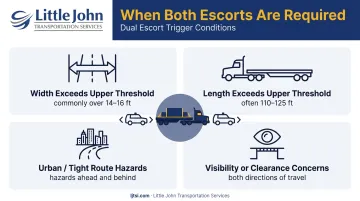
Simultaneous front and rear escorts are typically required when:
- Width exceeds the upper state threshold (commonly over 14–16 ft)
- Length exceeds the upper threshold (often 110–125 ft, depending on state)
- The route passes through urban areas, tight curves, or intersections where hazards exist both ahead and behind
- The load creates visibility or clearance concerns in both directions of travel
When both escorts are deployed, the more experienced operator should take the lead position. That's where route clearance decisions happen, often under time pressure with no margin to get it wrong.
State Variations and Special Escort Scenarios
Why State-by-State Verification Is Non-Negotiable
A load configured correctly for Texas may arrive at the New Mexico, Oklahoma, or Arkansas border with the wrong escort setup. The gap between states isn't always obvious — California's escort requirements are organized by route classification (Yellow routes, Brown routes) rather than simple statewide thresholds. A carrier running a California segment needs to know which route class applies, not just the load width.
Certification reciprocity is the most common compliance gap on multi-state moves. Key rules to verify before routing:
- New York doesn't accept pilot car certifications from any other state — it requires its own written test with a 70% minimum score
- Washington and Colorado are more widely recognized, but that recognition doesn't extend universally
- For any multi-state corridor, verify the escort driver's certification origin against each state's accepted list — never assume it transfers
The FHWA's Pilot/Escort Vehicle Operators training resource provides operational guidance, but enforceable requirements come from each state's DOT. Verify directly with state sources before planning any multi-state corridor.
Special Escort Scenarios
Manufactured/modular housing: Front and rear escorts are required in Texas for housing moves over 18 ft wide, with convoy spacing capped at 1,000 ft. Several states maintain entirely separate permit types for housing moves with their own escort placement rules.
Superloads: Washington defines a superload as anything over 16 ft wide, 16 ft high, 125 ft load length, or 200,000 lb — and moves over 200,000 lb require a written application at least 30 days before movement. New York uses similar thresholds: over 16 ft wide or high, over 160 ft long, or over 200,000 lb. These moves typically require utility coordination to raise power lines, full route surveys, and mandatory police escorts at the carrier's expense.
Common Escort Compliance Mistakes to Avoid
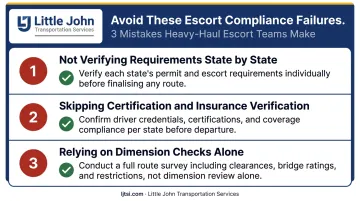
Three mistakes account for most escort compliance failures on multi-state moves:
1. Not verifying requirements state by state. Each state on the route must be verified individually. A load that sits just under the escort threshold in one state may exceed the threshold in the next — especially when dimensions fall near the boundary. The consequence isn't just a fine; it's the risk of a mid-route stop with a load that can't legally continue until the correct escort is arranged.
2. Skipping certification and insurance verification before the move. Always request proof of certification and insurance before the move begins. Confirm that the driver's certification is recognized in every state on the route — not just the state where they were trained. An escort driver certified in Washington but running a New York segment is out of compliance in New York regardless of their home-state certification. Insufficient insurance coverage creates direct liability exposure for the carrier if an incident occurs.
3. Relying on dimension checks alone without a route survey. Load dimensions determine the baseline requirement. The route determines whether that baseline changes. A two-lane highway segment, urban corridor, or low-clearance bridge can independently trigger an escort configuration that the load's dimensions alone wouldn't require. Route surveys — not just dimension checks — are the correct tool, particularly for superloads or any move through unfamiliar corridors.
For complex multi-state heavy-haul moves — industrial machinery, energy components, construction equipment — Little John Transportation Services handles escort coordination, permit acquisition, and full route engineering as part of a single managed operation. With 30+ years in heavy-haul and the #1 ranking on the ACT Transport 50 for 16 consecutive years, their team coordinates front, rear, height-pole, and police escort configurations matched to each load and corridor.
Frequently Asked Questions
Do oversized loads require escort vehicles?
Yes, once a load exceeds specific dimensional thresholds for width, height, length, or overhang. The exact triggers vary by state — New York requires an escort for loads over 12 ft wide, while Texas doesn't trigger a front escort until over 14 ft wide on two-lane roads. Every state on the planned route must be verified individually.
What equipment does an escort vehicle need to carry?
Core requirements include:
- Amber flashing lights or a rotating beacon visible from all directions
- "Oversize Load" signage with yellow background and black lettering
- Two-way radio for continuous communication with the load driver
A height pole is also required on the front escort when the load exceeds the state's height threshold, typically 14.5 to 17 ft.
What is the difference between a lead escort and a chase escort?
A lead (front) escort travels ahead of the load to warn oncoming traffic and monitor clearances — including operating the height pole for over-height loads. A chase (rear) escort follows behind to warn approaching traffic and assist with lane changes and turns. Many loads require both simultaneously.
Do pilot car drivers need to be certified?
Requirements vary by state. Washington, Florida, North Carolina, Georgia, and Utah require an 8-hour training course, a written exam, and state-issued certification. New York has its own written test and does not accept other states' certifications. A few states require only that the escort vehicle carry specific equipment.
What happens if you transport an oversized load without the required escort?
Consequences can include:
- Fines (North Carolina specifies $1,500 for a missing escort)
- Permit violations or full permit voidance
- Forced stops mid-route and civil liability if an incident occurs
Florida treats an off-route or non-compliant permit as null and void, with additional dimensional penalties up to $1,000 per vehicle.
How do escort requirements change from state to state?
Each state sets its own dimensional thresholds, equipment standards, certification rules, and insurance minimums. A load compliant in one state may need a different escort configuration in the next — particularly near state borders where thresholds shift. Route-by-route verification is the only reliable approach for multi-state moves.