Introduction
Moving an oil rig component, wind turbine blade, industrial press, or large power transformer is a coordination problem first and a freight problem second. These loads exceed federal weight limits, require state-by-state permits, and demand equipment that most carriers simply don't own. Choose the wrong partner and you're not just looking at a delayed shipment; you're looking at idle construction crews, missed installation windows, and project timelines that slip weeks or months.
The global project logistics market reached $443.60 billion in 2024 and is projected to grow at 5.6% annually through 2033 — a scale that reflects how central this freight category is to energy, infrastructure, and industrial sectors worldwide.
This guide covers the best logistics providers purpose-built for complex project cargo, what separates them from general carriers, and how to evaluate them before signing a contract.
Key Takeaways
- Project cargo demands specialized equipment, multi-state permits, and pre-shipment route planning — carrier capacity alone is not enough
- The best providers hold credentials like FMCSA HMSP, CTPAT validation, and ISO 9001 that general carriers lack
- Pre-shipment route surveys and contingency plans are non-negotiable for high-value loads
- Cross-border freight into North America requires bilingual teams and dedicated border infrastructure, not just equipment
- Evaluate providers on claim rates and compliance depth, not price alone
Project Cargo Logistics: Scope, Stakes, and Scale
Project cargo isn't defined solely by what's being shipped — it's defined by the planning required to move it safely.
TT Club defines project cargoes as "large, heavy, high-value, or complex pieces of equipment or materials that are typically critical to specific projects." In practice, that covers:
- Industrial machinery and CNC equipment
- Wind turbine blades and nacelles
- Oil rig components and BOP stacks
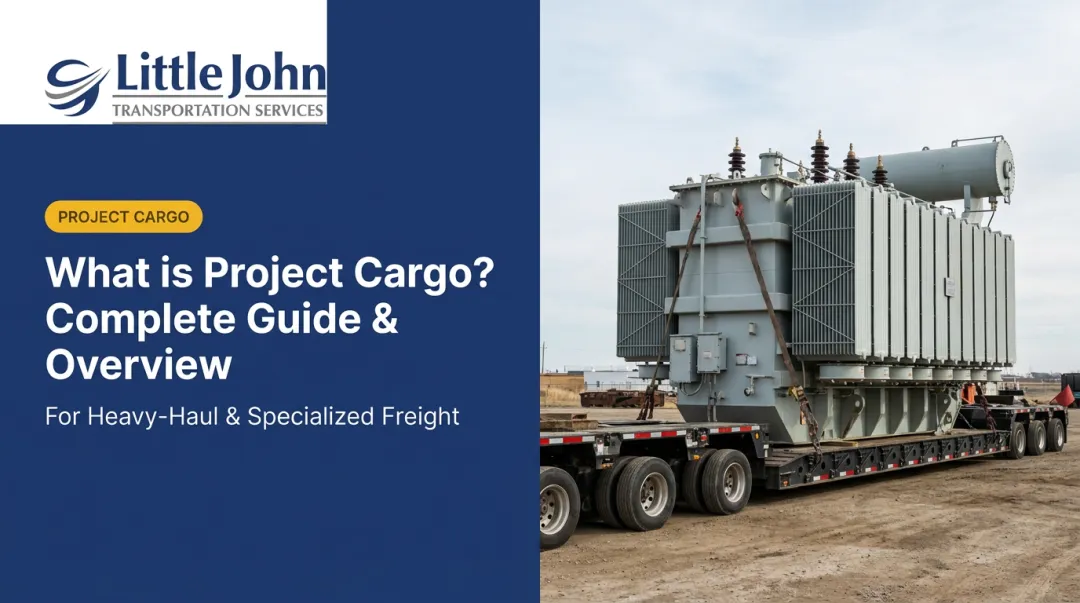
- Large power transformers and generators
- Offshore modules and prefabricated plant equipment
What makes this freight category genuinely complex isn't the weight alone. It's the combination of infrastructure risk, multi-stakeholder coordination, permit complexity, and errors that can't be undone once they happen.
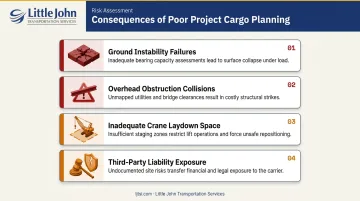
TT Club's risk documentation for project cargo at ports identifies these as documented consequences of poor planning:
- Ground instability failures during heavy lifts
- Overhead obstruction collisions during transport
- Inadequate crane laydown space at port facilities
- Third-party liability exposure from contractor coordination failures
That risk profile is also what makes this a high-stakes market to enter. At $443.60 billion globally and growing, the scale attracts both qualified specialists and generalist carriers who overstate their capabilities. When an underqualified provider takes on a project cargo move, the failures documented above become real — not theoretical. Choosing the right provider isn't a formality; it's risk mitigation from day one.
Best Logistics Solutions for Complex Project Cargo
These providers were evaluated across four criteria:
- Specialized equipment access and fleet depth
- Compliance credentials and regulatory standing
- Geographic coverage across relevant corridors
- Demonstrated experience with high-complexity freight
Little John Transportation Services
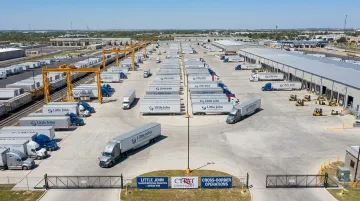
Founded in 1995 and headquartered in Russellville, Arkansas, Little John Transportation Services has spent 30 years building specifically for the cargo most carriers refuse: heavy-haul, hazmat, and U.S.–México cross-border freight. The company operates through a network of 8,000+ dedicated owner-operators and 65,000+ vetted carriers, covering 65 million+ miles annually.
What separates Little John from most carriers is credential depth. The company holds an FMCSA Hazardous Materials Safety Permit (HMSP), required for transporting highway route-controlled quantities of radioactive material, certain explosives, and bulk toxic-by-inhalation quantities. That permit demands a satisfactory FMCSA safety rating, a documented security program, and written route plans for the most sensitive cargo categories.
Every BCO (Business Capacity Owner) in the network carries a hazmat endorsement, meaning compliance is embedded at the operator level rather than managed from the top down.
For cross-border project cargo, Little John maintains bilingual teams positioned in Laredo, Monterrey, and Guadalajara, with a 50-acre CTPAT-compliant Laredo facility. Their client roster — Caterpillar, Tesla, Honda, Microsoft, Google — reflects 30+ years of industrial project experience, with an average top-client tenure of 33 years.
| Category | Details |
|---|---|
| Geographic Coverage | U.S., México, Canada; 12 locations including Laredo TX, Calexico CA, Monterrey, Guadalajara, and Ciudad de México |
| Key Certifications | FMCSA HMSP, CTPAT Validated, ISO 9001:2015, TWIC Certified, AA&E Certified, TPS Approved, EPA SmartWay Partner |
| Specialization | Heavy-haul, hazmat (all 9 classes), cross-border freight, oversized industrial and energy equipment, AA&E/defense cargo |
Mammoet
Mammoet traces its origins to 1807 in the Netherlands and is now part of SHV Holding, operating across more than 40 countries with approximately 7,000 professionals. Its focus is engineered heavy lifting and transport for energy, power, raw materials, and infrastructure projects.
Where Mammoet stands apart is its engineering-first methodology. Rather than adapting standard carrier processes to heavy freight, Mammoet designs transport solutions from the load outward: self-propelled modular transporters (SPMTs) with up to 44 tonnes of capacity per axle line, in-house route engineering, and heavy-lift vessel access for offshore cargo.
This approach makes them well-suited to single-piece loads of extreme weight or dimension that require custom transport engineering.
| Category | Details |
|---|---|
| Geographic Coverage | 40+ countries; North America included among operating regions |
| Key Certifications / Standards | ISO 9001:2015 certified (location-specific); internal SHE-Q and Safety First programs |
| Specialization | Engineered heavy lift, SPMTs, offshore and onshore project cargo, installation and decommissioning |
Barnhart Crane & Rigging
Family-owned since 1969 and headquartered in Memphis, Tennessee, Barnhart operates more than 70 North American locations including 60+ U.S. branches. Its primary industries include nuclear, refinery, chemical, steel, and power generation.
Barnhart's differentiation is integration. By combining crane rental, rigging, heavy haul ground transport, and outage planning under one provider, clients avoid the coordination risk that comes from managing multiple specialized vendors on a single project move. Crane operators are NCCCO-certified, and operations conform to OSHA 29 CFR 1926 Subpart CC and ASME B30.5. For industrial project cargo where the lift and the transport are equally complex, that single-source model reduces handoff risk substantially.
| Category | Details |
|---|---|
| Geographic Coverage | 70+ North American locations; 60+ U.S. branches |
| Key Certifications / Standards | NCCCO-certified crane operators; OSHA 29 CFR 1926 Subpart CC; ASME B30.5 compliance |
| Specialization | Crane and rigging integration, heavy haul ground transport, industrial machinery, power generation, nuclear and chemical plant work |
Sarens
Founded in 1955 in Wolvertem, Belgium, Sarens remains 100% family-owned and operates across more than 65 countries on six continents. U.S. offices are located in Texas, Florida, Louisiana, and New Jersey; Canadian offices span Alberta, Ontario, and British Columbia.
Sarens maintains a proprietary fleet that includes the SGC-250 "Big Carl," rated at 250,000 tonne-metres with a 5,000-tonne maximum load capacity and a 160-metre maximum boom. Combined with a global engineering team and integrated SPMT fleet, that capability makes Sarens the right fit for energy sector projects, offshore installations, and out-of-gauge loads that exceed conventional transport limits.

Their integrated management system follows ISO 9001:2015, ISO 14001:2015, and ISO 45001:2018.
| Category | Details |
|---|---|
| Geographic Coverage | 65+ countries; U.S. offices in TX, FL, LA, NJ; Canadian offices in AB, ON, BC |
| Key Certifications / Standards | ISO 9001:2015, ISO 14001:2015, ISO 45001:2018, VCA-P 2017/6.0 |
| Specialization | Heavy lift cranes, SPMTs, offshore installations, wind energy transport, out-of-gauge and overweight transport |
Kuehne + Nagel Project Logistics
Kuehne + Nagel operates as a freight forwarder and multimodal project coordinator rather than a heavy-lift operator. Its Project Logistics division covers heavy and oversized cargo across sea, air, road, and rail, with 950+ specialists in 60+ countries. In North America, the company maintains 60+ offices and 160+ certified customs brokers, with more than 2.5 million customs declarations filed.
For international project cargo requiring multimodal coordination — vessel chartering, 3D load simulation, purchase-order management, and complex customs compliance — Kuehne + Nagel's global agent network and continuous ISO 9001 certification since 1995 make it a strong option. The provider is best suited to clients who need end-to-end freight forwarding rather than ground-level heavy-haul execution.
| Category | Details |
|---|---|
| Geographic Coverage | Project Logistics in 60+ countries; 60+ North American offices |
| Key Certifications / Standards | ISO 9001 (continuous since 1995), ISO 14001, ISO 45001, Cargo iQ, AEO-certified customs |
| Specialization | Multimodal project freight forwarding, vessel chartering, customs and documentation management, vendor and purchase-order control |
How to Select the Right Project Cargo Provider
The Evaluation Framework
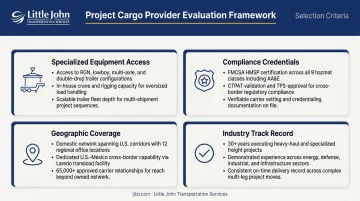
Provider selection for project cargo should run on four criteria:
- Specialized equipment access — does the provider own or control the specific trailer configurations, cranes, or SPMTs your load requires?
- Compliance credentials — FMCSA HMSP for hazmat, CTPAT for cross-border, ISO 9001 for quality management; these aren't marketing badges, they're operational prerequisites
- Geographic coverage — branch locations, border infrastructure, and in-country teams matter for multi-state and cross-border moves
- Industry track record — energy, oil & gas, industrial machinery, and automotive each have distinct freight profiles; confirm the provider has moved your cargo type before
Common Selection Mistakes
Companies choosing project cargo providers frequently make the same errors:
- Prioritizing rate over compliance depth — a general carrier without HMSP authority cannot legally move certain hazmat loads regardless of price
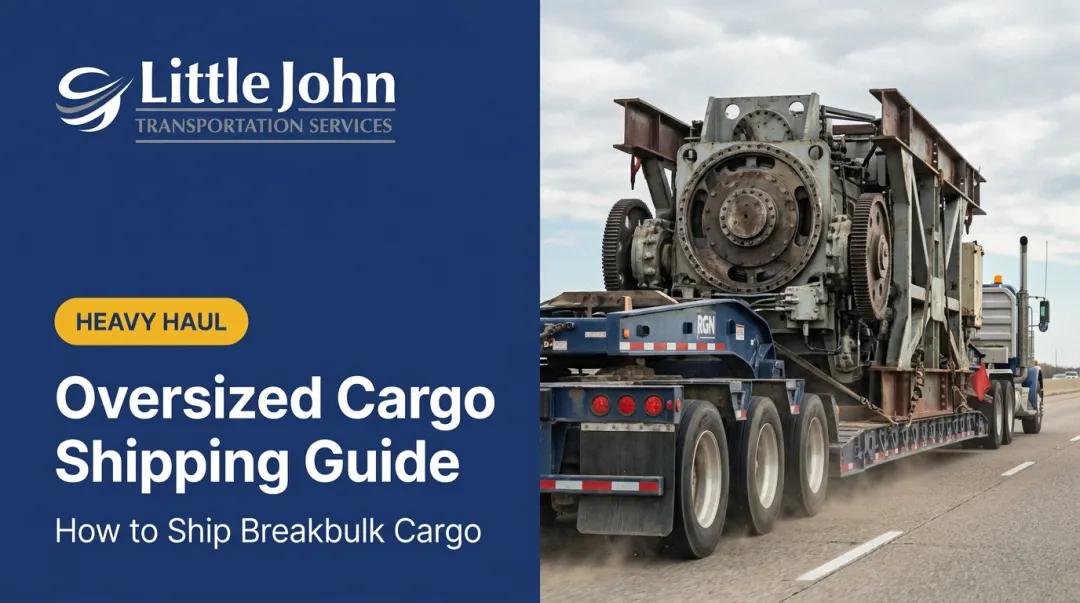
- Failing to verify equipment availability — trailer configurations like multi-axle RGNs or Schnabel trailers require confirmation before signing a contract
- Skipping permit experience checks — complex superloads require state-by-state manual DOT review; a provider without established permitting processes adds timeline risk
- Overlooking cross-border documentation capability — for U.S.–México freight, customs documentation gaps can hold cargo at the border far longer than any transit delay
What to Ask Before Signing
The mistakes above share a common cause: shippers don't ask hard questions early enough. Before signing, put every provider through this checklist:
- What is your claim-free delivery rate, and how is it calculated?
- Do you hold FMCSA HMSP authority, and are your drivers individually hazmat-endorsed?
- How do you manage permit acquisition for multi-state or superload moves?
- What contingency protocols apply if a route is blocked or equipment fails mid-move?
- Can you provide references from clients in my specific industry?
The answers tell you everything. A provider running a 99.9% claim-free delivery rate with DOT crash frequency near half the national average has the data to back the conversation. One that hesitates on any of these questions carries the risk your project can't afford.
Conclusion
For complex project cargo, the provider you choose determines whether equipment arrives on schedule and intact. No single provider is right for every freight profile — align your selection to the specific demands of your shipment:
- For heavy-haul with hazmat components, prioritize FMCSA HMSP holders with hazmat-endorsed operators
- For cross-border U.S.–México freight, require CTPAT validation, bilingual teams, and proven border infrastructure
- For offshore or extreme-dimension loads, evaluate engineered heavy-lift specialists with proprietary SPMT and crane fleets
- For international multimodal coordination, look for freight forwarders with global agent networks and AEO customs credentials
Look beyond the initial rate quote. Claim frequency, permit success rates, and compliance audit readiness tell you more about a carrier than their pricing ever will — a 99.9% claim-free rate and DOT crash frequency near half the national average are the benchmarks worth asking for.
For heavy-haul, hazmat, or cross-border freight across the U.S., México, and Canada, Little John Transportation Services has spent 30+ years building the credentials to move the freight most carriers refuse — including FMCSA HMSP holder status held by fewer than 1% of carriers, a 50-acre CTPAT-compliant Laredo facility, and 8,500+ hazmat-endorsed owner-operators. Request a quote at quotes@ljtsi.com.
Frequently Asked Questions
What is project cargo logistics?
Project cargo logistics is the end-to-end coordination of oversized, overweight, or high-complexity freight — covering route surveys, permits, specialized equipment selection, multimodal transport, and compliance management. The goal is safe, on-schedule delivery of freight that exceeds standard carrier capabilities and requires dedicated pre-shipment planning.
How is project cargo different from standard freight?
Project cargo exceeds federal weight or dimensional limits (80,000 lb GVW, 8 ft 6 in width on the National Network), requiring special permits, multi-axle or custom trailer equipment, and longer pre-shipment planning cycles. Standard truckload freight moves through established carrier networks; project cargo requires engineered transport solutions and multi-agency coordination.
What certifications should a project cargo carrier have?
Look for FMCSA HMSP for hazardous materials authority, CTPAT or C-TPAT validation for cross-border compliance, ISO 9001 for quality management systems, and individual hazmat endorsements for drivers. Each credential has a specific legal or operational function — together, they confirm a carrier is equipped to handle the most complex specialized loads.
What are the biggest challenges in project cargo management?
The most common obstacles include:
- Multi-stakeholder coordination across shippers, carriers, and agencies
- Route and infrastructure limits (bridge loads, road clearance, port access)
- Permit timelines for superloads requiring state DOT manual review
- Damage risk for high-value, irreplaceable cargo
- Cross-border customs complexity
What equipment is typically used for project cargo transport?
Common specialized equipment includes multi-axle hydraulic trailers, RGN (Removable Gooseneck) trailers, step-deck and lowboy trailers, flat-rack containers, heavy-lift cranes, and self-propelled modular transporters (SPMTs). Equipment selection depends on cargo dimensions, weight, and the infrastructure constraints along the delivery route.
How do I reduce risk and cost when shipping project cargo?
Run a pre-shipment route survey, secure permits well ahead of your move date, and verify your carrier's credentials match your cargo type. Pre-define contingency routes and centralize all documentation — permits, customs paperwork, and compliance records — before the load rolls.