Key Takeaways
- Chain of custody tracks who handled a specimen, under what conditions, and when custody changed — from collection to lab accession.
- HIPAA, CLIA, and CAP accreditation standards require it; it is not simply a best practice.
- Digital systems provide real-time traceability that paper logs cannot match, closing gaps most common in regulatory inspections.
- Mislabeling, temperature excursions, or undocumented handoffs at any transfer point can compromise diagnostic integrity.
- A certified carrier with audit-ready documentation is as critical to specimen integrity as the lab's own processes.
What Is Chain of Custody in Medical Specimen Transport?
Chain of custody in this context is the chronological, documented trail that records specimen identity, handling conditions, authorized handlers, and custody transfers from collection through laboratory analysis — a continuous record of accountability, not just a delivery confirmation.
This documentation proves a specimen reached the lab untampered, correctly routed, and within required environmental parameters — satisfying both diagnostic integrity standards and regulatory compliance obligations under frameworks like CLIA and CAP.
Chain of custody is not the same as shipment tracking. The distinction matters in practice:
- Shipment tracking shows where a specimen is at a given moment in time
- Chain of custody documents who controlled it, under what conditions, and how each transfer was authorized and verified
Tracking satisfies a logistics question. Chain of custody satisfies a legal and regulatory one — and the two are not interchangeable in audit or litigation contexts.
Why Chain of Custody Matters in Medical Specimen Transport
Regulatory Frameworks That Govern the Custody Chain
No single regulatory framework owns the complete custody chain. Each governs a distinct layer:
| Framework | What It Governs |
|---|---|
| CLIA (42 CFR 493.1232, 493.1242) | Positive specimen identification, integrity, written transport procedures, receipt timestamps, and preanalytic quality assessment |
| CAP | "Chain-of-custody specimen collection and handling" and "specimen transport and tracking" are explicitly listed under Laboratory General in the 2025 CAP checklist summary |
| HIPAA | Secure handling of PHI associated with specimens; ePHI transmission security under the Security Rule |
| DOT/PHMSA | Hazard classification, packaging, marking, and documentation for specimens classified as infectious substances |
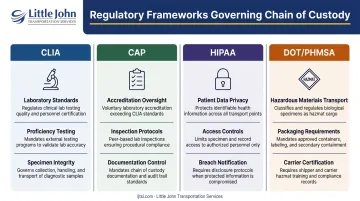
During CLIA surveys, CMS Appendix C directs inspectors to review procedures, requisition forms, receipt timestamps, rejected-specimen condition and disposition, referral lab credentials, transport-delay monitoring, corrective action records, and staff knowledge. These are the exact documentation components a rigorous chain of custody process produces.
Compliance with one framework does not establish compliance with the others. A shipment can be correctly packaged under DOT rules yet fail CLIA identity controls — or preserve specimen integrity while mishandling protected health information.
The Clinical and Diagnostic Stakes
A 2022 meta-analysis covering 16,118,499 blood specimen requests found a pooled rejection rate of 1.99%, with documentation and labeling errors accounting for 7.31% of those rejections. A separate 2016 study published in the American Journal of Clinical Pathology identified "lack of chain of custody upon specimen drop-off" among operating-room specimen defects — pointing directly at the collection-to-laboratory boundary as a high-risk handoff point.
Contested diagnostic results — in oncology, toxicology, or infectious disease — require documented proof that the specimen was handled properly from collection through accessioning. Without that proof, the result becomes clinically indefensible regardless of the laboratory's analytical quality.
What Breaks Down Without It
Common failure modes when chain of custody is treated informally:
- Specimen mislabeling and misrouting that go undetected until accession
- Temperature excursions during transit that aren't visible on delivery
- Undocumented intermediate handoffs that create traceability gaps
- No way to determine where accountability broke down when a result is disputed
Chain of Custody as a Provider Relations Tool
Referring providers increasingly evaluate laboratory partners not only on turnaround time and test menus, but on the transparency of the logistics operation connecting them. Laboratories that can produce real-time tracking data and documented chain of custody records build provider confidence that those relying on paper-based systems cannot match. The labs that invest in documented custody processes don't just satisfy auditors — they become harder to replace as partners.
How the Chain of Custody Process Works
The process spans five stages: pre-transport authorization, collection, monitored transit, documented handoffs, and final delivery confirmation. Each stage builds on the last — a gap in any one of them can compromise the entire chain.
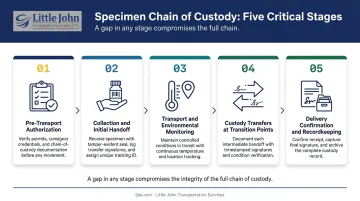
Step 1: Pre-Transport Planning and Authorization
Before transport begins:
- Authorized parties are confirmed and documented
- Specimen type and handling requirements are specified
- Packaging and temperature parameters are defined per the ordered test
- Required regulatory documentation — requisition forms, transport manifests, and any DOT hazardous materials paperwork — is prepared
For DOT classification, the shipper must determine whether a specimen qualifies as an exempt human specimen, Category B (UN 3373), or Category A (UN 2814/2900) before selecting documentation and packaging. "Diagnostic specimen" is not a sufficient classification on its own.
Authorization and a documented handling plan must be in place before a courier is dispatched — that sequence cannot run in reverse.
Step 2: Collection and Initial Custody Handoff
At the point of collection:
- The specimen is identified via barcode or unique identifier
- Its condition is assessed and documented
- Custody is formally transferred from the collecting clinician or facility to the courier with a timestamped electronic or signed record
This is the first link in the chain. How it's documented sets the standard — and the expectations — for every handoff that follows, including the environmental controls in transit.
Step 3: Transport and Environmental Monitoring
During transit:
- GPS tracking provides continuous location data and route documentation
- Temperature monitoring equipment records environmental conditions in real time
- Deviations trigger automated alerts so exceptions are identified before specimens are compromised
Temperature requirements vary by ordered test, not by specimen type alone. CDC shipping guidance defines bands of 15–25°C (ambient), 2–8°C (refrigerated), ≤−20°C (frozen), and ≤−70°C (deep frozen) — but the correct band is determined by the specific ordered test, not specimen type alone. Applying the wrong temperature range constitutes a chain of custody failure.
Step 4: Documented Custody Transfers at Each Transition Point
Every change of hands — at transfer hubs, intermediate stops, or between courier shifts — requires a documented custody transfer recording:
- Individuals involved
- Time and location
- Specimen condition at handoff
These intermediate handoffs are the most common source of chain of custody gaps — and the most commonly underestimated. Each one carries the same documentation obligation as the initial pickup and the final delivery.
Step 5: Delivery Confirmation and Post-Delivery Recordkeeping
Upon arrival at the laboratory:
- The receiving party's identity is verified
- Specimen condition is assessed
- A delivery confirmation with timestamp and electronic signature completes the chain
Post-delivery, all records are retained in an accessible, audit-ready format. CLIA regulations under 42 CFR 493.1105 require at least two years for most test records; pathology reports require ten years. State rules and litigation holds can extend these periods further.
Key Factors That Affect Chain of Custody Quality
Documentation Method: Digital vs. Paper
Paper logs can be lost, damaged, or incomplete. More critically, they provide no real-time visibility. Digital systems with electronic signatures, barcode scanning, and automated audit trails eliminate the most common documentation gaps.
CLIA accepts both manual and electronic systems where its requirements are met — neither is categorically required. The evaluation criteria are completeness, accuracy, retrievability, and auditability, regardless of medium. However, electronic systems make it substantially easier to demonstrate all four.
Temperature and Environmental Controls
For many specimen types, maintaining the correct temperature range throughout transport is as important as the documentation itself. Temperature excursions can compromise specimen integrity in ways that are not visible on delivery. A study of plasma from 26 participants found that 24 hours at 21°C produced mean analyte differences of nearly 20% for certain biomarkers compared to refrigerated storage — yet the specimens would appear visually acceptable.
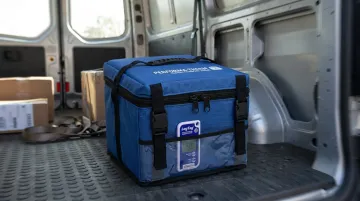
Real-time monitoring and logged environmental data are core components of the chain of custody record, not supplementary safeguards.
Number of Custody Transfer Points
Each handoff introduces risk, and those risks compound when routing is inefficient. Reducing unnecessary transfers through direct routing and limiting intermediaries lowers the probability of:
- Documentation gaps
- Misrouting incidents
- Condition deviations going undetected
Carrier Certifications and Compliance Credentials
The logistics carrier is a critical link in the chain. When evaluating carriers for medical specimen or pharmaceutical freight, relevant credentials include:
- ISO 9001:2015: Documents a carrier's quality management system. Note that it does not itself certify medical specimen handling or temperature control
- FMCSA Hazardous Materials Safety Permit (HMSP): Required for specific high-risk materials and quantities under 49 CFR 385.403; held by fewer than 1% of U.S. carriers
- IATA Packing Instruction 650: Governs air packaging of Category B (UN 3373) specimens directly; relevant for any air-transported biological substance
- CTPAT validation: Addresses cross-border security and cargo facilitation — not specimen integrity standards
Little John Transportation Services holds ISO 9001:2015, FMCSA HMSP, and CTPAT certifications, with GDP-compliant cold chain capabilities and 100% thermally mapped equipment — credentials that pharmaceutical and life sciences shippers should verify with any transport partner before committing freight.
Technology Integration
The quality of the chain of custody record is directly proportional to the technology supporting it. Carriers using integrated mobile applications with barcode scanning, electronic signatures, and GPS-linked condition logging provide a demonstrably stronger audit trail than those relying on manual processes.
Common Issues and Misconceptions
Three misunderstandings come up consistently in audits and inspections — and each one creates real compliance exposure.
| Misconception | Reality |
|---|---|
| GPS tracking is chain of custody | Tracking confirms location. Chain of custody documents possession, condition, authorization, and accountability at every transition point. These are not the same thing — and CLIA and CAP inspectors will treat the gap accordingly. |
| Chain of custody only applies to pickup and delivery | Intermediate handoffs carry the same documentation requirement as the first and final leg. Missing records at any transfer point creates the same traceability failure as no documentation at all. CAP checklist items GEN.40511 and GEN.40530 cover transport quality management at every stage, not just receipt. |
| Chain of custody is paperwork assembled after delivery | Documentation must be generated contemporaneously — at the moment of each transfer, not reconstructed afterward. Auditors evaluate the timing of records. A file compiled after the fact does not satisfy the requirement, regardless of how complete it appears. |
Frequently Asked Questions
When is chain of custody documentation required?
Chain of custody documentation is required whenever regulated, sensitive, or diagnostically critical specimens are transported — including those subject to HIPAA, CLIA, CAP, or DOT regulations. It's also required when a diagnostic result may face dispute, legal challenge, or accreditation review.
What documentation is required for a proper chain of custody?
Core elements include:
- Specimen identification records
- Timestamped pickup and delivery confirmations
- Signatures or electronic verification at each handoff
- Temperature and condition logs throughout transport
- Applicable regulatory paperwork (DOT hazmat documentation, HIPAA-compliant requisition forms)
What is a secure chain of custody?
A secure chain of custody restricts specimen handling to authorized individuals, documents every custody transfer, and continuously monitors environmental conditions. All access is controlled, and the resulting records are tamper-evident and audit-ready.
What is the difference between chain of custody and basic shipment tracking?
Basic tracking shows where a shipment is at a point in time. Chain of custody documents who had control, under what conditions, and how each transfer was authorized and confirmed. Chain of custody satisfies regulatory and legal accountability requirements that tracking data alone cannot meet.
What regulatory standards govern chain of custody in medical specimen transport?
Key regulatory frameworks include:
- HIPAA: Governs secure handling of PHI associated with specimens
- CLIA and CAP: Require labs to demonstrate control over pre-analytical handling, including transport
- DOT: Applies to specimens classified as hazardous materials
- State health departments: May impose additional jurisdiction-specific requirements
What happens if the chain of custody is broken during specimen transport?
A break in chain of custody can trigger specimen rejection by the receiving laboratory, expose both the shipper and logistics provider to liability, and flag a deficiency in CLIA or CAP accreditation inspections that requires documented corrective action. Without a complete custody record, any subsequent diagnostic result is open to challenge.