According to the Bureau of Transportation Statistics, U.S.-Canada freight totaled $712.8 billion in 2025, with trucks carrying 55.7% of that value — roughly $396.8 billion. That's an enormous volume of freight, and the ones that clear quickly share one thing in common: complete, accurate documentation filed before the truck reaches the border.
CUSMA (the successor to NAFTA) eliminates most duties on qualifying U.S.-manufactured goods, but only when the right paperwork travels with the load. Specialized freight — hazmat, oversized equipment, temperature-sensitive cargo — adds another layer of compliance that standard carriers simply aren't equipped to handle.
This guide covers everything: required documents, the customs clearance process, duties and taxes, carrier credentials, and the mistakes that cause the most costly delays.
Key Takeaways
- Every commercial U.S.-to-Canada shipment requires CBSA customs entry — no exceptions
- Core documents: Bill of Lading, Commercial Invoice, and Canada Customs Invoice (for commercial shipments)
- CUSMA duty-free status requires a certification of origin; without one, standard duties apply even on qualifying goods
- PARS pre-arrival filing lets brokers clear shipments before the truck reaches the border
- Carriers holding C-TPAT validation, FAST certification, and CSA certification access dedicated expedited lanes
What U.S.-to-Canada Freight Shipping Actually Involves
"Just driving across" is a common misconception among first-time cross-border shippers. Commercial freight doesn't work that way.
Every load requires:
- A customs entry filed by an importer of record
- Coordination with a licensed customs broker
- Advance document submission to CBSA
Who Is the Importer of Record?
The importer of record is the party legally responsible for ensuring the shipment complies with Canadian import laws and for paying any applicable duties.
Either the U.S. shipper or the Canadian receiver can assume this role. In practice, the Canadian consignee takes it on more often — they already have a customs broker in place and hold a Canadian Business Number for CBSA transactions.
That designation carries real weight. As of January 1, 2026, CBSA updated its importer of record framework: the importer is now the primary verification contact and carries direct liability for recordkeeping, corrections, and duties. Using a broker doesn't transfer that responsibility.
Required Documentation for Cross-Border Freight to Canada
Documentation errors are the leading cause of CBSA inspection holds and clearance delays. Here's what every commercial shipment needs.
Bill of Lading (BOL)
The BOL is the foundational contract between the carrier and shipper, required by both the customs broker and border agents. It must match the commercial invoice exactly — discrepancies between the two documents trigger holds.
Commercial Invoice
CBSA agents review this document more closely than any other in the shipment. It must include:
- Vendor's full legal name and address
- Consignee information
- Detailed description of each item (not vague terms like "industrial parts" or "machinery components")
- Quantity, unit price, and total declared value
- Country of origin for each line item
CBSA agents are trained to flag generic descriptions. "Steel components" will get more scrutiny than "cold-rolled steel angle brackets, ASTM A36, 2″ x 2″ x ¼″."
Canada Customs Invoice (CCI / Form CI1)
CBSA requires either a complete commercial invoice containing all required data elements, or a standard commercial invoice supplemented by Form CI1. For shipments with a value for duty not exceeding CAD $2,500, a supporting document may suffice.
CBSA retains the right to request additional documentation on inspection. If requirements are unclear, file the full CI1.
HS Codes
All commercial shipments to Canada require tariff classification. Canada uses 10-digit codes — the first six digits are the international HS code, digits seven and eight are Canadian tariff items, and the final two are statistical suffixes. Using the complete 10-digit code reduces hold risk. Use the Canada Tariff Finder to verify classifications before filing.
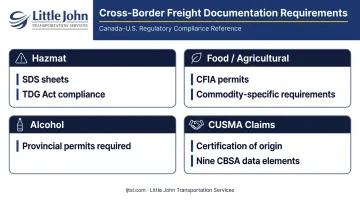
Additional Documents by Freight Type
| Freight Type | Additional Requirements |
|---|---|
| Hazmat | Safety Data Sheets (SDS); compliance with Canada's Transportation of Dangerous Goods (TDG) Act |
| Food / Agricultural | Permits or import requirements from the Canadian Food Inspection Agency (CFIA); vary by commodity |
| Alcohol | Provincial permits required |
| CUSMA duty-free claims | Certification of origin using CBSA's nine required data elements |
How the Customs Clearance Process Works
Customs clearance for U.S.-to-Canada freight begins before the truck leaves the origin facility. The quality of documentation determines whether a load clears in hours or sits for days.
Pre-Arrival Filing (PARS)
The Pre-Arrival Review System allows a customs broker to submit accounting documentation to CBSA electronically before the truck departs. The highway carrier transmits cargo and conveyance data; CBSA must receive and validate it at least one hour before arrival at the port of entry.
When the driver arrives, they present the BOL, carrier documentation, and the PARS bar-coded Cargo Control Number. CBSA links that to the pre-filed data and processes release — rather than starting from scratch at the border.
PARS is standard practice for commercial FTL and LTL freight. When both the broker and carrier coordinate tightly, the truck arrives with release already in motion — which is exactly what determines how quickly it moves through the port of entry.
Border Crossing and Inspection
At the port of entry, CBSA officers verify pre-clearance status. Shipments get flagged for physical examination for three main reasons:
- Missing or inconsistent documentation triggers manual review
- Cargo classified as high-risk receives mandatory secondary inspection
- Random selection applies regardless of shipment history
A physical examination can add hours — sometimes days — to transit. This is where trusted trader credentials make a measurable difference.
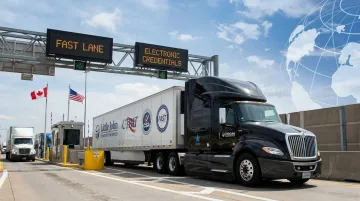
C-TPAT validated carriers receive fewer examinations and front-of-line treatment from CBP on the U.S. side. FAST-certified carriers and drivers access dedicated expedited lanes at designated Canadian ports of entry, separate from standard commercial queues.
Little John Transportation Services holds C-TPAT validation, FAST certification, and CSA (Customs Self-Assessment) certification through the Landstar Canada network. In practice, that means qualifying shipments move through dedicated FAST lanes rather than standard queues — a concrete difference when every hour of border dwell counts.
Post-Entry Release and Delivery
Once CBSA releases the shipment, the carrier proceeds to the Canadian consignee. The customs broker files final entry documents and calculates duties and taxes owed. Keep records clean through delivery — brokers may issue a delay notification if they need additional documentation post-release.
Duties, Taxes, and CUSMA: What Businesses Owe at the Border
CUSMA and Duty Elimination
CUSMA replaced NAFTA on July 1, 2020. U.S.-manufactured goods, or goods made with qualifying U.S.-origin materials, can enter Canada duty-free — but only when a valid certification of origin accompanies the shipment.
CBSA waives the certification requirement when the value for duty does not exceed CAD $3,300. Above that threshold, a formal certification using CBSA's nine required data elements must travel with the load. Without it, CBSA assesses standard duties regardless of origin eligibility.
Canadian Sales Tax on Imports
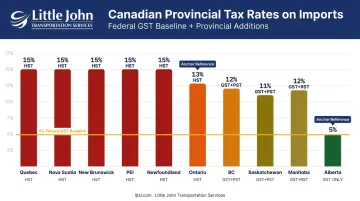
Federal GST applies to all commercial imports at 5%. Provinces add their own tax layer:
| Province | Rate | Structure |
|---|---|---|
| Ontario | 13% | HST |
| New Brunswick | 15% | HST |
| Newfoundland & Labrador | 15% | HST |
| Nova Scotia | 14% | HST (as of April 1, 2025) |
| PEI | 15% | HST |
| British Columbia | 5% + 7% | GST + PST |
| Manitoba | 5% + 7% | GST + RST |
| Saskatchewan | 5% + 6% | GST + PST |
| Alberta | 5% | GST only |
Tax is calculated on the Canadian-dollar equivalent of the declared value plus any applicable duties.
The 2025 Tariff Environment
Those baseline taxes now sit on top of a volatile trade policy layer. In March 2025, the U.S. imposed 25% tariffs on Canadian imports. Canada responded with 25% counter-tariffs on CAD $30 billion of U.S. goods, followed by a second round covering CAD $29.8 billion — including CAD $12.6 billion in steel and CAD $3 billion in aluminum.
Canada announced partial removal of counter-tariffs on August 22, 2025, effective September 1. As of Canada's official counter-tariff list updated June 19, 2026, 25% counter-tariffs remain active on U.S. steel, aluminum, and automobiles.
For businesses shipping industrial or manufacturing goods, verify your HS code classifications against the current CBSA tariff schedule before each shipment. Classification errors that were minor inconveniences before 2025 can now mean unexpected five-figure duty bills.
Brokerage Fees and DDP
With tariffs, counter-tariffs, and multi-province tax rates all feeding into your final number, brokerage fees are one more cost that catches shippers off guard. They're separate from duties and taxes — factor them into your total landed cost calculation from the start.
Delivered Duty Paid (DDP) arrangements, where the shipper collects and remits duties upfront, eliminate surprise charges at delivery and improve the experience for Canadian buyers.
Choosing the Right Freight Mode and Carrier
Primary Freight Modes
- Trucking (FTL/LTL): Handles 55.7% of U.S.-Canada freight value. Most flexible for door-to-door delivery across any lane.
- Rail: Cost-effective for high-volume bulk commodities over long distances. Adds transit time and requires intermodal coordination.
- Air: Reserved for time-critical, high-value, low-volume cargo. Premium cost relative to weight.
For most commercial freight — machinery, industrial equipment, chemicals, automotive components — truck is the practical choice. Once you've confirmed the mode, transit time is the next variable to plan around.
Typical Transit Times by Lane
These are driver-transit benchmarks, excluding customs clearance:
- Toronto – New York: ~2–3 days
- Chicago – Montreal: ~3–4 days
- Los Angeles – Vancouver: ~5–6 days
Pre-cleared shipments with complete documentation typically add same-day to two business days for customs. Incomplete documentation can extend that by a week or more.
What to Verify in a Cross-Border Carrier
Not all U.S. carriers are equipped for international freight. Before booking, confirm:
- FMCSA Satisfactory safety rating
- C-TPAT validation, which reduces inspection exposure on the U.S. side
- FAST certification for expedited lane access at Canadian ports of entry
- CSA certification to streamline CBSA customs processing
- FMCSA Hazardous Materials Safety Permit (HMSP) — required for hazmat loads and held by fewer than 1% of carriers
- Specialized trailer fleet — step decks, lowboys, RGNs for oversized or heavy-haul freight
- PARS filing capability — carriers unfamiliar with PARS miss the pre-arrival window and create clearance delays
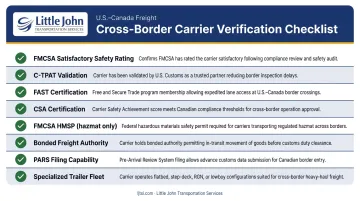
Little John Transportation Services carries C-TPAT validation, FAST and CSA certifications, and the FMCSA HMSP for hazmat freight — meeting every credential on this checklist. The company also operates 2,700+ specialized trailers, including step decks, RGNs, lowboys, and flatbeds, for cross-border heavy-haul and oversized loads.
Common Cross-Border Freight Mistakes
Documentation Errors That Cause Holds
Three documentation issues consistently trigger CBSA inspection:
- Vague or mismatched item descriptions — The BOL and commercial invoice must match and be specific enough for CBSA to classify, value, and examine the goods
- Missing or incorrect HS codes — Incorrect classification triggers holds and, in the current tariff environment, can result in unexpected duties
- Missing CUSMA certification of origin — The consignee gets charged duties they didn't owe, with no way to recover those costs afterward
Use the Canada Tariff Finder to verify 10-digit HS codes before every filing. Include the CUSMA origin certification as a standard document in every qualifying shipment package.
Undervaluation
Declaring goods below their actual transaction value to reduce duties is customs fraud. CBSA identifies undervaluation as an offence that can lead to shipment seizure, monetary penalties, and prosecution — plus heightened scrutiny on every future shipment from that importer. Declare actual value. The penalties are severe, and CBSA's pattern-flagging means one violation follows your shipments indefinitely.
Carrier selection is where documentation compliance meets execution. Even perfect paperwork fails if your carrier can't file PARS correctly or lacks the credentials to cross with your freight class.
Carrier Credential Checklist
Before booking any carrier for U.S.-to-Canada freight, verify:
- ✅ FMCSA Satisfactory safety rating
- ✅ C-TPAT validation
- ✅ FAST certification
- ✅ CSA certification
- ✅ FMCSA HMSP (hazmat loads only)
- ✅ Bonded freight handling authority
- ✅ PARS filing capability confirmed with their team
- ✅ Specialized trailer fleet (for oversize/heavy-haul loads)
Frequently Asked Questions
Do I have to pay customs for a package from the USA to Canada?
All commercial shipments crossing into Canada are subject to CBSA customs review. Duties may or may not apply depending on the goods' HS classification and CUSMA eligibility — but Canadian GST, HST, or PST typically applies to most commercial imports. The CUSMA courier de minimis thresholds (CAD $40 duty-free, CAD $150 duty-free) apply only to qualifying courier imports, not standard FTL/LTL freight.
What documents do I need to ship from the USA to Canada?
At minimum: a Bill of Lading, a Commercial Invoice with item descriptions and declared values, HS codes for all line items, and a certification of origin for any CUSMA duty-free claims. A Canada Customs Invoice (Form CI1) is required when the commercial invoice is missing CBSA-required data elements. Hazmat, food, alcohol, and other restricted goods require additional permits.
Do I need a customs broker to ship freight from the U.S. to Canada?
A broker isn't legally mandatory, but using one is strongly recommended for commercial freight. Brokers file PARS pre-arrival documentation, manage classification and valuation under CBSA rules, and handle duty payment on behalf of the importer of record. The importer remains legally responsible for the accuracy of all declarations regardless.
What is CUSMA and how does it affect duties on U.S.-to-Canada shipments?
CUSMA (the successor to NAFTA, effective July 1, 2020) allows most U.S.-manufactured goods to enter Canada duty-free. To claim that benefit, a valid certification of origin using CBSA's nine required data elements must accompany the shipment — otherwise, standard duties apply even on qualifying goods.
How long does it typically take to ship freight from the U.S. to Canada?
Major lanes range from 2–3 days (Toronto–New York) to 5–6 days (Los Angeles–Vancouver), excluding customs clearance. Pre-cleared shipments with complete documentation add same-day to two business days. Incomplete documentation can extend clearance by a week or more.
What types of freight are restricted or prohibited from entering Canada?
Prohibited items include counterfeit goods, unlicensed firearms and explosives, and unlicensed pharmaceuticals. Restricted categories — requiring additional permits before shipping — include food and agricultural products (CFIA), alcohol (provincial permits), hazmat (TDG Act), and cosmetics flagged under Health Canada's Cosmetic Ingredient Hotlist.