This scenario isn't rare. It's Tuesday at a busy U.S. port.
Drayage — the short-haul movement of containers from port to warehouse, rail yard, or distribution center — is where import supply chains succeed or fall apart. The distances are small. The stakes are not. This article covers the core operational, logistical, and compliance challenges that occur between the port gate and the freight hub, and the strategies experienced operators use to prevent costly disruptions.
Key Takeaways
- Drayage failures at the first-mile handoff ripple through every downstream stage of the supply chain
- Port congestion, chassis shortages, driver availability gaps, and compliance errors are the primary causes of drayage breakdowns
- Demurrage and detention fees start accumulating the moment a container is available, regardless of when the shipper is notified
- Specialized cargo (hazmat, oversized, cross-border) requires certifications most standard drayage carriers don't hold
- Pre-planning before vessel arrival is the single most effective lever for reducing drayage costs and delays
Why Drayage Is the Most Critical Link in Your Supply Chain
Drayage is the over-the-road movement of intermodal containers between ports, rail terminals, warehouses, or freight hubs. Most moves cover under 50 miles. That proximity creates a false impression of simplicity.
The U.S. drayage market operates at massive scale. The Port of Long Beach processed nearly 10 million TEUs in 2025, the Port of New York/New Jersey handled 8.9 million TEUs, and Port Houston recorded 4.3 million TEUs — its best year on record. According to S&P Global, more than 12,000 drayage carriers and 49,000 drivers serve the U.S. market. Every container those ports process requires a drayage move before it reaches its next destination.
At that volume, even a small failure rate translates to thousands of disrupted shipments. When drayage breaks down, the damage doesn't stay contained.
The First-Mile Consequence Chain
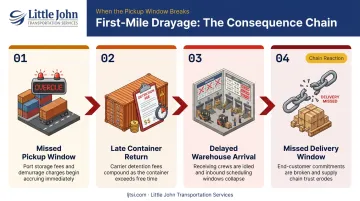
- Missed pickup windows trigger port storage charges on top of accumulating demurrage
- Late container returns generate detention fees from the ocean carrier
- Delayed arrivals disrupt warehouse receiving schedules and downstream distribution commitments
- Missed delivery windows create ripple effects through just-in-time manufacturing or retail replenishment
Drayage sets the tempo for everything that follows. The fees accumulate fast, but the harder cost is the downstream disruption — missed production runs, blown retail windows, and customer relationships that take far longer to rebuild than a single container takes to move.
The Core Challenges of Port-to-Hub Drayage
Port Congestion and Scheduling Conflicts
Import surges push terminals past their operational capacity, forcing drayage trucks into extended wait queues. Terminal appointment systems are unforgiving: miss a gate window and a driver loses an entire day's turn.
Port Houston reported an average truck turn time of approximately 40 minutes in 2025, a strong benchmark. That number degrades sharply during congestion events, when volumes spike and equipment bottlenecks compound.
Visibility makes it worse. OSHA guidance for marine terminals restricts electronic device use while operating equipment, which cuts off real-time driver communication inside port perimeters. Dispatchers fall back on manual terminal website queries or driver check calls — a slow, error-prone method that contributes directly to missed windows.
Chassis Shortages and Equipment Availability
Without a chassis, a container doesn't move — period.
IANA reports more than 730,000 registered chassis in North America across 100+ equipment providers. But registration counts don't reflect real-time availability at specific terminals during peak periods. When chassis pools run short (and they do, particularly during import surges), containers sit at the terminal accruing charges while trucks and drivers wait idle.
Parts and labor constraints have extended chassis maintenance timelines across the industry. Chassis manufacturers depend on components from at least 20 vendors, making fleet recovery during shortages slow and unpredictable.
Driver Shortages and Documentation Gaps
The drayage driver pool faces structural pressure. CDL and TWIC requirements create a higher credential bar than standard trucking, while unpredictable port wait times make drayage less attractive than long-haul routes with more predictable schedules. This tightens capacity precisely when volume surges demand more of it.
Documentation adds another layer. Before a pickup can happen, all of the following must align on container availability, customs release status, and documentation accuracy:
- Steamship line
- Port authority
- Freight forwarder
- Customs broker
- Drayage carrier
A single missing document or status mismatch can freeze a pickup that everyone assumed was on track.
The Hidden Cost Spiral: Demurrage, Detention, and Accessorial Fees
The clock starts before most shippers know it's running.
Demurrage is charged by the port or terminal when a container isn't picked up within the allowed free-time window. Detention is charged by the ocean carrier when the container isn't returned after the permitted use period. Both can run simultaneously.
What the Numbers Look Like
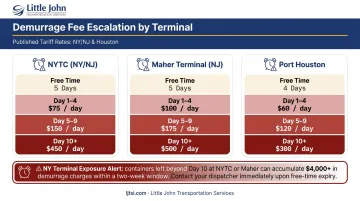
Current published tariffs show how quickly these charges escalate:
| Terminal | Free Time | Day 1–4 Rate | Day 5–9 Rate | Day 10+ Rate |
|---|---|---|---|---|
| NYTC (NY/NJ) | 4 working days | $221/day | $284/day | $475/day |
| Maher Terminal (NJ) | 4 working days | $222/day | $291/day | $507/day |
| Port Houston | 7 days (loaded imports) | $53.92/day | $80.88/day | $107.83/day |
At New York terminals, a container stuck for two weeks due to chassis unavailability and documentation delays can accumulate $4,000+ in demurrage alone before the carrier even shows up. During congestion events, circumstances entirely outside the shipper's control can consume free time — and the meter runs regardless.
Those line items are just the start. Drayage operations carry a separate layer of accessorial charges that stack on top — and in high-congestion scenarios, they hit simultaneously.
Accessorial Fees That Compound the Damage
- Chassis split fees — when the container and chassis come from different equipment pools, requiring repositioning
- Hazmat handling surcharges — NYTC charges $57.24 per hazardous unit and $580.63 for Class 1/Class 7 materials
- After-hours gate fees: Port Houston applies an extended-hours surcharge when fewer than 75 containers are processed in a window
- Overweight charges: triggered when container weights exceed standard axle limits
- Storage fees — separate from demurrage, assessed by the terminal for physical space
On a move that goes sideways — chassis shortage, customs hold, missed appointment — these fees don't just add up. They can overtake the base drayage rate entirely.
The Prevention Logic
The FMC's 2024 billing rule now requires invoices to identify free-time start and end dates, applicable rates, and container availability dates — giving shippers better grounds to dispute charges applied before notification. But the better strategy is avoiding the exposure entirely: confirm chassis availability, pre-file customs documents, and commit drayage carriers before the vessel arrives.
Specialized and Hazmat Cargo: When Standard Drayage Isn't Enough
A meaningful share of cargo moving through U.S. ports — chemicals, industrial materials, energy components, defense freight — requires specialized handling that most standard drayage carriers simply aren't certified to provide.
The Regulatory Bar Is Much Higher
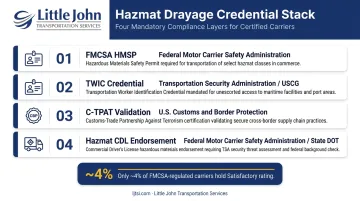
For hazmat drayage from ports, the credential requirements include:
- FMCSA Hazardous Materials Safety Permit (HMSP): required for highway-route-controlled quantities of Class 7 radioactive material, Division 1.1/1.2/1.3 explosives, and specified poison-inhalation-hazard materials. FMCSA data confirms only 32,490 carriers hold a Satisfactory safety rating out of 757,652 FMCSA-regulated carriers — and the HMSP pool is a fraction of that
- TWIC (Transportation Worker Identification Credential): required for unescorted access to secure areas of maritime facilities
- CTPAT validation: CBP-validated security practices that reduce inspection frequency and enable priority processing at ports
- Hazmat endorsements on CDL: mandatory for drivers transporting regulated dangerous goods
A single gap in these credentials can result in cargo being refused at the port gate. There's no work-around once the truck arrives without proper documentation.
Oversized and Heavy Industrial Cargo
Credential gaps aren't the only way a port move stalls. Oversized and heavy industrial freight — machinery, energy components, military equipment — creates a separate category of risk that credentials alone don't solve.
Container terminals were designed around standard ISO containers. When this freight arrives, it requires specialized trailers, advance permits, and route engineering that must be coordinated before the vessel docks.
Improper planning here can make cargo physically immovable from the terminal — requiring remediation equipment and emergency permitting to resolve.
Where Little John Transportation Services Fits
Little John Transportation Services holds the credentials most carriers can't match: 8,500+ BCOs who are 100% hazmat-endorsed, FMCSA HMSP certification, TWIC-credentialed personnel, and CTPAT validation. That's the complete requirement set for the cargo most carriers decline before the call ends.
Their intermodal and drayage service line — backed by a 65,000+ carrier network and five Class I rail partnerships — treats port and inland drayage as a single coordinated move, not a chain of disconnected vendor handoffs.
Thirty years moving chemical, energy, military, and cross-border loads means compliance is already embedded in operations, not treated as a case-by-case exception.
Proven Strategies to Reduce Drayage Bottlenecks
Pre-Plan Before the Vessel Arrives
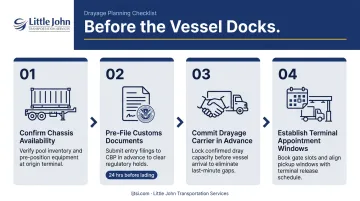
The most effective drayage operations are set in motion before the ship docks:
- Confirm chassis availability at the relevant terminal pool — don't assume equipment will be there
- Pre-file customs documents — CBP requires Import Security Filing data no later than 24 hours before cargo is laden aboard a U.S.-bound vessel; use that window to get ahead of clearance
- Commit your drayage carrier in advance, not after cargo availability confirmation
- Establish terminal appointment windows before the vessel arrives, not after notification
Shippers who treat drayage as a reactive task, triggered only by a container availability notice, face the greatest exposure to demurrage charges, chassis delays, and cascading schedule failures.
Prioritize Carriers with Real Visibility
GPS-equipped chassis and carrier dispatch software reduce the information gaps that cause preventable delays. When evaluating drayage partners, ask specifically:
- Do they offer proactive status communication, or just reactive check-in calls?
- Can they track containers through the terminal operating system in real time?
- Who contacts you when a terminal changes an appointment window at midnight?
The last question matters most. No technology platform replaces a carrier who answers the phone at 2 a.m. with actual decision-making authority.
Choose Carriers Staged Near the Port
Drayage turn times improve when the carrier has drivers, equipment, and operational teams positioned near the terminal rather than deadheading from distant locations. A carrier with no physical presence near a major port gateway will underperform one with local staging and established terminal relationships. Ask prospective drayage providers where their operational teams are located relative to your primary import ports — and whether they can show you proof of local activity, not just a service area map.
What to Look for in a Port Drayage Partner
Not every carrier can handle port drayage — especially for hazmat, overweight, or cross-border cargo. Before you commit, verify these credentials:
The non-negotiable criteria:
- FMCSA Satisfactory safety rating — the baseline credential for any commercial carrier
- Hazmat certifications — HMSP, CDL endorsements, and class-specific handling experience if your cargo qualifies
- TWIC credentials — required for drivers accessing secure port areas
- CTPAT validation — particularly for cross-border or security-sensitive cargo
- Demonstrated cargo-type experience — a carrier who handles general freight well may lack the protocols for hazardous, overweight, or temperature-sensitive loads
Beyond credentials, ask about human accountability. Who calls you when something changes — and do they have authority to act, or does every decision escalate through three layers before anyone moves?
Little John Transportation Services runs 24/7 bilingual dispatch staffed by real people, with dedicated account managers who own each load from port to delivery. That structure exists specifically for the freight most carriers won't touch.
Frequently Asked Questions
What are common challenges in the drayage process from ports to freight hubs?
Five recurring failure points define drayage risk:
- Port congestion and missed appointment windows
- Chassis shortages that prevent container pickup
- Driver availability gaps driven by CDL and TWIC requirements
- Compliance and documentation misalignments between parties
- Demurrage and detention charges when any of these hit at once
What is the difference between demurrage and detention in drayage?
Demurrage is charged by the port or terminal when a container isn't picked up within the allowed free-time window. Detention is charged by the ocean carrier when the container isn't returned within the permitted use period. Both clocks can run at the same time, compounding charges rapidly, especially during congestion events.
How do chassis shortages affect drayage at major U.S. ports?
When chassis aren't available, containers physically cannot leave the terminal regardless of driver readiness or customs clearance status. The container sits, demurrage accumulates, and the shipper has no recovery option until equipment is sourced. During peak periods, that wait can stretch days.
What certifications should a drayage carrier have for hazmat cargo?
The key credentials are: FMCSA Hazardous Materials Safety Permit (HMSP), 100% hazmat-endorsed CDL drivers, TWIC certification for port access, and CTPAT validation for cross-border or security-sensitive shipments. Carriers holding the complete stack are rare. FMCSA data shows Satisfactory-rated carriers represent only about 4% of all regulated carriers, and HMSP holders are a small subset of even that group.
How can shippers reduce drayage costs and avoid unnecessary fees?
Three levers make the biggest difference:
- Pre-plan before vessel arrival: customs pre-filing, chassis confirmation, and advance carrier commitment
- Use carriers with real-time visibility tools and proactive communication
- Select operators with established terminal relationships and staging near your key ports
What is pier drayage and how does it differ from other types of drayage?
Pier drayage refers specifically to the over-the-road movement of a container directly from a port or pier to a warehouse or distribution center — the most common form for imports. It differs from shuttle drayage (between nearby facilities) and intermodal drayage (between transport modes at rail hubs), though all three involve short-haul container movement within a larger logistics chain.