Introduction
Cold-chain medicines — vaccines, biologics, insulin, monoclonal antibodies — represent a significant and growing portion of the global pharmaceutical market. According to IQVIA, temperature-sensitive pharmaceuticals accounted for $384 billion, or 32%, of the nearly $1.2 trillion global pharmaceutical market in 2021 — excluding COVID-19 vaccines and therapeutics. Every dollar of that value depends on an unbroken chain of temperature-controlled handling from manufacturer to patient.
The problem: that chain breaks. And when it does, the consequences range from product disposal and financial loss to regulatory warning letters, import bans, and — most critically — patient safety risks.
This guide gives pharmaceutical logistics managers a practical, end-to-end reference covering:
- FDA and EMA regulatory requirements for cold chain handling
- Where excursions actually happen — including the points most operations overlook
- A step-by-step response protocol when an excursion occurs
- What to look for when selecting carriers and logistics partners for compliant transport
Key Takeaways
- A temperature excursion occurs when a pharmaceutical product is exposed to conditions outside its approved storage or transport range — even brief deviations can trigger recalls and patient safety risks.
- FDA compliance draws from 21 CFR Parts 211 and 610, USP Chapters 1079 and 1083, and 21 CFR Part 11 for electronic records.
- EMA compliance is governed by the 2013 GDP Guidelines (EudraLex Volume 4, Annex 6 for active substances).
- The riskiest cold chain points are dock-to-truck transfers, in-transit refrigeration failures, and last-mile delivery — not warehouse storage.
- Every excursion requires quarantine, documented investigation, stability review, and a formal quality decision before release or disposal.
- Logistics partners must offer validated processes, continuous temperature visibility, and audit-ready documentation — not just refrigerated equipment.
What Are Pharmaceutical Cold Chain Temperature Excursions?
Defining an Excursion — and Why It Differs from a General Deviation
USP General Chapter <1079> defines a temperature excursion precisely: "An event in which a pharmaceutical product is exposed to temperatures outside of the range(s) prescribed for storage and/or transport."
An excursion is a specific subset of a broader deviation. A deviation can include mishandling, documentation errors, or packaging failures. A temperature excursion refers specifically to the thermal event — the product was too warm, too cold, or both, relative to its approved conditions.
That distinction has real investigation consequences. When investigating an excursion, the temperature data is the starting point, not the whole picture. A packaging failure that caused the excursion is a separate finding requiring its own corrective action.
Why Even Brief Excursions Matter
The consequences of temperature exposure depend on the product and the direction of the deviation:
- Elevated temperatures accelerate chemical degradation — oxidation, hydrolysis, decomposition — reducing potency and generating impurities.
- Freezing causes ice formation, pH shifts from buffer crystallization, and cold denaturation. For protein-based products, peer-reviewed research documents temperature-driven unfolding, aggregation, and precipitation — changes that can be irreversible and are not always visible to the naked eye.
Biologics, vaccines, and cell and gene therapies carry the highest vulnerability because their efficacy depends on precise molecular structure. A vial that looks intact after a freezing excursion may have lost potency entirely.
The Stability Budget Concept
USP <1079.2> defines two tools that shape how cumulative thermal stress is evaluated:
- Mean kinetic temperature (MKT) — the single calculated temperature at which total degradation equals the cumulative degradation caused by actual varying temperatures over a period. Useful for assessing overall thermal stress, but not automatic release authorization.
- Stability budget — the finite cumulative tolerance each product has for temperature deviation across its entire shelf life. Once exhausted, no individual excursion is "minor."
Small excursions that look harmless individually can collectively exhaust that budget. Regulators expect complete, unbroken time-temperature histories — not snapshots at handoff points — precisely because cumulative exposure tells a different story than any single event.
FDA and EMA Cold Chain Compliance Requirements
FDA Requirements: GDP and USP Standards
FDA's cold chain framework is assembled from several overlapping requirements rather than a single dedicated regulation:
- 21 CFR Part 211 (cGMP for finished pharmaceuticals) requires written procedures for warehousing, distribution, deviation recording, and investigation. Deviations from written procedures must be recorded and justified under 21 CFR 211.100; unexplained failures require thorough investigation under 21 CFR 211.192.
- 21 CFR Part 610 establishes standards for licensed biological products, including potency, labeling, and storage conditions.
- USP <1079> provides best practices for temperature control during storage and transportation of finished drug products.
- USP <1083> covers good distribution practices for supply chain integrity, including drug components and drug products.
USP <659> temperature categories that apply during both storage and transport:
| Category | Temperature Range |
|---|---|
| Controlled Room Temperature | 20–25°C; MKT ≤ 25°C; excursions to 15–30°C permitted; transient spikes to 40°C for no more than 24 hours if MKT remains ≤ 25°C |
| Refrigerator | 2–8°C |
| Cold | Not exceeding 8°C |
| Freezer | -25°C to -10°C; locations below -20°C controlled to ±10°C |
| Ultra-Cold | Product-specific; defined in approved labeling |
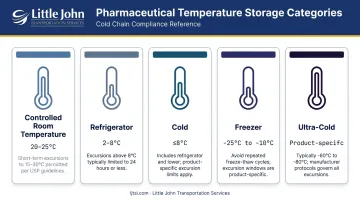
These are compendial definitions from USP <659>, not universal FDA-issued categories. The specific range for any product is set by the manufacturer's approved labeling and stability data.
Documentation requirements extend beyond storage standards. 21 CFR Part 11 governs electronic records and signatures when a monitoring system creates or maintains records required by an underlying predicate rule like cGMP. Requirements include system validation, complete audit trails, access controls, and record protection.
One important distinction: a platform is not "Part 11 compliant" by itself. Compliance depends on how the system is configured, used, and validated within the company's quality processes.
EMA and GDP Requirements for European Distribution
The 2013 EU GDP Guidelines (EudraLex Volume 4, Commission Guidelines 2013/C 343/01) establish the governing framework for European distribution. Key requirements include:
- Temperature mapping before a facility is used, under representative conditions; repeated based on risk assessment or after significant modifications (Section 3.2.1).
- Calibrated environmental monitoring equipment at defined, risk-based intervals with traceability to national or international standards (Section 3.3).
- Transport route risk assessment to determine where temperature controls are required (Section 9.2).
- Transport monitor calibration at regular intervals, at least annually (Section 9.2).
- Excursion reporting: transport deviations must be reported to the distributor and recipient (Section 9.2).
On both sides of the Atlantic, regulators now expect real-time temperature tracking data, documented excursion investigations, formal CAPA records, and unbroken chain-of-custody documentation. GDP non-compliance carries real consequences:
- Warning letters and mandatory corrective action
- Product seizure or recall
- Import bans affecting entire product lines
- Operational suspension pending investigation
Where Temperature Excursions Happen Most in the Pharma Supply Chain
IQVIA's cold chain research identifies the last mile — not warehouse storage — as the point where issues occur most frequently, citing less well-controlled environments and greater potential for temperature fluctuations. The EU GDP guideline supports this with a regulatory requirement for delivery-route risk assessment to determine where temperature controls are needed (Section 9.2).
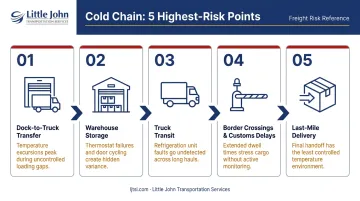
The Five Highest-Risk Points
Dock-to-truck transfer: Product may sit unmonitored on loading docks for extended periods while awaiting loading. No refrigeration unit is running; ambient exposure accumulates.
Warehouse storage: HVAC failures or door management failures during off-hours represent a well-documented risk, though typically better-monitored than transit points.
Truck transit: Refrigeration unit failures without real-time alerting mean an excursion may not be discovered until delivery. Passive data loggers reveal the problem after the fact.
Border crossings and customs delays: For US-Mexico pharmaceutical shipments, dwell times at crossings like Laredo can extend transit well beyond validated shipping windows. Multi-carrier handoffs create monitoring gaps, and communication failures between English- and Spanish-speaking teams can delay escalation when an excursion is detected.
Last-mile delivery: Uncontrolled vehicles, driver error, and packages left in direct sunlight or unrefrigerated staging areas at clinics and pharmacies are the terminal risk in the chain.
Cumulative Exposure Risk Across Multiple Legs
Each handoff adds potential unmonitored exposure time. A two-hour dock wait, a one-hour customs delay, and a 45-minute delivery window can each appear acceptable in isolation — but their total thermal impact must be evaluated against the product's cumulative stability tolerance.
Continuous monitoring with unbroken data chains is a regulatory expectation, not a best practice. A chain-of-custody record with gaps is itself a compliance finding — regardless of whether the product was actually exposed to out-of-range temperatures during those gaps.
How to Respond to a Temperature Excursion: Step-by-Step Protocol
No single FDA document provides a universal step-by-step excursion protocol. The requirements below are assembled from 21 CFR Part 211, USP <1079>, and EU GDP guidelines.
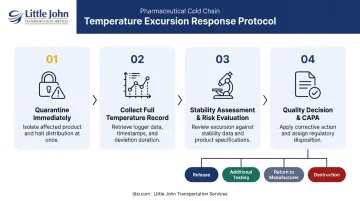
Step 1: Quarantine Immediately
The moment an excursion is detected or reported, quarantine the affected product. Under 21 CFR 211.142(a), product must be under Quality Control Unit oversight before release. Distributing or using product before completing a quality assessment is a documented GDP violation.
Document immediately:
- Time of identification
- Monitoring data that triggered the alert
- Who was notified and when
Step 2: Collect and Review the Full Temperature Record
Retrieve complete time-temperature data from all sources: data loggers, IoT sensors, chain-of-custody records. Establish:
- Exact duration of the excursion
- Magnitude (how far outside range)
- Rate of temperature change
- Any gaps in the monitoring record
Gaps in the data are a compliance problem in their own right. Regulators expect continuous, unbroken documentation.
Step 3: Stability Assessment and Risk Evaluation
Compare actual temperature exposure against the product's approved stability data and manufacturer guidance. Calculate MKT where applicable, but do not treat MKT alone as release authorization. Key considerations:
- Has the product's cumulative stability tolerance been exceeded?
- For biologics, vaccines, and mRNA products — any excursion may render the batch unfit regardless of duration.
- For Controlled Room Temperature products — excursions to 15–30°C within the product's approved stability window may be permissible per labeled conditions.
Authorized quality personnel must make and document the final quality decision.
Step 4: Quality Decision and CAPA
Based on the assessment, authorize one of four outcomes:
- Release — exposure within labeled tolerance; documented rationale required
- Additional testing — inconclusive stability assessment; testing before disposition
- Return to manufacturer — product integrity questionable; manufacturer assessment needed
- Destruction — exposure clearly exceeds stability data; product must not reach patients
Once disposition is authorized, initiate a formal CAPA. At minimum, this means documented root cause analysis, corrective actions with assigned owners and deadlines, and any necessary SOP updates, retraining, or equipment changes.
What the FDA enforces — not just recommends — makes this step non-negotiable.
What FDA looks for during inspections: The 2019 FDA warning letter to Glenmark Pharmaceuticals cited inadequate investigations of temperature excursions during US shipments, inadequate risk assessment for marketed batches exposed outside labeled conditions, and failure to take timely corrective action — resulting in a demand for retrospective risk assessment and warnings of possible import refusal.
Choosing a Carrier That Keeps Your Cold Chain Compliant
A carrier's failure is the pharmaceutical company's compliance problem. GDP and FDA expectations extend to every party in the distribution chain.
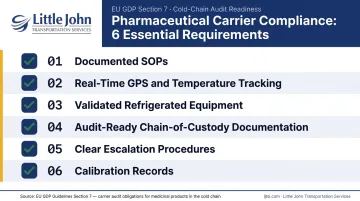
What to Require From Any Pharmaceutical Carrier
- Documented SOPs for temperature-sensitive freight, validated under your quality system
- Real-time GPS and temperature tracking — not passive data loggers that reveal excursions after delivery
- Thermally mapped, validated refrigerated equipment across the required temperature ranges
- Audit-ready chain-of-custody documentation for every leg, every handoff
- Clear escalation procedures: who is notified, how quickly, and through what channel when an excursion occurs in transit
- Calibration records for all monitoring equipment
Under the EU GDP guidelines (Sections 7.1–7.3), pharmaceutical shippers must assess carrier competence, establish written contracts defining responsibilities, and verify GDP compliance through audits. This applies to every logistics provider in the chain.
Cross-Border Requirements: US-Mexico Pharmaceutical Shipments
Border crossings add unique risks — extended dwell times, multi-party handoffs, and communication gaps that can delay excursion response. For pharmaceutical freight moving through high-volume crossings like Laredo, four capabilities stand out:
- CTPAT validation — CBP's Customs-Trade Partnership Against Terrorism program provides access to expedited processing lanes, reducing the time temperature-sensitive cargo spends outside controlled environments during border clearance.
- FAST certification — Further expedites processing for pre-approved shipments at major land border crossings.
- Bilingual operations — Real-time English/Spanish communication eliminates the delay between detection and escalation when excursions occur at or near the border.
- On-the-ground teams — Personnel physically positioned at key crossing hubs who can intervene immediately when a shipment is delayed.
Little John Transportation Services holds CTPAT validation and ISO 9001:2015 certification, with 24/7 bilingual dispatch and dedicated teams in Laredo and Monterrey. Their 50-acre Laredo facility provides staging capacity and in-house US and Mexican customs brokerage, reducing the handoff delays that create cold chain blind spots. Audit-ready chain-of-custody documentation is maintained across all cross-border pharmaceutical lanes.
Frequently Asked Questions
What does cold chain mean in pharma?
Pharmaceutical cold chain refers to the unbroken sequence of temperature-controlled storage, handling, and transportation steps — from manufacturer to patient — required to maintain the safety and integrity of temperature-sensitive medicines. Any break in that chain can compromise product quality and trigger regulatory consequences.
What is a pharmaceutical temperature excursion?
A temperature excursion is any event where a pharmaceutical product is exposed to temperatures outside its approved storage or transport range, as defined by the manufacturer's stability data and applicable regulatory requirements. Excursions can degrade potency, compromise safety, and trigger quarantine, investigation, and potential product destruction.
What is the temperature for cold chain drugs?
USP <659> defines the main categories: Controlled Room Temperature (20–25°C), Refrigerator (2–8°C), Cold (not exceeding 8°C), and Freezer (-25°C to -10°C). Ultra-cold requirements are product-specific and defined in approved labeling. The specific range for any product is set by the manufacturer's approved stability data.
What is the allowable temperature excursion limit?
There is no universal "allowable" limit — acceptability depends entirely on each product's stability data and approved labeling. For Controlled Room Temperature products, brief excursions to 15–30°C may be permitted. For refrigerated products (2–8°C), any excursion triggers a documented investigation and quality assessment before release.
What happens to a drug after a temperature excursion?
The product must be quarantined immediately. A quality assessment comparing actual exposure against the product's stability data then determines whether it can be released, requires additional testing, must be returned to the manufacturer, or must be destroyed.
What documentation is required for FDA cold chain compliance?
Core requirements include:
- Continuous temperature monitoring records with no gaps
- Calibration records for all monitoring equipment
- Written SOPs for storage and deviation handling
- Excursion investigation records including CAPA documentation
- Chain-of-custody records for all distribution steps
If electronic records are used, the system must meet 21 CFR Part 11 data integrity standards.