: Complete Guide](https://file-host.link/website/ljtsi-1p2sqw/assets/blog-images/22612ad6-dd20-4ad8-974f-312895d97169/1784537516544634_9095d27368564016b8f4eefa368a0130/360.webp)
The nacelle is the enclosed housing that sits atop the tower, containing the generator, gearbox, main bearing, and control systems. Getting it from a manufacturing facility or storage yard to a wind farm installation site requires specialized equipment, state-by-state permits, engineered convoy management, and planning that starts weeks before the truck ever rolls.
What makes nacelles categorically difficult isn't just weight — though Vestas specifies a maximum of 70 metric tons per transport unit for their onshore platforms, and offshore reference designs reach far beyond that. The real challenge is that nacelles contain precision-engineered internal components that don't tolerate road vibration, improper tilt, or careless handling. Damage during transit is expensive and project-delaying in ways that go well beyond a repair bill: inspection, specialized parts, remobilization, and schedule disruption all compound.
This guide covers the complete process end-to-end.
Key Takeaways
- Nacelles are classified as oversize/overweight (OSOW) loads, requiring a separate permit for every state crossed
- Trailer selection must match the nacelle's actual weight and center-of-gravity data; turbine class alone is not a sufficient basis
- Internal component protection (shaft locking, oil reservoir securing) is as critical as external tie-downs
- 49 CFR 392.9 requires securement re-inspection within 50 miles, then every 3 hours or 150 miles
- Weather holds and contingency scheduling are built into every compliant nacelle move — plan for them from the start
What Makes a Nacelle Different from Other Oversized Loads
The nacelle's function is straightforward: it converts rotor rotation into electrical energy by housing the drivetrain components — gearbox, generator, main shaft, yaw bearings, and control electronics — in a single protected assembly.
Its transport dimensions vary significantly by turbine class. Vestas publishes transport envelopes for their 2 MW platform at 10.4 m × 3.5 m × 4.0 m and their 4–5 MW platform at approximately 12.96 m × 3.98 m × 3.5 m. The NREL IEA 15 MW offshore reference design puts the nacelle alone at 630.9 metric tons, with the hub adding another 190 metric tons — a combined 820+ metric tons that is not road-transportable as a single unit.
Why Nacelles Are Harder Than Blades or Tower Sections
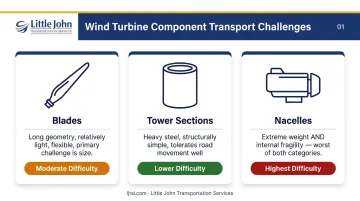
Each major wind turbine component presents a different transport challenge:
- Blades: Long and awkward, but relatively light and structurally flexible — the primary challenge is geometry, not fragility
- Tower sections: Heavy steel cylinders that tolerate road movement well; structurally simple loads
- Nacelles: Combine extreme weight with internal fragility — the worst of both categories
The gearbox gears, generator windings, yaw bearing races, and control electronics all carry specific tolerance limits for shock and vibration. The housing itself is an enclosure, not a structural member. Load it carelessly and you risk internal damage that won't surface until commissioning — at which point you've traded a repair window for a far more expensive operational failure.
That's also why a nacelle move can't be treated as a standard heavy-haul job. OEM transport manuals specify exact lifting points, tie-down configurations, and handling procedures. Deviating from those specs can void the equipment warranty outright — a costly outcome on a component that may have taken months to manufacture and deliver.
The End-to-End Nacelle Transport Process
Nacelle transport is a sequenced operation. Each stage gates the next, and rushing or skipping any phase compounds risk downstream. The total project timeline from engagement to delivery typically spans several weeks, with permit processing alone driving a significant share of that lead time.
Pre-Transport Assessment and Planning
The process starts with a full dimensional and weight survey of the nacelle in its exact transport configuration — with or without the hub attached, with or without the protective cover — including precise center-of-gravity data.
Center-of-gravity location matters for two reasons:
- Trailer configuration: The load must be positioned over the axle groups to achieve legal per-axle weight distribution. A nacelle with a forward CG requires different positioning than one with a rearward CG.
- Tie-down geometry: Securement forces must be calculated from the cargo's actual CG, not assumed from its shape. Per 49 CFR 393.102, the securement system must withstand 0.8 g forward, 0.5 g rearward, and 0.5 g lateral acceleration, plus a downward force equal to 20% of cargo weight.
The route study runs in parallel. Engineers identify critical constraints across the full corridor: bridge load ratings, vertical clearances, road surface ratings, turning radius bottlenecks, and sections requiring temporary traffic management.
State permit requirements add lead time at this stage. For large onshore nacelles transporting at 14–16 feet or more in height, Iowa requires escorts to measure every vertical clearance above 14 ft 6 in. Texas requires company-certified physical route inspections for loads exceeding 20 ft wide, 18 ft 11 in high, or 125 ft long, with requests submitted 3–5 days before movement.
Loading the Nacelle onto the Trailer
Loading requires a crane of sufficient capacity for the specific nacelle weight and lift radius, properly rated lifting slings or spreader bars, and a level, compacted loading area.
The OEM-controlled transport drawing specifies the designated lift points — these are non-negotiable. Lifting from unauthorized points risks structural damage to the nacelle housing or internal mounting structures. Crane capacity, spreader arrangement, and sling angles must all come from the project lift plan, not from generic MW-class rules of thumb.
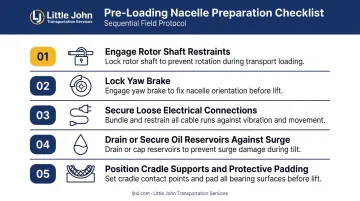
Before the nacelle leaves the ground:
- Rotor shaft restraints must be engaged
- Yaw brake must be locked
- Loose electrical connections must be secured
- Oil reservoirs must be drained or secured against surge
- Cradle supports and any protective padding must be in position
The nacelle is then positioned on the trailer centered over the axle groups, seated in cradle supports or timber blocking shaped to its base geometry.
Road Transport and Convoy Management
Convoy requirements are state-specific and load-specific. There is no universal national template.
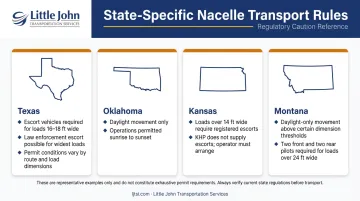
State-specific escort rules vary significantly:
- Texas: Loads over 16–18 ft wide require escort vehicles; TxDMV may also require law enforcement
- Oklahoma: Oversize movement is generally restricted to daylight — from 30 minutes before sunrise to 30 minutes after sunset
- Kansas: Loads over 14 ft wide require registered escort providers; Kansas Highway Patrol does not supply them
- Montana: Non-interstate loads above 10 ft wide, 150 ft long, or 15 ft 6 in high are daylight-only; non-interstate loads over 24 ft wide require at least two front and two rear pilot vehicles
Nighttime restrictions are common because reduced traffic volume doesn't offset the reduced visibility for overhead clearance detection. Escort vehicles for a typical nacelle move include:
- Front lead vehicles for clearance warning and traffic management
- Rear escorts for following traffic control
- Height-pole vehicles where vertical clearance is a concern
- Law enforcement units where state rules mandate them
If a bridge or intersection is found non-compliant mid-route, the load stops. The standard protocol involves holding the convoy at a safe position, contacting the permitting authority, and evaluating the alternative route or requesting a re-inspection rather than proceeding through a questionable structure.
Site Delivery and Offloading
Once the convoy clears the public road network, the final-mile challenge begins. Wind farm access roads are frequently unpaved, weight-restricted, and too narrow for standard heavy-haul configurations. Common solutions include:
- Temporary access mats to distribute trailer load over soft ground
- Site road reinforcement for high-traffic delivery corridors
- Switching to a self-propelled modular transporter (SPMT) for the last segment where road geometry makes standard trailer navigation impossible
Scheuerle's SPMT provides up to 60 metric tons per axle line and 700 mm of hydraulic axle compensation, keeping the deck level across uneven ground — a critical requirement on unprepared wind farm terrain where conventional trailers would bottom out or lose load stability.
Offloading requires the site crane to be pre-positioned and the crane pad to be prepared before the nacelle arrives. Installation sequencing drives this: the tower must be complete and the crane staged before nacelle delivery begins. Misalignment between the transport arrival and the crane schedule is one of the most common sources of project delay.
Specialized Trailers and Load Securement
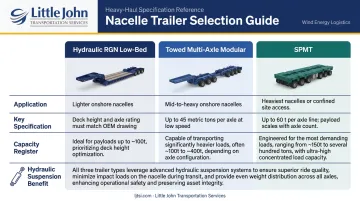
Trailer selection is an engineering decision, not a catalog choice. The right trailer depends on the nacelle's actual weight, its axle load distribution, its dimensions, and the permitted route's restrictions.
Primary Trailer Types
| Trailer Type | Primary Application | Key Consideration |
|---|---|---|
| Hydraulic RGN low-bed | Lighter onshore nacelles | Deck height and axle group rating must match OEM transport drawing |
| Towed multi-axle modular | Mid-to-heavy onshore nacelles | Goldhofer THP/SL rates 45 metric tons per axle at low speed |
| Self-propelled modular transporter (SPMT) | Heaviest nacelles or confined site access | Scheuerle rates up to 60 t/axle line; max payload rises with axle count |
No single weight threshold universally dictates trailer type — what matters is net axle-load compliance under each state's permitted route, ground pressure on the access road, and deck height relative to the permitted corridor.
Hydraulic Suspension and Why It Matters
Hydraulic suspension systems on specialized trailers serve two functions for nacelle transport. First, they dampen road-transmitted vibration before it reaches the nacelle housing and internal components. Second, they allow the trailer deck to be leveled independently of road gradient, preventing unintended tilt loads on internal component mounts.
For a precision assembly worth millions of dollars, that suspension is protective equipment — not a ride-quality upgrade.
External and Internal Securement
External securement requirements under 49 CFR 393.104:
- High-tensile chain binders at OEM-designated hard points on the nacelle base frame
- Synthetic strapping over the nacelle housing to prevent lateral movement
- Edge protection wherever abrasion or cutting can occur
- All devices must be serviceable; tiedowns cannot contain knots
Internal protection measures:
- Gearbox locking mechanisms engaged
- Loose electrical connections secured
- Oil reservoirs drained or positively secured
- Protective foam or rubber padding at all nacelle-to-cradle contact surfaces
Per 49 CFR 392.9, securement must be re-inspected within the first 50 miles, then after any duty-status change, every 3 hours, or every 150 miles — whichever comes first. Those inspection stops must be built into the movement schedule before the load departs.
Managing that compliance across multi-state corridors is where carrier experience shows. Little John Transportation Services processes over 100,000 OSOW permits annually and coordinates front, rear, height-pole, and police escorts scaled to the specific load and corridor. That FMCSA Satisfactory safety rating — held by fewer than 6% of U.S. carriers — is a documented eligibility requirement for complex multi-state permit moves.
Permits, Route Planning, and Compliance
The federal government does not issue OSOW permits — permitting is entirely a state function. Every state crossed requires a separate application with the state's DOT, and processing timelines vary. Montana Class 1 superloads (18–34 ft wide or 17–24 ft high) require department approval within 2 working days. Texas route inspection requests should be submitted 3–5 days ahead of movement. Other states publish no fixed processing guarantee.
What permit applications typically require:
- Exact load dimensions and transport configuration
- Weight per axle group
- Proposed route with GPS coordinates
- Requested travel windows
- Escort vehicle specifications
- Carrier safety rating documentation
State permits cover the route — federal regulations govern the carrier. FMCSA compliance requirements include:
- Driver qualification under 49 CFR Part 391
- Hours-of-service compliance: 11 driving hours after 10 consecutive off, within a 14-hour window, with a 30-minute break after 8 cumulative driving hours
- Cargo securement to 49 CFR Part 393 standards
- A satisfactory FMCSA safety rating — an unsatisfactory-rated carrier is generally prohibited from operating
Travel restriction windows vary by state and can include daylight-only movement, holiday prohibitions, peak-traffic blackout periods, and weather-triggered holds. These windows interact directly with project schedules. Given state processing windows of 2–5 days and unpredictable weather holds, most experienced carriers build 5–10 days of buffer into nacelle delivery sequences as a baseline risk control.
Common Misconceptions in Nacelle Transport
Any experienced heavy-haul carrier can handle a nacelle move. Not quite.
The OEM transport manual specifies exact lift points, tie-down configurations, internal locking sequences, and handling limits. A carrier without wind energy component experience will treat the nacelle like standard heavy machinery — which it is, but it also contains precision components with failure modes that don't surface until the turbine is running. Voiding an OEM warranty mid-project is a multi-month, multi-million-dollar problem.
New and replacement nacelles transport the same way. They don't.
A factory-fresh nacelle arrives in OEM packaging with all internal components in the known, tested configuration. A replacement or refurbished unit may have been partially disassembled, may lack factory packaging, and may have internal components in a different state. The planning process needs to account for what's actually inside — not what the original packaging would normally indicate.
Weight alone determines the trailer. It's one variable among several.
Equipment selection depends on more than the load's gross weight. Key factors include:
- Center of gravity (CG) location and its effect on axle load distribution
- Deck height and overall transport height
- Per-state permit compliance along the full route
- Road surface bearing capacity on the access haul
A nacelle that clears the weight threshold for one trailer type may still require a different configuration based on CG position alone.
Weather risk is consistently underestimated. A nacelle housing presents a large, bluff surface area — essentially a sail. High-wind events during transport can generate lateral forces that exceed securement design assumptions.
Real-time weather monitoring along the full route — not just at origin — is a standard requirement. A transport hold protocol must be agreed upon before the load departs, not improvised when conditions deteriorate mid-route.
Frequently Asked Questions
How heavy is a wind turbine nacelle?
Vestas specifies a maximum of 70 metric tons per transport unit for their onshore platforms. The NREL IEA 15 MW offshore reference design puts the nacelle at 630.9 metric tons excluding the hub, with the hub adding another 190 metric tons. Exact nacelle mass for any specific project should come from the OEM transport drawing, not MW-class estimates.
What type of trailer is used to transport a wind turbine nacelle?
Hydraulic RGN low-beds handle lighter onshore units; towed multi-axle modular trailers cover mid-to-heavy onshore nacelles; SPMTs are used for the heaviest units or where site access geometry rules out conventional trailers. Actual weight, CG data, and route-specific axle load limits determine the correct choice, not trailer name alone.
What permits are required to transport a wind turbine nacelle?
Every state crossed requires a separate OSOW permit from that state's DOT. Applications must include load dimensions, per-axle weights, the proposed route, travel windows, and escort specifications. Multi-state moves require parallel applications with varying processing times, so engage your carrier before committing to a schedule.
How is a wind turbine nacelle secured during road transport?
External securement uses high-tensile chain binders at OEM-designated hard points and synthetic strapping over the housing. Internal measures include shaft locking, oil reservoir securing, and anti-vibration cradle supports. Under 49 CFR 392.9, securement must be re-inspected within 50 miles and then at defined intervals throughout transit.
Can a wind turbine nacelle be transported in one piece?
Most onshore nacelles transport as a single unit. For the largest offshore designs, the hub ships separately: the NREL 15 MW reference treats the nacelle (630.9 t) and hub (190 t) as distinct units, each requiring independent route clearance verification before planning begins.
How long does it take to transport a wind turbine nacelle?
Physical transit for a 200-mile move may take 1–3 days of actual driving, depending on permitted travel windows and convoy speed. Total project duration from engagement to delivery is driven primarily by permit processing, route survey completion, and equipment mobilization — contact your carrier early to build an accurate project timeline.